Latest Articles
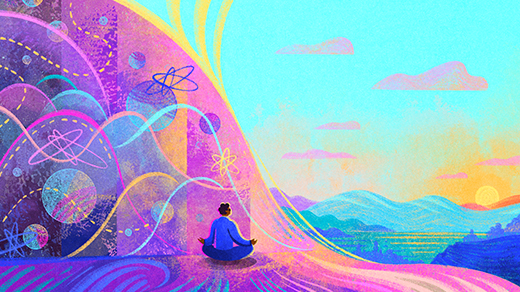
Where Does the Quantum World End and Ours Begin?
Jonathan Halliwell explains how quantum decoherence is key to understanding how we transition from a world with a wave-like nature of matter and energy to the classical macroscopic world that we’re used to.
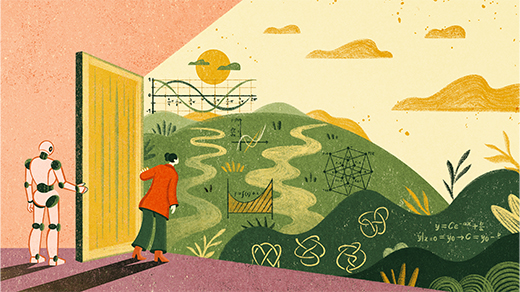
Live from ICM 2026: What Is Math For in the Age of AI?
In this special live recording from the International Congress of Mathematicians in Philadelphia, July 2026, the central question discussed was what do mathematicians really value about doing mathematics in the first place?
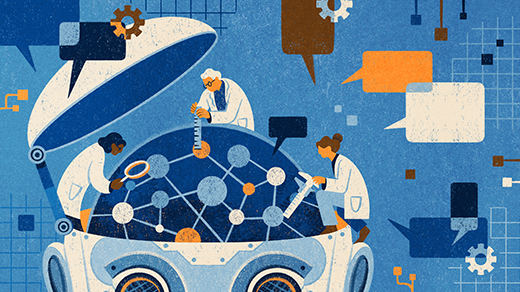
Are We Thinking Correctly About AI Intelligence?
Computer scientist Melanie Mitchell discusses why artificial intelligence doesn’t “think” or “reason” like humans, and how we can create better methods for measuring machine cognition.
How Does Touch Lead To Pain Or Pleasure?
Neuroscientist Ishmail Abdus-Saboor discusses efforts to understand how skin contact can be painful or pleasurable, and what touch-obsessed naked mole rats might teach us about human social behavior.
How Fast Is the Universe Really Expanding?
One of the most contested issues in astrophysics is our understanding of the Universe’s expansion. Adam Riess discusses why there is disagreement and what might resolve it.
Will We Ever Find Alien Civilizations?
Astronomer David Kipping discusses why claims of extraterrestrial life keep dissolving under scrutiny, why we need a more statistically grounded approach to searching for life beyond Earth, and why it’s rational to believe that we may be alone.
What Is the Positive Grassmannian and Why Does It Show Up Everywhere?
Lauren Williams tells 'The Joy of Why' how studying a fundamental object in algebraic combinatorics led to a career full of surprises.
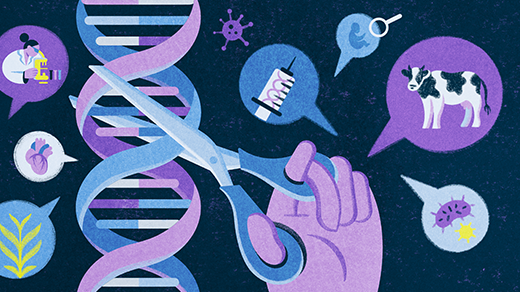
What’s the Future of Gene Editing?
In the first episode of the new season of ‘The Joy of Why,’ Nobel Laureate Jennifer Doudna discusses how she discovered CRISPR’s genome-editing power, the breakthroughs and hurdles during its explosive growth, and what lies ahead for this groundbreaking technology.
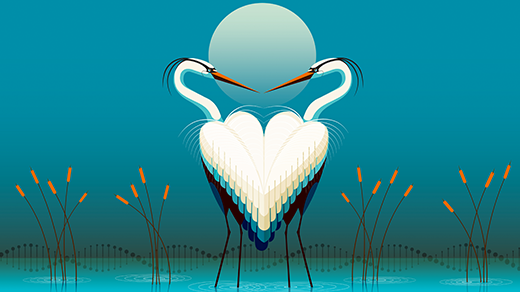
Do Beautiful Birds Have an Evolutionary Advantage?
Richard Prum explains why he thinks feathers and vibrant traits in birds evolved not solely for survival, but also through aesthetic choice.