Why Is Ice Slippery? A New Hypothesis Slides Into the Chat.
Introduction
The reason we can gracefully glide on an ice-skating rink or clumsily slip on an icy sidewalk is that the surface of ice is coated by a thin watery layer. Scientists generally agree that this lubricating, liquidlike layer is what makes ice slippery. They disagree, though, about why the layer forms.
Three main theories about the phenomenon have been debated over the past two centuries. Earlier this year, researchers in Germany put forward a fourth hypothesis that they say solves the puzzle.
But does it? A consensus feels nearer but has yet to be reached. For now, the slippery problem remains open.
Hypothesis 1: Pressure
In the mid-1800s, an English engineer named James Thomson suggested that when we step on ice, the pressure we exert melts its surface, making it slippery. Under normal conditions, ice melts when the temperature rises to zero degrees Celsius (32 degrees Fahrenheit). But pressure lowers its melting point, so that even at lower temperatures, a layer of water might form on the surface. This theoretical relationship between melting point and pressure was experimentally confirmed by Thomson’s younger brother William, better known as Lord Kelvin.
In the 1930s, though, Frank P. Bowden and T.P. Hughes of the Laboratory of Physical Chemistry at the University of Cambridge cast doubt on the pressure melting theory. They calculated that an average skier exerts way too little pressure to significantly alter ice’s melting point. To do so, the skier would have to weigh thousands of kilograms.
Hypothesis 2: Friction
Bowden and Hughes suggested an alternative explanation for the formation of the water layer: that it melts because of heat generated by friction caused by whatever is sliding against it.
They tested their theory in an artificial ice cave in the Swiss Alps, using a complex contraption to measure the friction between ice and other materials. They found that the friction was higher with materials that are good at conducting heat, such as brass, than with poor conductors like ebonite. From this, they concluded that when ice is rubbed by a material that easily absorbs heat, less heat is available to melt the ice, making it less slippery. This supported their theory that frictional melting is responsible for ice’s slipperiness.
Although this explanation still appears in textbooks, many scientists disagree with it. “The problem with that is you only melt the ice behind you, not the ice you are actually skating on,” said Daniel Bonn, a physicist at the University of Amsterdam. Ice can be slippery the moment we step on it, before any motion has occurred that could cause frictional heating.
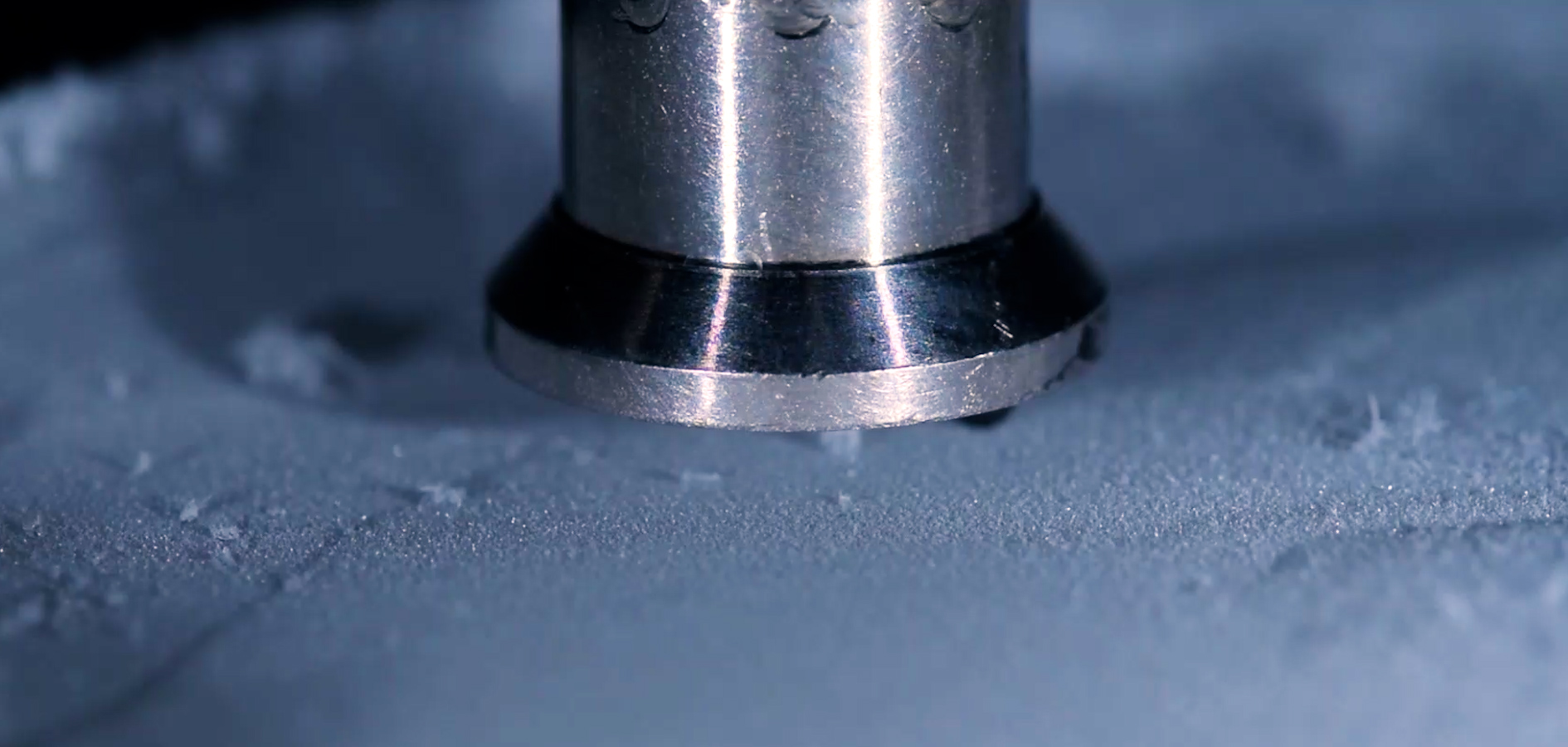
To test the friction hypothesis, Bonn and his team created a microscopic ice-skating rink. They rotated a piece of metal (standing in for the blade of a skate) at different speeds, each time measuring the force required to move the metal and the force that the metal exerted on the ice. The ratio of these forces gave them a measure of the ice’s slipperiness. The scientists found that the slipperiness did not depend on the speed, suggesting that frictional heating — which should increase with speed — isn’t what makes ice slippery.
Hypothesis 3: Premelting
There’s another possibility: that ice’s surface is wet even before anything makes contact with it.
In 1842, the English scientist Michael Faraday observed that two touching ice cubes will freeze to each other, and even a warm hand will stick to ice. He attributed this phenomenon to a thin, premelted layer that sits on ice’s exposed surface, and that freezes again when covered up. Faraday couldn’t explain why it happens, and it took almost a century for other scientists — notably Charles Gurney and Woldemar Weyl — to propose why “surface premelting” might occur.
They intuited that the molecules near the surface behave differently from those deep within the ice. Ice is a crystal, which means each water molecule is locked into a periodic lattice. However, at the surface, the water molecules have fewer neighbors to bond with and therefore have more freedom of movement than in solid ice. In that so-called premelted layer, molecules are easily displaced by a skate, a ski or a shoe.
Today, scientists generally agree that the premelted layer exists, at least close to the melting point, but they disagree on its role in ice’s slipperiness.

The textbook explanation for ice’s slipperiness emerged from experiments in the 1930s at the Jungfraujoch Ice Palace, a human-made ice cave in the Swiss Alps. Today, many scientists disagree with that explanation.
Nathaniel Noir
A few years ago, Luis MacDowell, a physicist at the Complutense University of Madrid, and his collaborators ran a series of simulations to establish which of the three hypotheses — pressure, friction or premelting — best explains the slipperiness of ice. “In computer simulations, you can see the atoms move,” he said — something that isn’t feasible in real experiments. “And you can actually look at the neighbors of those atoms” to see whether they are periodically spaced, like in a solid, or disordered, like in a liquid.
They observed that their simulated block of ice was indeed coated with a liquidlike layer just a few molecules thick, as the premelting theory predicts. When they simulated a heavy object sliding on the ice’s surface, the layer thickened, in agreement with the pressure theory. Finally, they explored frictional heating. Near ice’s melting point, the premelted layer was already thick, so frictional heating didn’t significantly impact it. At lower temperatures, however, the sliding object produced heat that melted the ice and thickened the layer.
“Our message is: All three controversial hypotheses operate simultaneously to one or the other degree,” MacDowell said.
Hypothesis 4: Amorphization
Or perhaps the melting of the surface isn’t the main cause of ice’s slipperiness.
Recently, a team of researchers at Saarland University in Germany identified arguments against all three prevailing theories. First, for pressure to be high enough to melt ice’s surface, the area of contact between (say) skis and ice would have to be “unreasonably small,” they wrote. Second, for a ski moving at a realistic speed, experiments show that the amount of heat generated by friction is insufficient to cause melting. Third, they found that in extremely cold temperatures, ice is still slippery even though there’s no premelted layer. (Surface molecules still have a dearth of neighbors, but at low temperatures they don’t have enough energy to overcome the strong bonds with solid ice molecules.) “So either the slipperiness of ice is coming from a combination of all of them or a few of them, or there is something else that we don’t know yet,” said Achraf Atila, a materials scientist on the team.
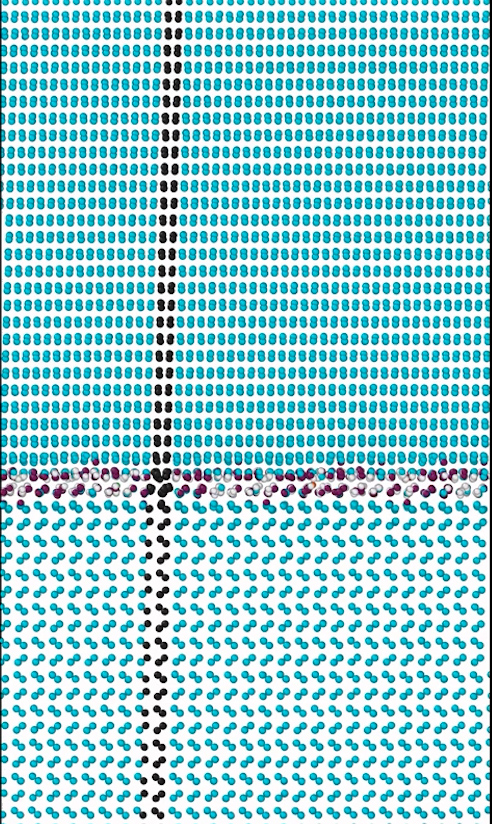
The scientists looked for alternative explanations in research on other substances, such as diamonds. Gemstone polishers have long known from experience that some sides of a diamond are easier to polish, or “softer,” than others. In 2011, another German research group published a paper explaining this phenomenon. They created computer simulations of two diamonds sliding against each other. Atoms on the surface were mechanically pulled out of their bonds, which allowed them to move, form new bonds, and so on. This sliding formed a structureless, “amorphous” layer. In contrast to the crystal nature of the diamond, this layer is disordered and behaves more like a liquid than a solid. This amorphization effect depends on the orientation of molecules at the surface, so some sides of a crystal are softer than others.
Atila and his colleagues argue that a similar mechanism happens in ice. They simulated ice surfaces sliding against each other, keeping the temperature of the simulated system low enough to ensure the absence of melting. (Any slipperiness would therefore have a different explanation.) Initially, the surfaces attracted each other, much like magnets. This was because water molecules are dipoles, with uneven concentrations of positive and negative charge. The positive end of one molecule attracts the negative end of another. The attraction in the ice created tiny welds between the sliding surfaces. As the surfaces slid past each other, the welds broke apart and new ones formed, gradually changing the ice’s structure.
The scientists repeated the simulations, replacing one of the ice surfaces with other materials that are either attracted or repelled by water. Again, molecules on the surface of the ice were displaced with sliding, but more so when the other substance attracted the ice.
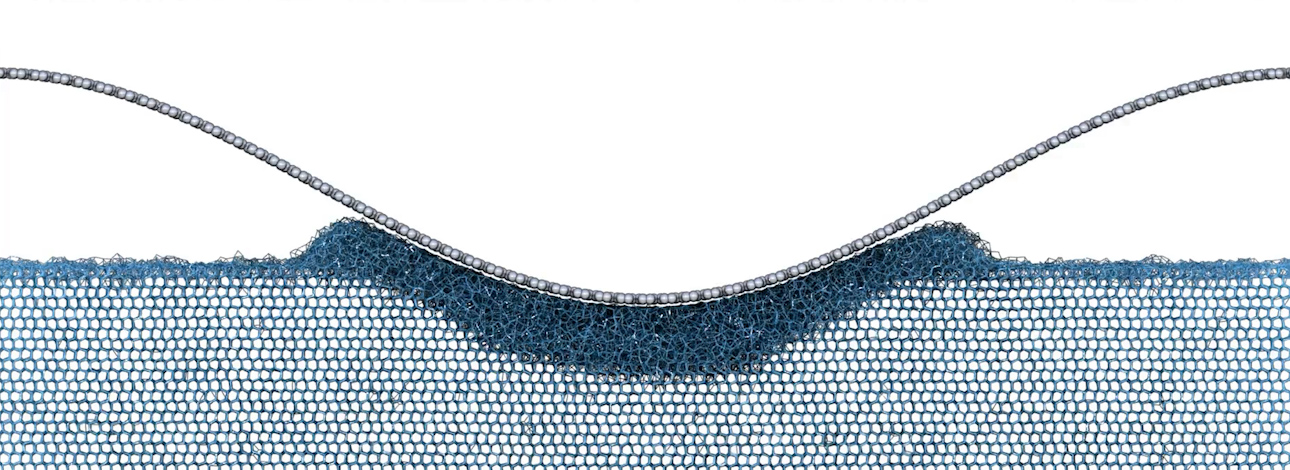
The simulations indicated that sliding mechanically destroys the ordered crystal lattice of ice, creating an amorphous layer that thickens as the sliding goes on. The team says that this, rather than melting, explains ice’s slipperiness — especially at low temperatures.
A Consensus Kept on Ice
MacDowell trusts the results from Atila and collaborators, although he thinks amorphization occurs only at high sliding speeds (the authors disagree, but simulating low sliding speeds requires a prohibitive amount of computational power).
Bonn also supports the new explanation, which he says aligns with experimental studies of objects sliding on ice conducted by his group in 2021. Those experiments and the new simulations both suggest that ice is slippery because of structural changes in its surface, though the researchers characterize what’s happening in different terms. Atila believes that the changes are driven by the mechanical displacement of water molecules, whereas Bonn focuses on how mobile the surface molecules are to begin with. He compares the surface to a floor filled with little balls: “Because they’re so mobile, it’s impossible to stay upright if you’re in such a room. Just as it’s very difficult to stay upright when you’re on ice.”
The difference between their descriptions “is a semantic issue,” according to Bonn, but Atila’s co-author Sergey Sukhomlinov disagrees. “I believe these are different mechanisms, even though they may look similar,” he said.
We’re surely getting closer to settling the seemingly simple, centuries-old question of why ice is slippery. At this point, the lack of a shared vocabulary among researchers might be one of the biggest hindrances to resolving the issue. Similar effects might get different names, suggesting different hypotheses. Bonn also blames the fact that “ice researchers do have different and contradictory opinions, but they don’t really tell each other that they disagree with each other.”