Climate Physicists Face the Ghosts in Their Machines: Clouds
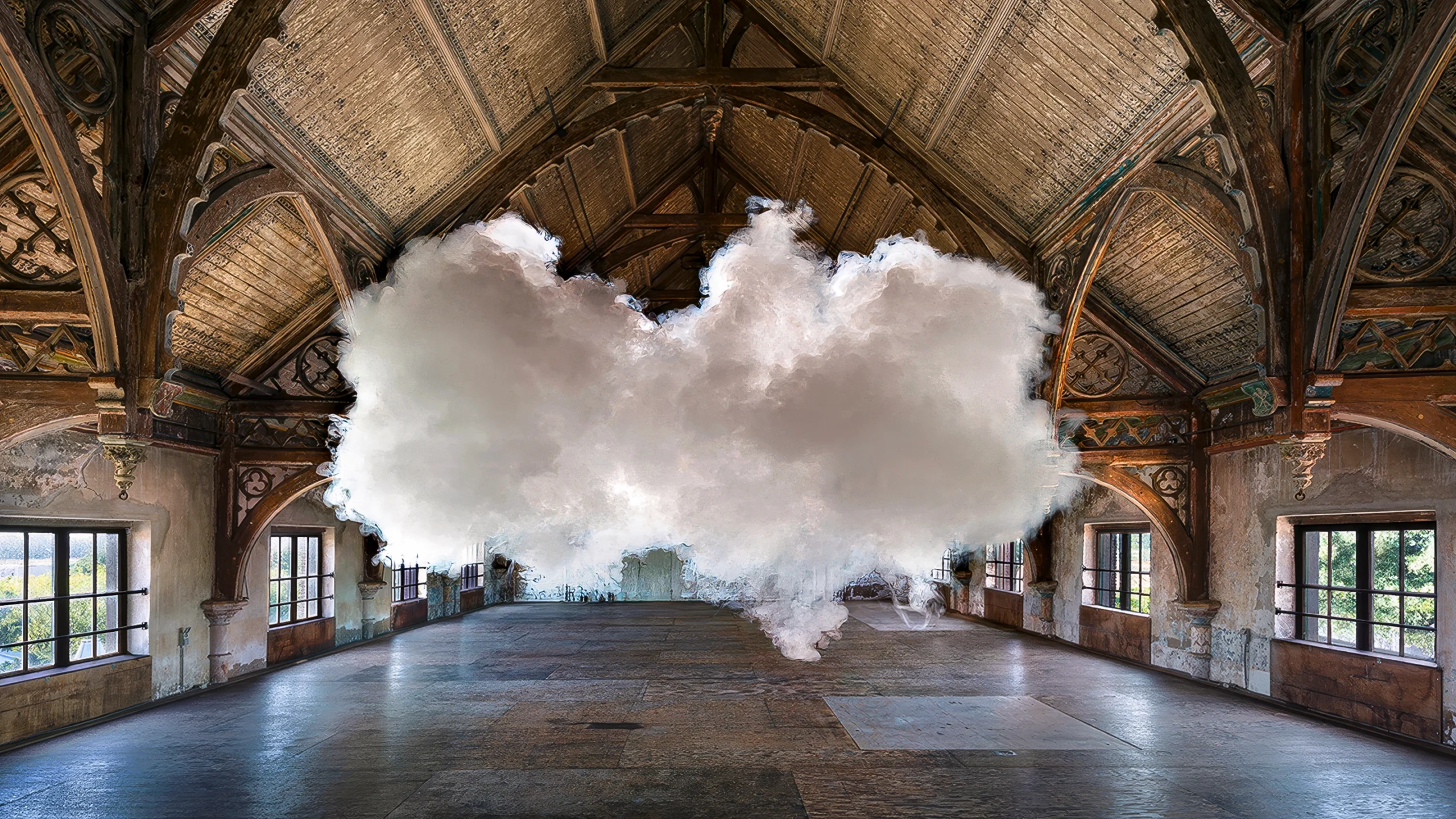
Clouds are a tricky mix of ephemeral and ethereal, making them challenging to simulate.
Berndnaut Smilde
Introduction
In October 2008, Chris Bretherton lifted off from the coast of northern Chile in a C-130 turboprop plane. It was too dark to see the sandy hills of the Atacama Desert below, but the darkness suited Bretherton just fine. The researcher wasn’t going sightseeing. Seated directly behind the pilots, he kept his focus entirely on the sky.
The plane was stuffed with instruments, and its wings bristled with sensors and other devices. Bretherton’s immediate mission was to help the pilots collect information about the ice, water vapor, and air pressure around them. His longer-term goal was to use that data — as well as data he would collect over California, Hawai‘i, and Antarctica — to deal with one of the most challenging factors in climate science: clouds.
The plane passed a fluffy cumulus, and Bretherton spotted a rainbowlike prism of colors. This was strange; the cloud seemed too thin to host the large droplets required to refract light in this way. “The six-to-nine-hour flights rarely get boring,” Bretherton said, “because we always run into surprising cloud structures that rattle our scientific preconceptions.” He would later conclude that the air must have been so pristine that the cloud’s vapor was condensing into unusually large droplets on an unusually small number of particles.
In the nearly two decades since Bretherton boarded that plane, the globe has warmed by roughly half a degree Celsius. And clouds, which both reflect sunlight and trap heat, are still the biggest source of uncertainty in climate predictions. The world’s top supercomputers aren’t nearly super enough to include tiny digital clouds in the gigantic digital Earths they simulate. So climate scientists are developing workarounds, techniques for coaxing relatively cloudless climate simulations to swirl, storm, and warm as if they contained a full portfolio of realistic clouds.
Over the last few years, a competition has broken out among physicists to build the next generation of these crystal balls for climate. Bretherton, now working at the Allen Institute for Artificial Intelligence (Ai2), is one prominent entrant. Tapio Schneider at the California Institute of Technology is another.
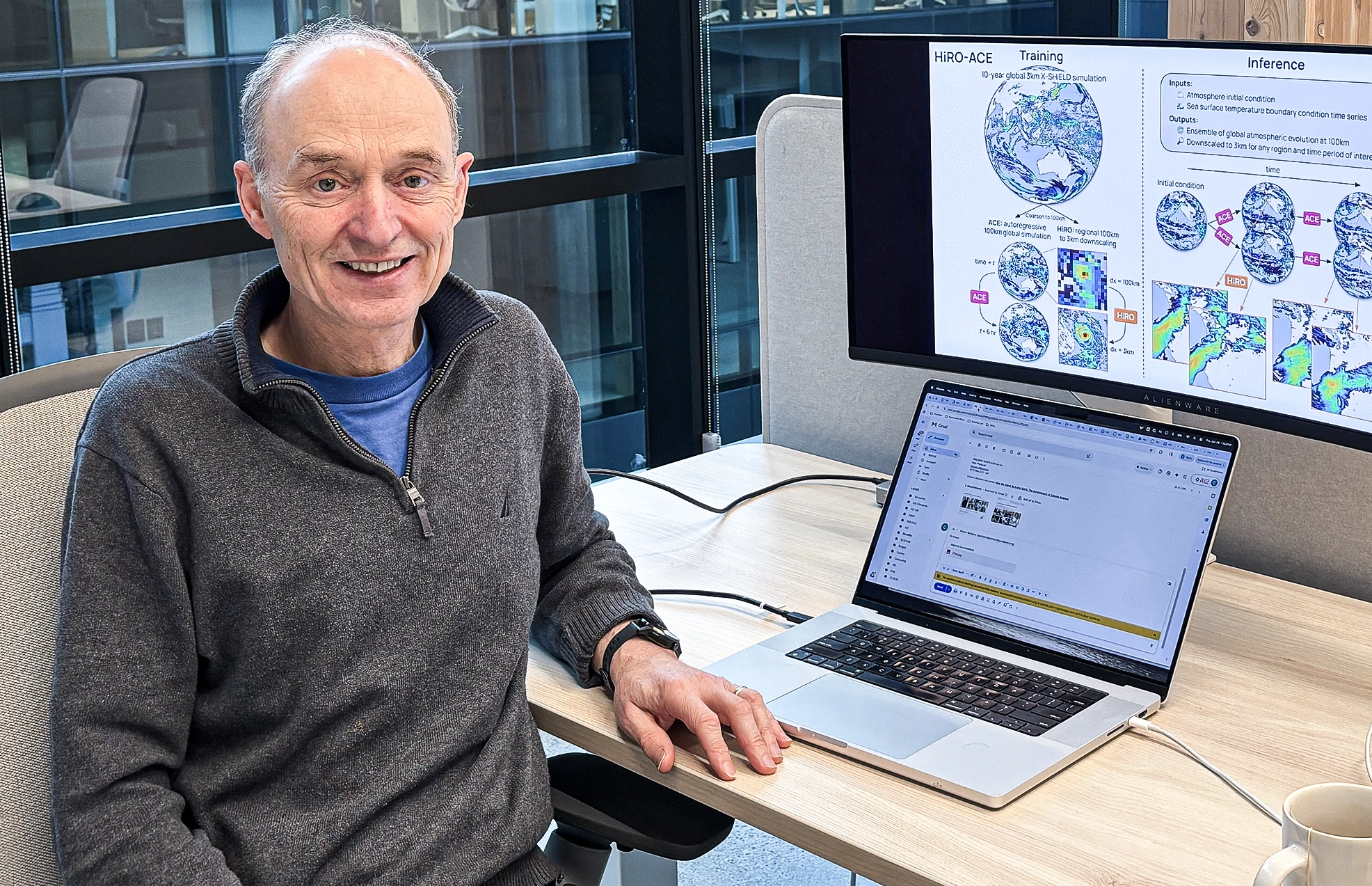
Chris Bretherton of the Allen Institute for Artificial Intelligence pivoted after spending decades studying clouds to developing AI techniques that can implicitly learn how clouds behave from real data.
Courtesy of Chris Bretherton
Galvanizing these new efforts is the rise of machine learning techniques categorized as artificial intelligence. Schneider leans on AI to better incorporate the effects of clouds into climate models that use physics equations to see what’s ahead. Bretherton, worried that these equations will never fully capture clouds’ behavior, is developing new AI tools that can predict the future directly from real-world data, barely relying on physics equations at all.
While Schneider, Bretherton, and other physicists differ in their approach, they share a sense of urgency. “Climate is changing fast,” Bretherton said. “Having a perfect model in 100 years will not be useful for solving the climate crisis.”
The Library of Fake Clouds
If humanity continues to fill the atmosphere with carbon at its current rate, some simulations predict that over the next 50 or so years, the climate is headed for 2 degrees Celsius of warming. Others say 6. The first possibility would lead to a future of increased severe weather events and amplified food and water scarcity — a dangerous situation for many communities, but one that the global population may be able to adapt to. The latter possibility, however, could give rise to enough disaster and famine to fully destabilize human civilization. “Six degrees would be pretty frightening,” Schneider said.
Modern climate simulations account for the influence of the planet’s atmosphere, its ocean, its land, its ice, and more, with each model handling these components in its own way. But more than half of the variation between predictions comes from how the simulations treat clouds. “If you are off by a few percent — 2 or 3% — of cloud cover, you will get warming that is several degrees Celsius different,” said George Matheou, a physicist studying clouds at the University of Connecticut.
In 2022, the Department of Energy tasked Frontier, then the world’s most powerful supercomputer, with running a new flagship climate model. The model was based on the physics of fluid dynamics, as calculated via a set of equations called Navier-Stokes. Developing the model marked, in some sense, the culmination of a six-decade enterprise of improving the accuracy of climate models by increasing the resolution of the computer simulation. Simulations had gone from thousands of kilometers per pixel, to hundreds, to — in this case — three.
But even this state-of-the-art model couldn’t directly account for the subtle cumulative effects of clouds, which can span just meters and be shaped by even tinier zephyrs of air. “To get to the low clouds, you need something like 100 billion times the compute power we have,” Schneider said, “so that’s not going to happen in my lifetime.”
Unable to add clouds to their models directly, physicists have effectively resorted to estimating their influence. They add extra, nonphysical terms, called parameters, to the Navier-Stokes equations that indirectly capture the effects of clouds. These alternative equations are engineered to produce digital atmospheric currents that bend and curl in the ways that a truly cloudy model would. In a laborious process, researchers tweak these factors until the models produce accurate predictions based on past data.
But data is patchy, so physicists also let their intuition guide them. In the end, it’s tough to know whether one model’s parameters are better than another’s. “You have to guess a little bit,” Matheou said.
The need to turn parameter picking from an art into a science was one of the reasons Schneider established the Climate Modeling Alliance, CLIMA, in 2019. He hoped to automate the process and make it less subjective by training machines to pick the best parameters possible. But to do that, researchers would need a lot more data about different types of clouds: California clouds, mid-Pacific clouds, winter clouds, summer clouds, and so on.
Researchers like Bretherton can afford to fly planes through real clouds only so often. So cloud physicists turn to the next best thing: a Navier-Stokes simulation called a large-eddy simulation. “LES is the best model we have for cloud turbulence, for a limited area and a short time,” said Zhaoyi Shen, a CLIMA researcher at Caltech.
The catch is that generating an LES also doesn’t come cheap: It takes a formidable amount of computational power. Until somewhat recently, Shen said, researchers had produced just a few dozen high-quality cloud simulations — not enough to give physicists a comprehensive view of cloud behavior, and certainly not enough to teach a machine how clouds work. So a few years ago, Schneider approached scientists at Google for help.

Sheide Chammas and his collaborators at Google coded an LES algorithm from scratch to run on custom computer chips called tensor processing units. They ran the code on thousands of these chips, churning out simulation after simulation. Ultimately, they developed a library of over 8,000 digital clouds native to 500 locations in the Pacific Ocean during all four seasons. “Sheide’s library will be game-changing,” Schneider said. “We’ve never had anything like it.”
Schneider and other CLIMA researchers have now trained an algorithm on this digital menagerie and used it to configure new cloud parameters. That was one of a number of improvements that Schneider believes will make CLIMA’s global climate model the leading next-generation model.
As of this winter, the model is finally up and running. The collaboration will unveil it at a conference in Japan in March, but Schneider says preliminary testing suggests that they are well on their way to achieving their main goal: building a model twice as accurate as any other. “It is more accurate than other models in key metrics — and with room for further improvement,” he said.
But even as CLIMA researchers celebrate the results of a decade of work, other physicists are championing an alternative vision for the next generation of climate models — one that skips the thorny issues of cloud parameters by largely abandoning the equations of fluid dynamics.
Predicting a Century of Weather
Marveling through the windows of propeller planes, Bretherton developed an appreciation for — and apprehension about — the complexity of clouds. He would spend decades trying to grapple with clouds through LES techniques, but he became frustrated as climate models seemed to hit an accuracy ceiling. Perhaps, he eventually concluded, clouds contained too much richness to be imitated with parameters, even ones based on high-resolution large eddy simulations. In 2017, he wondered whether there might be a way for climate scientists to bypass the tyranny of the Navier-Stokes equations and go straight to the ultimate source: real data describing the real atmosphere with real clouds. Soon after, he found validation in climate’s sister field of weather.
Weather simulations resemble climate simulations. Until recently, the best weather forecasts relied on the Navier-Stokes equations to calculate how heat, pressure, and moisture in the air would interact to produce rain, sleet, and snow. In 2018 and 2020, however, physicists and computer scientists teamed up to pioneer a new strategy.
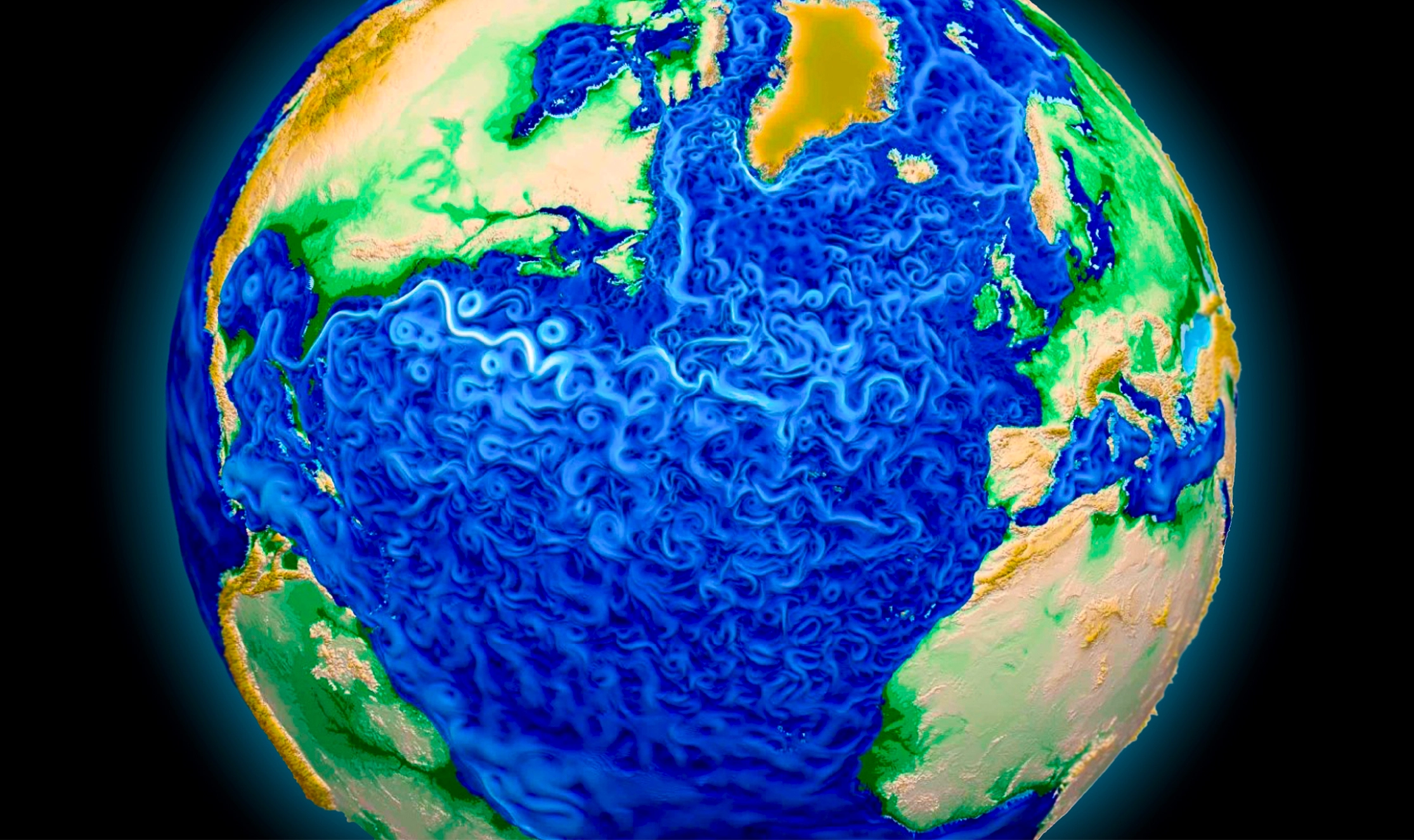
The Energy Exascale Earth System Model, one of the most detailed climate simulations to date, was developed over the course of a decade.
Hyun Kang/ORNL, E3SM, U.S. Department of Energy
They were inspired by video generation, a task already mastered by computer scientists. The process consisted of training a type of machine learning algorithm called a neural network on a corpus of videos so that the network would learn to take in a frame of a new video and output a plausible next frame. By looping this process, the algorithm could generate whole videos.
Weather forecasters wondered if they might do the same. If they could train a neural network on historical data about the weather in Kansas and then feed it the status of the atmosphere in Kansas at noon, could they generate an accurate guess as to what would happen in the state that evening — no Navier-Stokes equations required?
At first, the answer was “not really.” But by 2022, multiple groups were proving that answer wrong. “No one expected the weather enterprise to transform as rapidly as it has,” said Mike Pritchard, director of climate simulation research at Nvidia. Today AI weather forecasts are roughly 10% more accurate than physics-based weather simulations.
Throughout this weather revolution, Bretherton and his collaborators were building similar tools for forecasting the climate. In 2024, they released the Ai2 Climate Emulator version 2 (ACE2), a neural network trained on how the atmosphere has behaved over the past 50 years (bolstered, where data is patchy, with fill-in-the-gap simulations). This data incorporates the effects of real clouds on the real atmosphere, and so ACE2 makes forecasts that also reflect that influence. Similar to CLIMA, with its improved parameters, ACE2 smuggles in clouds indirectly.
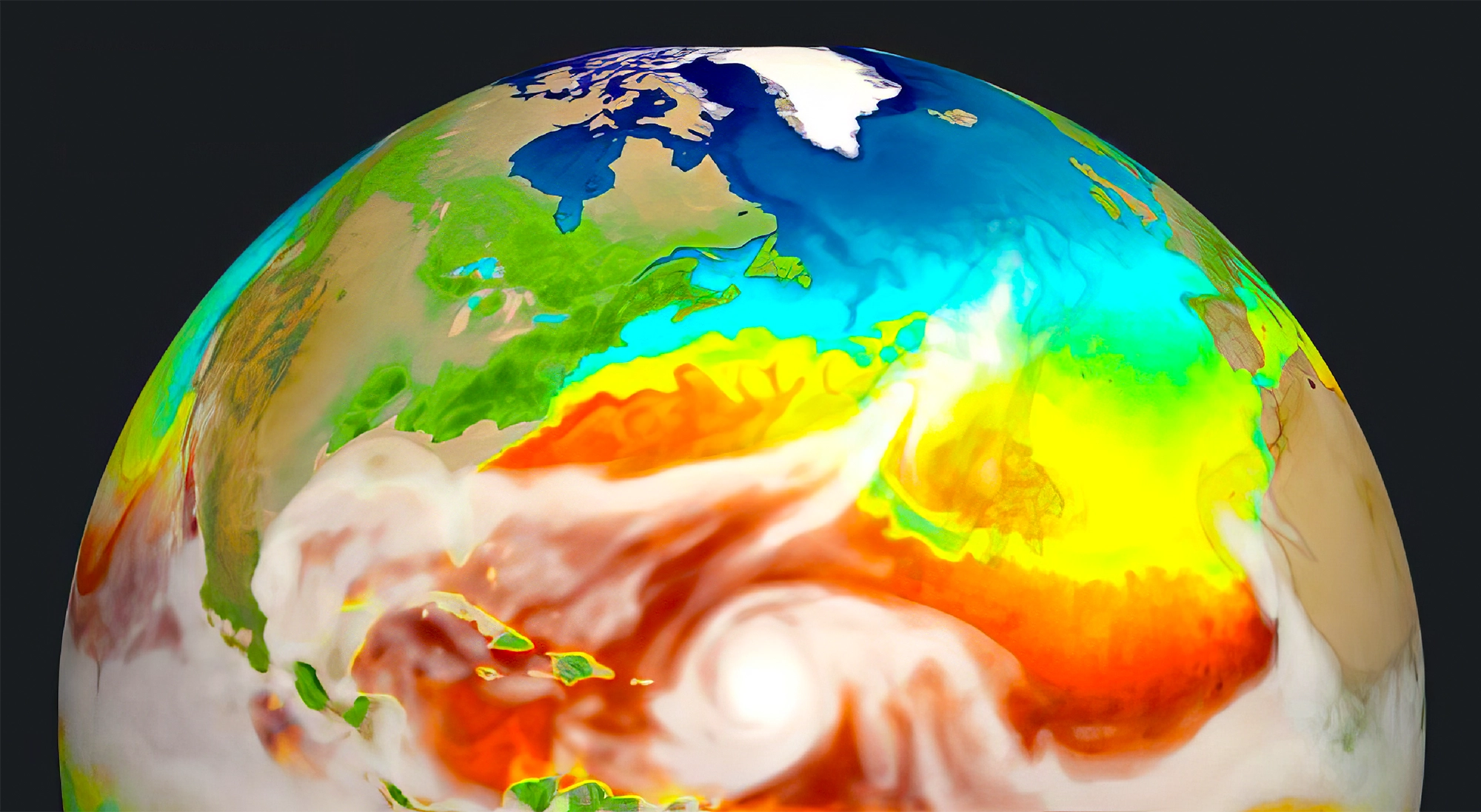
This simulation, produced with the Energy Exascale Earth System Model, shows a hurricane approaching North America from over the Atlantic Ocean.
Mathew Maltrud/Los Alamos National Laboratory
Scientists can feed ACE2 a snapshot of the atmosphere at one moment, then use it to predict how it might look six hours later, then six hours after that, and so on. The futures it sees have many of the rich atmospheric events seen in the real world: cyclones, abrupt warming events in the stratosphere, and other familiar phenomena. But are these machine visions actually useful as mid-term forecasts?
Recent work suggests that they are. Last year, the United Kingdom’s national meteorological service tasked ACE2 with peering one full season into the future. They found that, for a 23-year period beginning in 1993, ACE2 could start with the sea surface temperature in one season and predict global temperatures and precipitation three months later nearly as well as the best Navier-Stokes–based simulation. Moreover, where a traditional physics-based simulation might take hours to run on a supercomputing cluster, the ACE2 simulations took two minutes on a single machine.
What’s thus far unproved — and the topic of fierce debate — is whether algorithms like ACE2 can keep up over the long term. A weather forecast might focus on how a cold front will move over North America in the next 10 days, but climate forecasts must ultimately predict how temperatures will change over the whole planet in the next century.
Physicists have good reasons for skepticism. Unlike fluid dynamics equations, neural networks only approximate the laws of physics. If you run them for a long time, their small errors can begin to pile up. Another problem is that neural networks excel at reproducing complicated patterns in their training data, but climate predictions deal with events no one has seen before.
“These are things that are trying to predict the future,” said Sarat Sreepathi, a computer scientist at Oak Ridge National Laboratory who coordinated the development of the Department of Energy’s flagship climate model. “How much confidence do you have? If [your predictions are] based on physical principles, you might have a bit more.”
The New Art of the Possible
While individual researchers compete to develop their preferred methods of predicting the climate precisely, they recognize that theirs is a collective effort, in which progress on one side spurs progress on another.
In addition to training neural networks on real atmospheric data, as scientists did with ACE2, scientists are training neural networks on predictions from physics models — then using those neural networks to make new predictions at lightning speed. Compared to the physics models themselves, “it’s 100 to 1,000 times faster,” Pritchard said.
Pritchard sees this speedup as the killer AI climate app. That’s because the goal of climate forecasting isn’t to predict the exact state of the Earth in 30 years. Rather, the goal is to get a statistical sense of which possible futures are likely, which ones are rare, and how our fossil fuel habit disturbs that distribution.
While innovations aren’t likely to have a noticeable impact on the average person anytime soon, they feel transformative to researchers working in the field. Even incremental improvements to how well we can anticipate future temperatures, rainfall patterns, and storms can add up to big benefits over time. And researchers are making more than incremental improvements.
“We’ll have a different notion for how predictable the Earth system is in 10 years,” Pritchard said. “All my climate-scientist colleagues are buzzing with the art of the possible.”
Of course, what we do with that information is up to us.
Current climate models clearly show that our carbon emissions are making the planet a hotter, more dangerous place. The next generation of models, with their improved implicit handling of clouds, will tell us with greater precision how much hotter, and how much more dangerous. But no simulation can tell us whether gaining that knowledge will spur us to aim for a different future. “It’s a question that goes beyond just the science of it,” Schneider said. “It’s hard to predict.”