In Quantum Mechanics, Nothingness Is the Potential To Be Anything
Introduction
Suppose you want to empty a box. Really, truly empty it. You remove all its visible contents, pump out any gases, and — applying some science-fiction technology — evacuate any unseeable material such as dark matter. According to quantum mechanics, what’s left inside?
It sounds like a trick question. And in quantum mechanics, you know to expect a trick answer. Not only is the box still filled with energy, but all your efforts to empty it have barely put a dent in the amount.
This unavoidable residue is known as ground-state energy, or zero-point energy. It comes in two basic forms: The one in the box is associated with fields, such as the electromagnetic field, and the other is associated with discrete objects, such as atoms and molecules. You may dampen a field’s vibrations, but you cannot eliminate every trace of its presence. And atoms and molecules retain energy even if they’re cooled arbitrarily close to absolute zero. In both cases, the underlying physics is the same.
Zero-point energy is characteristic of any material structure or object that is at least partly confined, such as an atom held by electric fields in a molecule. The situation is like that of a ball that has settled at the bottom of a valley. The total energy of the ball consists of its potential energy (related to position) plus its kinetic energy (related to motion). To zero out both components, you would have to give a precise value to both the object’s position and its velocity, something forbidden by the Heisenberg uncertainty principle.
What the existence of zero-point energy tells you at a deeper level depends ultimately on which interpretation of quantum mechanics you adopt. The only noncontentious thing you can say is that, if you situate a bunch of particles in their lowest energy state and measure their positions or velocities, you will observe a spread of values. Despite being drained of energy, the particles will look as if they’ve been jiggling. In some interpretations of quantum mechanics, they really have been. But in others, the appearance of motion is a misleading holdover from classical physics, and there is no intuitive way to picture what’s happening.
Zero-point energy was first introduced by Max Planck in 1911. After that, “it was Einstein, I think, who took it seriously for the first time,” said Peter Milonni of the University of Rochester, a theorist who studies the quantum vacuum. Einstein and others invoked zero-point energy to explain numerous phenomena, including the subtle vibrations of molecules and crystal lattices, even in their lowest energy states, and the failure of liquid helium to condense into a solid at ordinary pressure, even at temperatures so low you would expect atoms to lock in place.
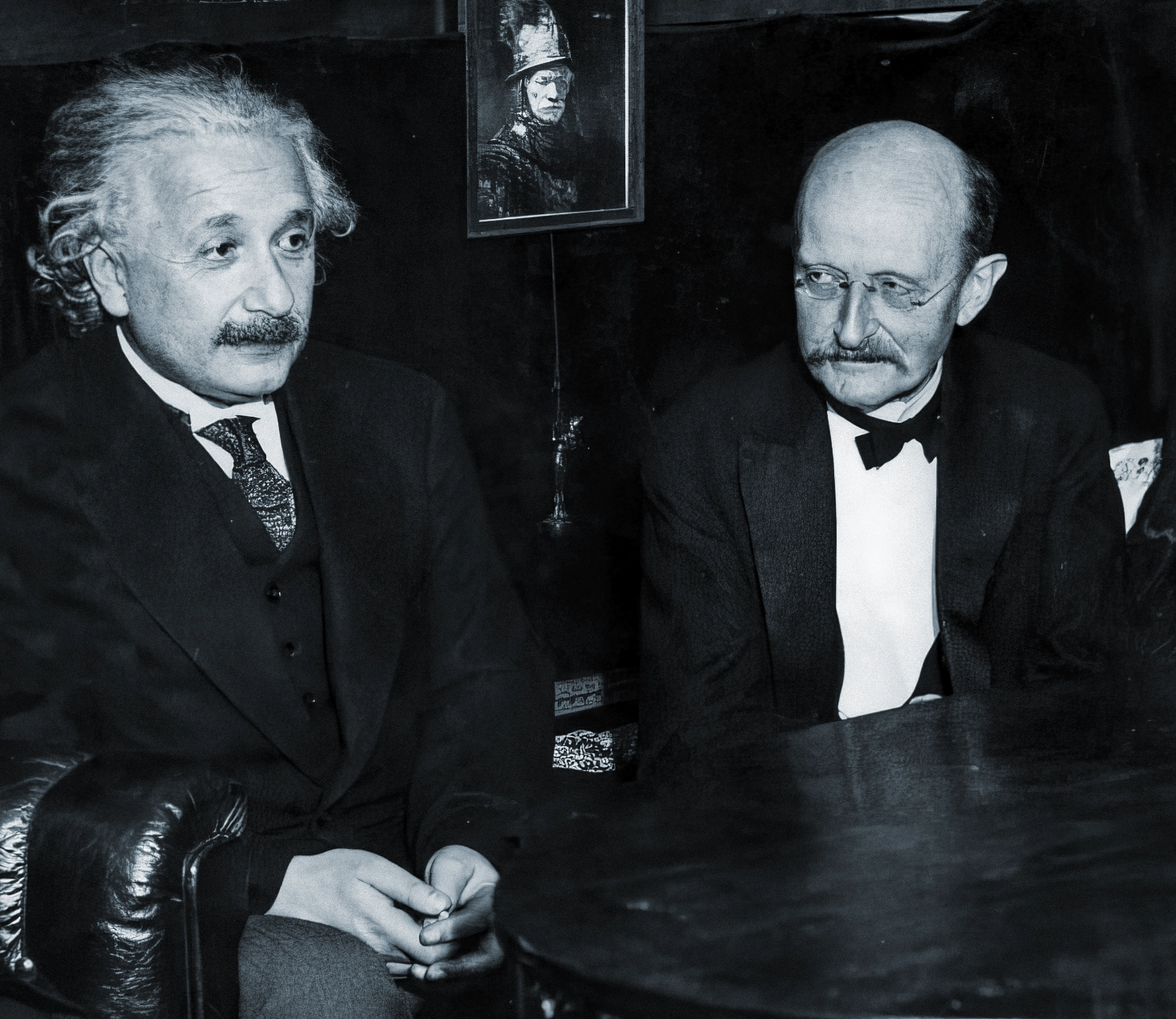
Albert Einstein (left) with Max Planck in Berlin in November 1931.
Linda Hall Library of Science, Engineering and Technology
A recent example was published in 2025 by researchers at the European X-Ray Free-Electron Laser Facility near Hamburg, among other institutions. They cooled iodopyridine, an organic molecule consisting of 11 atoms, almost to absolute zero and hammered it with a laser pulse to break its atomic bonds. The team found that the motions of the freed atoms were correlated, indicating that, despite its chilled state, the iodopyridine molecule had been vibrating. “That was not initially the main goal of the experiment,” said Rebecca Boll, an experimental physicist at the facility. “It’s basically something that we found.”
Perhaps the best-known effect of zero-point energy in a field was predicted by Hendrick Casimir in 1948, glimpsed in 1958, and definitively observed in 1997. Two plates of electrically uncharged material — which Casimir envisioned as parallel metal sheets, although other shapes and substances will do — exert a force on each other. Casimir said the plates would act as a kind of guillotine for the electromagnetic field, chopping off long-wavelength oscillations in a way that would skew the zero-point energy. According to the most accepted explanation, in some sense, the energy outside the plates is higher than the energy between the plates, a difference that pulls the plates together.
Quantum field theorists typically describe fields as a collection of oscillators, each of which has its own zero-point energy. There is an infinite number of oscillators in a field, and thus a field should contain an infinite amount of zero-point energy. When physicists realized this in the 1930s and ’40s, they at first doubted the theory, but they soon came to terms with the infinities. In physics — or most of physics, at any rate — energy differences are what really matters, and with care physicists can subtract one infinity from another to see what’s left.
That doesn’t work for gravity, though. As early as 1946, Wolfgang Pauli realized that an infinite or at least gargantuan amount of zero-point energy should create a gravitational field powerful enough to explode the universe. “All forms of energy gravitate,” said Sean Carroll, a physicist at Johns Hopkins University. “That includes the vacuum energy, so you can’t ignore it.” Why this energy remains gravitationally muted still mystifies physicists.
In quantum physics, the zero-point energy of the vacuum is more than an ongoing challenge, and it’s more than the reason you can’t ever truly empty a box. Instead of being something where there should be nothing, it is nothing infused with the potential to be anything.
“The interesting thing about the vacuum is every field, and therefore every particle, is somehow represented,” Milonni said. Even if not a single electron is present, the vacuum contains “electronness.” The zero-point energy of the vacuum is the combined effect of every possible form of matter, including ones we have yet to discover.