Mathematicians Harness Randomness To Crack a 55-Year-Old Conjecture

Introduction
The late Ronald Graham wore two hats. He was a renowned mathematician, at one time president of the American Mathematical Society. He was also a serious juggler, and president of the International Jugglers’ Association. “He loved tricks,” said Fan Chung, a mathematician at the University of California, San Diego, who was married to Graham. “You know, spinning a ball, spinning a coat hanger, spinning several balls together, throwing pens against the wall.”
Sometimes Graham wore both hats at once. “It’s interesting, in fact, that many mathematicians and computer scientists have an interest in juggling,” he said in a 1980 television interview. “I think it’s the search for patterns and structure that is responsible for this.”
He would go on to write numerous papers, some with Chung, on the mathematics of juggling. But back in 1971, decades before he made that connection explicit, he posed a question that some mathematicians now say might have been inspired by juggling, too.
Start with a random set of different integers, not including zero. Can you always rearrange them so that if you add up the first two numbers, then the first three, then the first four, and so on, every “partial sum” turns out different? In the language of juggling, this would mean that if each ball stays in the air for a different amount of time, you can always find an order to throw them in such that two balls won’t come crashing down on the same beat — which would ruin the act.
If the numbers are all positive, then the answer to Graham’s question is obviously yes: The sums will always grow larger as you add more numbers. Similarly, if there are both positive and negative numbers in the mix, the answer is also known to be yes. But what if the numbers live in a finite world — like numbers wrapped around a clock, which repeat after a certain count?
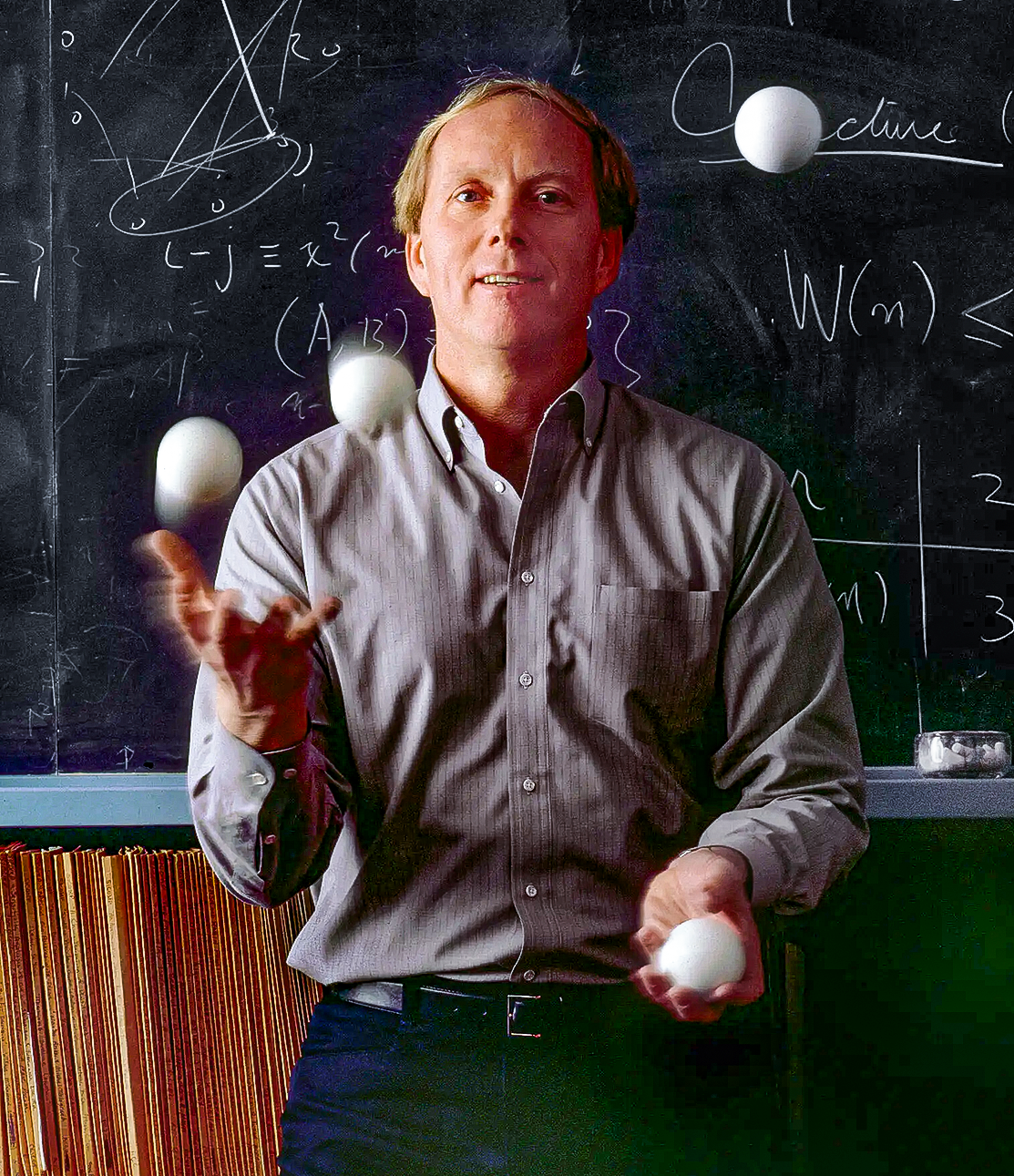
The late mathematician Ronald Graham was also a skilled juggler.
Peter Vidor
That’s what Graham wanted to know. He conjectured that the answer should still be yes. It often happens, he figured, that even when dealing with rigid constraints, you can still find enough flexibility to construct special patterns or structures — just as it’s usually possible to find a valid sudoku board or Latin square (another kind of puzzle) despite their many rules. “It fits nicely in all these questions about designs and about very symmetric structures,” said Noga Alon, a mathematician at Princeton University. But for decades, no one could prove Graham’s intuition to be true.
That changed recently, when several young mathematicians picked up the balls. In a proof that spanned four papers and various fields of mathematics, they finally resolved Graham’s rearrangement conjecture. The final paper, by Lisa Sauermann of the University of Bonn and Huy Tuan Pham of the University of Chicago, appeared in February 2026, officially closing the problem.
Across the papers, one theme prevailed: the power of randomness to draw out patterns. As Alon put it, “It’s the power of collaboration, the power of the young generation, the power of probabilistic methods” that solved the problem.
The Cascade
Alp Müyesser, a mathematician at the University of Oxford, often finds himself drawn to problems whose solutions need two ingredients: a random process, and something extra as well. After solving one such problem in 2022 while he was still a graduate student, he encountered Graham’s conjecture and realized that his just-finished proof could help there, too.

Alp Müyesser enjoys thinking about problems that require him to combine randomness with something else.
Kangxin Chen
The conjecture is set in the world of clock arithmetic. You start by placing the whole numbers on a number line, then you wrap the line around the face of a clock so that the numbers repeat after some prime number, p. Say p is 7, for instance. In this setting, 0, 7, 14, and all other multiples of 7 are equivalent — meaning that you can add two positive numbers (like 3 and 4) and get zero.
Graham asked the following: If you pick any set of nonzero numbers off this number line (for any p), can you always rearrange them so that the partial sums you get are all different?
The challenge depends on how big your set is compared to p. The more numbers you pick, the more sums there are to manage. But if you choose fewer numbers, there will be fewer ways to rearrange them. These different cases inspire different approaches.
Müyesser, along with his former adviser, Alexey Pokrovskiy of University College London, tackled the case where your set includes almost every possible number up to p. With sets this large, it can be extremely hard to construct a valid ordering. But it turned out that starting with a random ordering can bring you most of the way there.
“Computer scientists often call this a ‘finding the hay in the haystack’ problem,” Müyesser said. You might know that lots of good orderings are out there, but actually finding one is hard. “If you do it randomly, it’s likely going to work, but it’s hard to explicitly describe what the solution is supposed to look like.”
Müyesser and Pokrovskiy needed to ensure that no sequence of numbers anywhere in the ordering added up to zero. Otherwise, adding those numbers to the previous partial sum would repeat that sum.
A completely random ordering might have a few of these troublesome sequences. So Müyesser and Pokrovskiy first set aside a few specially chosen numbers from the set, then randomly scrambled the rest. They scanned their random ordering for any problems; if they came across an interval that added up to zero, they could insert one of the spare numbers to change it. In 2022, they posted their solution, though it was hidden in a paper that focused on applying the same technique to a more general problem.
A couple of years later, Noah Kravitz of Oxford, unaware of Müyesser and Pokrovskiy’s solution, stumbled on Graham’s conjecture in an online archive of unsolved problems. “I saw there was an open problem, and I was like, it’s embarrassing for humanity that we don’t know this,” Kravitz said. “This situation just had to be rectified.”
He decided to approach the conjecture from the opposite end. Together with Benjamin Bedert of Oxford, he considered the case where the set of numbers is tiny compared to p — for instance, Alon said, if you have a set of 100 numbers where p is 1 billion.
Kravitz and Bedert solved Graham’s conjecture for those cases and posted their proof in September 2024. Müyesser saw it and reached out, sharing his own work; the three of them (plus two other colleagues) then teamed up to extend Müyesser’s original approach.
“It was a pretty unlikely combination of people,” Kravitz said. He and Müyesser come from two areas of combinatorics that don’t typically collaborate. “Different sections have completely different techniques,” he said.
Their paper, which they posted in August 2025, handled more cases where the set of numbers is relatively large compared to p. But between those cases and the small-set cases that Kravitz and Bedert had covered, a gap remained. No one could figure out what to do about medium-size sets, such as those that include roughly half as many numbers as p. “Our methods didn’t work there, and there were clear reasons that they would not have worked,” Müyesser said.
It seemed as though research on the problem might enter another long hiatus.
Then, in February 2026, a surprise appeared online.
The Fountain
Lisa Sauermann and Huy Tuan Pham were old friends. The two mathematicians had met in 2015 at Stanford University, where Sauermann was a graduate student and Pham an undergraduate. Today they live on different continents — Sauermann in Bonn, Germany, and Pham in Chicago. But a conference in Germany in September 2025 provided a rare chance for them to share a chalkboard again, and afterward Pham followed Sauermann to Bonn for a short visit. All they needed was a problem to work on.
At the conference, they heard two talks on Graham’s conjecture by mathematicians who had attempted but failed to bridge the gap. They were intrigued. And as it later turned out, Sauermann had encountered a closely related problem in the International Mathematical Olympiad as a high school student. She solved it correctly, and by the time she finished high school, she’d won a gold medal in the prestigious competition four times. (Most likely, it was Chung who placed the problem on that year’s exam, as she was on the committee that wrote the questions, and she frequently took inspiration from Graham’s many puzzles.)
By the end of their three-day visit, Sauermann and Pham had a plan for how to crack the case.
It hinged on a technically demanding method called anti-concentration. Here, an anti-concentration statement asserts that some event has a particularly low chance of happening. But the mechanics of proving these kinds of statements are so intricate that, though Kravitz and others were aware that such an anti-concentration approach might succeed, “we just hadn’t had the guts to actually try it,” he said.
First, though, Sauermann and Pham began the way their predecessors had. They randomly reordered their set of numbers and came up with a procedure to fix any problems — that is, any sequences that add up to zero. Any time they found a zero-sum sequence, they swapped out the last number in the sequence with another one.
This procedure often went without a hitch. But three types of “bad events” would cause it to fail. One: A zero-sum sequence might occur toward the end of the entire arrangement; then there would be no other numbers to swap in. Two: Many zero-sum sequences might appear too close together, making it impossible to fix them all. And three: Fixing one bad sequence might create another zero-sum sequence down the line.
Sauermann and Pham hoped to prove, using anti-concentration, that each of these bad events was sufficiently unlikely. Then there would have to be a way to rearrange the set of numbers to satisfy the conjecture.
To do this, the duo used Fourier analysis — an area of math that lets you rewrite functions as sums of simple waves — to show that in general, when you add up random sets of numbers, no one sum is especially likely to appear. They then used this insight to carefully estimate the probability that each bad event would occur, ultimately showing that the total chance of getting a bad event was less than 100%. That was enough to settle the conjecture.
A few months after their stint in Germany, Sauermann and Pham posted their 27-page proof online. They had shown not only that a satisfactory rearrangement was always possible, but that a random ordering could be rearranged to eliminate bad events at least 90% of the time — a massive success rate.
The mathematicians who had previously worked on the problem were surprised to see the remaining case closed so quickly. “Their approach is just completely different,” Müyesser said.
Together, the four papers prove Graham’s conjecture for sets of all sizes. But they all assume that p is very large; though no one has calculated its exact value, think along the lines of 10 raised to the 100th power. To mathematicians, that’s fine — the salient point is that you’re working in the setting of clock arithmetic. But another aspect of the problem technically remains unsolved — you might still try to resolve the conjecture for all p. And if you want to use the result to choreograph a real juggling routine, you’re out of luck: To correspond to such a large p, the routine would have to be much too long.
The proof confirms that even within these strange, limited number settings, “there are some nice structures that always exist,” Alon said. You can always achieve some degree of flexibility, shuffling the numbers in your set around to avoid revisiting the same partial sums.
“To pose a good problem is really an art,” Chung said. “I think Ron would be extremely happy to see the problem solved.”