What's up in
Quantum gravity
Latest Articles
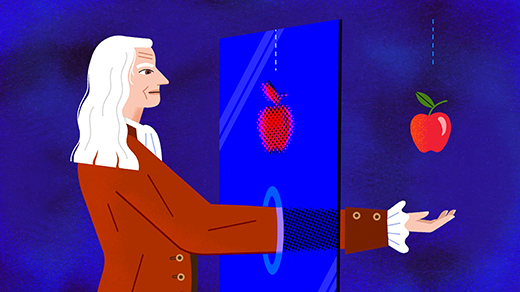
Entanglement Builds Space-Time. Now “Magic” Gives It Gravity.
In holographic theories, physicists may have traced the pliability of space-time to its quantum roots: a measure of quantumness known as “magic.”
Are Strings Still Our Best Hope for a Theory of Everything?
Columnist Natalie Wolchover examines the latest developments in the “forever war” over whether string theory can describe the world.

Where Some See Strings, She Sees a Space-Time Made of Fractals
Pushed down to a certain scale, the laws of physics seem to fall apart. Astrid Eichhorn, a leader in an area of study called asymptotic safety, thinks we just need to push a little further.
Cosmic Paradox Reveals the Awful Consequence of an Observer-Free Universe
Encouraged by successes in understanding black holes, theoretical physicists are applying what they’ve learned to whole universes. What they’re finding has them questioning fundamental assumptions about how physics ought to be done.
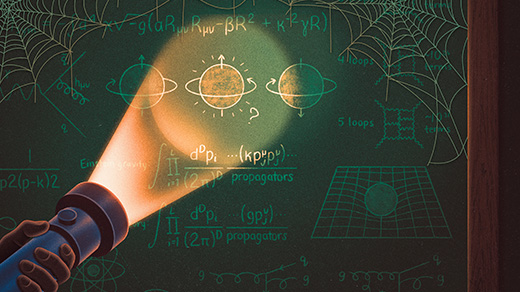
Old ‘Ghost’ Theory of Quantum Gravity Makes a Comeback
Has the secret to understanding gravity been hiding in plain sight for nearly 50 years?

Carlo Rovelli’s Radical Perspective on Reality
The theoretical physicist and best-selling author finds inspiration in politics and philosophy for rethinking space and time.
Astrophysicists Find No ‘Hair’ on Black Holes
According to Einstein’s theory of gravity, black holes have only a small handful of distinguishing characteristics. Quantum theory implies they may have more. Now an experimental search finds that any of this extra ‘hair’ has to be pretty short.
Is Gravity Just Entropy Rising? Long-Shot Idea Gets Another Look.
A new argument explores how the growth of disorder could cause massive objects to move toward one another. Physicists are both interested and skeptical.
Singularities in Space-Time Prove Hard to Kill
Black hole and Big Bang singularities break our best theory of gravity. A trilogy of theorems hints that physicists must go to the ends of space and time to find a fix.