‘It’s a Mess’: A Brain-Bending Trip to Quantum Theory’s 100th Birthday Party
It in no way reflects my feelings toward Quanta staff writer Charlie Wood that my favorite moment of the year in physics happened when he got seasick this summer aboard a ferry full of physicists on the North Sea.
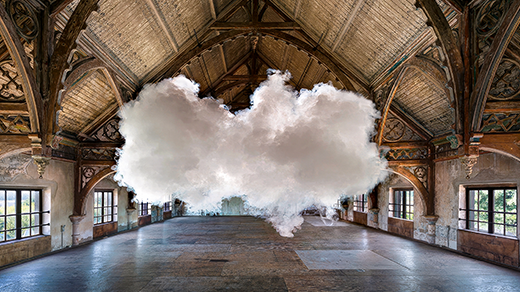
Charlie and hundreds of the world’s top quantum researchers were en route to Helgoland, the island birthplace of quantum mechanics, for a historic conference to mark the theory’s centennial. In the hundred years since Werner Heisenberg successfully formulated quantum theory while scrambling over Helgoland’s rugged cliffsides, quantum mechanics has transformed the world. Yet physicists remain confused and divided over the theory’s meaning and what it implies about the nature of reality. Charlie’s rip-roaring account of the Helgoland conference surveys the tangled web of quantum interpretations that are in play.
The heated debate got underway not long after the passengers embarked. “What do you mean, what do I mean?” one physicist yelled at another, as the boat pitched and rolled and Charlie’s queasiness set in.
DESI Collaboration
Is Dark Energy Getting Weaker? New Evidence Strengthens the Case.
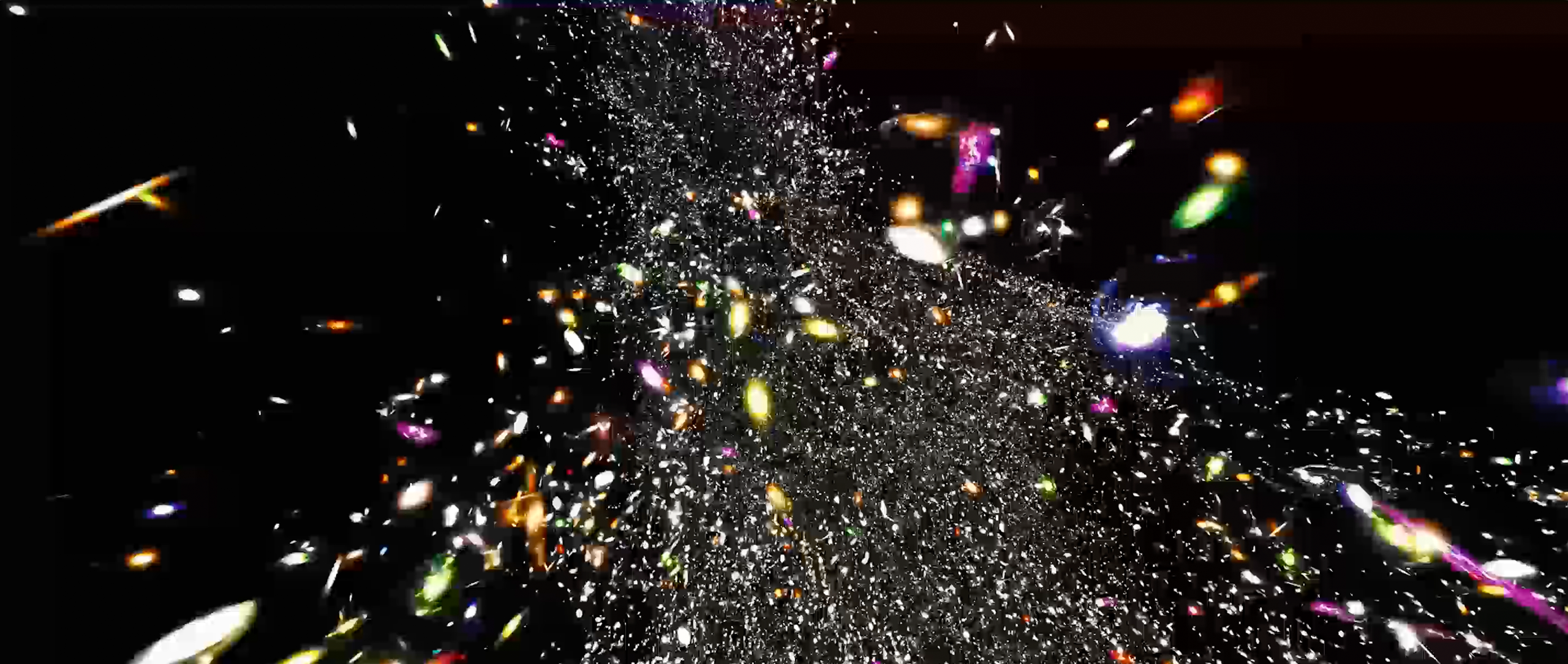
The biggest news this year in fundamental physics was also the biggest news last year. In April 2024, a map of the cosmos released by the Dark Energy Spectroscopic Instrument (DESI) hinted that dark energy, the repulsive agent that’s driving the expansion of space, has been weakening over time. It seemed too interesting to be true, but this March, DESI physicists returned to the podium with an even bigger cosmological map (15 million galaxies this time, rather than 6 million) and a stronger conclusion. “We are much more certain than last year that this is definitely a thing,” one DESI member told Quanta. The same month, a second effort, the Dark Energy Survey, also reported evidence that dark energy is losing steam.
Dark energy is spread thinly throughout space, amounting to a few atoms’ worth of mass per cubic meter; it can be thought of as the energy of space itself. But where it comes from, and why it is so diffuse, no one can say. If dark energy’s density really is dropping from one gigayear to the next, that points to a totally different explanation than if it were holding steady.
The 2025 results are still not statistically strong enough to constitute a discovery. More data is needed. Luckily, the Vera C. Rubin Observatory, a powerful new telescope in Chile that began operations this summer, will map the locations of 20 billion galaxies over the next decade. That ought to be enough for researchers to say for sure whether dark energy is varying or not.
Quanta Magazine; source: JWST/NASA/ESA/CSA and Lukas Furtak
A Single, ‘Naked’ Black Hole Rewrites the History of the Universe
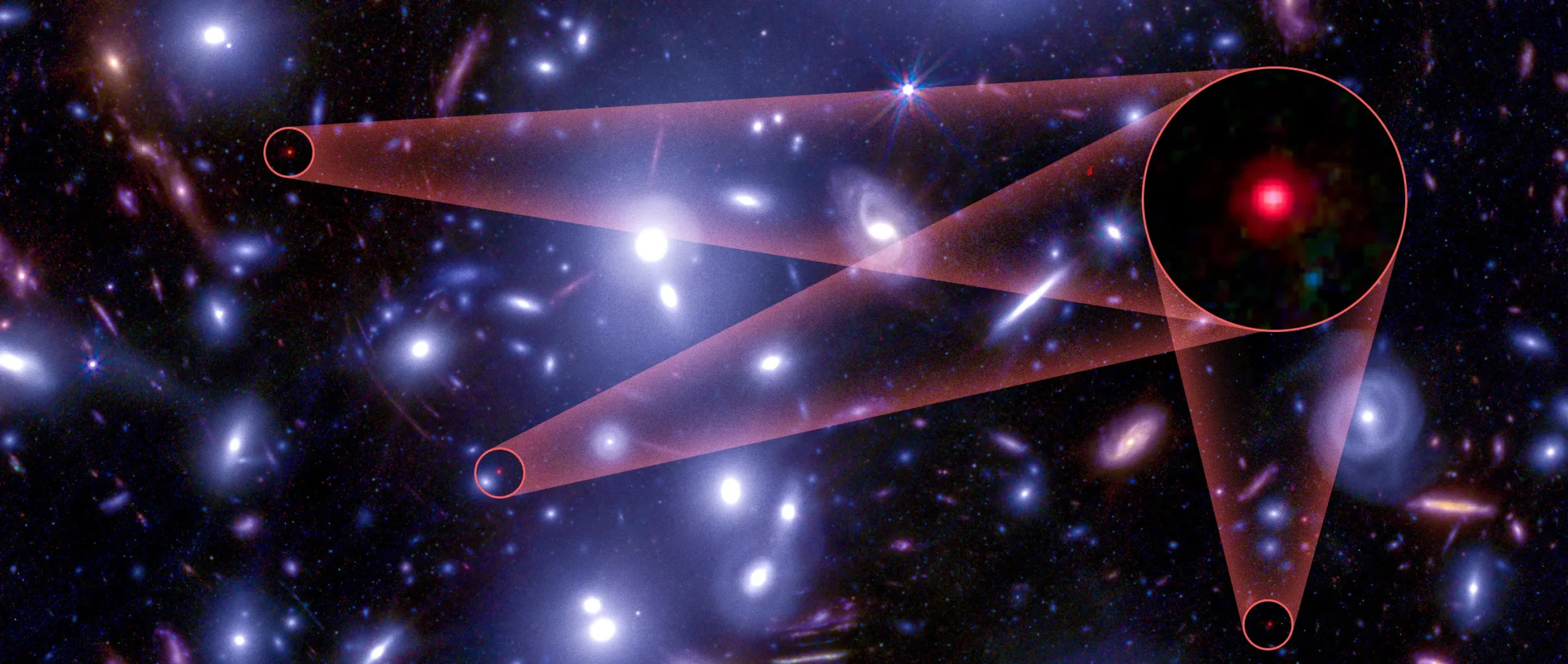
Speaking of flagship telescopes, the James Webb Space Telescope yielded a major discovery about the early universe. We could barely see anything from the first billion years until the Webb launched a few years ago. Since then, the telescope has spotted aptly named “little red dots” all over the infant cosmos. Now physicists have worked out the identity of one of the dots: It’s an enormous black hole weighing 50 million suns, sitting alone in the young universe, shrouded by the thinnest veil of gas.
We’ve detected black holes before, but this “naked” one is unique. It singlehandedly upends notions about the young universe. Black holes were thought to have come along only after the formation of galaxies, once stars gravitationally collapsed into black holes that then merged and grew. But this newfound behemoth exists with no galaxy in sight. Perhaps a galaxy took shape around it later. How this naked black hole (and any others like it) formed in the early universe — and whether it might even be primordial, originating from the Big Bang itself — has yet to be determined. “It’s terribly exciting. It’s highly informative,” said one of the physicists who worked out its identity.
Mark Belan/Quanta Magazine
How Climate Scientists Saw the Future Before It Arrived
In September, as part of How We Came To Know Earth, Quanta’s special issue on climate science, Zack Savitsky told the epic story of climate modeling: an account of humanity’s largely successful quest over the past 60 years to build a computer model of Earth in order to ask what the future holds.
The answer is dire. But the achievement is awe-inspiring.
Climate modeling essentially amounts to solving an enormous set of equations describing how fluids slosh around the globe. The process of figuring out how to do that — what to put in the model and what to leave out — serves as a synecdoche for science as a whole. Always, understanding comes from pinpointing the relevant factors and forgetting the rest, from compressing nature’s endless intricacies into a human-readable story about the universe.

Señor Salme for Quanta Magazine
AI Comes Up With Bizarre Physics Experiments. But They Work.
With all the attention on AI this year, it’s natural to wonder whether our purportedly clever new machine friends are helping with our headiest human pursuits. In July, Anil Ananthaswamy reported on the impact AI is having on physics so far. Notably, the computers seem to have a knack for concocting bizarre physics experiments — designs that humans wouldn’t think of, which nevertheless work.
Another impact of AI is the growing use of chatbots to generate calculations and proofs that look legitimate but are gibberish. In June, I had trouble telling whether someone really had solved the Yang-Mills mass gap problem — a calculation pertaining to the strong force that’s so difficult, it comes with a $1 million reward — as claimed in a paper posted to the physics preprint site arxiv.org. They had not. The formulas in the paper were AI-generated claptrap, but the paper had slipped through arxiv.org’s automatic filters. “The rejected-submission rate has risen dramatically since 2023 and has continued spiking upward in recent months, all driven by AI slop from quasi-technical people,” site administrator and physicist Paul Ginsparg told me. This dreck, he said, “poses an existential threat to arxiv methodology.”