What Crystals Older Than the Sun Reveal About the Start of the Solar System
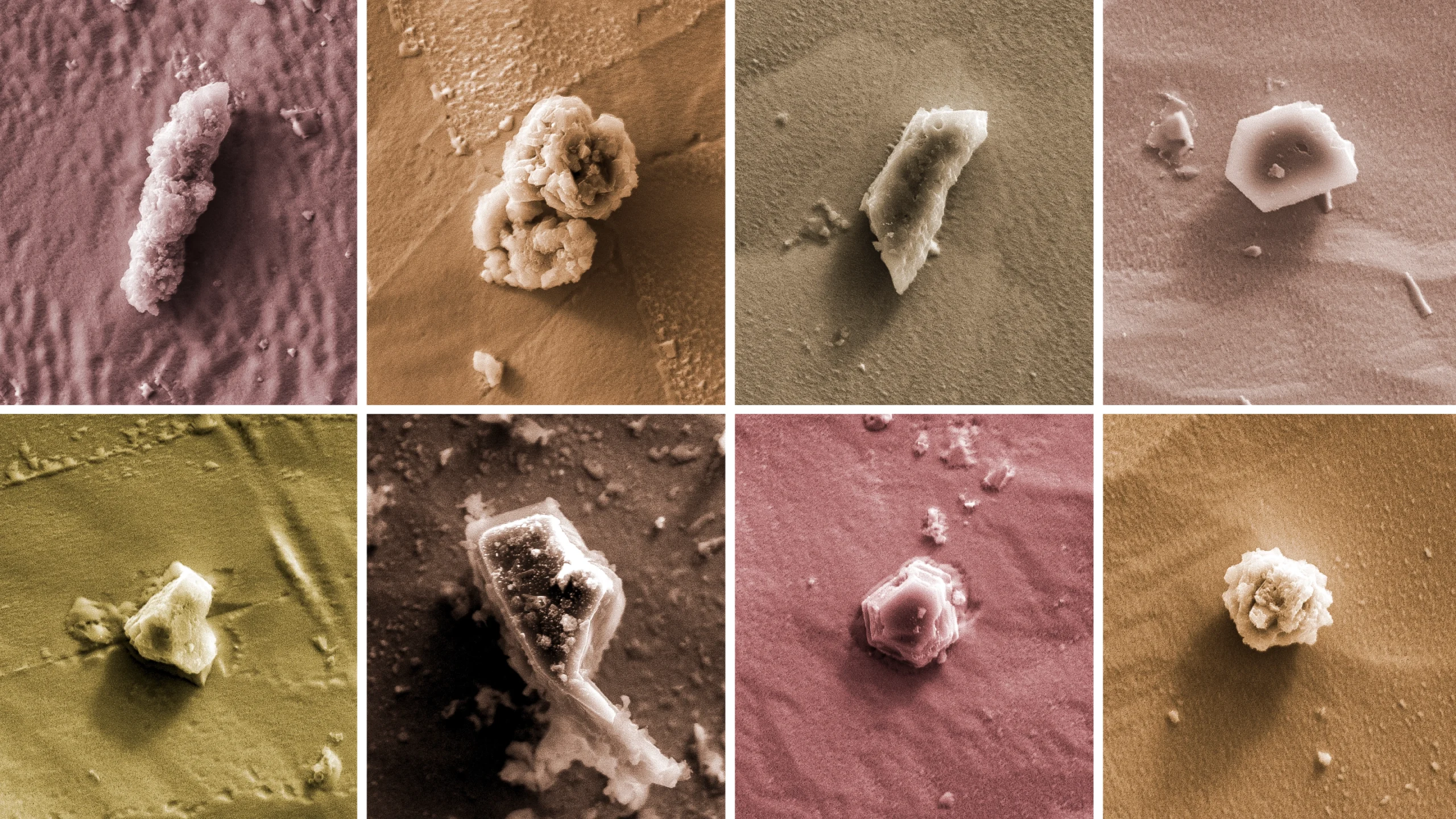
Presolar grains, found in meteorites, are smaller than a bacterial cell.
Photos courtesy of Nan Liu
Introduction
The standard story of the origin of our solar system has gone like this: 4.6 billion years ago, a giant cloud of dust hung frozen in space. Then the explosion of a nearby star caused part of that dust cloud to collapse. Pulled by gravity toward a central point, the dust coalesced into a radiating ball of hydrogen and helium about 1.4 million kilometers in diameter — what would become our sun. The remainder, which fell into orbit, collected into our solar system’s planets, along with a mess of asteroids and other cosmic leftovers.
To test the validity of this story, researchers need to peer back in time to the solar system’s first moments and beyond. And the cosmochemist Nan Liu has a way to do that: Locked in a safe on her desk at Boston University’s Institute for Astrophysical Research is a shard of meteorite flecked with material older than the sun.
“It’s the most pristine [type of] meteorite, not altered by water or heat,” Liu said as she took out and held up the specimen — a shiny, dark stone about the size and shape of an arrowhead.
Meteorites like this one formed around the time of the dust cloud collapse. The collapse of the cloud and the ignition of the sun melted away much of the chemical information contained in the meteorite, but within it some microscopic crystals — smaller than a single bacterial cell — survived intact. These crystals, called presolar grains, are far and away the oldest material accessible to us on Earth.
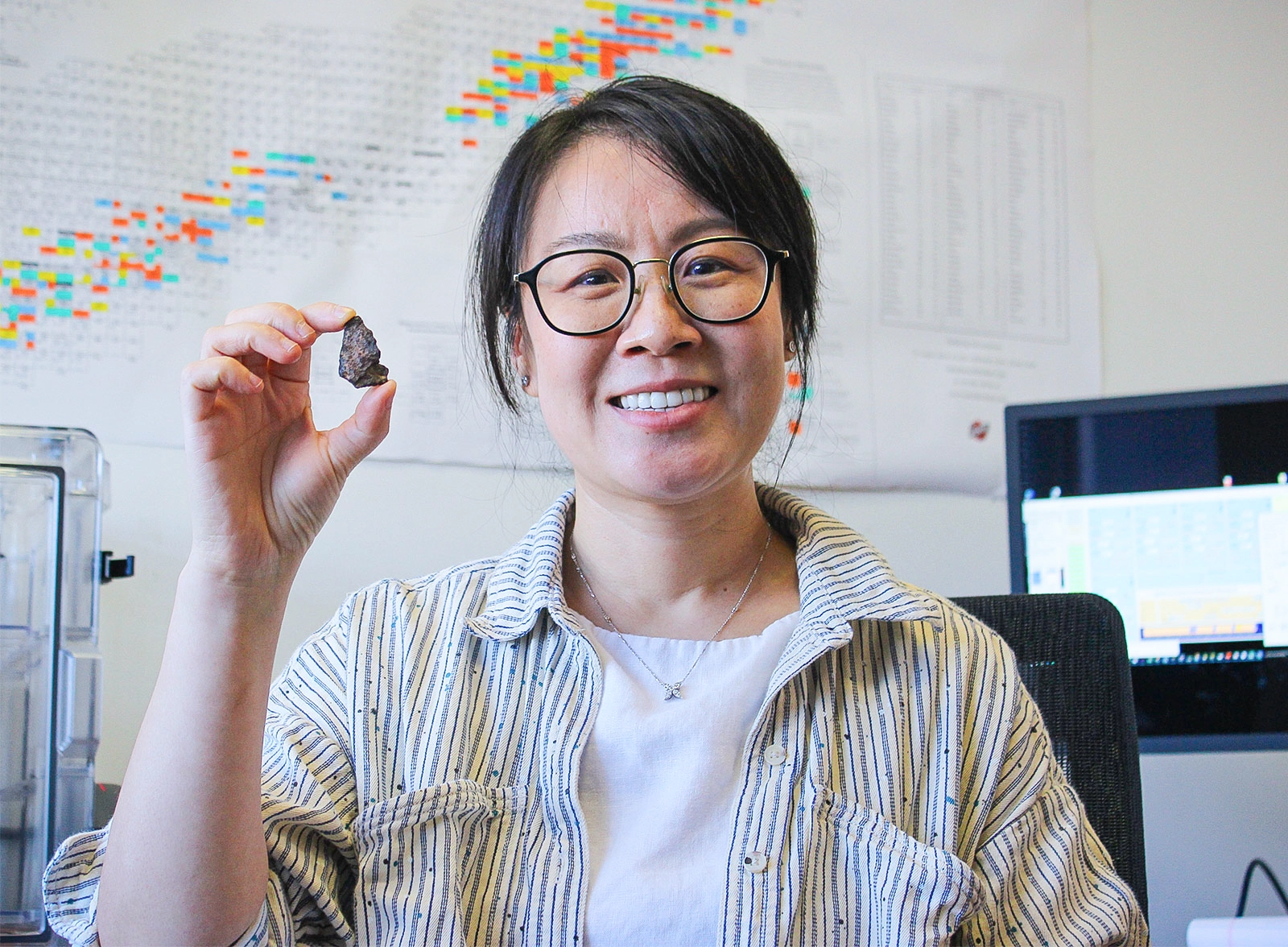
Nan Liu, a cosmochemist at Boston University’s Institute for Astrophysical Research, holds up a piece of meteorite that contains grains of material older than the sun.
James Dinneen for Quanta Magazine
Over the past decade or so, scientists have used meteorites like Liu’s to challenge the story of how the solar system formed. Instead of a supernova, the solar system and everything in it might owe its existence to a more placid-sounding cosmic scenario: Maybe our solar system cobbled itself together from the winds blown off of a gargantuan star. New studies of presolar grains could offer a way to determine whether this new story is correct.
Starts With a Bang
Scientists got their first clue about what could have triggered the formation of the solar system when a fireball appeared over Mexico in 1969. The now-famous Allende meteorite spread its debris over more than 500 square kilometers.
In 1976, researchers reported that samples from Allende contained a surprise: an unexpectedly large amount of a stable isotope called magnesium-26. They proposed that the meteorite formed with an abundance of aluminum-26, which is radioactive and leaves behind magnesium-26 when it decays.
Yet aluminum-26 was not known to be a normal component of the interstellar medium — the dusty space between stars that would have provided the materials for Allende. Ordinary stars don’t make that particular isotope. “Most of these isotopes as we observe them in the early solar system, they were just the natural product of galactic chemical evolution,” said Maria Lugaro, an astrophysicist at the Konkoly Thege Miklós Astronomical Institute in Hungary. “The most important exception is aluminum-26.”
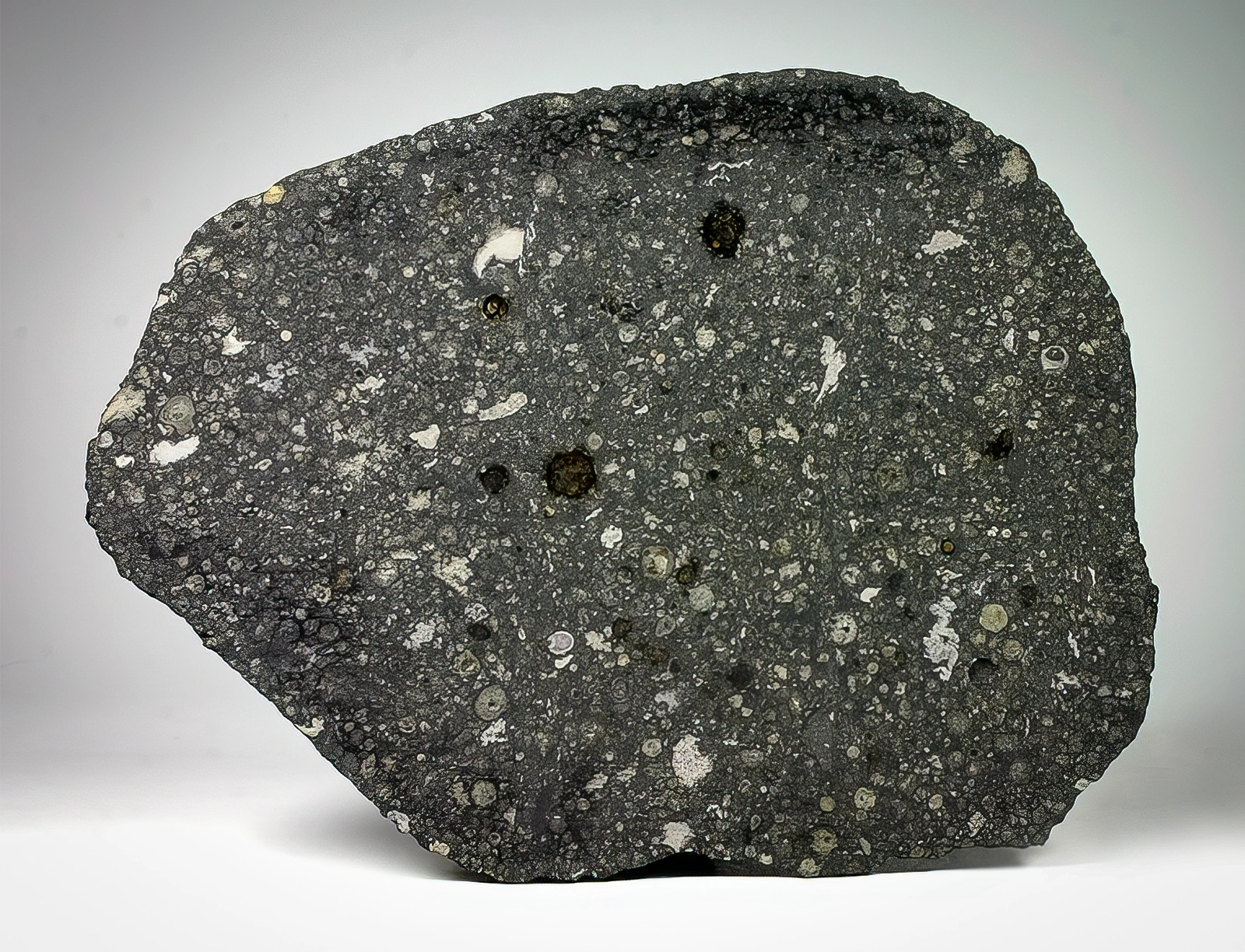
Pieces of the Allende meteorite landed across the Mexican state of Chihuahua.
Matteo Chinellato
So where’d it come from? In 1977, two eminent astrophysicists proposed that the anomalous aluminum likely came from a nearby supernova explosion. Other phenomena can produce aluminum-26, but the supernova shock wave could also have caused the collapse of the cloud. With a single event, astronomers could explain how two rare occurrences — the injection of aluminum-26 and the formation of a new solar system — happened at virtually the same moment. “Everybody felt that we needed something to trigger the collapse,” said Vikram Dwarkadas, an astronomer at the University of Chicago.
The supernova trigger remained the favored scenario for decades, supported by detailed astrophysical models, as well as further measurements of enriched magnesium-26 in pristine meteorites. But over the past decade or so, that view has run up against other measurements that don’t seem to match. The problem: The solar system has an iron deficiency.
Not So Ironclad
Supernovas don’t just make aluminum. Any nearby supernova would likely also have injected lots of the radioactive isotope iron-60. Therefore, if a supernova launched the formation of the solar system, “we should see quite high initial [iron-60] abundances in the early-formed objects,” wrote Linru Fang, a cosmochemist at the University of Copenhagen, in an email.
Some studies have reported finding enough iron-60 in meteorite samples to support the supernova story. But not all scientists agree with those findings; several researchers told Quanta that most cosmochemists now think that, while there was an abundance of aluminum-26 at the start of the solar system, there wasn’t much iron-60 after all.
Early last year — in a study described by its authors as the most precise measure of iron-60 in the early solar system to date — Fang and her colleagues reported low levels of iron-60 (measured via its stable decay product nickel-60) in a planetesimal formed just after the collapse of the cloud. The result is inconsistent with a supernova scenario, she said.
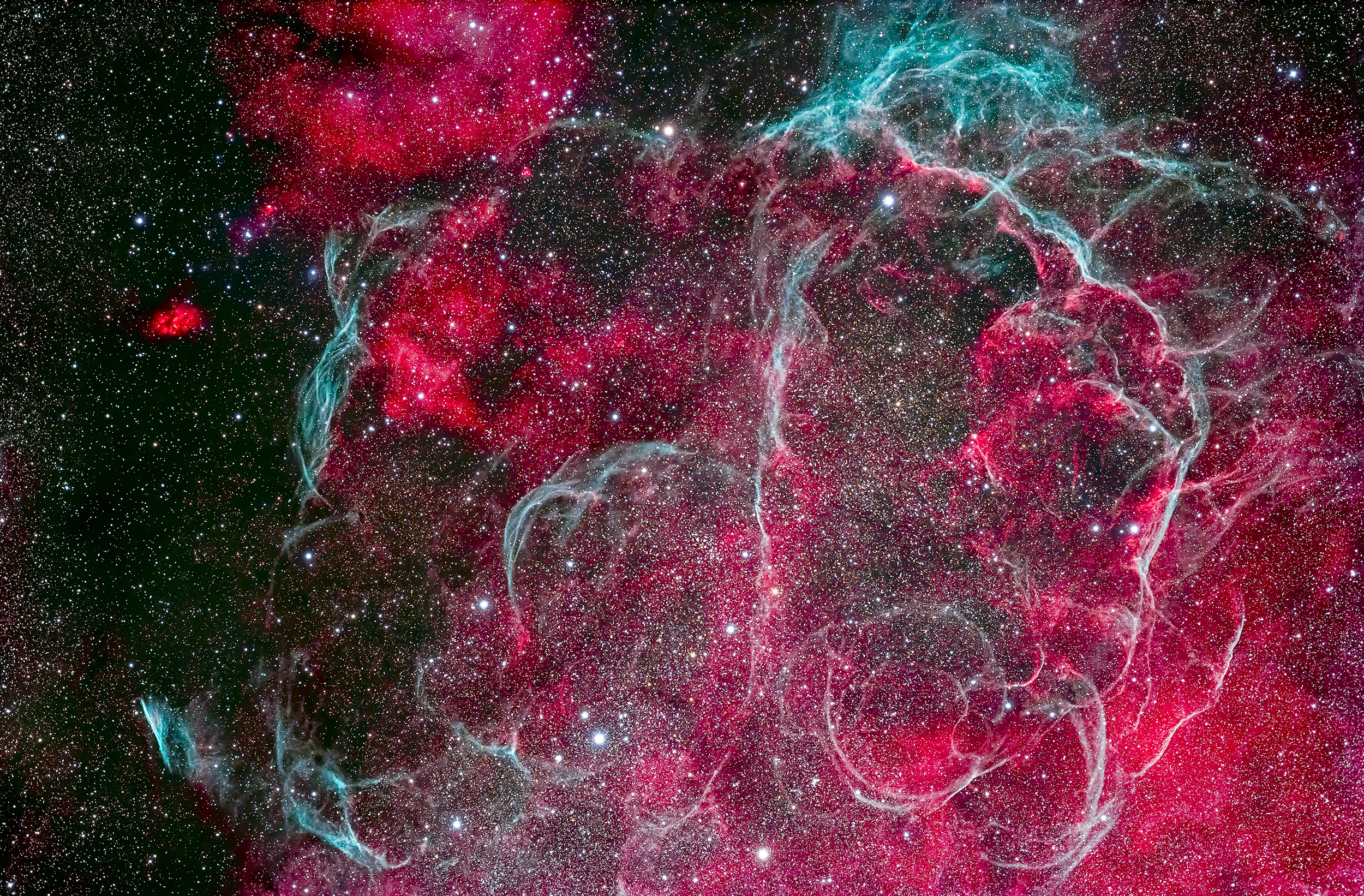
The Vela Supernova Remnant formed after the explosion of a star in a supernova.
Alan Dyer/Stocktrek Images/Science Source
Researchers have come up with explanations for the missing iron. “Meteoricists are famously argumentative folks,” wrote Alan Boss, an astronomer at Carnegie Science in Washington, D.C., in an email. “There always seems to be a counterexample to anything someone claims to be the case.”
For instance, the aluminum could have exploded out of the supernova, while the iron — coming from deeper in the star’s core — could have fallen back into the dead star. Or the explosion could have come from a quirky supernova that didn’t generate iron-60 at all. It could also be that iron-60 wasn’t distributed evenly in the cloud, which could mean measurements from individual meteorites aren’t giving us the full picture.
Dwarkadas dismisses these explanations as “hand-waving” attempts to fine-tune the models to match the data rather than finding a more general solution. “Many people seem to accept the idea that it’s not a supernova,” he said.
But if the solar system didn’t start with a supernova, where did it get all that aluminum?
Born in a Bubble
A possibility many researchers now favor is that the aluminum-26 was delivered on the winds of a Wolf-Rayet star.
Compared to our sun, a Wolf-Rayet star is much shorter-lived, dozens of times larger, and thousands of times as luminous. A star becomes a Wolf-Rayet star when its outer hydrogen shell is stripped away, either by the gravitational attraction of another star or by the strength of its own solar winds.
A Wolf-Rayet star’s exposed core can send out solar winds at speeds of up to 3,000 kilometers a second. “It basically sweeps up the surrounding material like a snowplow,” Dwarkadas said. That swept-up material forms a shell around the star that can be 100 light-years across. The shell, which creates a bubble around the Wolf-Rayet star, is tens of thousands of times denser than the surrounding interstellar medium.
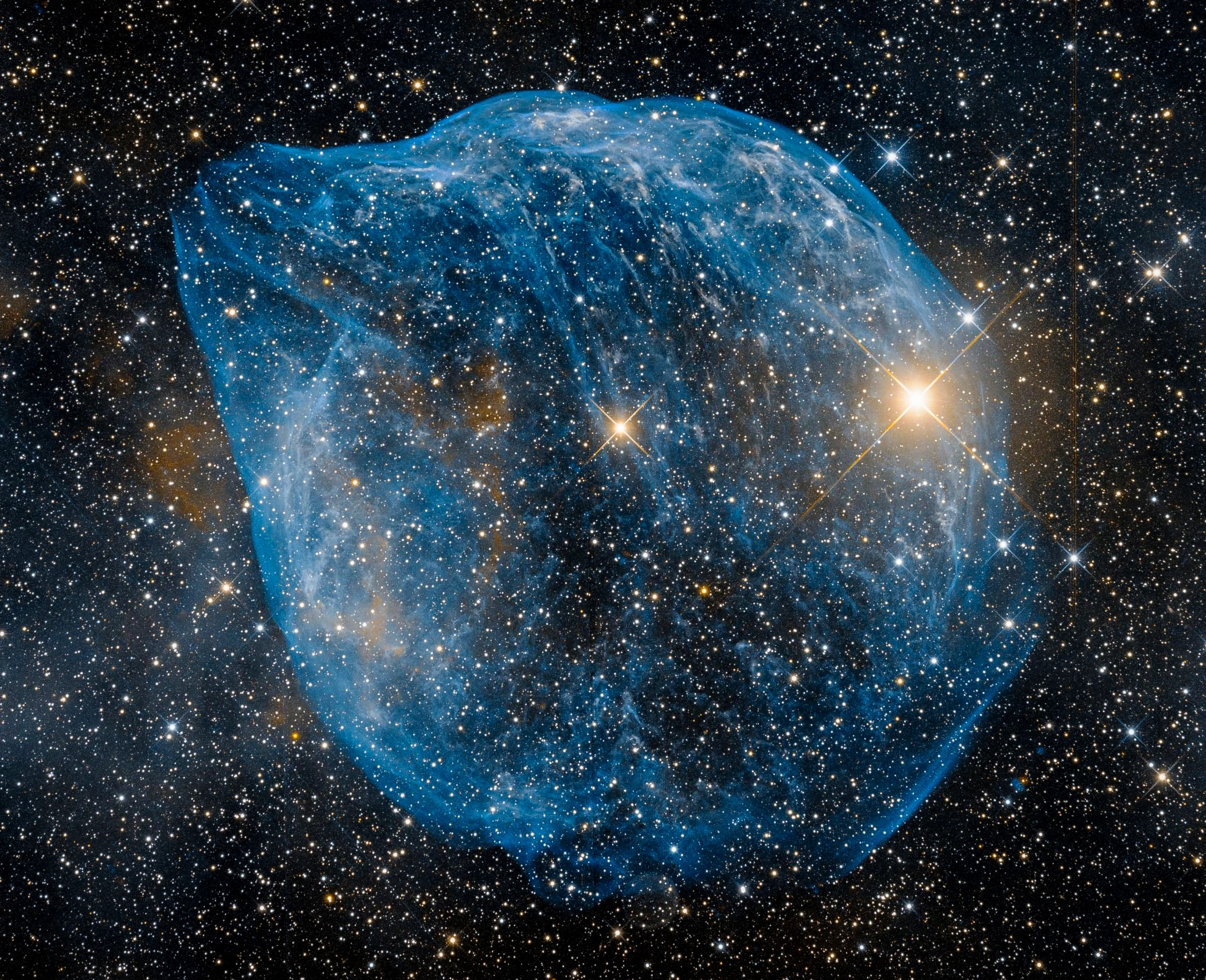
The Dolphin Head Nebula is a Wolf-Rayet star surrounded by a bubble an estimated 60 light-years across.
Image processed by Sauro Gaudenzi, original data from Telescope Live.
The shell contains enough material to build a solar system. It should contain a lot of aluminum-26, and — crucially — it should contain very little iron-60. “I’m looking for a star that produces only aluminum-26,” Lugaro said. “The place where we can make only aluminum-26 is in the winds of these very massive stars.”
Astronomers have observed suns forming within the shells of Wolf-Rayet stars, Dwarkadas said. By his estimate, as much as 16% of all sun-size stars in our galaxy could have formed this way. “If it’s true, there’s no reason it should be true only for our solar system,” he said. “Ours will not be unique.”
Dwarkadas and his colleagues have laid out perhaps the most complete model for how the solar winds of a Wolf-Rayet star could have blasted aluminum-26 into our solar system as it formed. Afterward, the Wolf-Rayet star, with a lifetime of only a few million years, would most likely have collapsed into a black hole, although evidence for this would be long gone, Dwarkadas said.
There are problems with the Wolf-Rayet idea, Lugaro said. For instance, a Wolf-Rayet star creates such an energetic environment that it should have torn our newly formed solar system apart.
Boss still favors the theory that our cloud of dust was ignited by a supernova. Lugaro does not. “At the moment, from the nuclear-physics point of view,” she said, “I favor the winds of the Wolf-Rayet stars.” However, she said, new information could change her mind next week. “This is a problem that needs to be looked at from different angles. We are still fighting a bit about this.”
Gone Fishing
In Boston, Liu put the meteorite back in its safe. On her computer, she opened a live view through the microscope of a nanoprobe that can measure the chemical composition of tiny pieces of material. She and other researchers are using the device to study bits of meteorite dissolved in acid, on the hunt for grains with the right chemical composition to have come from a Wolf-Rayet star.
Liu operated the nanoprobe remotely (it was in Washington, D.C.), slowly scrutinizing the meteorite bits scattered across a field of gold foil. “This is like a fishing expedition,” Liu said. Her next step, assuming she can find a good number of grains with the right chemical composition to have come from a Wolf-Rayet star, would be to measure whether they show signs of having been enriched in aluminum-26. This chemical information could then be used to constrain astrophysical models of the Wolf-Rayet scenario for the start of the solar system.
Liu acknowledged that the presence of such grains wouldn’t be a slam dunk for the Wolf-Rayet star theory; for instance, aluminum-enriched dust could have been produced by much older stars long before our solar system formed. But the absence of such grains would suggest that the Wolf-Rayet idea is off.
She watched the nanoprobe at work, delving billions of years into the past. Studying these grains, Liu said, gives her a new sense of the unique circumstances that led to the existence of our planet. “If you think about these radioactive isotopes — these rock-forming elements and life-forming elements,” she said, “when you know how they are produced in stars, you realize it is not so easy to get the right amount. You have to form at the right time and place.”