How Do You Take a Picture of a Black Hole?
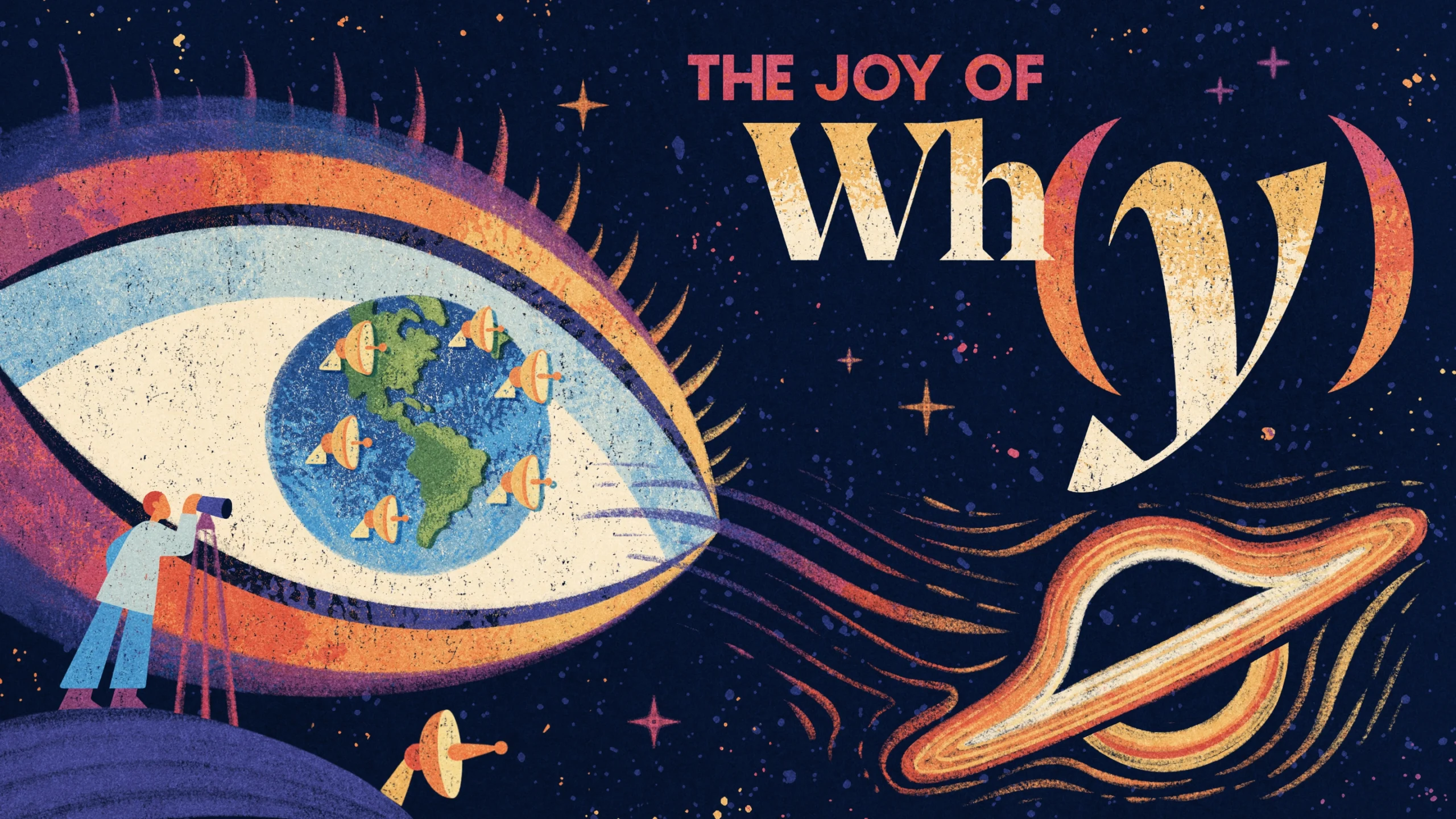
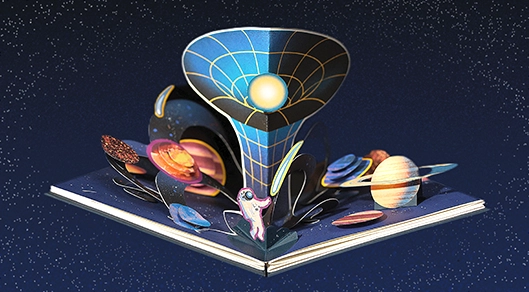
Chanelle Nibbelink for Quanta Magazine
Introduction
Black holes are one of the universe’s most exotic and elusive objects. When nothing, not even light, can escape their powerful gravitational grasp, taking a picture of one seems unimaginable. But an image of a black hole, or more accurately its shadow, could offer insights that theory alone may not provide when testing predictions. So how can it be done?
Harvard astrophysicist Shep Doeleman and a team of 250 researchers achieved this extraordinary feat by linking a group of radio telescopes around the world. This network, called the Event Horizon Telescope, produced the first image of a supermassive black hole in the galaxy M87, around 55 million light-years away, and the first image of the black hole at the heart of our galaxy. In this episode, Doeleman tells co-host Janna Levin how he turned the Earth into a telescope capable of seeing a black hole, the incredible level of science and collaboration that was required to achieve this, how the images have furthered our understanding of these exotic objects, and how movies of black holes may be possible by the early 2030s.
Listen on Apple Podcasts, Spotify, TuneIn or your favorite podcasting app, or you can stream it from Quanta.
Transcript
JANNA LEVIN: Okay. I’m Janna Levin
STEVE STROGATZ: And I’m Steve Strogatz.
LEVIN: And this is The Joy of Why
STROGATZ: A podcast from Quanta Magazine where we look at some of the biggest unanswered questions in math and science today.
LEVIN: Welcome to another episode.
STROGATZ: Great to see you.
LEVIN: Great to see you. I’m pretty excited about this one. I cannot deny or hide it. We’re talking about not only an area where I’ve spent a lot of my life black holes — the greatest, strangest topic out there — but also I had a chance to talk to an old friend. So it’s a fun episode, I hope.
STROGATZ: I’m really looking forward to hearing it. I know you’ve always had a special affection for black holes. I’ve had a chance to interview you in some earlier version of this.
LEVIN: That’s right.
STROGATZ: And you blew my mind over and over about black holes.
LEVIN: Yeah, they require some defense. They’ve got a bad reputation, not entirely earned.
STROGATZ: What’s the bad reputation? Because they like to eat things?
LEVIN: Yeah. You know, black holes, kind of this monster truck language around black holes all the time. You know, they’re like… But actually, black holes are remarkably elegant, clean, simple systems. They leave you alone if you leave them alone. They’re actually quite small for their heft. That’s kind of their whole gestalt, that they’re actually tiny for their heft.
And, uh, you know, though they’re the darkest phenomenon in the universe, they figure out a way to become the brightest beacons that we see on the edge of what’s observable.
STROGATZ: Wow.
LEVIN: So, they’re, they’re pretty awesome. I also think that they’re fundamental to physics, unlike any other macroscopic object you can think of.
STROGATZ: Hmmm. When I think of black holes, I tend to focus on what they do to spacetime. You know, that they cause singularities. It’s their geometry that always grabs me. But that’s not really necessarily the only way to think about black holes. They’re really objects. Real players.
LEVIN: Yeah. I think after people got over the thrill that they actually existed out there and that they could indirectly be detected, there was a sense that they’re not major players in the universe. “Eh, so there’s some black holes out there.”
Quite to the contrary, I think we’ve come to understand that they sculpt our history and our past, that they have a very regulating and important role in determining the shape and size of galaxies and where there might be habitable regions even. And ultimately, we’re kinda doomed to fall into black holes eventually. So, they’re kind of our past and our future.
But, it might surprise people that we had never actually taken a picture of a black hole. All of our evidence had been indirect until about 10 years ago, and that group worked for well over a decade, for some people up to two decades, to try to capture the first picture of a black hole.
STROGATZ: Huh. Wild.
LEVIN: It was a tremendous accomplishment, led by Shep Doeleman, who is our guest. So let me tell you about Shep. Shep is a senior research fellow at Harvard University, the assistant director of Harvard’s Black Hole Initiative, also an astrophysicist at the Smithsonian Astrophysical Observatory.
And he was the founding director of the Event Horizon Telescope Consortium, which is a network of observatories around the world which gave us the first and only images humanity has ever captured of black holes.
STROGATZ: Hmm. This sounds like it’s gonna be a great discussion of science at its best.
LEVIN: Yeah, it’s an epic story. Let’s hear from Shep himself.
[Music plays]
LEVIN: Shep, welcome to The Joy of Why.
SHEP DOELEMAN: It’s good to be here, Janna.
LEVIN: It’s a pleasure to have you on the show. I’m really curious if you remember not just your way into black holes, but your way into the entire idea of thinking about the universe?
DOELEMAN: Wow. Well, everybody falls in love with astronomy at some point. I don’t care who you are, you fall in love with astronomy. And whether it’s staring up at the night sky, you know, at summer camp or seeing a meteorite, for me, it was seeing a total solar eclipse. I was 13, 1980. And my parents took me out to the middle of the desert in Oregon and at first we thought we weren’t gonna see totality, the clouds were moving in, and then the clouds just parted and we saw this amazing eclipse. It was just tremendous.
LEVIN: Did you think at that moment, “Well, this is what I’m gonna do for the rest of my life”? Or is it that the memory comes back and we reconstruct the story, you know?
DOELEMAN: That’s a great question. I think it mostly, it just comes back. Life isn’t linear like that. But I will say the idea that there would be these huge objects that were moving and they could align perfectly and allow you to see what would normally be hidden, like the corona of the sun, was startling to me. I mean, it didn’t have to be that way. Like, the angular diameter of the moon doesn’t have to be the same as the sun so they totally block each other out. But these coincidences sometimes give you a special view into nature.
LEVIN: Yeah. I, I love that there’s just this idea that we’re inspired by the firmament, science’s oldest instrument, and that we all have it in common.
Um, so I really feel we have to make a confession ’cause we’ve known each other a really long time. I feel like we met maybe the first week of graduate school at MIT. I think over a cookie table.
DOELEMAN: I think so.
LEVIN: So I remember just you were always trying these crazy ideas in graduate school. You were like a creative curiosity in search of a problem. Tell me a little bit first about how you landed on this idea of pursuing a portrait of a black hole?
DOELEMAN: Portrait of a black hole, I love that. So I graduated high school pretty early. I was 15 years old. And went to college, and then after that I was pretty burned out, and I saw an advertisement that said, “Go to Antarctica and run all these experiments down there.” And I said, “That’s for me.” I interviewed for the position, and somehow they gave it to this 19-year-old kid. They needed some warm body down there to look after the cosmic ray experiments, the aerophotometry experiments, the electromagnetic experiments, and I got a real taste for doing experimental research in difficult circumstances. I just loved it. And then came back to MIT, where I met you in 1988.
LEVIN: Oh, you didn’t have to say the year, man. That was unnecessary [laughs].
DOELEMAN: I know, when the Earth was cooling. But, I cast around a bit. I started in the X-ray group there, and then I did a little bit of neuroscience looking at biophysics. And then I was introduced to this idea of turning the Earth into a telescope, and this experiment that we use to image black holes and that immediately drew me in.
LEVIN: Yeah. So we’re gonna talk about this project, but when you were in graduate school, what was the status of black holes scientifically? Were they detected? Did everyone believe that they were real astrophysical phenomena?
DOELEMAN: There was really a sense that black holes existed or strong evidence for them. And of course, there are two flavors of black holes. There are stellar-mass black holes which form during star death. So when a star goes supernova, it will explode the outer shells off, and then the interior part will collapse and if the star is massive enough, it will turn into a black hole, and that black hole could be tens of solar masses.
But then there are these behemoths, these supermassive black holes that live in the centers of galaxies. And while there can be many stellar-mass black holes in a galaxy, there’s probably just one, maybe two, supermassive black holes at the core of any given galaxy.
And for the stellar-mass black holes, people had seen these X-ray binaries, and they were seeing very fast fluctuations in X-rays and even in the radio from these stellar-sized sources. And everything fit with this idea that there was a black hole eating another star that goes an X-ray binary.
LEVIN: And that was Cygnus X-1, a first X-ray object in the direction of the constellation Cygnus, right?
DOELEMAN: Exactly, it was those kinds of sources. And then the radio people predominantly had seen some very high-resolution images that were very troubling. So you would see in the optical, a galaxy would look like a normal run-of-the-mill galaxy with a lot of optical light coming from stars.
But then if you looked at it in the radio, you would see these oppositely directed jets of material all tracing to the center of the galaxy. What is causing that?
And the best idea that people had for that was a spinning supermassive black hole that was energizing jets that moved at near light speed from the north and south pole of that black hole, and it was piercing the entire galaxy.
So from two completely different lines of inquiry you had one flavor of black holes being suspected from the X-ray, and you had another suspected predominantly by the radio.
LEVIN: So even though people started to theorize that these must be black holes, nobody had taken a picture of a black hole, not in the ’70s, ’80s, ’90s, the noughts. I think that was a surprise to people because we talked about them as being such compelling inhabitants of the universe, death states of stars, but we had actually technically never seen one directly. Never taken a portrait. And that’s really what you set out to do in many ways.
DOELEMAN: Yeah. I think the simplest way of saying it is that seeing is believing in a certain way. I mean, you can theorize something, but actually seeing it confers a reality on things that you don’t get otherwise. And there were some really important signatures, too. It wasn’t just seeing it. It was measuring it. Taking the measure of the thing not only gives you confidence in its reality, but you can test predictions.
So in 1915, when Einstein came with his theory of general relativity, which governs the space time around a black hole, and then the year after that Schwarzschild solved it in the trenches of World War I, a story that we know well, even after that, it was pretty clear that if you went to the conclusion of that solution, you would wind up seeing a ring of light around the black hole.
That if a bunch of gas was drawn to the black hole, it heated up to hundreds of billions of degrees because you’re confining it to a small volume, and it emits light. That light would be curved by the gravitational force of the black hole. And from any direction that you look at the black hole, you would see a ring of light. Basically, the emission from behind the black hole lensed around into a ring. And the size of that ring you can derive from Einstein’s equations.
And so we theorized that if we could make a photo, if we could see this ring, we’d be able to measure the mass of the black hole. But also just the ring itself would be like the best evidence for the existence of supermassive black holes at that scale. So it wasn’t just a coffee table book we were after. We were after the real measurement of the fundamental nature of the universe.
LEVIN: Now, when people hear this idea that you’re gonna try to turn the Earth into a telescope or a telescope the size of the world, it sounds like such a crazy lark. What made you think it was viable? It was no mean feat.
DOELEMAN: Yeah. Well, so, so this idea of turning the Earth into a telescope had been around for a long time, since the ‘60s. And the key is that the angular resolution of a telescope or the ability to magnify things on the sky, it scales as the wavelength of light you’re observing, lambda, divided by the size of your telescope.
So if you wanna see things that are really small in the sky, you either reduce your wavelength of light or you expand the size of your telescope. So you’ll often see these huge blocks of glass on top of mountaintops. These huge optical dishes, and they’re big for a reason. They collect a lot of light, but also the bigger they are, the smaller the objects they can see.
LEVIN: The better the resolution.
DOELEMAN: The better the resolution, precisely. And so there are some objects that are so small, and black holes are the smallest objects predicted by Einstein’s theory of gravity, that you need extremely big telescopes, extremely fine angular resolution to see them, and you’ve gotta take this idea of turning the Earth into a telescope to the utmost extremes.
You have to operate it at wavelengths that had never been operated before ’cause you have to really go to smaller and smaller wavelengths to get the angular resolution you need. And that’s what took us 20 years, to push the technique to the absolute limit.
LEVIN: Yeah. So there’s a couple of things. One is a lot of people are surprised to hear that black holes are small. They imagine that they’re enormous. Can you explain that to us? Why they’re actually spatially tiny even though they’re incredibly hefty?
DOELEMAN: Yeah. Black holes simply put are when you confine enough matter into a small enough volume that the force of gravity runs away and the material undergoes catastrophic gravitational collapse into a point of infinite density. And you’d think, “Okay, that’s pretty tiny,” but what happens is that around that is a membrane called the event horizon, and that’s where the gravitational force is so strong that light can’t escape. So that really defines the region of space that we can observe ourselves.
And then astrophysical black holes are not invisible, because you would think to yourself, “Well, if you can’t see it,” because it’s got this event horizon around it, but they attract gas and dust and everything you can imagine to them, and you’re cramming it all into a very, very small space so it heats up. And so in a paradox of their own gravity, these black holes can shine extremely brightly.
And if you get one that’s at the center of a galaxy that weighs millions or billions of times what our sun does, it can outshine all the combined light of the stars in that galaxy. So you see these very small objects, but they can be extremely bright.
LEVIN: So how did they deduce that that’s a black hole if that wasn’t predicted, if that wasn’t expected?
DOELEMAN: Yeah, a lot of it was the timescale of the variations because that tells you the scale of what you’re looking at. So typically in astronomy, if you see something that is varying on a certain timescale, you just say, “Well, I think it can move faster than the speed of light.” And so this gives you an idea of how big that object can be.
And for its luminosity, it was very difficult to think that there could be anything bigger than a black hole that was causing these kinds of fluctuations. And then there was the amount of energy coming out was related to it falling into this gravitational well and energy being liberated. That was another clue that people had. So as you say, there were these indirect methods of modeling what we were seeing as black holes, and the black holes fit the best.
For the supermassive black holes, there people could see the energy coming out of these jets, and really the only mechanism that we could think of was magnetic fields twisting in the warped space time of the black hole itself. And like egg beaters twisting around, they fling these charged particles out at near the speed of light. And the observations were so extreme that really that’s the only model that fit. And miraculously, as you got better and better angular resolution, as you trace the jet all the way down to the center, it kept looking like this jet.
It didn’t break this model. You kept seeing this jet getting closer and closer and closer, and there was this mad idea that we had to see what was causing this.
LEVIN: So let’s distinguish death states of stars, which are the kinds of objects that were creating signals like Cygnus X-1. Two star systems born and died together. One becomes a black hole, the other starts to descend. It gets cannibalized. It creates these X-rays, these jets. These supermassive black holes, at the time we were calling them quasi-stellar objects or quasars, right? It was not understood where these supermassive black holes came from or if they were so prevalent, if they had permeated the entire universe. I mean, it was a surprise, wasn’t it, that those quasars were commonplace, that they probably exist in every single galaxy.
DOELEMAN: Yeah. There’s a lot of different lines of evidence for this. Certainly for the galaxies that are radio loud and where you can do interferometry along the lines of what we did to take the picture of the black hole. There, you wind up seeing these jets of material, and those account for maybe 10% of the galaxies that we see. For the other galaxies, we see these cusps of stellar population that increase dramatically as you get to the center, and so you can postulate that there could be a supermassive black hole there.
And now with better resolution and better telescopes, we’ve seen the statistical velocities of stars very, very close to the center of these galaxies within a couple of light years of these galaxies. And it’s now become clear that all galaxies seem to have these super massive black holes at their cores.
And why some are radio loud, why some emit in the radio waves, why some don’t probably has a lot to do with the direction that you’re looking at them. It also has to do with the evolutionary moment in the lifespan of that galaxy. Some radio loud at some times and some not at other times. So we’re seeing the great variety, like the zoo of galaxies across cosmic time, and we’re fortunate that some of them really exhibit these tremendously illuminating radio structures that we can image with an Earth-sized telescope.
And that’s really what drove the field of radio interferometry. We needed to make a picture that was, let’s say, 10,000 times better than anything that we had made before. And the magic of interferometry is that you can detect radio waves from a black hole, let’s say in Chile, and you can time tag them with an atomic clock so you see all the crests and the troughs of these radio waves as they’re coming in. And you can do the same thing in, let’s say Hawai‘i. And then you can bring those waveforms together and compare them as though they had been received by one huge telescope, and they will be coherent. You can play them back against each other, and you can line up the troughs and the crests. Now this is the secret that allows you to turn the Earth into a telescope.
LEVIN: So this is what you mean when you say very long baseline interferometry or interferometry in general. You’re talking about connecting these dishes around the globe. Now, it’s over decades that this work really begins in imagination, conception, execution. But, when was the Event Horizon Telescope as a project officially founded?
DOELEMAN: Well, it depends. I’d wrote my thesis in 1995 and pushed the technique up to wavelengths that were close but not quite sufficient to do this black hole imaging. So we had a pretty good idea of where we were going. And then we really started in earnest thinking about it in maybe 1998. We started doing experiments that were gonna push it to these frontier frequencies, like 230 gigahertz, that were high enough that it would be able to see through all the gas and dust.
In 2008, we discovered event horizon scale structure in the galactic center. And then, I wrote a paper along with a small number of colleagues for the 2010 Decadal Review, in which we said we’re building an event horizon telescope in the next decade. So that’s when I kinda think we kicked things off. The actual Event Horizon Telescope formed as a body in 2016, and I was the founding director of that.
LEVIN: So, where were the telescopes originally that you were using?
DOELEMAN: Well, let’s see. South Pole, there were two telescopes in Chile, a telescope in Mexico, two telescopes in Hawai‘i, telescope in Arizona — two telescopes now in Arizona. One in Spain, one in France, and that was just enough.
LEVIN: You know, what’s so fascinating about this project, was that all of these telescopes existed. The idea was to use telescopes that already existed that were being used for other purposes, not the same idea at all as building a satellite and starting from scratch.
How did that go over, this idea of trying to build a coalition out of all of these different observatories? And, it’s a really international collaboration. I mean, hundreds of people.
DOELEMAN: I’ll, I’ll put it to you this way. In my group, we spent a lot of time working on instrumentation that would allow a telescope to record information that could then be compared to recordings made at other telescopes. This is how interferometry works on a global scale.
But this was not what these telescopes were doing, so we had to convince these telescopes that we could bring our instrumentation, bolt it in, in some cases manhandle some of their very, very sensitive equipment, operate the telescope in a way that it had not been designed to be operated in, and then take all these disks with data and disappear, and then maybe tell them months later what happened.
And that’s the key thing because we needed to get time on these telescopes, and we had to convince them that this was a worthy project. And we had done enough precursor observations, and we detected event horizon-scale structure in the galactic center in the Milky Way black hole, this is the four million solar mass black hole at the center of our Milky Way galaxy. We detected that, and so they were listening to us, but they were still kinda skeptical that we were gonna be able to pull this off. And it was a lot of cajoling. There was a lot of convincing. There was a lot of applying for time. But we were careful, and we produced results all along the way. And then people began to realize you might actually pull this off. And so they kinda let us in. They gave us the keys to the observatory…
LEVIN: Uh-huh.
DOELEMAN: … Like “Have it back by midnight.” You know, that kind of thing.
LEVIN: Right. I also wanna return to the idea of the atomic clock, because these atomic clocks are so precise that, what you lose a few seconds over the age of the universe?
DOELEMAN: Uh, well, no, they’re not, they’re not that good. And I’ve been around for most of the age of the universe, so I know. So yeah, so the key thing is that when you record the radio waves at any of the Event Horizon Telescope sites, you need for the signal not to jitter.
It has to be stable so that when you have another one, they line up in just the right way. And if the signal is jittering back and forth because your clock is imperfect, you’ll never be able to line up these waveforms from different parts of the Earth.
So you need a super stable clock. We use hydrogen maser clocks, and these lose about one second every 10 million years or so, and that’s the stability that we need in order to keep everything stable.
LEVIN: I see.
DOELEMAN: I remember being at the Large Millimeter Telescope in Mexico and watching as they winched one of these atomic clocks up the central part of a helical staircase, and just like wondering what I was doing at 15,000 feet watching this precision timepiece being winched up and into place.
And then we put it into a wooden enclosure because, you know, it needed to be at a certain temperature, and we used light bulbs inside to heat it to just the right temperature. So you get very imaginative when you’re at the top of a mountain, how am I gonna keep this atomic clock you know, swaddled?
LEVIN: Right. And you still need for nature to comply, ’cause you need the weather to go your way. You can’t have snow accumulating in the telescope. It can’t freeze if you’re trying to point it. And so there is genuinely a lot of that in making an observation.
DOELEMAN: Well, so every evening before we trigger the observations, we have to make sure that the weather is good everywhere.
LEVIN: Now, when you’re stringing all these instruments together and you have these incredibly precise atomic clocks, and so you’re lining up the crest so you’re now have one big eye taking in these objects that looking in a certain direction and focusing on a particular object, how good a resolution have you gotten?
DOELEMAN: So for example, the supermassive black hole in the center of the Milky Way galaxy is 4 million times the mass of the sun. At the distance of the center of the galaxy, about 27,000 light years, the whole lensed part of the event horizon subtends about 50 microarcseconds.
Now, that’s insanely small. That’s like, you know, if you’re in New York City and your friend is holding a quarter in Los Angeles, you can read the date on that quarter. Or if there’s a tangerine or really a citrus fruit of any variety on the moon, you could see that fruit. Even a pomelo, possibly a tangerine.
LEVIN: Let’s not be picky.
DOELEMAN: And, so we’re, we’re trying to get the highest angular resolution possible from the surface of our planet. That’s what’s needed.
LEVIN: So when we’re talking about these black holes, even the one that’s closest to us, which you just mentioned at 27,000 light years away in the center of our own Milky Way galaxy, is barely, barely on the edge of visibility. What other supermassive black holes could we possibly see?
DOELEMAN: Well, so we’re lucky in the sense that we have one, Sagittarius A*, that we felt for sure we could image. And then there was another one, M87, which is in the constellation Virgo. That black hole is about six billion times what our sun weighs, but it’s fifty-five million light years away. So it’s about two thousand times farther away, but it’s also about two thousand times more massive. And the event horizon scales with mass, so its angular size is about the same as the supermassive black hole in the center of the Milky Way galaxy.
LEVIN: Now, I remember when you sent me a note saying there’s going to be a press conference. So I come racing out to the National Press Club in Washington, DC ’cause I know you’re not holding a press conference to tell us you failed. So here is the moment, where you’re about to reveal the first picture humanity has ever procured of a black hole ever. And I’m expecting what we call Sagittarius A*, our own black hole in the center of the Milky Way that we’ve been discussing. But instead it’s M87. I did not expect this. Were you surprised that that’s what you were able to resolve first? Did you know people like me would be surprised?
DOELEMAN: You know, it all makes sense when you look back on it. Of course, Sagittarius A* was the preferred candidate. We’re all in love with our own supermassive black hole in the center of the Milky Way galaxy.
But there’s a problem with Sagittarius A* as much as we love it, because it’s only 4 million solar masses, the time it takes matter to orbit Sagittarius A* is only about half an hour. Now, what that means is that during a night of observing, the thing you’re trying to take an image of is changing in its appearance. Things are orbiting around it, it’s burbling, it’s turbulent, and it looks different from one moment to the next. In aggregate, averaged, you would see this ring, but from moment to moment it would change.
So even from first principles, we should have realized that imaging that source would’ve been much more difficult, whereas M87*, is 6 billion solar masses, so the timescales scale with mass. So during a night of observing, it’s essentially stationary. It’s not changing its appearance at all, so you can add up all the data you take during a night of observing with all the changing look directions and the changing baselines as the Earth is turning to build up a very, very good image. So, that’s the one we came with first because it was much easier to image. But being able to announce that discovery, and knowing that there was astronomers who were experts who were taken by surprise, that was actually kind of cool about the whole thing.
LEVIN: [Laughs] Yeah.
DOELEMAN: We finally did come with an image of Sag A*, but only after we had overcome the algorithmic problems of how to deal with something that’s changing while you’re looking at it. So we have two of these sources, and we’ve imaged both of them with the Event Horizon Telescope.
And when we laid a ruler across the spacetime of the event horizon, we did verify that for their mass, they’re exactly the size that Einstein predicted, to within the uncertainty of our measurements, which is the best evidence that we have for the existence of supermassive black holes in the centers of galaxies. And also, yay for Einstein. He keeps passing all these tests that we throw at him.
[Music plays]
STROGATZ: It’s very inspiring to listen to the story of how much science goes in to make the stunning image that a billion people or whatever got to see. How much fundamental science between the atomic clocks, the idea of interferometers, all the general relativity…
LEVIN: I totally agree that this remarkable precision of the clock that they needed, and the industriousness of being on the edge of observability, I mean, it really was almost impossible. You could totally have imagined that somebody would’ve said, “This is ridiculous. Give this up. You need a telescope the size of the Earth, so move on to something else. We’ll never see a picture of any black hole ever.”
And instead, they thought, “Well, how would I make a telescope the size of the Earth,” and calling on observatories that had been in use for other purposes, as opposed to building a fundamentally new instrument.
So I just loved so much that went into it: the preexisting observatories, the notions of the timing having become so precise and linking it together just on the edge of observability. Really, it’s just a few pixels that they have.
STROGATZ: You raise an interesting point about existing observatories. I hadn’t appreciated that, that unlike LIGO, Ray Weiss and that vision where you had to create a whole new instrument to get the gravitational wave detection, in this case, the observatories existed, but the ingenuity seems to be the coordination. But I’m sure there must be much more to it than just that.
LEVIN: Yeah, I mean, but no, the coordination was no mean feat. It really was. It was a lot of that. It was a lot. And realizing it was possible, just the fact that they could accurately enough link up just a couple of telescopes in the beginning, that they could do that proof of concept.
There’s a great New York Times article about it actually long before they succeeded, just following them up a mountain and the radio dish freezes and there’s piles of snow in it, and they have earthquakes and all they’re trying to do in those early runs was just prove the concept was possible.
And, so a lot of it did not involve building new instruments, but some of it did rely on new instruments being built for a larger purpose with a larger audience in mind and getting time on that instrument.
STROGATZ: Okay. One thing I was wondering about it, wasn’t there indirect evidence for the existence of black holes going back many years?
LEVIN: Oh, yeah. You could see things changing on a timescale that was so fast it suggested a very small object, but the amount of power coming out suggested a very massive object, and that’s exactly what you’re looking for in the combination of a black hole.
So like X-ray jets coming out when a black hole’s cannibalizing a neighboring star. So these are star-sized black holes, not supermassive black holes. But it’s very indirect. You’re quite far out when you’re seeing those jets. You’re collecting X-rays. The jets are huge. You’re nowhere near honing into that shadowy region, which is the defining character of a black hole.
And so what they’re achieving by getting in so close is testing strong field gravity, a gravity where it’s even stronger than what you see when you’re looking at a star being cannibalized, surprisingly.
And so, that’s why people look at it as tests of general relativity because general relativity predicts the event horizon. That’s the prediction. That’s the golden ticket, you know? And indeed, that’s what they’re seeing. They’re seeing something a little bit bigger, a little bit outside because the light is orbiting a little bit further out, but so close that it is really an incredibly strong test of the success of that prediction.
STROGATZ: Uh-huh. And so that’s how we should hear when Shep says, “Yay, Einstein.” It’s for that kind of thing?
LEVIN: Yay, Einstein. There sure looks like there’s an event horizon, you know? And that we couldn’t say with that kind of confidence.
So there was a Nobel Prize awarded for observing stars orbiting Sagittarius A*. And they were patiently watching those stars for 17 years, and from their orbits deducing that there was a supermassive black hole at the center of our galaxy. And so this is much closer in. He’s seeing stuff with the Event Horizon Telescope that’s much, much closer and shorter timescales.
STROGATZ: Mmm-hmmm.
LEVIN: What’s exciting though about Sagittarius A* and the fact that it is changing on such a short timescale, is that they’re now working on movies.
STROGATZ: Huh.
LEVIN: The next big release that we can anticipate from this project is that we’ll watch the stuff orbit around the black hole in real time, and that’s remarkable. But to hear about that, you’ll have to wait until after the break.
[Music plays]
LEVIN: Welcome back to The Joy of Why. We have Shep Doeleman here telling us about the first images ever taken of a black hole.
So you decide to go for M87, and you make this announcement. A billion people around the globe watch this reveal. What is that like after two decades of working on this?
DOELEMAN: It was pretty amazing. It was humbling. There were times when I was close to tears during part of this because you work for something so long in your career, and it winds up being so meaningful, and then to see that it’s impactful for others is startling. I mean, it was on the front page of most newspapers around the globe, and you realize it touches a core because you’re seeing something for the first time.
And so it was with awe, humility, but also wonder, a lot of relief because after 20 years, it’s a lot of work and effort under the bridge. But also the team that came together to realize it was very special. We needed 250 people to pull this off. And we’d been through a lot together.
LEVIN: Yeah. How is this process for you? Are you, I mean, is it in a moment that you see it or is it over months?
DOELEMAN: It’s a slow burn in a certain way. So, the first thing you see is just a graph, a two-dimensional graph. And you see on the Y-axis, it’s the amount of energy the two telescopes that are widely separated are seeing. On the X-axis, it’s the distance between the telescopes. And what happens is that if you see a ring, you’d see a characteristic bounce in this graph, and that’s what we saw. So, we plotted up the data, and without making an image, and we saw this characteristic bounce, and we realized there’s something really special about these data.
I think there’s a picture of me at a fancy dinner. I’m wearing a tie and one of my post-docs is showing me the data for the first time, and there’s a picture of me going like, “What am I, am I looking at?” And I came back to my office that night, and I went through the calculations based on where these bounces were, and I realized it’s exactly the size it’s supposed to be, right?
So that was the first indication that we had something. And then we started imaging. So we had been perfecting these imaging algorithms on synthetic data. We’d fed these algorithms made-up data. So we would take a black hole image that we might be looking at. We’d corrupt it with noise, and we’d send it through these algorithms, and we’d refine these to the point where we were pretty confident in these algorithms.
But before we set these loose on the data, we also realized that human error or human groupthink could be a really big problem. So we split our teams up into four groups. Each group had the data, but they could not talk to each other because we wanted to make sure that we all weren’t in the same room thinking like, “I see a ring. Do you see a ring? I see a ring.” And it’s not a ring, right?
So we had four different geographically separated groups, and they all used different algorithms. And then we all came together to the building where I am sitting right now, the Black Hole Initiative at Harvard in July of 2018, and we were in the basement of this building, and the four teams put up their images, and they were all rings.
That was a moment where there was a lot of crying and screaming. Uh, and, and then we all, and then we spent the next six months trying to make those rings go away. So we would train the algorithms on everything except for rings.
So they became very good at imaging double sources, or they became very good at imaging filled disks. And then we would set them loose on the data, and they would always come back to the ring. And that’s when we also knew in a more robust way that the ring image was real.
LEVIN: Let’s talk about the ring image again. You’ve alluded to why it looks this way. There’s material splattered around the black hole that’s orbiting outside of the event horizon, to be clear, and but close, really close. You mentioned some observations of things in orbit around the black hole were thousands of times the event horizon away, way too far to have any confidence.
These are right on top of the event horizon, maybe 1.5 the event horizon, something like that, really up against it. And, and so really the black hole is just a dark shadow in the center of this bright ring, and that’s what you’re trying to isolate. But if I was looking at a ring like the rings of Saturn, that’s not gonna isolate the shadow for me.
So can you talk us through again how the light from behind the black hole allows us to have it enveloped so that we can actually see the shadow cast?
DOELEMAN: Yeah. The way this works is that when you’re so close to the black hole, the paths of light, which normally would travel in a straight line, is forced to travel along the curved spacetime. And so it’s really tracing the metric of spacetime. It’s tracing the gravitational well that it finds itself in.
So when light leaves hot gas that’s swirling around the galactic center, let’s say, it starts off, but then instead of going in some straight line, it’ll curve around and come to you. So all the light from behind the black hole is being lensed around to form this ring.
And it’s the size of this ring that is given by Einstein’s equations. And you get these crazy factors like two the square root of 27. G is Newton’s gravitational constant, M is the mass of the black hole, c is the speed of light. But you realize that the diameter of this ring basically just controlled by the mass of the black hole.
LEVIN: Yeah, there’s nothing, there are no ingredients in there that aren’t fundamental facts of nature except the mass of the black hole. And that’s, I think people don’t appreciate how black holes are fundamental in that way. There’s… all stars are kinda different. Different colors, but, you know, black holes are essentially their mass. Sometimes they have electric charge, sometimes they spin. But that is the whole story that is so stunning about them. They’re almost featureless.
DOELEMAN: Yeah, yeah. Now the cool thing is that imagine there was an astronomer on the other side of the galaxy. They would see a ring too, because they would see all the light from where we are lensed around in their direction. So any civilization, and we can talk about different civilizations in the Milky Way if you want to, but anyone in the Milky Way galaxy would be seeing the same thing we are.
So if anyone’s curious about testing Einstein’s theories or whatever theories have been concocted by another civilization, they would be curious about this same object that we’re looking at.
LEVIN: Do you know what you made me think of is that when we try to send alien civilizations, that we hope exist but have not yet discovered, a message that says, “We’re thinking about the same things you’re thinking about,” we sometimes use like rational numbers or irrational numbers or special signals. What if we showed them a picture of the black hole? Because they see the same picture.
DOELEMAN: I think that would be a very good way to communicate. I mean, we sent out the golden record in the Voyager spacecraft, and I think that’s interesting. I think showing them something that they may already know would also be very interesting.
LEVIN: That is wild. I did wanna return to something which is gonna push us into the future. You were describing how Sag A* was alive. You know, it’s moving, it’s changing, and this very much speaks to the next generation. You’ve already mentioned going to even higher angular resolutions. I’ll ask you how you’re gonna do that. But also it suggests that maybe you can take movies. And so where is Event Horizon Telescope? Where is that project going now? What’s the next gen? And you do call it next gen, don’t you?
DOELEMAN: I know. It’s in the most unimaginative, unoriginal way possible. So we’ve taken still images of black holes, and with any great discovery, they just raise the next set of questions. So the next natural thing to ask is, can we make a movie of the black hole and see not just light bending around, but the motion of matter as it orbits the black hole?
Because this will be the key to other even more sensitive tests of Einstein’s theory. But it will also unlock the astrophysics, the processes that allows these supermassive black holes to launch those jets that I was telling you about. So there’s every reason for us to keep going, and the key is adding more radio dishes around the globe.
If we can add more radio dishes, we’ll fill in the Earth-sized virtual lens much faster. The number of connections goes as N times N minus one, so there’s a quadratic factor in there. So you don’t just get one more telescope, you get all the connections to that telescope. And also, having more telescopes ensures that as the Earth turns, you always have a critical number to make the next frame in a movie.
Five sites that are critical to allowing this to happen: One is in Chile, one is in Mexico, one is in Wyoming, and one is in the Canary Islands, and a fifth in Tanzania on the slopes of Mount Kilimanjaro would also be very, very nice to have. If we had all those, and we were observing at the highest frequencies, we can absolutely make movies of black holes, and high definition, high sensitivity, full color movies of black holes.
And this is the next step. I’ll just say we’ve secured all the funding to build the first telescope in the Canary Islands. I’ve now summited Mount Kilimanjaro twice, scouting for locations to build a telescope up there.
LEVIN: Wow.
DOELEMAN: This is what I live for. I live for putting steel on mountaintops. uh, and Kilimanjaro by far is the best site in the entire African continent to make these kinds of measurements just because of its altitude. Now that being said, it’s a very sensitive site, so we started over three years ago working with The Open University of Tanzania and other institutes in Tanzania to develop the idea. We’re still quite a ways off from doing everything.
The most important thing is to get the technical possibilities in line, and equally important, if not more important, is to make sure that everyone who’s affected at all levels, economic, social, educational, cultural, are all approving it. And what I tell the team is, “No is an acceptable answer, full stop.” But if we can, then I think it would be a tremendous asset for the country, for the community, for education, and of course for astronomy. So by the early 2030s, I think we’ll have real movies of an event horizon.
LEVIN: And what’s the payoff for a movie scientifically? I mean, obviously it’s gonna be thrilling. I’m gonna wanna see it. But beyond just the thrill of it, what can I extract from watching a movie that I can’t from a still image?
DOELEMAN: So there’s a couple things. So one is that spin is elusive. So, a, a black hole basically has only a few characteristics that define it. Its mass, its spin, maybe its charge, but most of the astrophysical black holes that we know of probably have charge equalized, because there’s plasma around it that would do that. So the mass is pretty easy. The size of this ring is directly related to mass. We’ve checked that one off.
But the spin of the black hole imprints its history, like how it grew over time, and the spin also tells you about the frame dragging, the warping of spacetime as it spins. And to get a handle on that, you need to really look at dynamics of matter.
To give you a sense of the problem, if you have a black hole and it’s spinning not at all, you get one size of the ring related to its mass. If it’s spinning maximally, the fastest it can ever spin, you see the same ring, but it’s just about 4% smaller, okay? So spin is not measured well by looking at the shadow of the black hole that we’ve already seen.
But the time it takes matter to orbit the black hole, that for Sagittarius A* ranges from half an hour if it’s not spinning to four minutes if it’s maximally spinning. Now we have an indicator, now we have a measurement we can make that would tell us cleanly what the spin is. So, the biggest payoff for astronomers and physicists is that we can make a precise measurement of spin by looking at matter orbiting the black hole.
LEVIN: Yeah. Spin is definitely a very interesting aspect. I would say I don’t buy that black holes are neutralized, but if you have a spinning black hole in a magnetic environment, which presumably you do have magnetic fields from all of that hot plasma, then its actual low energy state is charged.
DOELEMAN: Interesting, yeah.
LEVIN: I think I wouldn’t exclude charge too out of hand.
DOELEMAN: Let’s not exclude it. Let’s just measure it.
LEVIN: Let’s not, man. I’ve been trying to talk to you about this for years.
DOELEMAN: But Janna, you said something really interesting. ’Cause you said, “Well, what if the black hole could be charged?” And I couldn’t agree more. When we unlock the dynamics with these movies, we’re not just gonna see the unpolarized light. We’ll see polarized light, which will trace magnetic fields. So we’ll see not just the shape of the spacetime, but also the morphology, the shape, the configuration of the magnetic fields threading that spacetime. So that would help disentangle these battery models that you’ve come up with which are really cool.
The other thing I would say is that shame on us for just thinking about GR. I mean, there are other objects out there that are not black holes, right? And one of the cool things about the work we’re doing is that we’re beginning to make some of the first tests to rule out these exotic objects that can be black hole mimickers.
These are objects that are just large enough so that they’re a little bit bigger than the event horizon, so they have a surface of some kind, but in all other ways mimic the black hole and its gravity. And we’re at the point now where we can start to combine the EHT observations with infrared observations, where you would predict that if you had a surface, it would glow in the infrared, and we are now putting limits on that. So with the EHT observations and observations from other wavebands, we’re starting to rule out even non-black hole solutions.
LEVIN: So, you have two things on the horizon, so to speak, which include making movies of the objects that you’ve already resolved, but also new candidate black holes. That’s really thrilling. You were just saying, well, what’s beyond GR? What other objects can you look at besides black holes?
DOELEMAN: Oh yeah. So, even now, the EHT, Event Horizon Telescope, is a bit democratic, so other researchers who are not in the collaboration can still apply for time on it, and there’s been like one or two cases I think where that’s happened. But also more to your point about what else can we look at, we train the Event Horizon Telescope not just on Sag A*and M87, but on many radio loud quasars. So these are supermassive black holes that produce these jets of oppositely directed matter, and we’re able to get the best angular resolution that you can get on those sources. So we’re studying the propagation of jets, the collimation of those jets.
They’re very far away, but we can get the best most detailed images of them using the EHT. So it’s advanced our understanding of how jets are produced and how they maintain their shape very far from the black hole. And then there’s also a couple of other objects we can look at.
When stars die, they release some of their atmosphere, and so you can wind up with a red giant star with a molecular soup around it, and the light from the star pumps that molecular soup, and you can get effectively a laser the size of the star.
And around the edge of the star, around the limb of the star, you can get pinpoints of laser light in the radio, and these can be now observed with the Event Horizon Telescope too. So we may be able to see stars breathe in and out by using the Event Horizon Telescope with these molecular lines.
LEVIN: Now, you said the timescale is 2030s?
DOELEMAN: Early 2030s?
LEVIN: Early 2030s. And then you think you’ll be online, then it’ll take a couple of years to collect data?
DOELEMAN: Actually, I think we’ll be able to produce images very quickly. So when the first time we imaged a black hole, we had no idea what we were doing. Well, we knew what we were doing, but we had never imaged a black hole before, so we proceeded extremely carefully.
Now that we understand the instrument much better, now that we’ve imaged these black holes multiple times, now that we have great confidence in our instrument. We’re developing imaging techniques now that will process the data and image it within days.
LEVIN: Wow.
DOELEMAN: So, I don’t think we’re gonna have to wait another two years as we did the first time.
LEVIN: So, you described this childhood experience of seeing an eclipse, something essentially rendering the sun nearly invisible, right? But then the moon renders the corona, the outer atmosphere of the sun, visible. And in some ways, this has been a thread through a lot of your work and your curiosity since then. Do you still find that same joy?
DOELEMAN: I really do. The ability to see something for the first time, the ability to see something hidden, the ability to coax this image from the black hole when it does everything in its nature not to be seen is really special. It’s the work of a lifetime, of a career and more than that, it just- it fills me with an intense joy to be able to do this.
I feel as though the team here is doing something almost sacred. We’re getting to the heart of something, and we’re bringing it to the planet. You can get the best people working on something from across borders, and you are fixated on a common science vision, and together you can do what individually you can’t. That’s a lesson I think that we can take broadly across the globe.
LEVIN: Hmm. Well, that’s beautiful, Shep, and I’m grateful and I’m looking forward with anticipation to see what’s next. Thanks so much for joining us on The Joy of Why.
DOELEMAN: Oh, it’s a great pleasure, Janna. Thanks for having me.
[Music plays]
STROGATZ: I love hearing that. This image of the scientists from all over the planet and also the cool places that you get to go if you’re in this line of work, the Canary Islands, Mount Kilimanjaro.
LEVIN: Yeah. It’s kind of funny they had to explore here on Earth so that they could explore way out there.
STROGATZ: And so what is it about seeing an image emotionally, do you think? I mean, I realize this is getting into psychology rather than physics, but why is it so important for us to have that gorgeous picture of the ring with the blackness inside it?
LEVIN: I mean, it’s thrilling. We are observers of the sky. We look at the sky and it was our first instrument in many senses, and our first clock and our first recognition that, wow, there’s something beyond this Earth. And so I think just the idea that here we are looking at something — literally looking at it two million light years away — that is extending our cosmos even further out. I just think that is a human disposition to be thrilled by that.
STROGATZ: Uh-huh. You guys in your conversation mention that the moon just happens to occlude the sun. It just happens that the moon is the right size, given its distance and given the sun’s distance and given the sun’s size, that it can block the sun, but not totally. Lets you see the corona, okay.
Do you think that this might have something to do with the human belief in miracles and gods? That because early people might have observed solar eclipses, that it’s such a bizarre coincidence and so, so what? So scary that the sun goes black at some point. Like maybe that gave us a sense of wonder as a species, and if the astronomical coincidence hadn’t been there, maybe we wouldn’t have ever started asking why?
LEVIN: Hmm, that’s so interesting. There’s so much mysterious about the universe, I feel like even just the sun rising and setting day after day. But it is remarkable the moon is 400 times smaller than the sun, but 400 times closer, and that crazy accident gives us the best eclipses in the solar system, if you ask me.
But, famously there was an eclipse that speaks to your question. It was something like 500 in the Common Era, I think, where there was a war that had fully broken out and somewhere around now modern-day Turkey. And in the middle of a battle there was a total solar eclipse, and apparently both sides put their weapons down and made peace. [Laughs] Fearing, fearing the rage of the gods. They thought better of their circumstances.
STROGATZ: We need more of those eclipses. Well, this has been a really interesting discussion, and I really appreciate your expertise walking all of us listeners through this topic of black holes. and it really is a very uplifting subject.
LEVIN: Well, It was quite remarkable. I think there’s more ahead.
STROGATZ: Looking forward to the next encounter.
LEVIN: To the next encounter.
[Music plays]
STROGATZ: If you’re enjoying The Joy of Why and you’re not already subscribed, hit the subscribe or follow button where you’re listening. You can also leave a review for the show. It helps people find this podcast. Find articles, newsletters, videos, and more at quantamagazine.org.
LEVIN: The Joy of Why is a podcast from Quanta Magazine, an editorially independent publication supported by the Simons Foundation. Funding decisions by the Simons Foundation have no influence on the selection of topics, guests, or other editorial decisions in this podcast or in Quanta Magazine.
The Joy of Why is produced by PRX Productions; the production team is Caitlin Faulds, Jade Abdul-Malik, Genevieve Sponsler, and Merritt Jacob. The Executive Producer of PRX Productions is Jocelyn Gonzales. Edwin Ochoa is our project manager.
From Quanta Magazine, Simon Frantz and Samir Patel provided editorial guidance, with support from Samuel Velasco, Kit Sudol, Simone Barr, and Michael Kanyongolo. Samir Patel is Quanta’s Editor-in-Chief.
The episode art is by Chanelle Nibbelink and our logo is by Jaki King and Kristina Armitage. Special thanks to Garth Avery at the Cornell Broadcast Studio.
I’m your host, Janna Levin. If you have any questions or comments, please email us at [email protected]. Thanks for listening.
[Music ends]