How M.C. Escher’s Art Creates Bizarre Mathematical Worlds
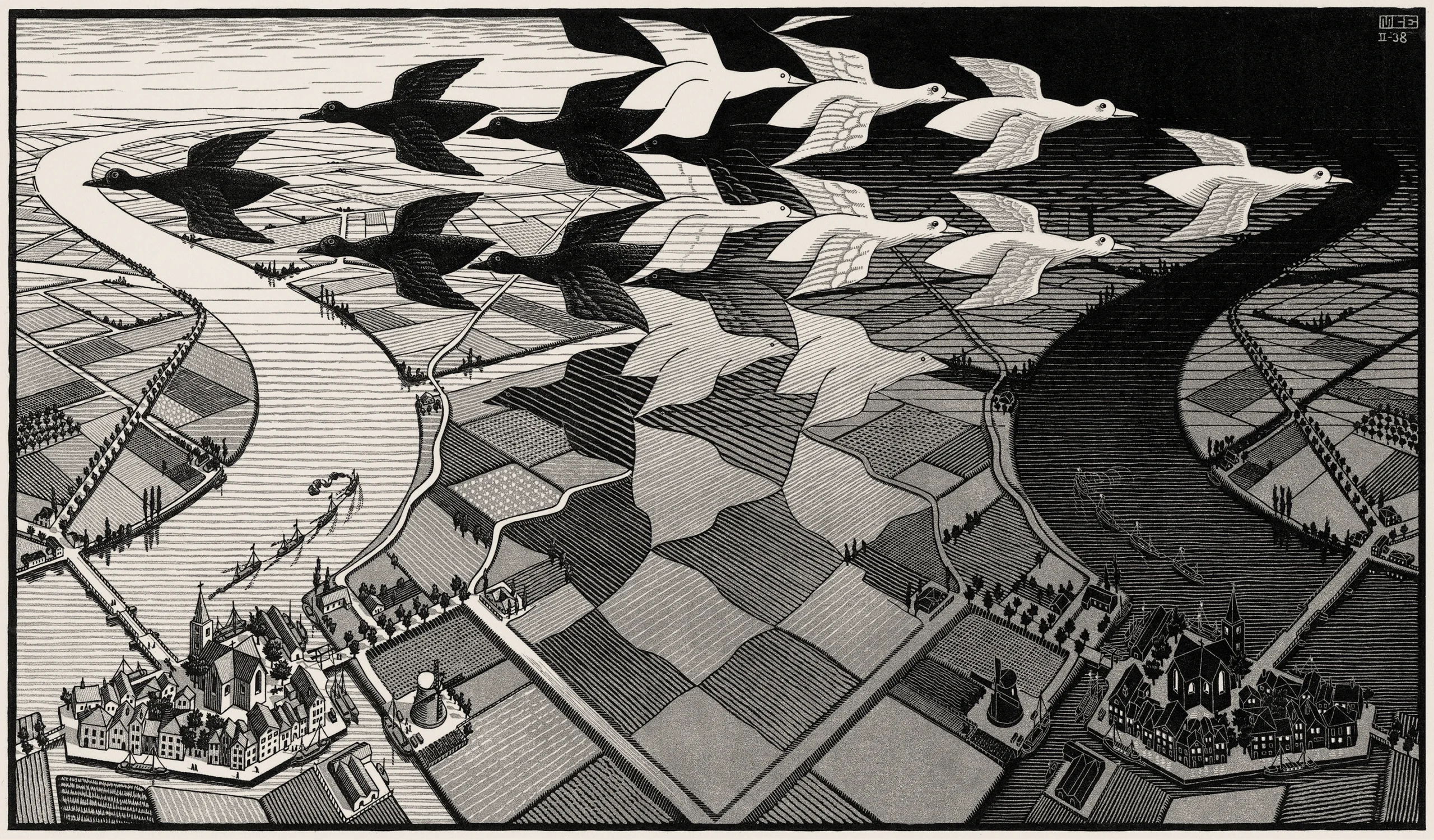
Day and Night, February 1938, woodcut printed from two blocks, 15 3/8 x 26 5/8 in
M.C. Escher artwork ©The M.C. Escher Heritage. EscherSite collection.
Maurits Cornelis Escher didn’t plan on becoming the darling of mathematicians. Born in 1898 in the canal-lined city of Leeuwarden in the Netherlands, Escher struggled with mathematics as a student, once remarking that he “never got a pass mark.” He ended up studying decorative arts and printmaking, and he used his artwork to explore the strange rules of nature that he found operating around him.
Escher saw that nature can sometimes produce impossible-seeming images. All around him, he saw distorted reflections, odd perspectives, and superimposed worlds, like the surface of a pond where you can see images of both the fish below and the trees reflected from above.
In rendering these and other visions, his artwork took on unmistakably mathematical qualities. “By keenly confronting the enigmas that surround us, and by considering and analyzing the observations that I had made, I ended up in the domain of mathematics,” he wrote in his introduction to the book M.C. Escher: The Graphic Work.
His journey among these enigmas is the subject of an exhibition entitled Mathematics and the Art of M.C. Escher at the National Museum of Mathematics (MoMath) in New York City.
Escher’s path toward math started with his love of tilings. After completing his arts education in 1922, Escher visited Granada, Spain, and was taken with the tile patterns that decorated the Alhambra. Inspired, he began to systematically study how to fill a sheet of paper with repeating shapes without leaving any gaps.
Years later, Escher’s half-brother, a geologist named Berend, sent him a paper by a mathematician named George Pólya. The paper categorized all the ways to cover a flat space with tiles, broken down into 17 groups, each with different symmetries. Escher had intuited a mathematical question, and here he had a mathematical answer.
Escher carefully traced the paper’s diagrams and studied them meticulously. Over time, he developed his own system for tessellating space, finding ways to cover a print with irregular shapes that resembled fish, birds, bats, lizards, and so on.
“He had worked out a whole theory that he called his layman’s theory, so he knew which edges had to match which edges,” said Doris Schattschneider, a mathematician and leading authority on Escher, and a curator of the exhibition.
Carolina MacGillavry, a Dutch crystallographer, took notice of Escher’s mastery of color symmetry — the rule ensuring that adjacent shapes in a tessellation are always different colors — and published a book in 1965 analyzing his drawings.
“[MacGillavry] realized that [Escher] knew more than all the crystallographers about color symmetry,” Schattschneider said. “It was something he discovered very intuitively.”
In 1954, his work was exhibited at the International Congress of Mathematicians in Amsterdam. There, he was introduced to the geometer Harold Scott MacDonald (H.S.M.) Coxeter. The two exchanged letters until Escher’s death in 1972, and these exchanges inspired some of his most mathematically complex work.
As Escher’s relationship with math grew, his artworks became more mathematically intricate, even inspiring the research of later mathematicians. But living his double life wasn’t always easy. “I’m starting to speak a language which is understood by very few people. It makes me feel increasingly lonely,” he wrote in a letter to his son in 1959.
The following images show the winding road that Escher took through art and mathematics. Mathematics and the Art of M.C. Escher at MoMath runs through February 8, 2027.
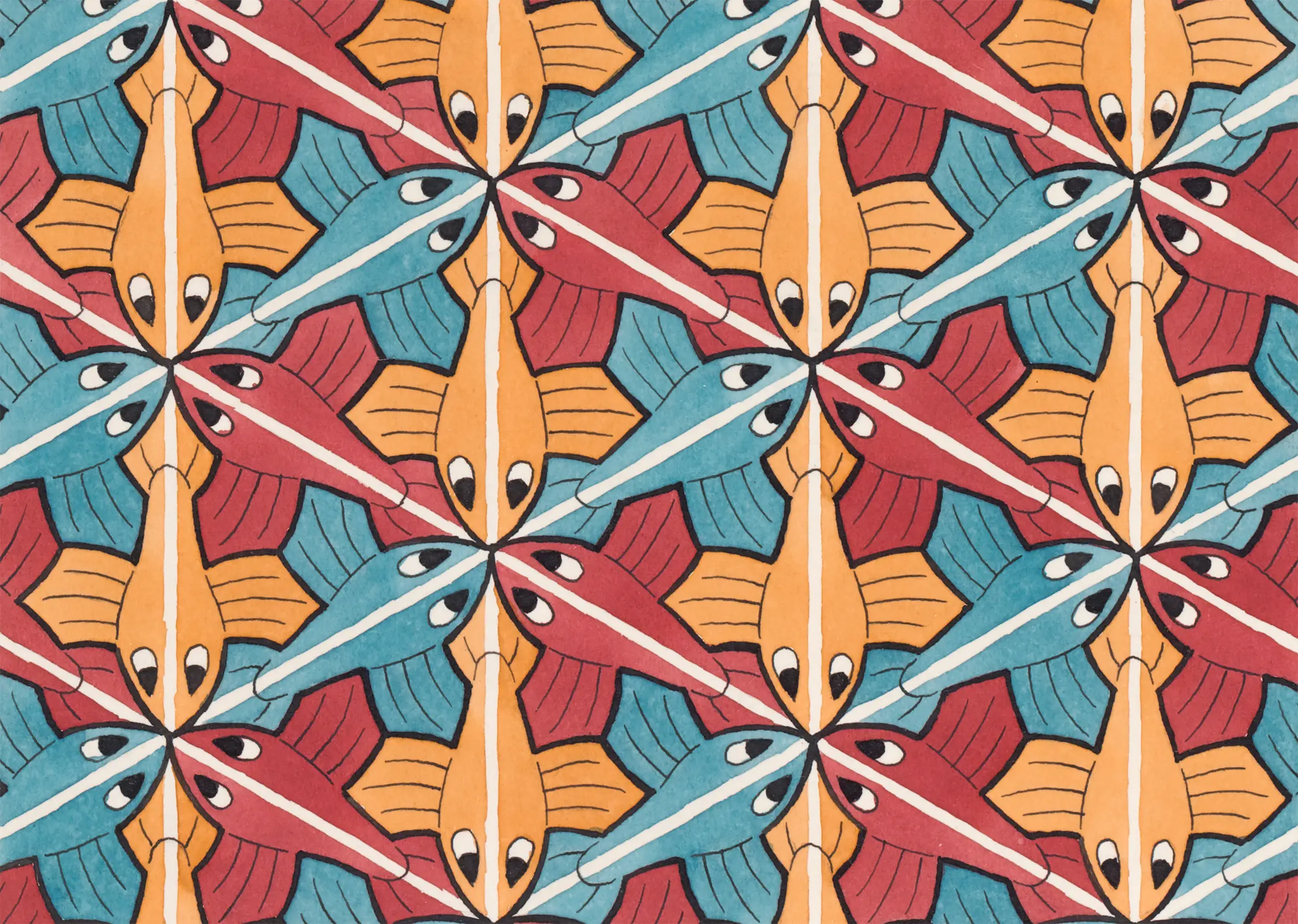
Symmetry Drawing No. 123, April 1964, ink and watercolor, 9 x 9 1/16 in
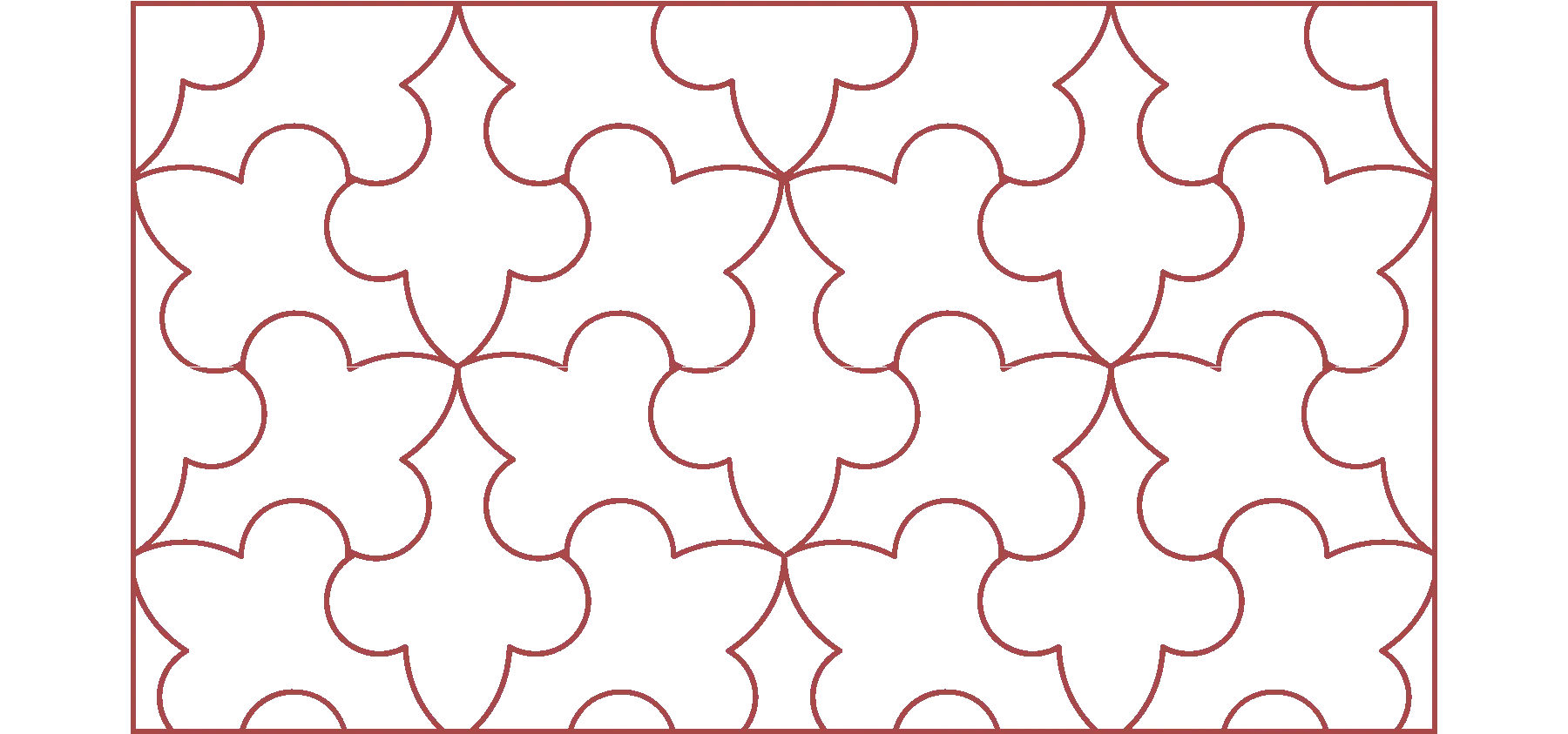
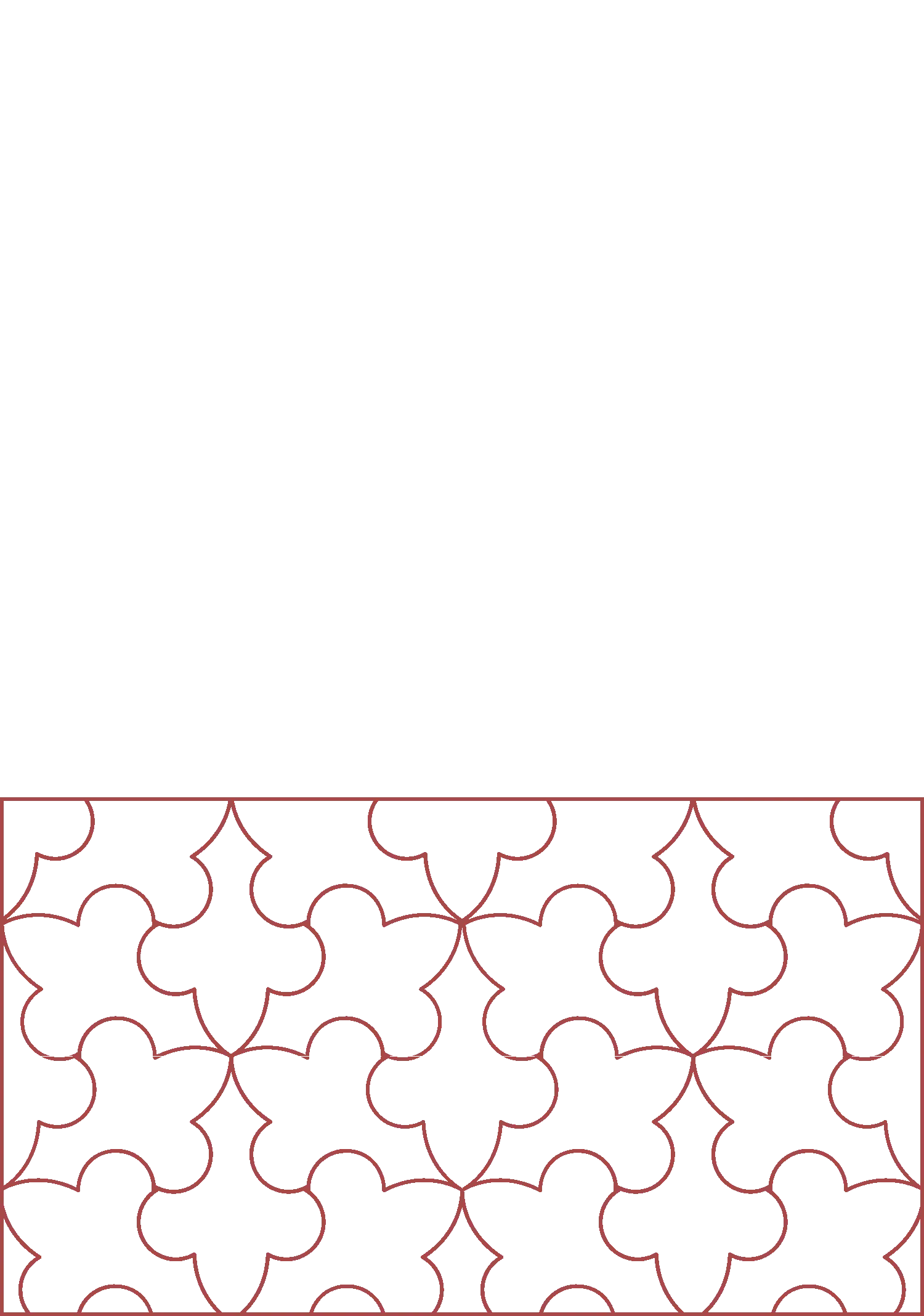
Escher drew hundreds of tessellations over the course of his career. This one (top), entitled Symmetry Drawing No. 123, may have been inspired by one of the diagrams from George Pólya’s paper (bottom) that Escher closely studied. At each central intersection, the heads of three fish meet with the tails of three others.
M.C. Escher artwork ©The M.C. Escher Heritage. EscherSite collection (top); Quanta Magazine
Symmetry Drawing No. 123, April 1964, ink and watercolor, 9 x 9 1/16 in
Escher drew hundreds of tessellations over the course of his career. This one (left), entitled Symmetry Drawing No. 123, may have been inspired by one of the diagrams from George Pólya’s paper (right) that Escher closely studied. At each central intersection, the heads of three fish meet with the tails of three others.
M.C. Escher artwork ©The M.C. Escher Heritage. EscherSite collection (left); Quanta Magazine
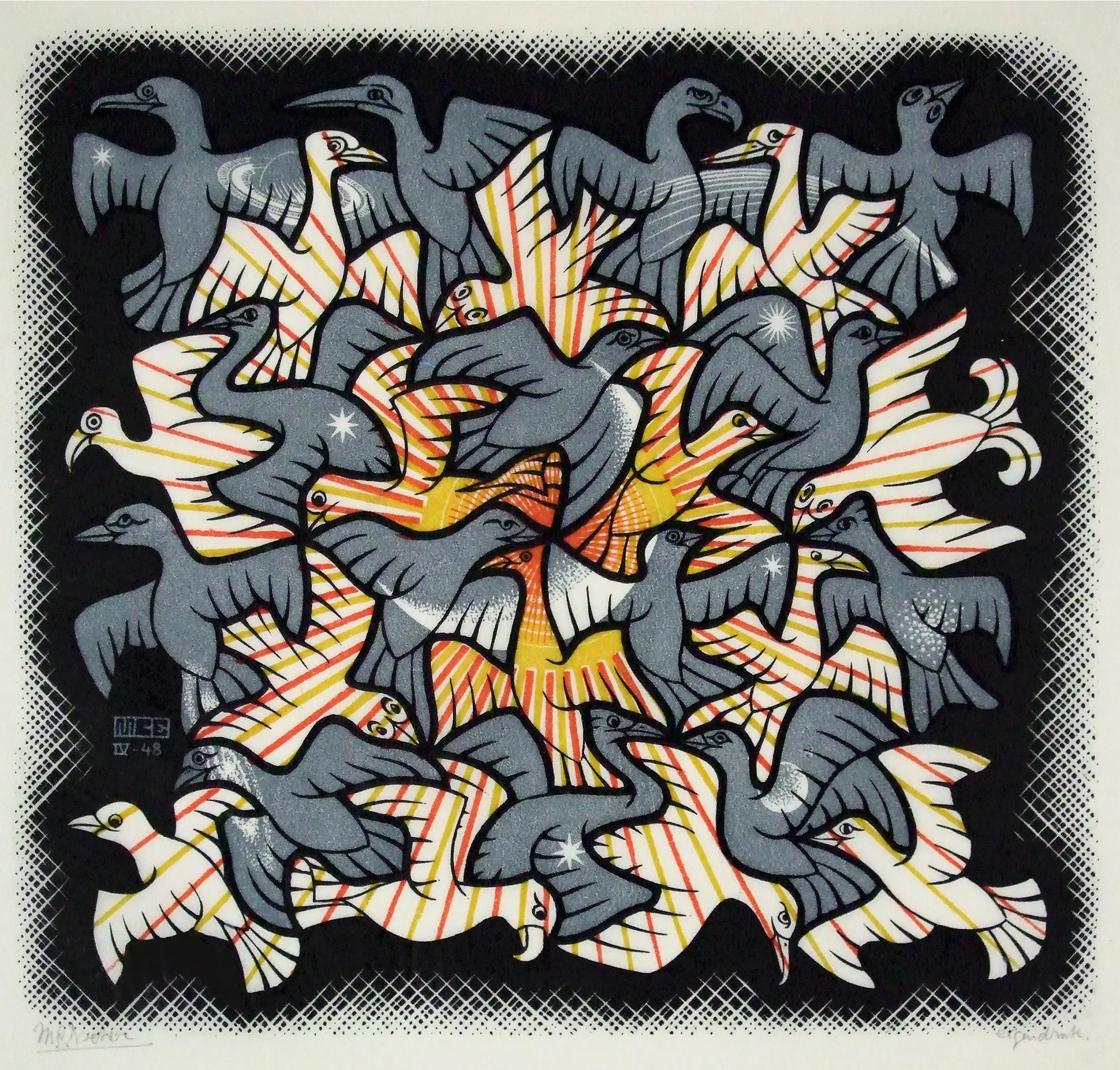
Sun and Moon, April 1948, woodcut printed from four blocks, 9 7/8 × 10 5/8 in
In Sun and Moon, Escher uses tessellation to cover the print with irregularly shaped birds in two color schemes, one imbued with the image of a sunny day, and the other with that of a moonlit night, giving the impression of night and day coexisting.
M.C. Escher artwork ©The M.C. Escher Heritage. EscherSite collection.
Sun and Moon, April 1948, woodcut printed from four blocks, 9 7/8 × 10 5/8 in
In this work, Escher uses tessellation to cover the print with irregularly shaped birds in two color schemes, one imbued with the image of a sunny day, and the other with that of a moonlit night, giving the impression of night and day coexisting.
M.C. Escher artwork ©The M.C. Escher Heritage. EscherSite collection.

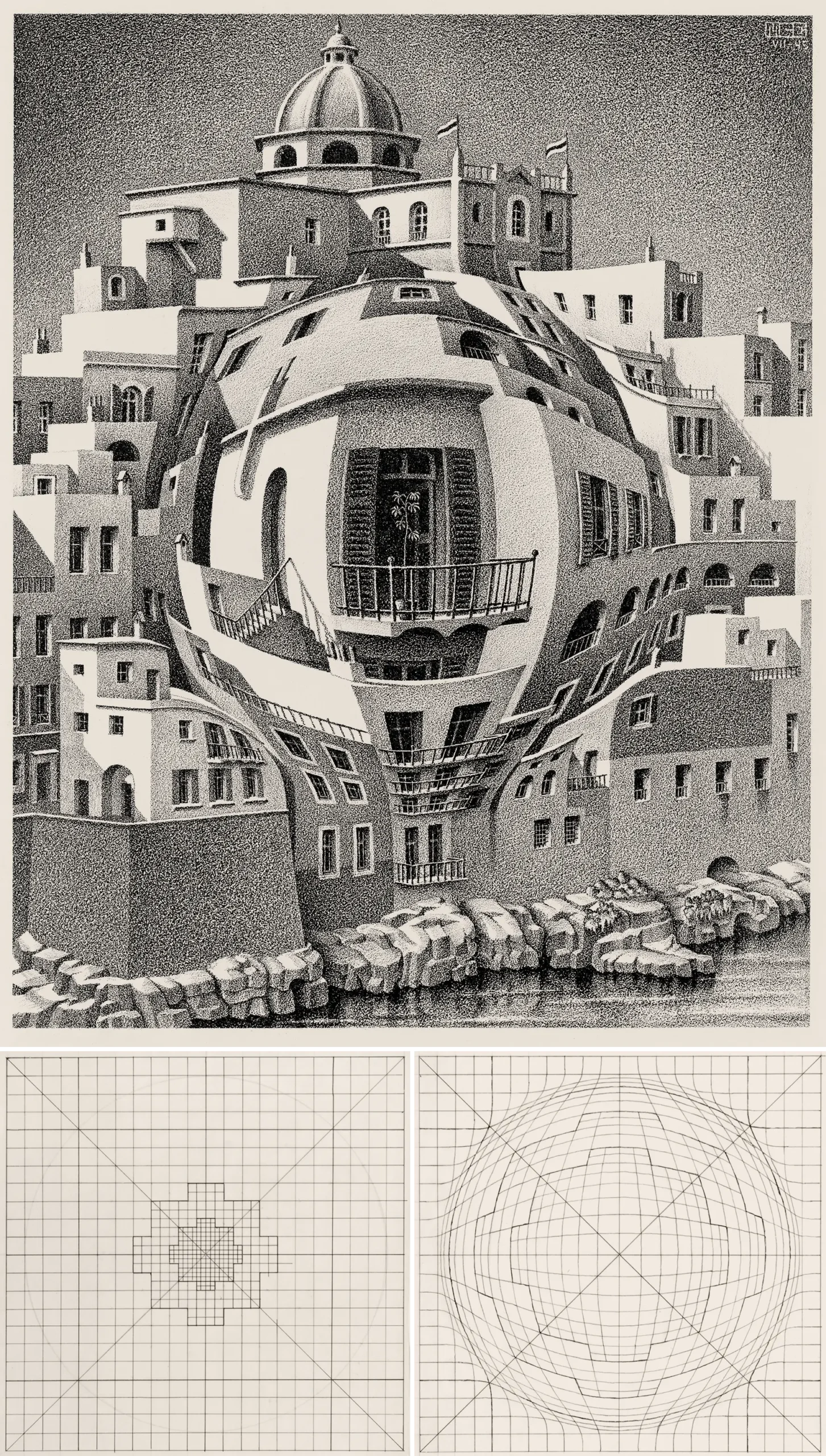
Balcony, July 1945, lithograph, 11 3/4 x 9 1/4 in (top); preparatory grids for Balcony
Escher also played with image distortion, producing an effect similar to that of a curved mirror, which redirects light to contort its reflection. In Balcony (top), Escher creates the illusion of a bulge pushing through the print. Today, computers can easily create such a distortion. But Escher worked by hand to create a system of grids (bottom) that he used to map his original image onto a warped one, square by square.
M.C. Escher artwork ©The M.C. Escher Heritage. EscherSite collection.
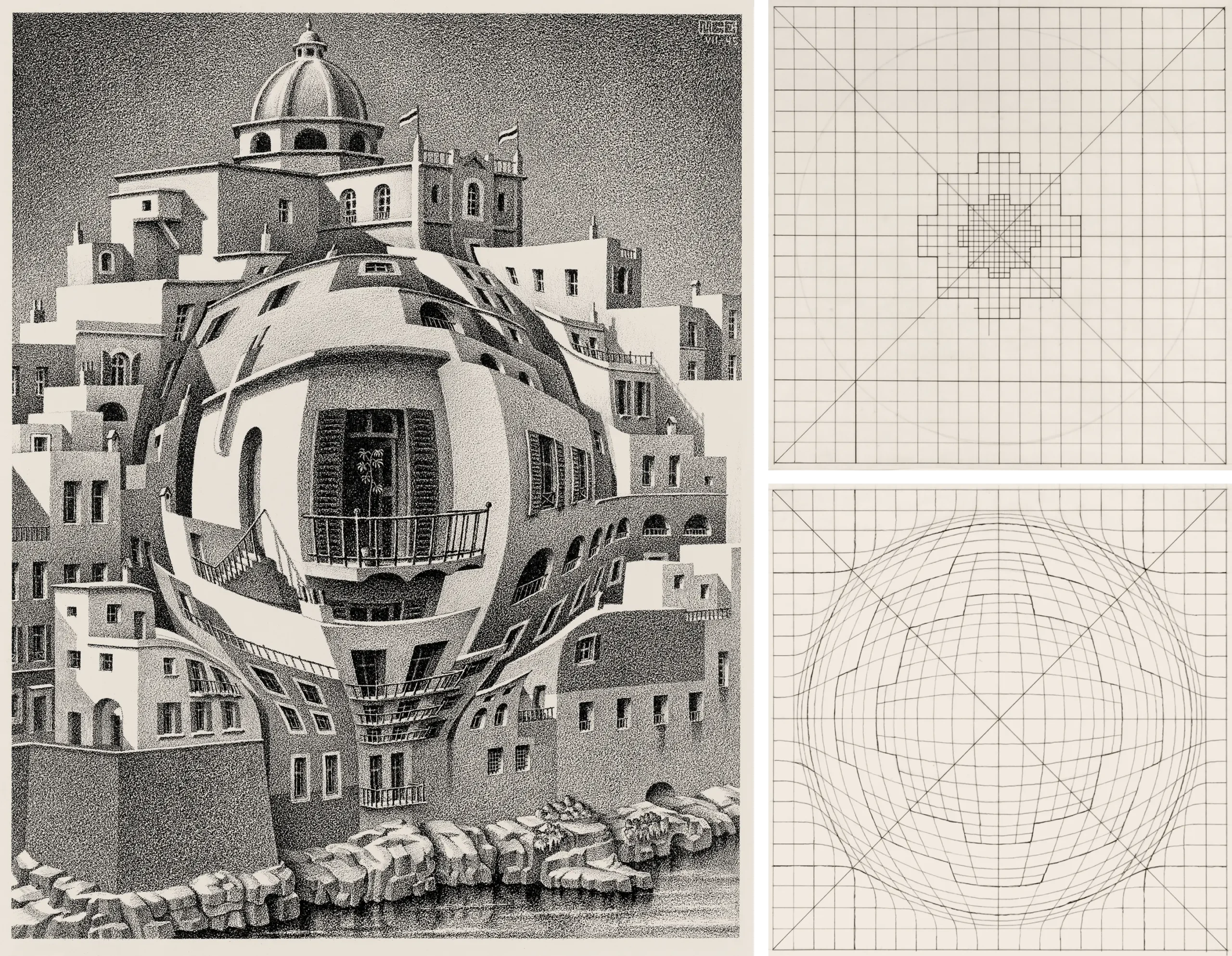
Balcony, July 1945, lithograph, 11 3/4 x 9 1/4 in (left); preparatory grids for Balcony
Escher also played with image distortion, producing an effect similar to that of a curved mirror, which redirects light to contort its reflection. In Balcony (left), Escher creates the illusion of a bulge pushing through the print. Today, computers can easily create such a distortion. But Escher worked by hand to create a system of grids (right) that he used to map his original image onto a warped one, square by square.
M.C. Escher artwork ©The M.C. Escher Heritage. EscherSite collection.
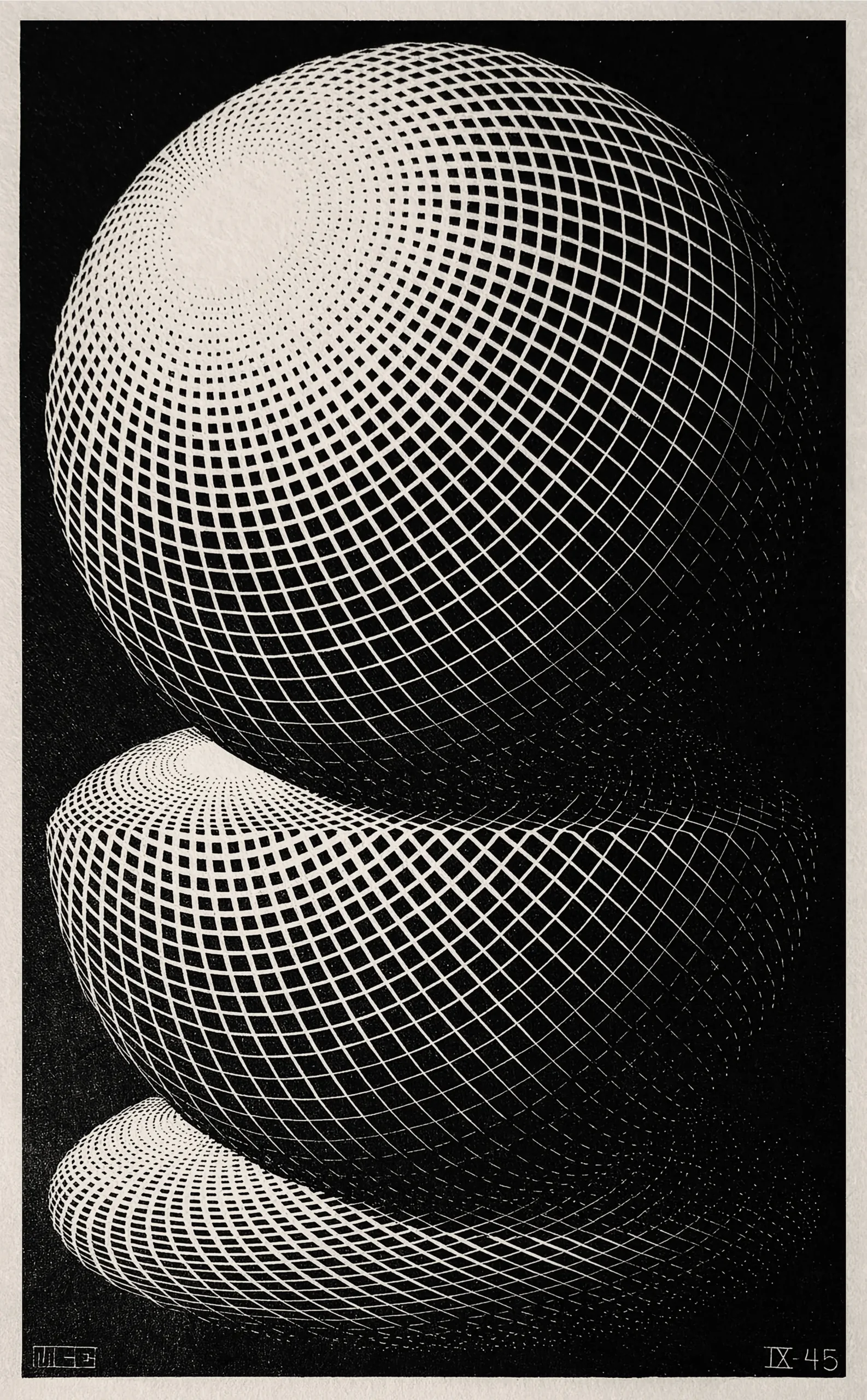
Three Spheres I, September 1945, wood engraving, 11 x 6 5/8 in
In Three Spheres I, Escher pokes fun at the viewer by revealing that what appears to be a three-dimensional sphere at the top of the print is really a flat, two-dimensional image. In the middle, he folds the “sphere” in half, revealing it to be an illusion. The bottom shows what the sphere really is: a flat circle. In future pieces, he would continue to manipulate the rules of dimensions and projection.
M.C. Escher artwork ©The M.C. Escher Heritage. EscherSite collection.
Three Spheres I, September 1945, wood engraving, 11 x 6 5/8 in
Escher pokes fun at the viewer in Three Spheres I by revealing that what appears to be a three-dimensional sphere at the top of the print is really a flat, two-dimensional image. In the middle, he folds the “sphere” in half, revealing it to be an illusion. The bottom shows what the sphere really is: a flat circle. In future pieces, he would continue to manipulate the rules of dimensions and projection.
M.C. Escher artwork ©The M.C. Escher Heritage. EscherSite collection.
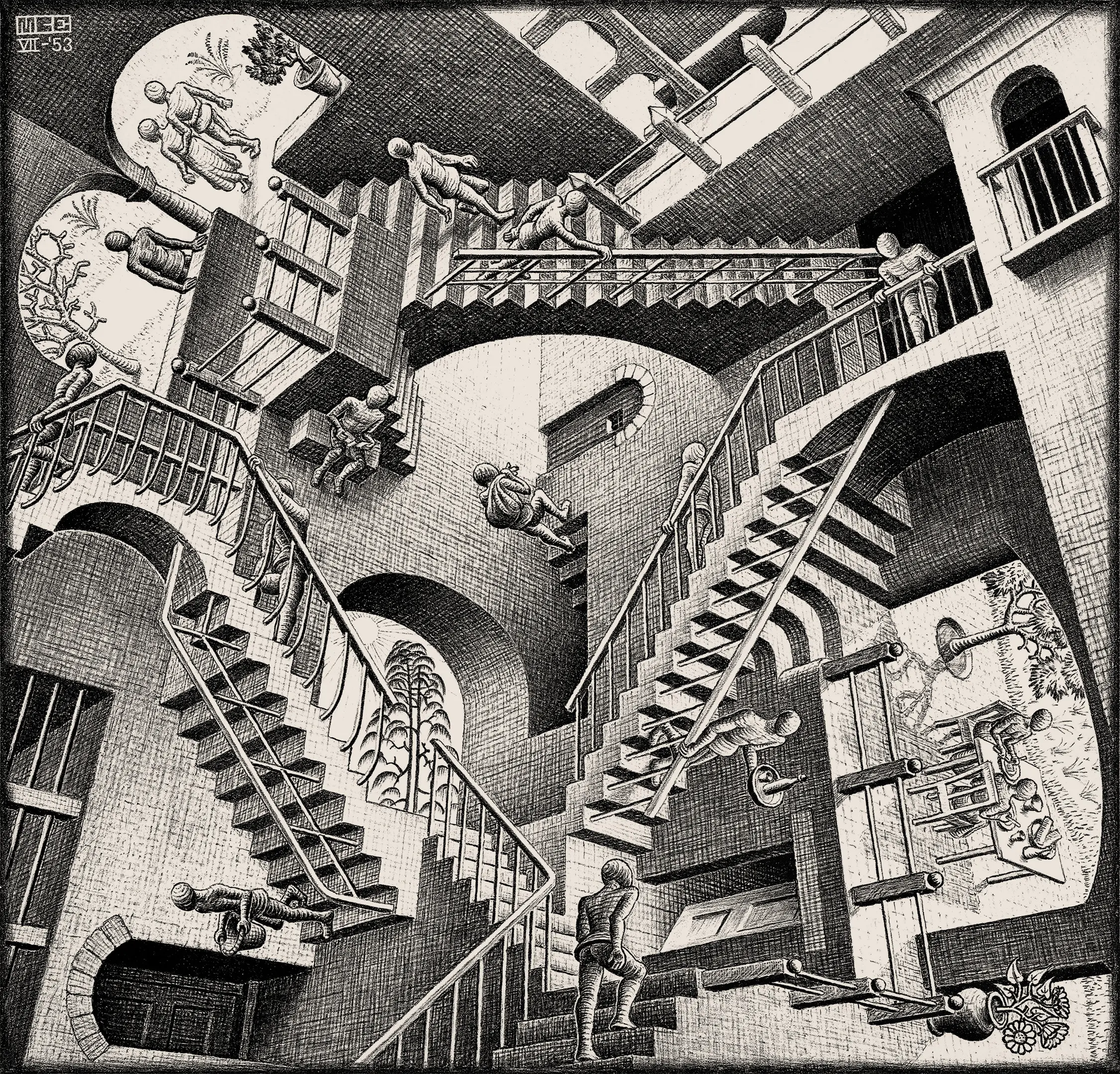

Relativity, 1953, lithograph, 10 7/8 x 1/2 in
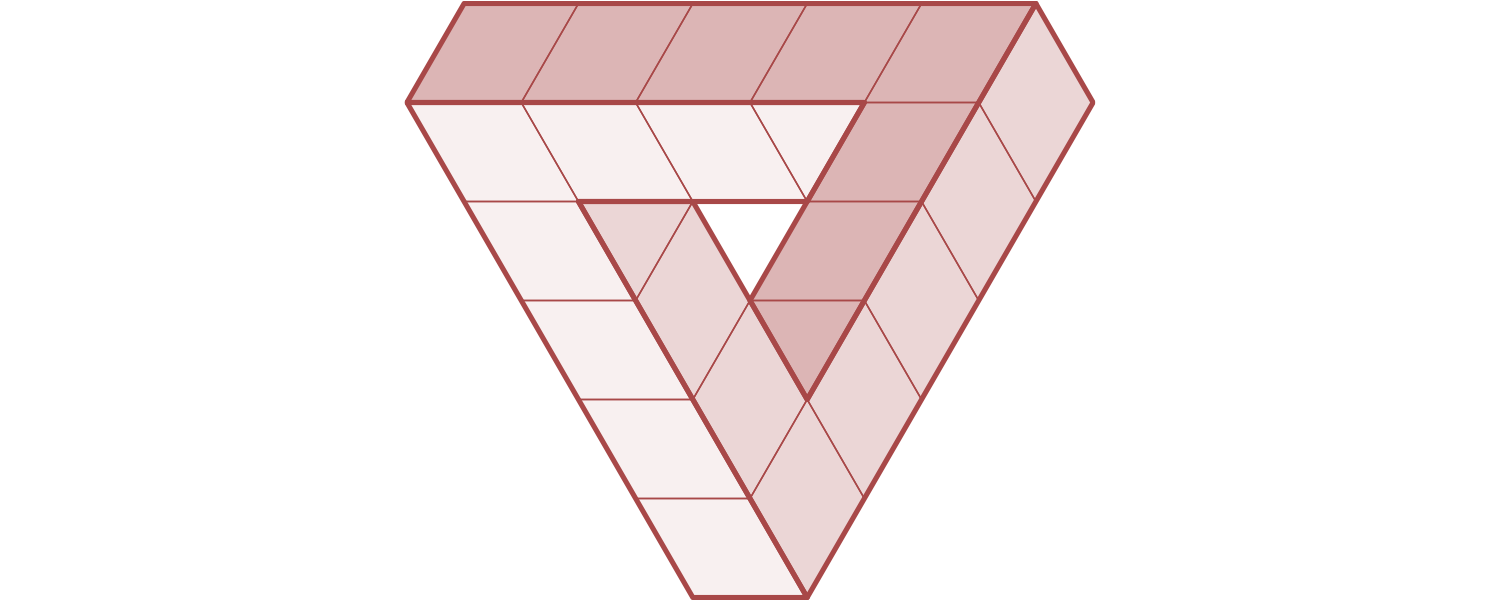
Escher created Relativity (top), named for Albert Einstein’s theory of gravity, after musing about a world where gravity points in three different directions at once. When the physicist Roger Penrose saw this piece, he was inspired to create a real shape that could replicate this paradoxical geometry, which became known as the Penrose tribar (bottom). The illusion is created when the three-dimensional shape is viewed at an angle that collapses it into a two-dimensional image of an impossible triangle. (Unbeknownst to Penrose, this tribar had previously been discovered in 1934 by Oscar Reutersvärd.)
M.C. Escher artwork ©The M.C. Escher Heritage. EscherSite collection (top); Quanta Magazine
Relativity, 1953, lithograph, 10 7/8 x 1/2 in
Escher created Relativity (left), named for Albert Einstein’s theory of gravity, after musing about a world where gravity points in three different directions at once. When the physicist Roger Penrose saw this piece, he was inspired to create a real shape that could replicate this paradoxical geometry, which became known as the Penrose tribar (right). The illusion is created when the three-dimensional shape is viewed at an angle that collapses it into a two-dimensional image of an impossible triangle. (Unbeknownst to Penrose, this tribar had previously been discovered in 1934 by Oscar Reutersvärd.)
M.C. Escher artwork ©The M.C. Escher Heritage. EscherSite collection (left); Quanta Magazine
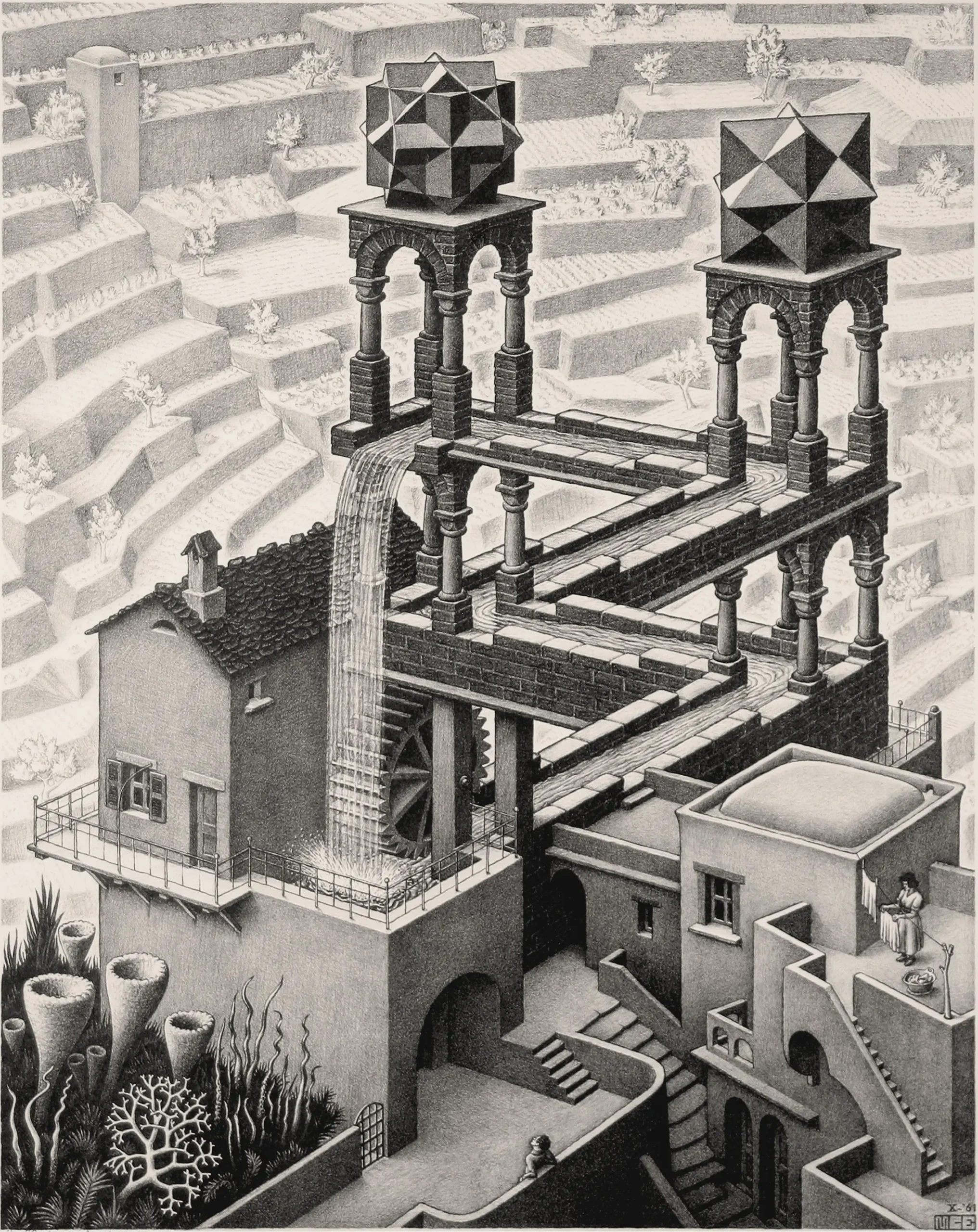
Waterfall, October 1961, lithograph, 15 × 11 1/2 in
Inspired in turn by Penrose’s tribar, Escher began creating worlds that used its impossible geometry. He was not in the business of optical illusions, as the writer Bruno Ernst points out in his book The Magic Mirror of M.C. Escher. Rather, Escher was demonstrating that drawing is deceptive. When representing three dimensions with just two, the artist can manipulate the rules of projection to deceive you into seeing, in this case, a perpetual motion machine, where the water flows in a strange loop that goes both downward and upward.
M.C. Escher artwork ©The M.C. Escher Heritage. EscherSite collection.
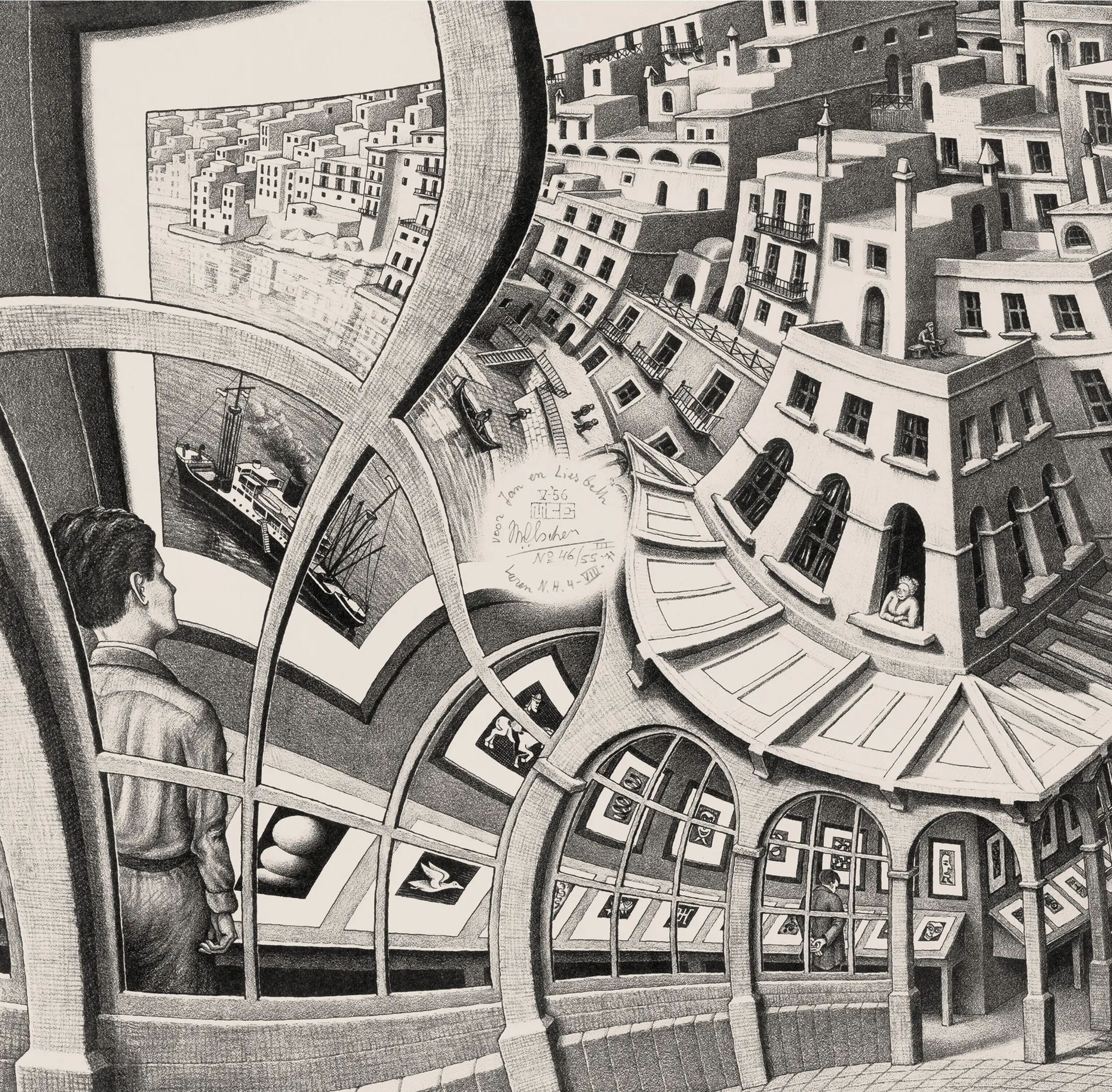
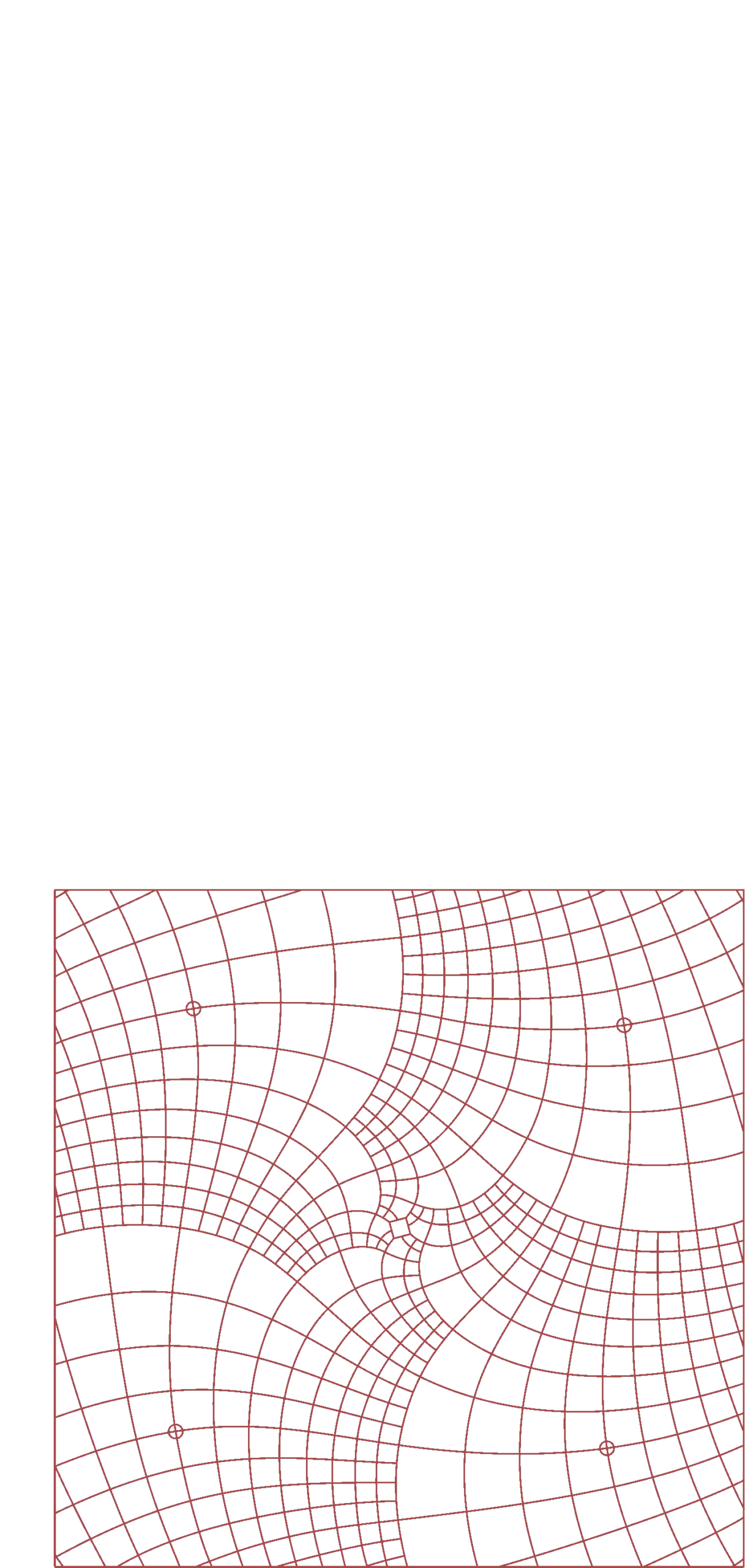
Print Gallery, May 1956, lithograph, 12 1/2 × 12 1/2 in
In a feat of mathematical intuition, Escher’s Print Gallery (top) renders a static zoom. Starting from a boy looking at a print of a town, the image magnifies into the world of the print as the viewer’s gaze travels clockwise. Zooming in, we see that the town portrayed in the print contains the gallery in which the boy is found again, looking at the print.
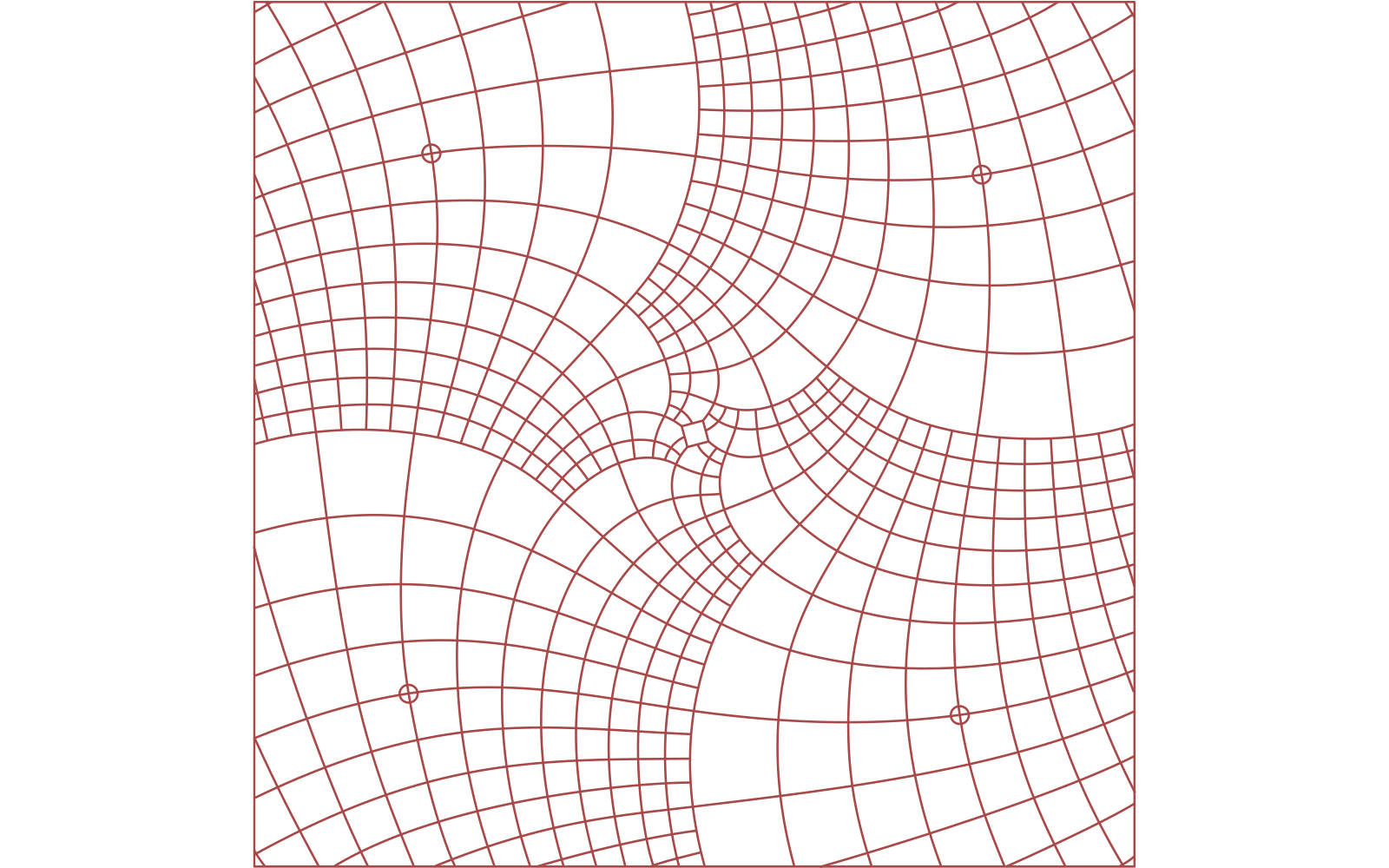
Escher achieved this by developing a complex system of grids in which the scale of each square increases from corner to corner. In 2003, the mathematicians Hendrik Lenstra and Bart de Smit reverse engineered the mathematics behind the piece, revealing that Escher had effectively taken a complex exponential of an image (bottom). They also filled in the gap that Escher left in the center.
M.C. Escher artwork ©The M.C. Escher Heritage. EscherSite collection (top); Quanta Magazine
Print Gallery, May 1956, lithograph, 12 1/2 × 12 1/2 in
In a feat of mathematical intuition, Escher’s Print Gallery (left) renders a static zoom. Starting from a boy looking at a print of a town, the image magnifies into the world of the print as the viewer’s gaze travels clockwise. Zooming in, we see that the town portrayed in the print contains the gallery in which the boy is found again, looking at the print.
Escher achieved this by developing a complex system of grids in which the scale of each square increases from corner to corner. In 2003, the mathematicians Hendrik Lenstra and Bart de Smit reverse engineered the mathematics behind the piece, revealing that Escher had effectively taken a complex exponential of an image (right). They also filled in the gap that Escher left in the center.
M.C. Escher artwork ©The M.C. Escher Heritage. EscherSite collection (left); Quanta Magazine
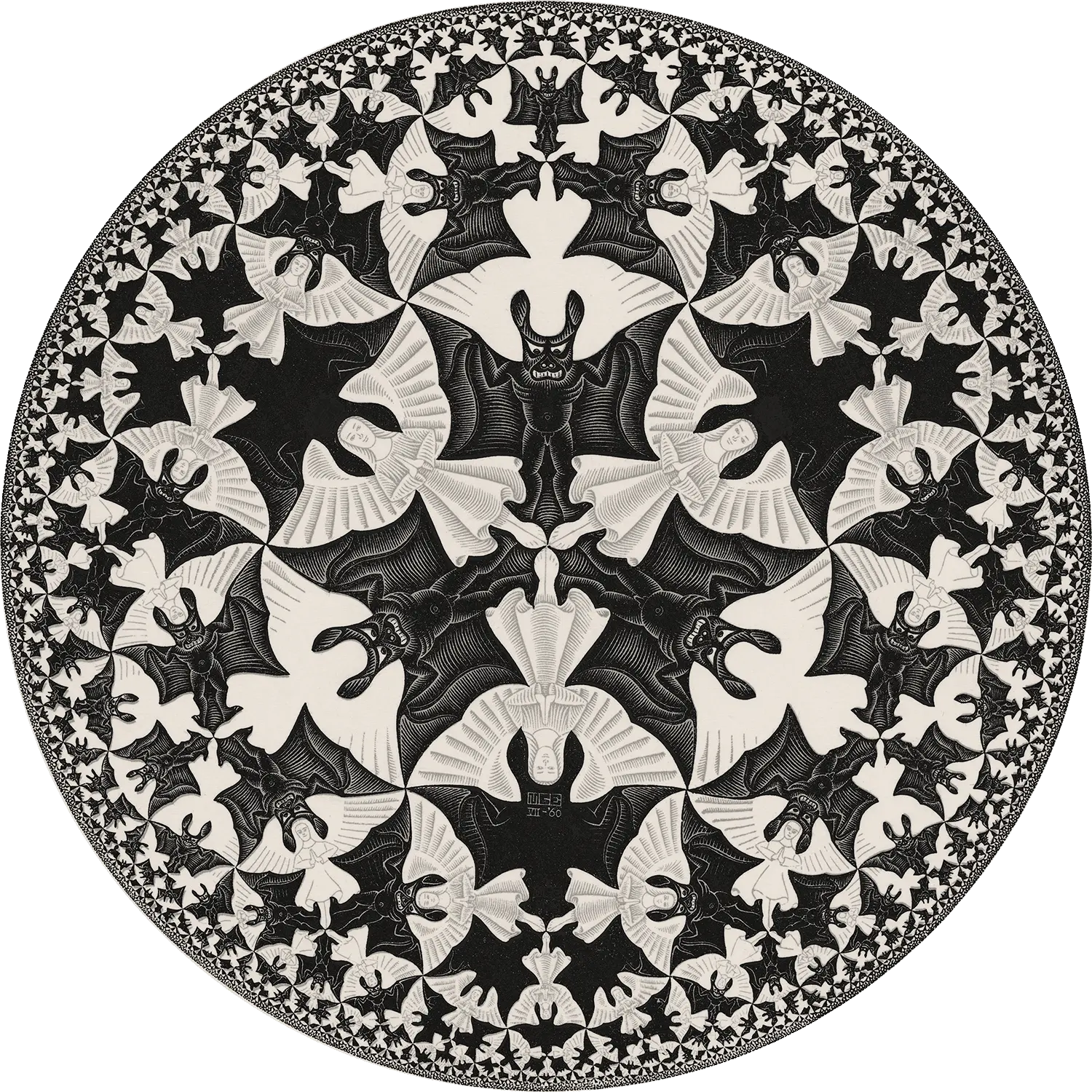
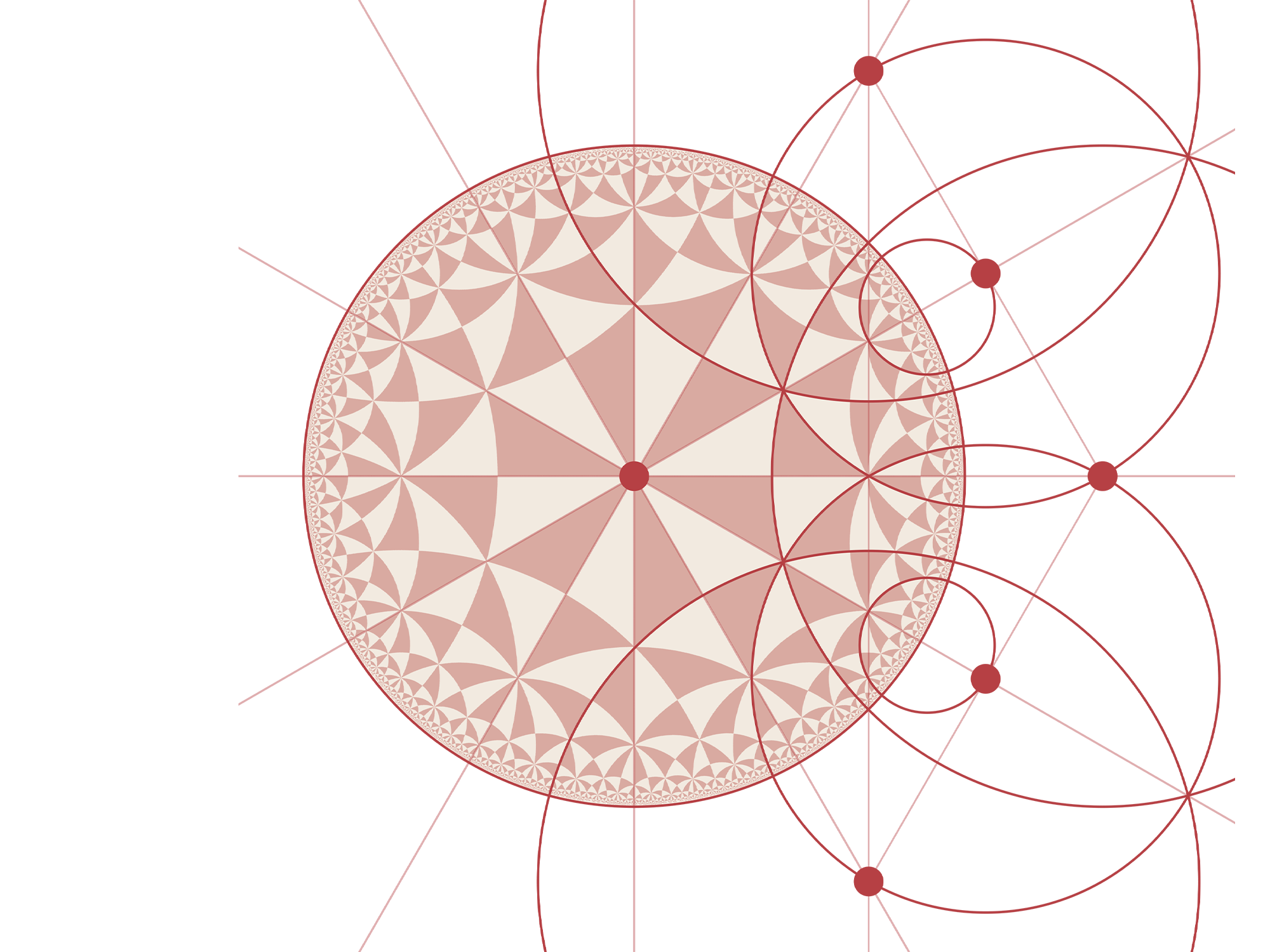
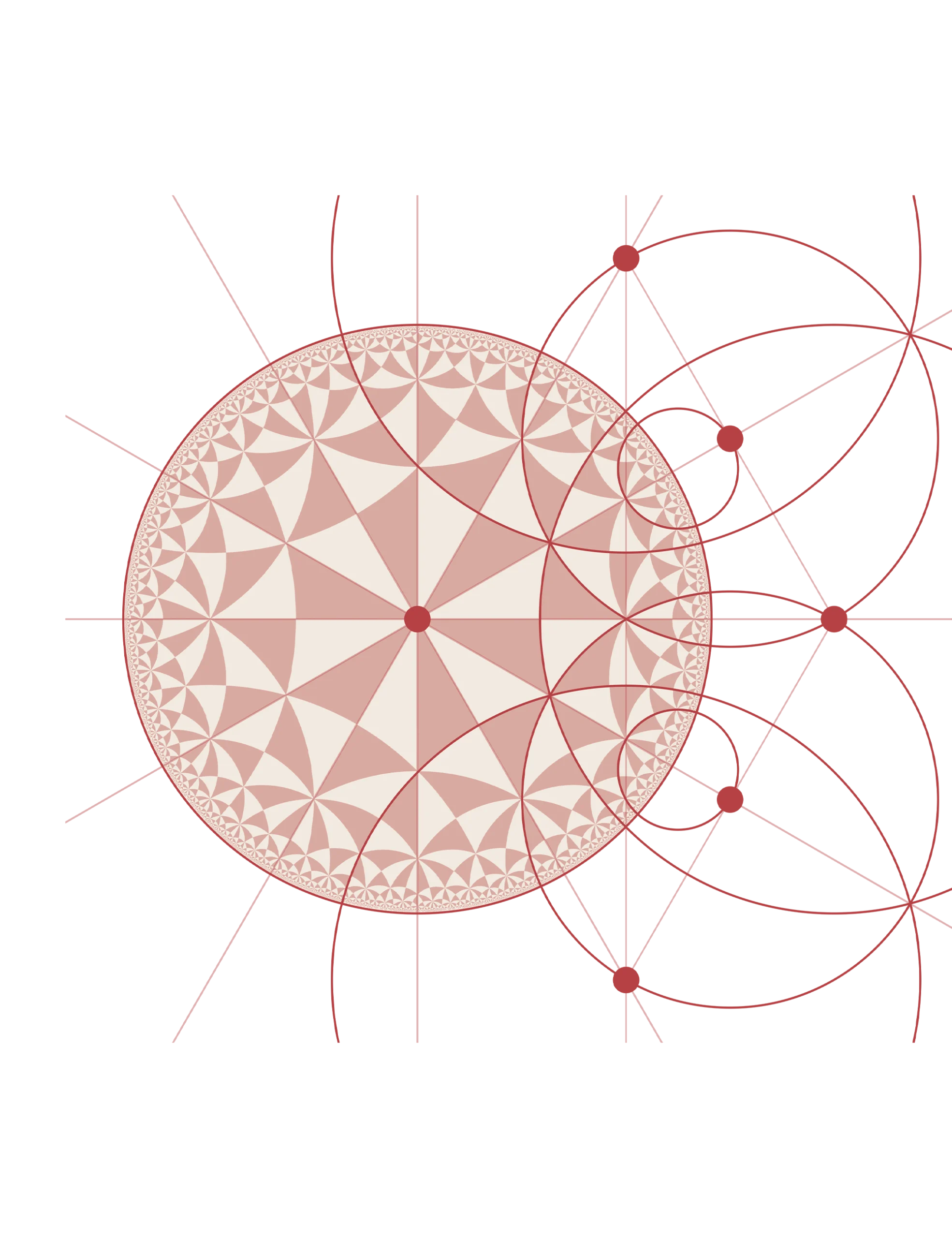
Circle Limit IV, July 1960, woodcut, 16 3/8 in diameter
In 1958, H.S.M. Coxeter sent Escher a paper of his on tessellations of curved spaces. Escher wrote back saying that one of its diagrams “gave me quite a shock.” The figure showed a circle filled with rounded triangles that get smaller as they approach the edge, ad infinitum. It’s a representation of two-dimensional hyperbolic space (bottom), a negatively curved space where parallel lines diverge. The arcs in the disk represent straight paths through hyperbolic space. Escher studied this figure, tracing its arcs and determining the pattern of the circles that were implicit in it. Using what he had learned, Escher created his Circle Limit series. In Circle Limit IV (top), the figures take the form of angels and bats, symbols of good and evil, of which infinitely many fit in the piece.
Escher wrote to Coxeter that “not one single component ever reaches the edge. … And yet this round world cannot exist without the emptiness around it … because it is out there in the ‘nothingness’ that the scaffolding lies, determining with geometric precision the centres of the circular arcs which form the skeleton.
M.C. Escher artwork ©The M.C. Escher Heritage. EscherSite collection (top); Quanta Magazine
Circle Limit IV (Heaven and Hell), July 1960, woodcut printed from two blocks, 16 3/8 in diameter
In 1958, H.S.M. Coxeter sent Escher a paper of his on tessellations of curved spaces. Escher wrote back saying that one of its diagrams “gave me quite a shock.” The figure showed a circle filled with rounded triangles that get smaller as they approach the edge, ad infinitum. It’s a representation of two-dimensional hyperbolic space (right), a negatively curved space where parallel lines diverge. The arcs in the disk represent straight paths through hyperbolic space. Escher studied this figure, tracing its arcs and determining the pattern of the circles that were implicit in it. Using what he had learned, Escher created his Circle Limit series. In Circle Limit IV, shown on the left, the figures take the form of angels and bats, symbols of good and evil, of which infinitely many fit in the piece.
Escher wrote to Coxeter that “not one single component ever reaches the edge. … And yet this round world cannot exist without the emptiness around it … because it is out there in the ‘nothingness’ that the scaffolding lies, determining with geometric precision the centres of the circular arcs which form the skeleton.”
M.C. Escher artwork ©The M.C. Escher Heritage. EscherSite collection (left); Quanta Magazine
Editor’s Note: The National Museum of Mathematics has received funding from the Simons Foundation, which also funds this editorially independent magazine. Simons Foundation funding decisions have no influence on our coverage.