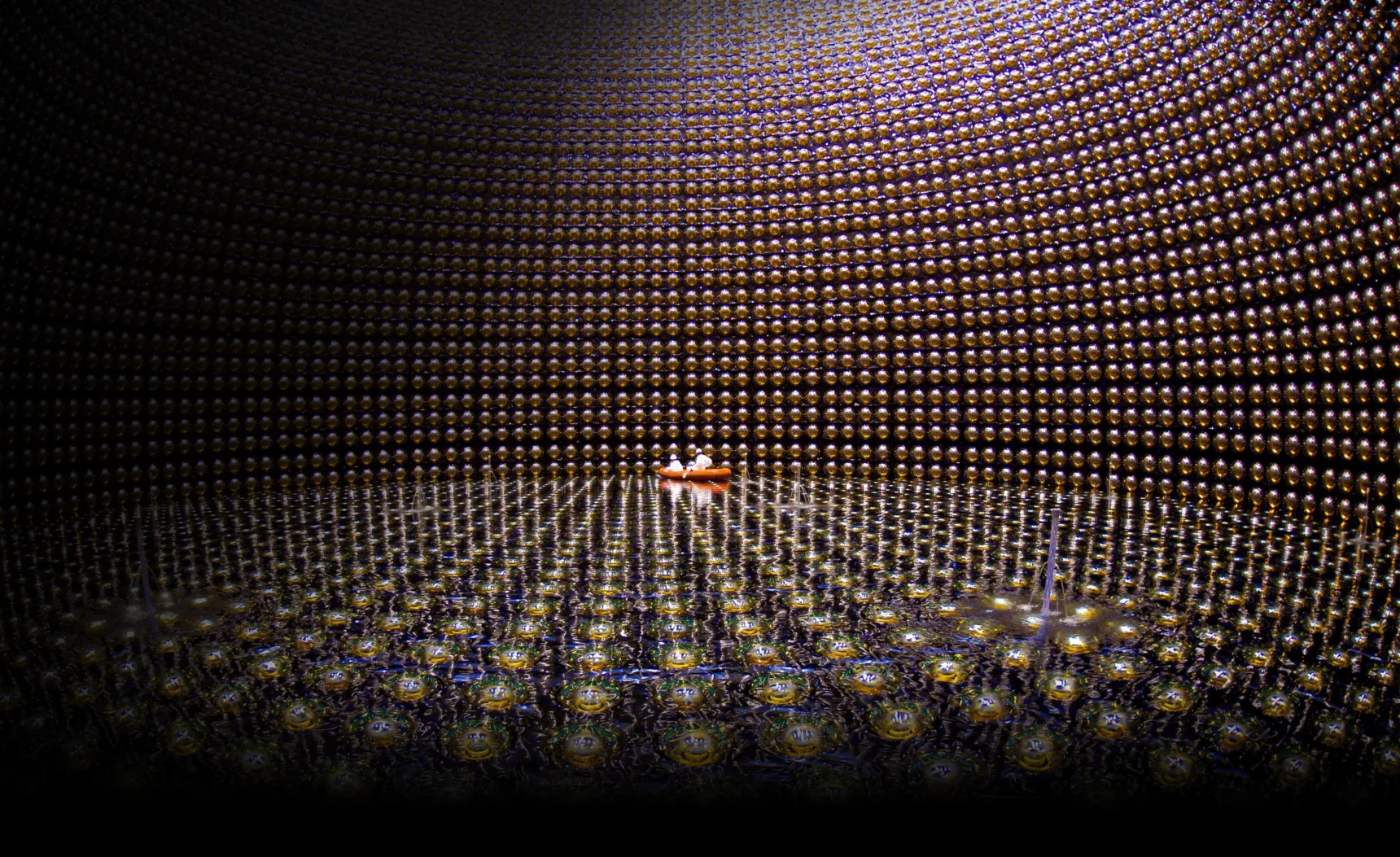
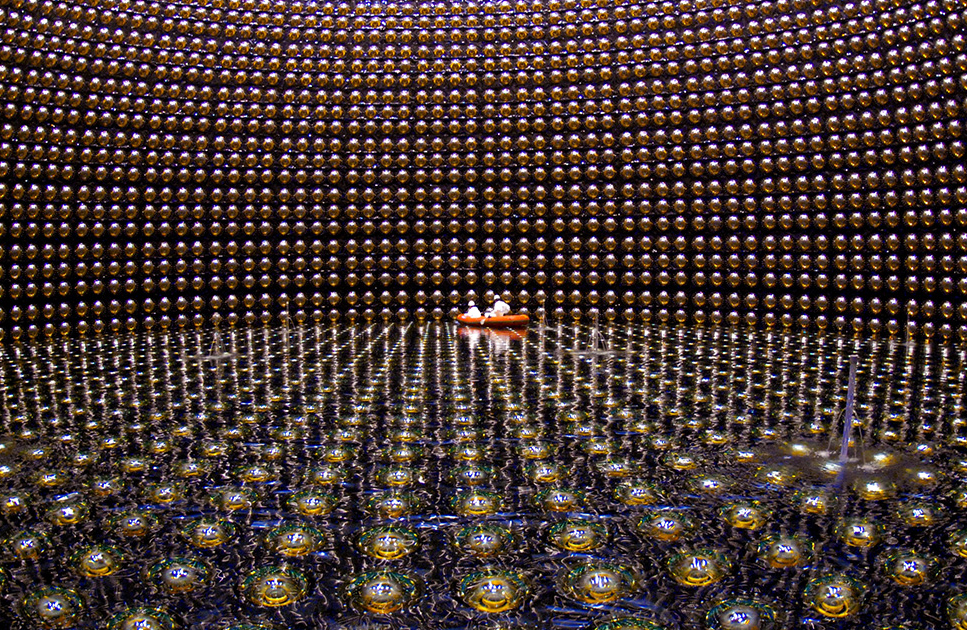
The Super-Kamiokande neutrino detector was rebuilt following a catastrophic chain-reaction implosion of some 6,600 of the photomultiplier tubes lining its walls. Here the observatory is being refilled with ultrapure water in 2006.
Kamioka Observatory, ICRR, The University of Tokyo
Introduction
Seventy years ago, the physicists Clyde Cowan and Frederick Reines took a custom-built 10-ton detector, surrounded it with thick lead walls and wet sandbags, and placed it near a powerful nuclear reactor at the Savannah River Plant in South Carolina. They called the experiment “Project Poltergeist,” designed as it was to catch a ghost.
More than a quarter of a century before, physicists had been puzzling over why energy appeared to be lost during a radioactive process called beta decay. Something was missing, and there was no known physics to explain it. Then in 1930, the Austrian physicist Wolfgang Pauli proposed a radical solution: A virtually undetectable particle was silently carrying the missing energy away. “I have done a terrible thing,” Pauli told a friend. “I have postulated a particle that cannot be detected.” It would come to be known as the neutrino. Having almost no mass and no charge, these particles can pass through Earth and everything on it, including our bodies, virtually unimpeded.
The massive device that Cowan and Reines deployed in early 1956 was meant to find what Pauli thought was impossible. That June, the pair of physicists from the Los Alamos National Laboratory sent Pauli a telegram: “We are happy to inform you that we have definitely detected neutrinos.”
Attention then shifted to a broader question. If nuclear reactions produce neutrinos, could we use them to peer at the nuclear fireworks inside stars, including the sun? This presented a huge challenge: How can you possibly catch particles shooting from distant stars if these particles can pass through almost anything undetected? The suspicion was that detecting a particle that rarely collides with matter requires a vast amount of matter for it to collide with. Moreover, the matter would have to be shielded from the noise of other forms of radiation. So the answer scientists came up with was to build some of the biggest, deepest, and most exotic experimental traps in scientific history … and then wait.
In the 1960s, Raymond Davis Jr. and colleagues at Brookhaven National Laboratory placed a tank 1.5 kilometers underground in the Homestake mine in South Dakota and filled it with nearly 400,000 liters of a chlorine-based cleaning fluid called perchloroethylene. On the rare occasion that a passing neutrino struck a chlorine nucleus, it would be transformed into a radioactive form of argon that could be detected and counted. The experiment, which would run for 25 years, found just one-third the number of neutrinos coming from the sun that had been predicted in theoretical models. This became known as the solar neutrino problem.
Decades passed before it was solved — by yet more massive experiments. Deep in the Kamioka mine in Japan, Masatoshi Koshiba built a different kind of detector called Kamiokande, which used 3 million liters of ultrapure water. In this setup, neutrinos occasionally interact with atomic nuclei in the water. The interaction creates an electron that moves so fast, it generates a flash of what’s called Cherenkov light. This light gets picked up by detectors.
Kamiokande and Koshiba confirmed Davis’ shortfall, and a second, even larger detector, Super-Kamiokande, as well as Canada’s Sudbury Neutrino Observatory, explained the discrepancy. Neutrinos come in three different “flavors” (electron, muon, and tau) and can oscillate, or switch, between them. To do so, neutrinos must have mass, which the laws of physics failed (and still fail) to predict.
Newer neutrino detectors continue the tradition of grand ambitions and surprising results. The IceCube Neutrino Observatory below the Amundsen-Scott South Pole Station uses Antarctic ice instead of water. It has developed a map of the Milky Way made up only of neutrinos and traced these high-energy cosmic particles back to active galaxies powered by supermassive black holes. On the floor of the Mediterranean Sea, the Cubic Kilometer Neutrino Telescope (KM3NET) has detected the highest-energy cosmic neutrino on record. Its source remains unknown.
Neutrino oscillations, and the myriad mysteries they give rise to, have driven the development of the newest wave of detectors. China’s Jiangmen Underground Neutrino Observatory (JUNO) launched in 2025; initial data published in June 2026 provided the most precise measurements of neutrino oscillation reported to date. Japan’s Hyper-Kamiokande (Hyper-K) and the Deep Underground Neutrino Experiment (DUNE) in the American Midwest are both expected to begin operation later this decade.
Because of these and other audacious experiments, the particle that Pauli was sure could never be caught has slowly been revealing its secrets. The recipe for discovery hasn’t changed in seven decades: Think big, go deep, and summon patience.
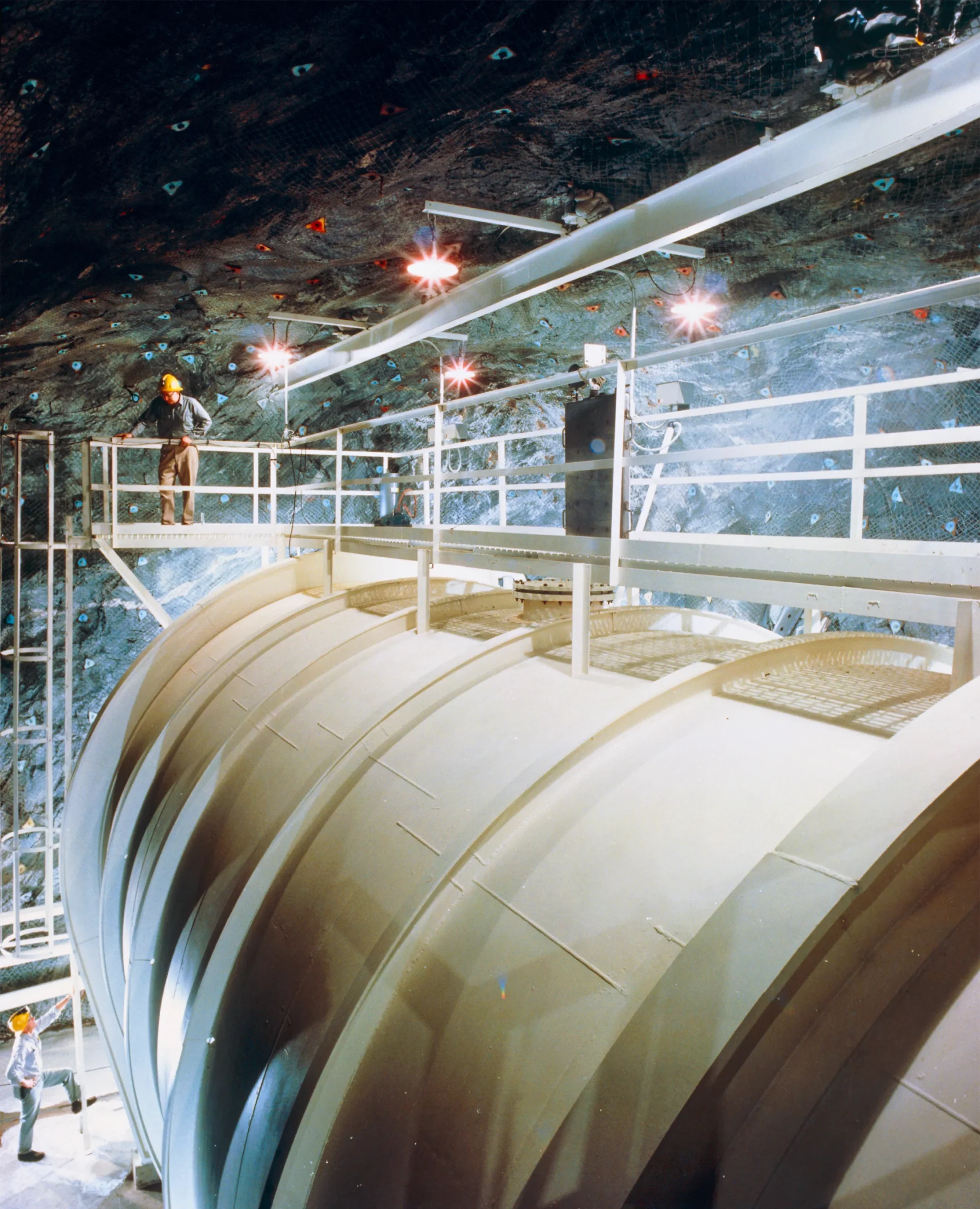
Raymond Davis Jr. is dwarfed by the giant tank used by the Homestake detector in South Dakota, which first detected solar neutrinos. Creating a large enough trap for neutrinos required a tank one-fifth the volume of an Olympic-size swimming pool filled with chlorine-rich dry-cleaning fluid and buried almost 1.5 kilometers underground.
Brookhaven National Laboratory/Science Photo Library
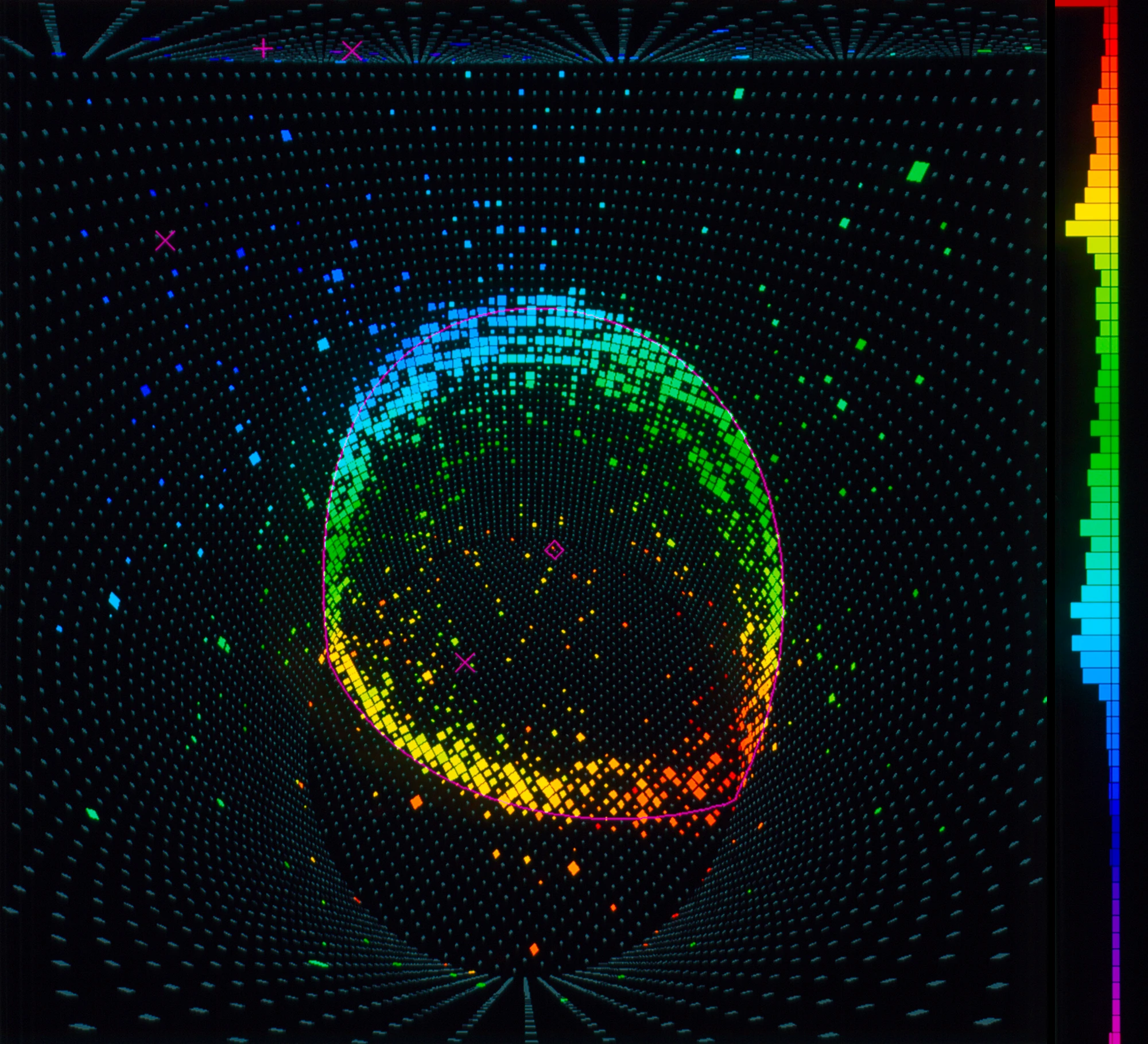
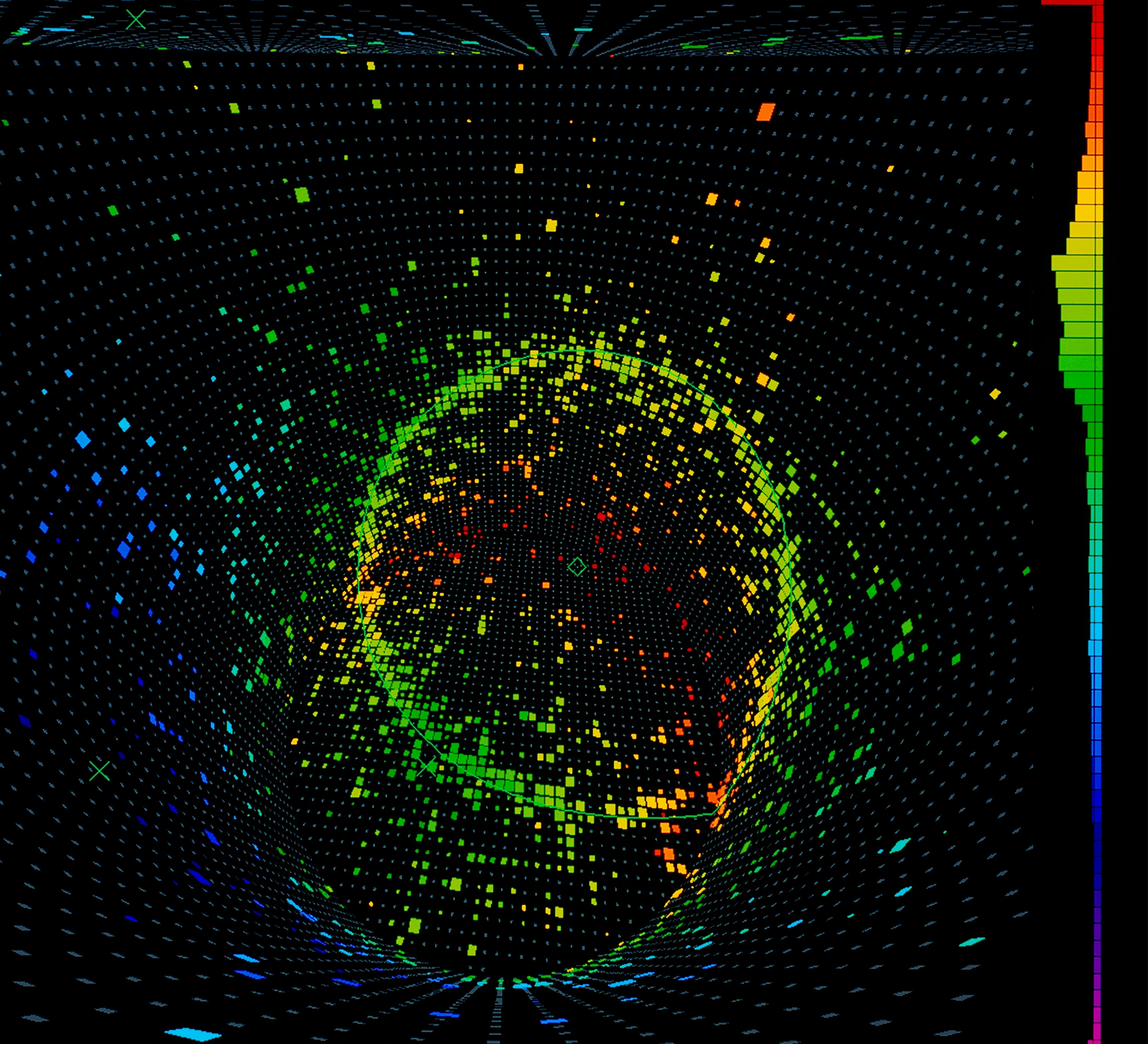
Different varieties of neutrinos passing through the Super-Kamiokande detector create telltale patterns on the walls of the detectors. Here we see a muon neutrino (top) and an electron neutrino (bottom): two of the fundamental particles in the Standard Model of particle physics.
Different varieties of neutrinos passing through the Super-Kamiokande detector create telltale patterns on the walls of the detectors. Here we see the traces of a muon neutrino (left) and an electron neutrino (right): two of the fundamental particles in the Standard Model of particle physics.
Super-Kamiokande Collaboration/Science Photo Library
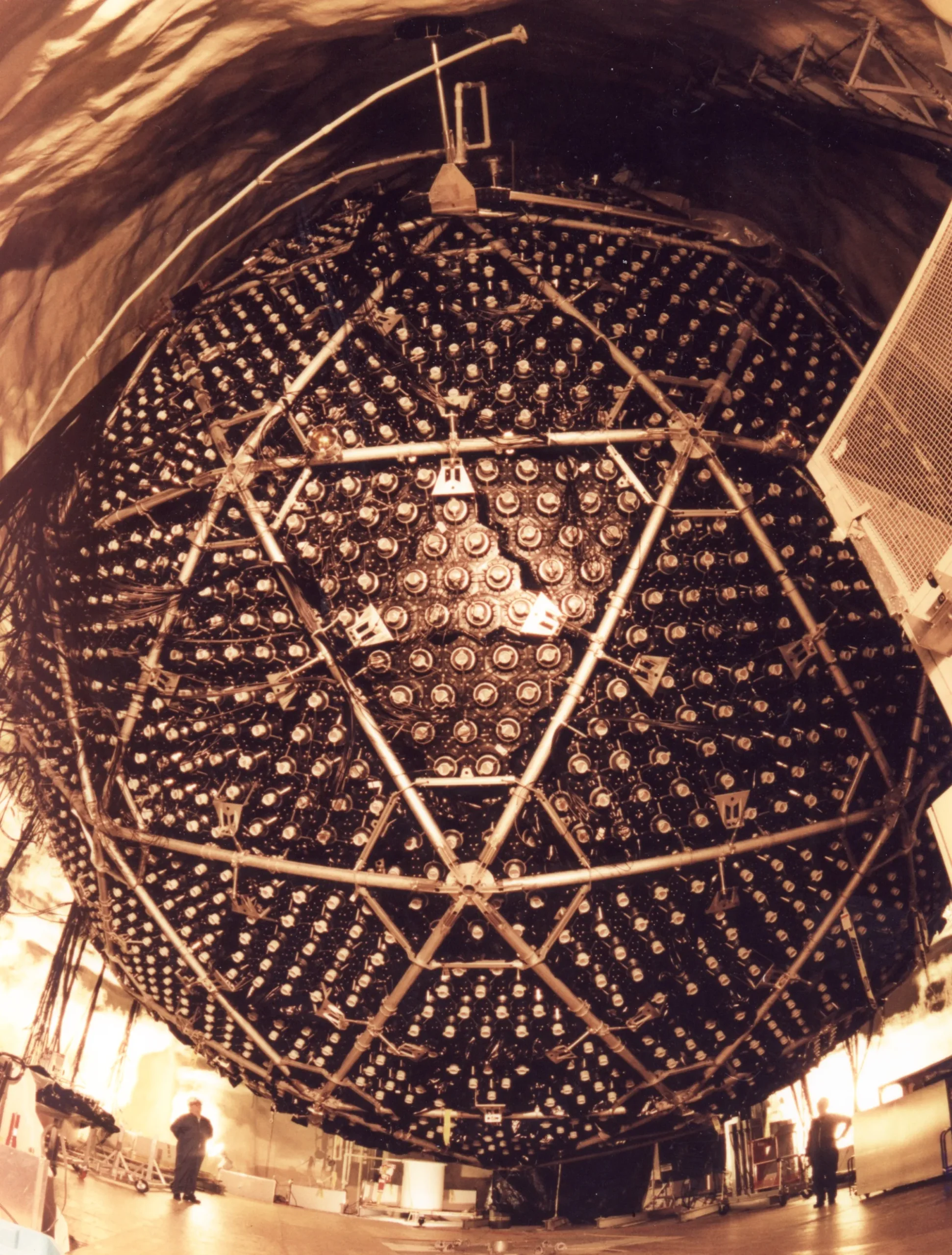
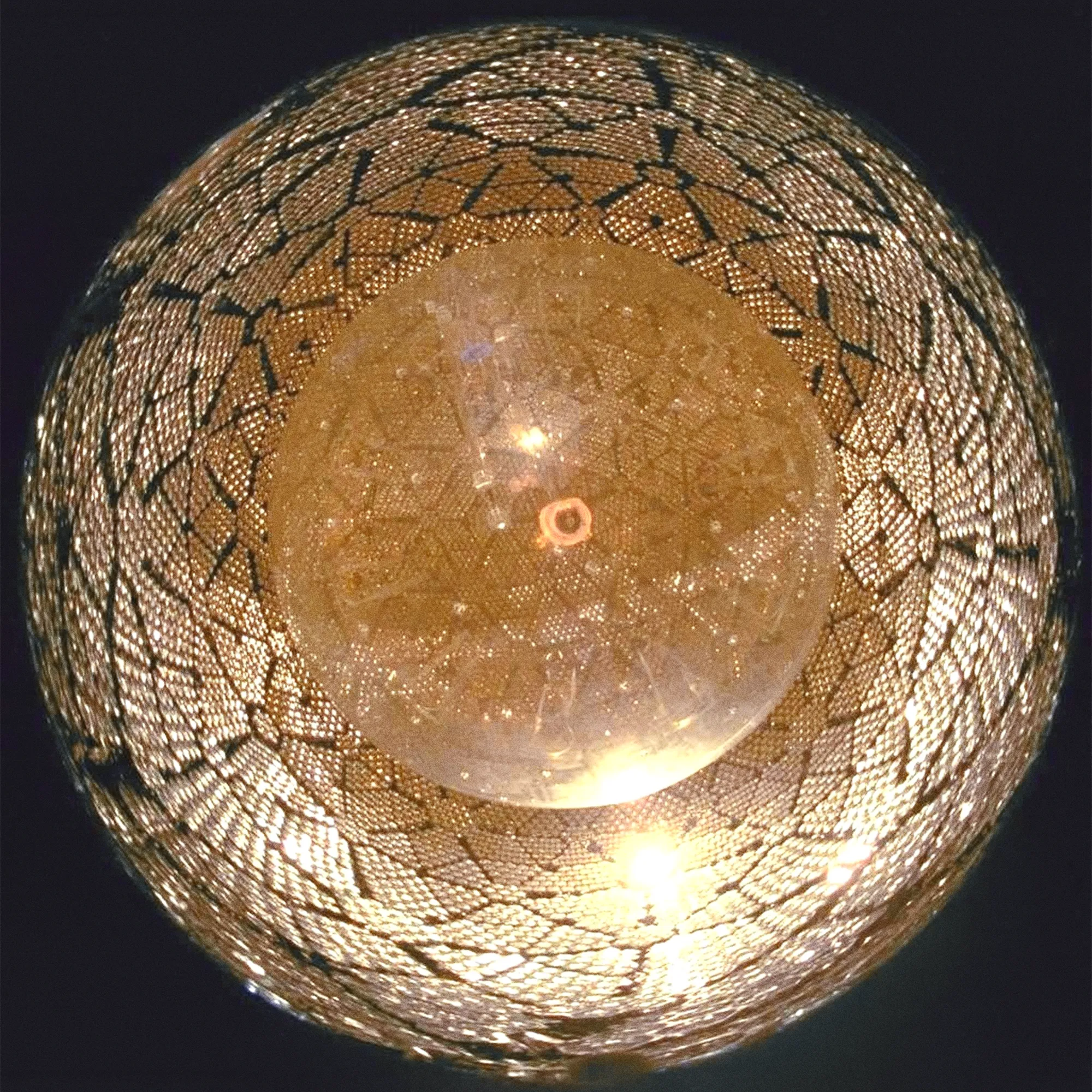
Located 2.1 kilometers underground in the Creighton mine in Ontario, Canada, the Sudbury Neutrino Observatory’s detector (top) was filled with “heavy” water, which features deuterium in place of hydrogen atoms. Its findings provided evidence that neutrinos can change, or “oscillate,” between different flavors. On the bottom is a wide-angle view of the detector’s interior, in the center of which sits a 12-meter-diameter acrylic sphere that holds 1,000 tons of ultra-pure heavy water.
Located 2.1 kilometers underground in the Creighton mine in Ontario, Canada, the Sudbury Neutrino Observatory’s detector (left) was filled with “heavy” water, which features deuterium in place of hydrogen atoms. Its findings provided evidence that neutrinos can change, or “oscillate,” between different flavors. On the right is a wide-angle view of the detector’s interior, in the center of which sits a 12-meter-diameter acrylic sphere that holds 1,000 tons of ultra-pure heavy water.
Courtesy of SNO
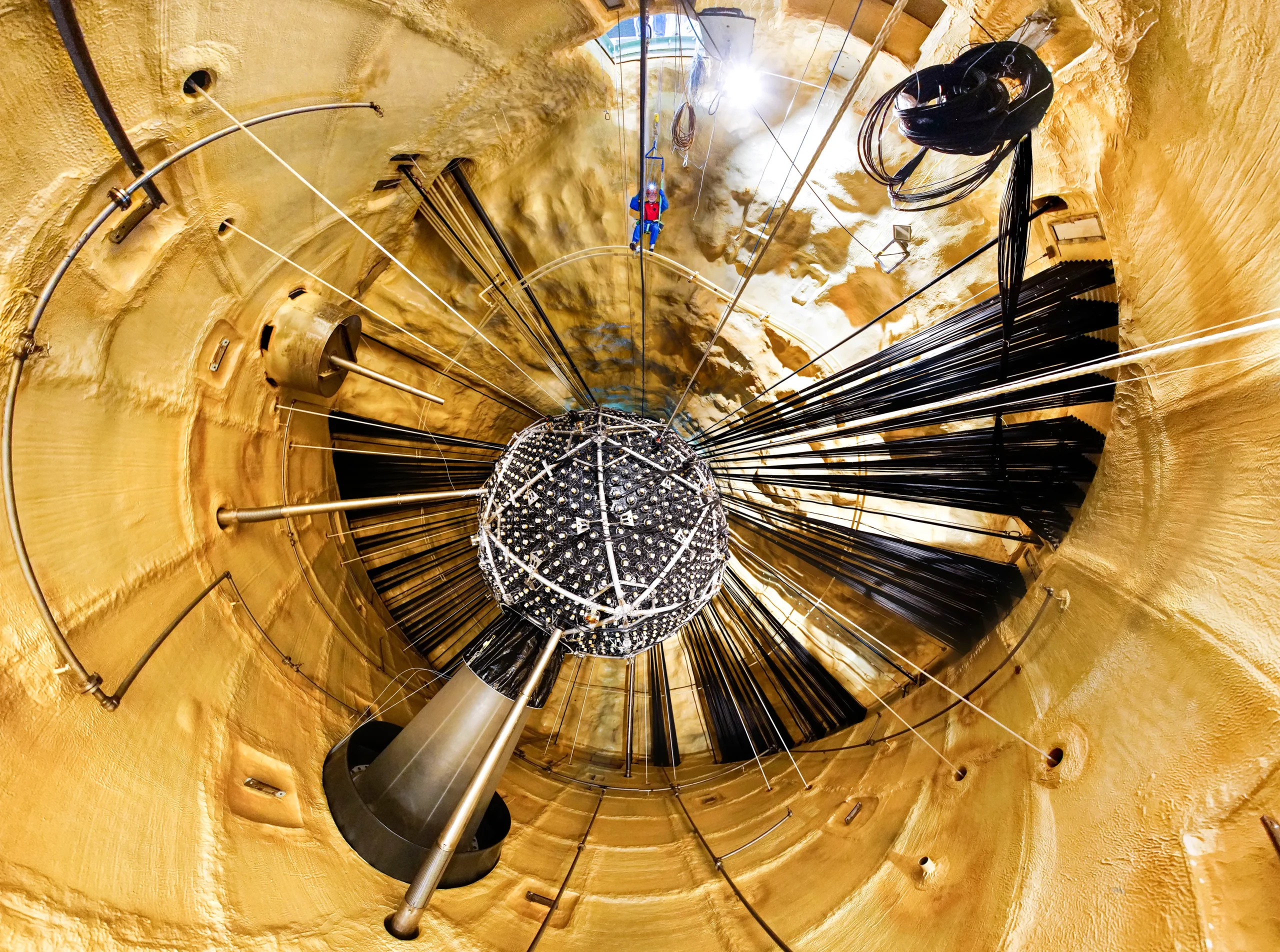
SNO+ succeeded the Sudbury Neutrino Observatory in the Creighton mine and repurposed some of its predecessor’s equipment. But instead of heavy water, it was filled with linear alkylbenzene (LAB), which is used commercially to manufacture dish soap. LAB produces signals 50 times brighter than those produced by heavy water. Hanging from the top is the experiment’s director, Art McDonald.
Volker Steger/Science Photo Library
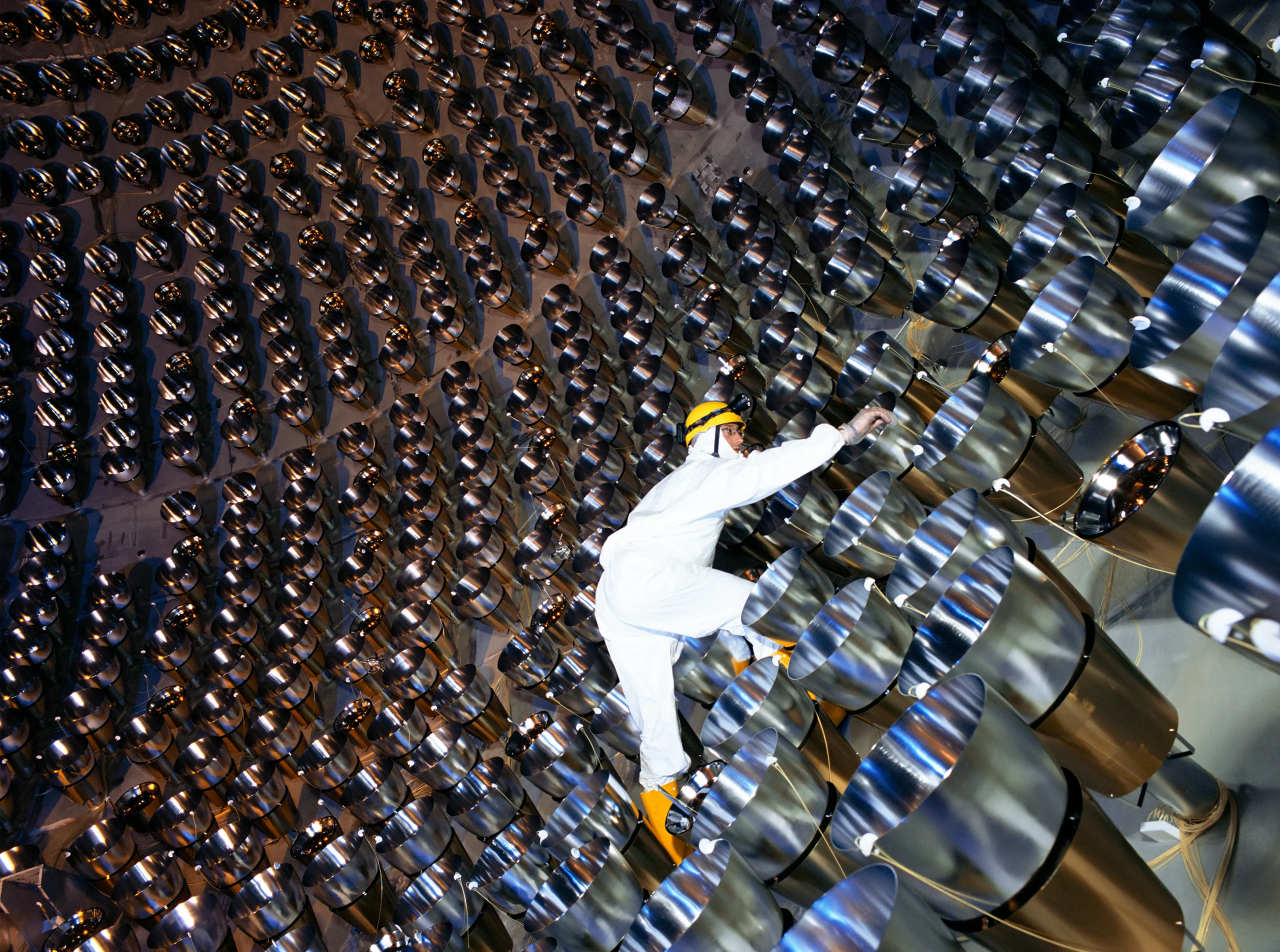
The Borexino neutrino detector, buried near Abruzzo, Italy, at the Gran Sasso National Laboratory, provided the first direct evidence that the sun fuses hydrogen into helium in more than one way. Above, a researcher checks a photomultiplier tube, which amplifies light created by neutrino interactions.
Volker Steger/Science Photo Library
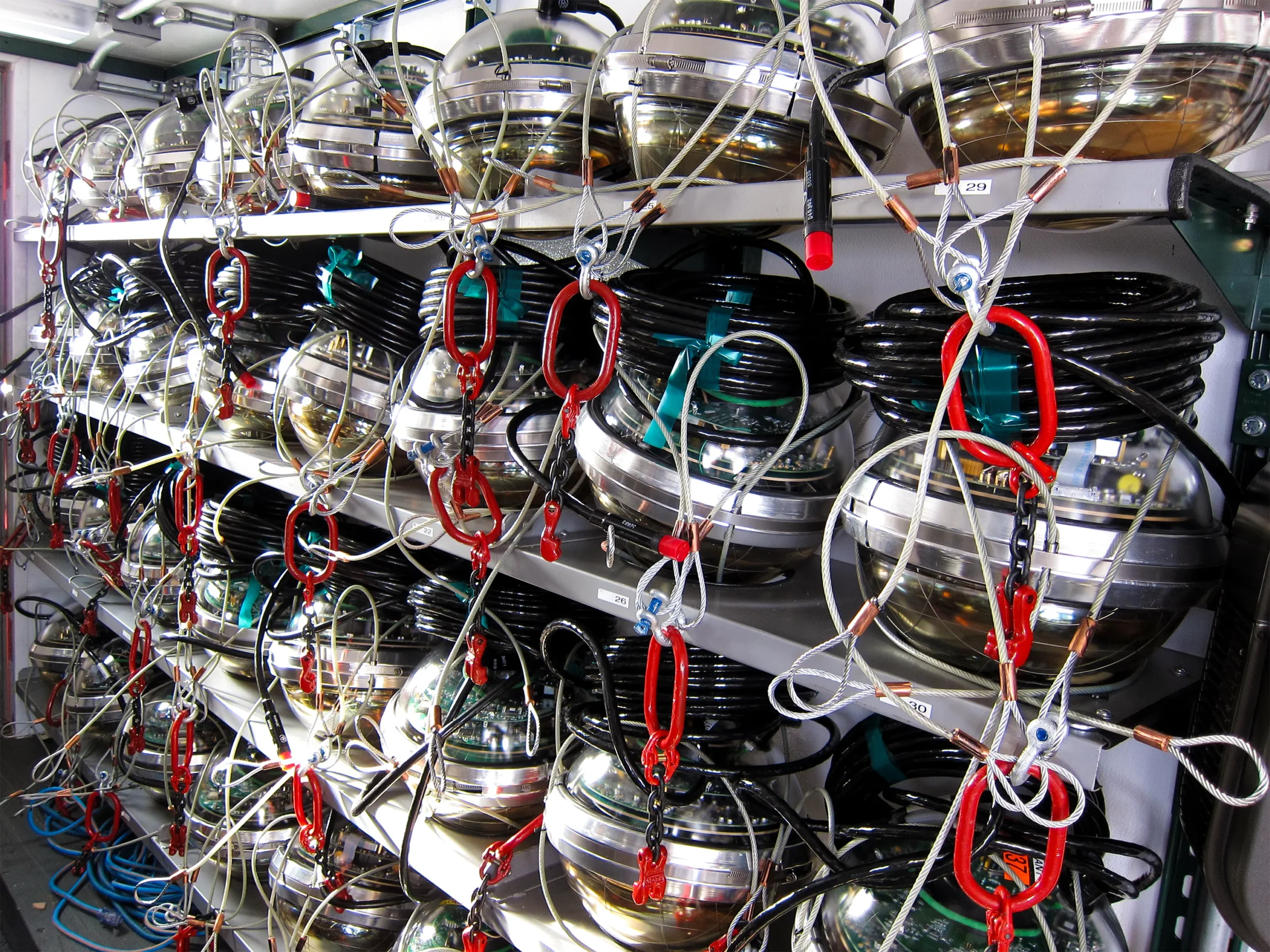
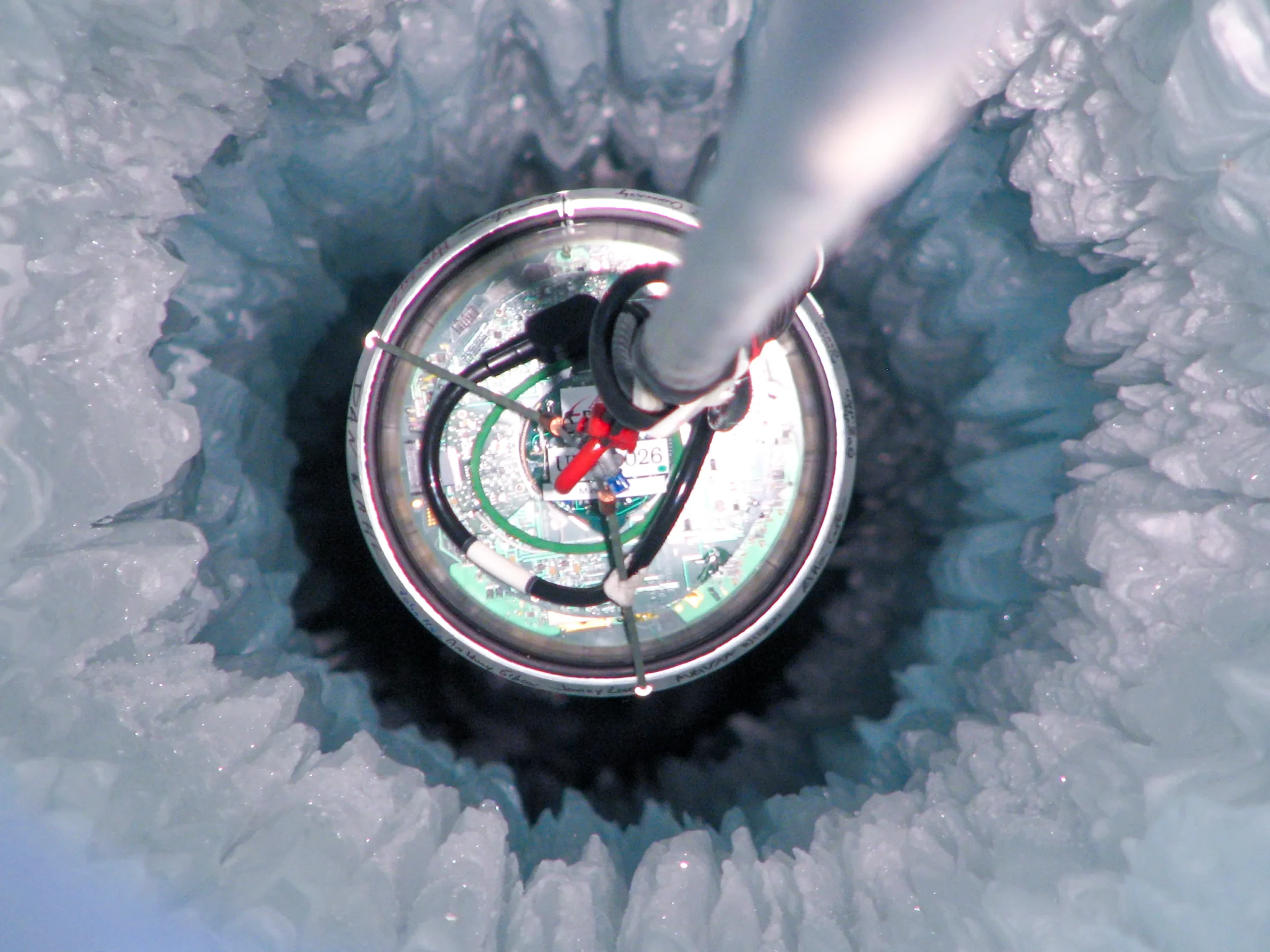
These basketball-size digital optical modules (DOM) are the primary sensors used by the IceCube Neutrino Observatory at the South Pole. Scientists threaded more than 5,000 DOMs onto cables like pearls on a necklace, then used jets of hot water to bury them up to 2.5 kilometers deep under Antarctic ice. Here, ice serves the role that liquid does inside other detectors — a neutrino collision creates a fast-moving electron, and the subsequent flash gets picked up by the DOMs.
Jim Haugen, IceCube/NSF (left); Mark Krasberg, IceCube/NSF
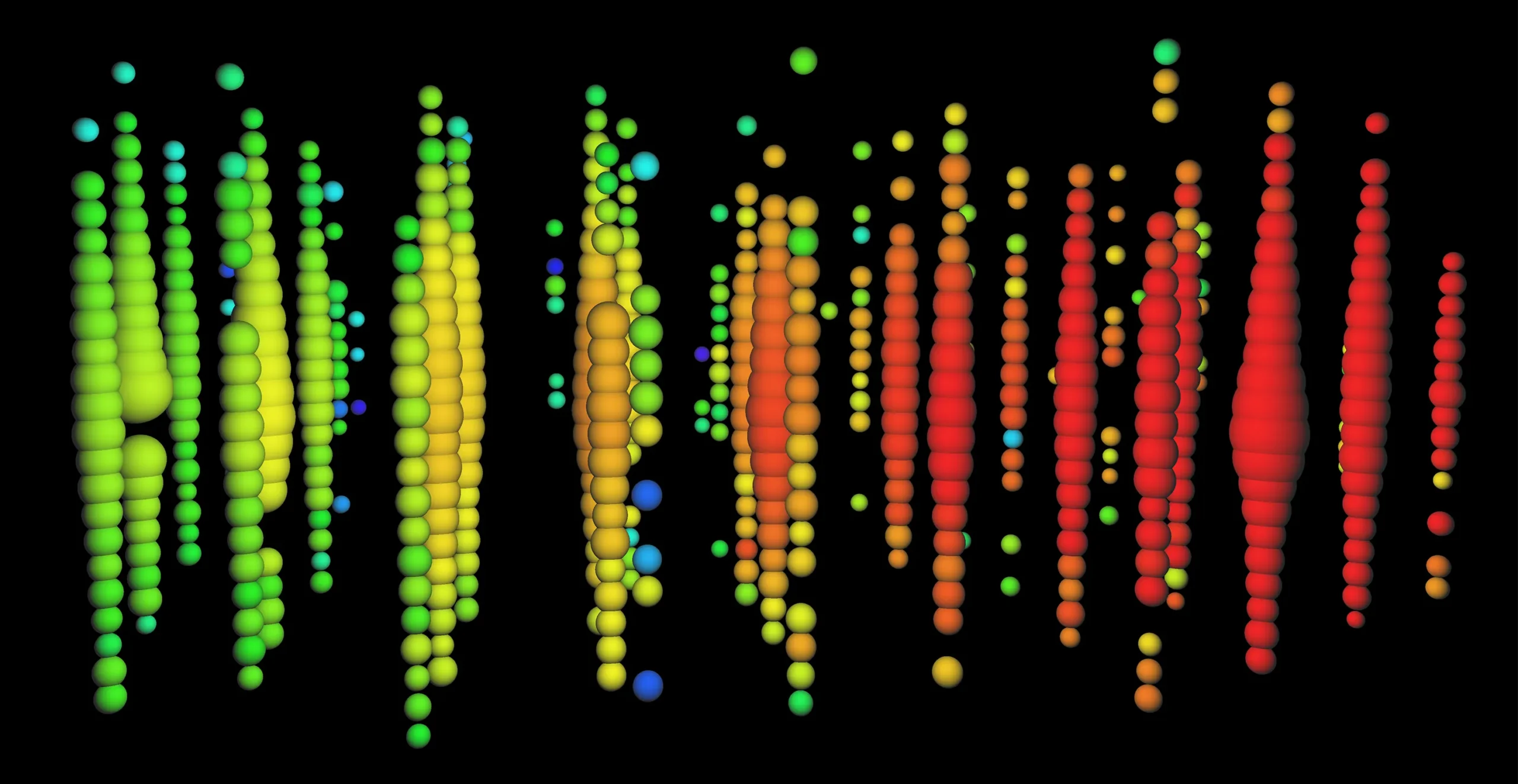
This data visualization shows a neutrino rippling across the buried strings of DOMs in the IceCube Neutrino Observatory. The event, from 2010, corresponds to a high-energy neutrino generated by sources within the Milky Way. The size of each sphere corresponds to the brightness of the signal detected by each DOM, and the colors indicate arrival time — red first and blue last.
IceCube Collaboration
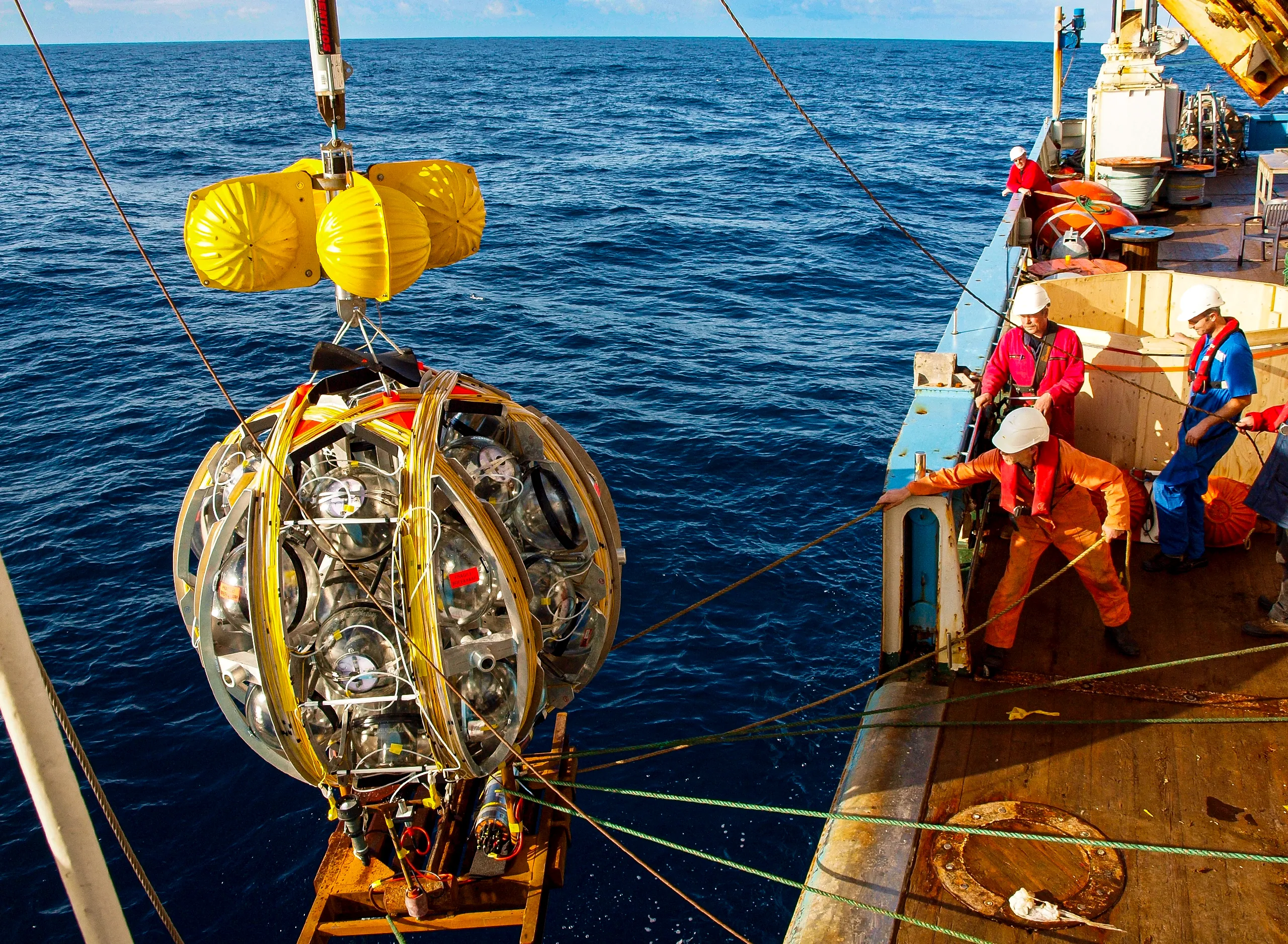
Workers deploy digital optical monitors for the underwater KM3NET neutrino detector, which is still under construction. Nearly 200,000 optical sensors will be anchored to the floor of the Mediterranean Sea at a depth of around 3,500 meters off the coast of Sicily, as well as in a second, smaller array near Toulon, France. The sensors will detect the Cherenkov light generated by secondary particles produced by neutrino interactions with the surrounding water or rock.
Courtesy of KM3NET
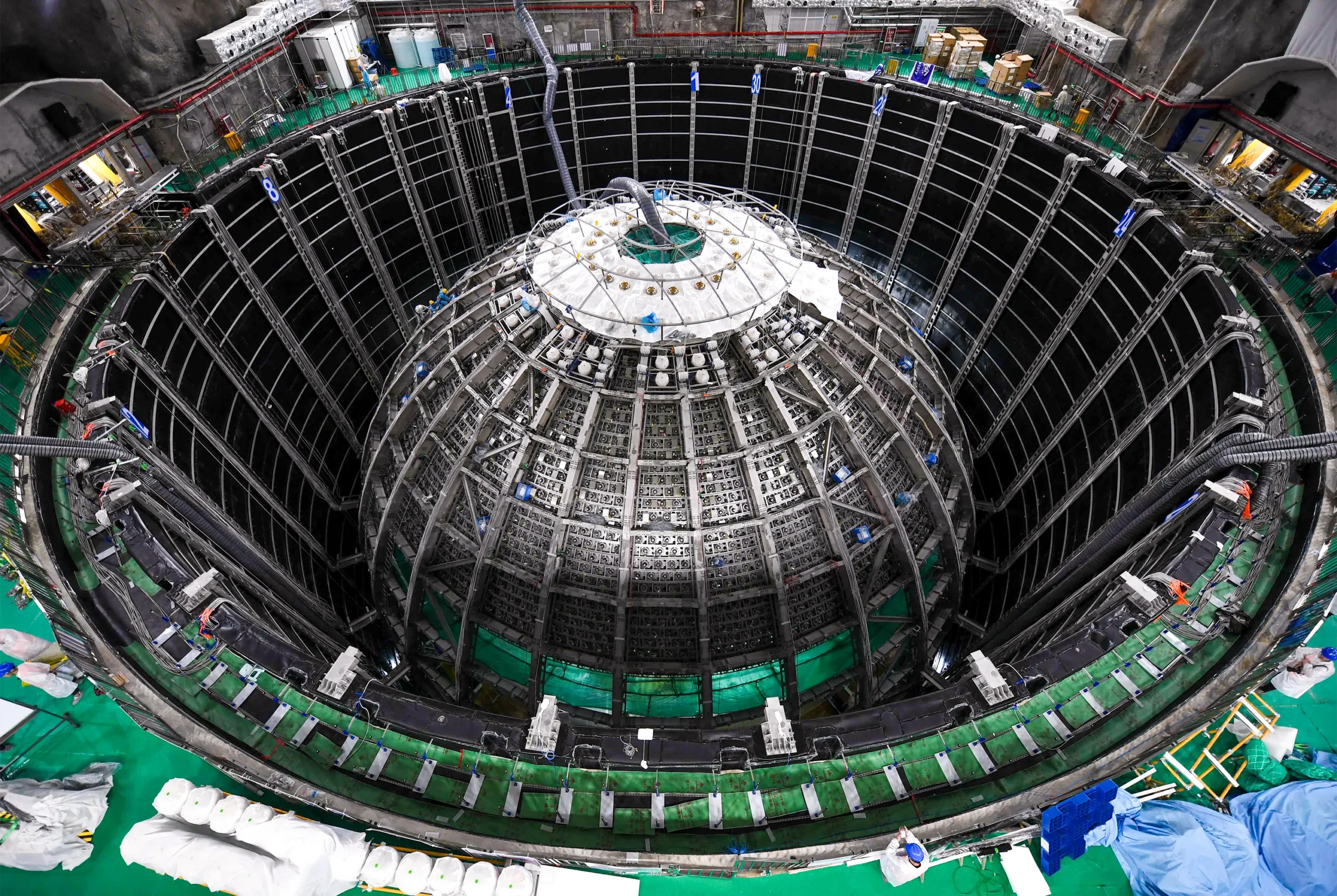
China’s Jiangmen Underground Neutrino Observatory (JUNO), seen here under construction in 2023, is currently the world’s largest neutrino detector. It began collecting data in August 2025; one of its main goals is to determine the outstanding mystery of how heavy each flavor of neutrino is.
Xinhua
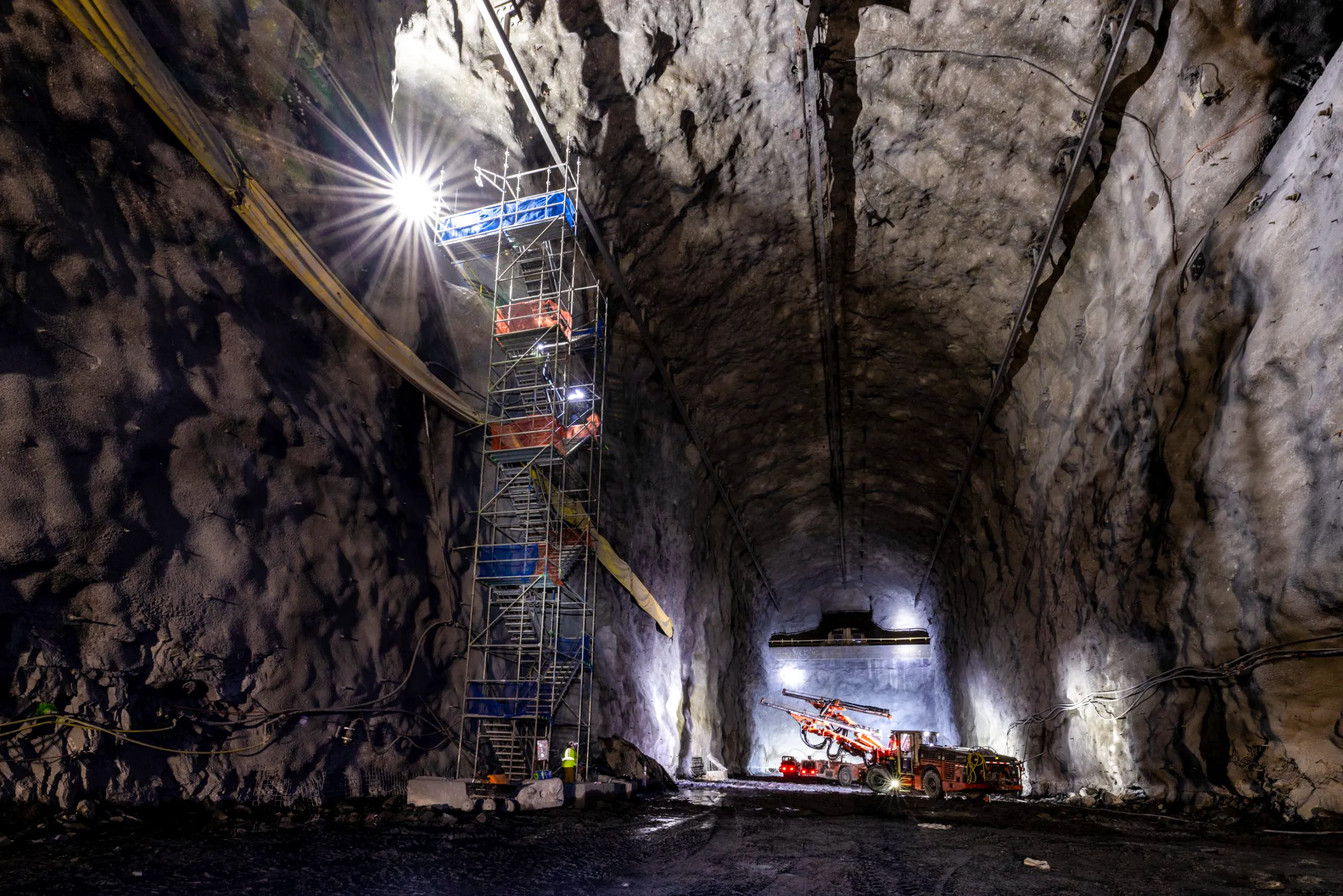
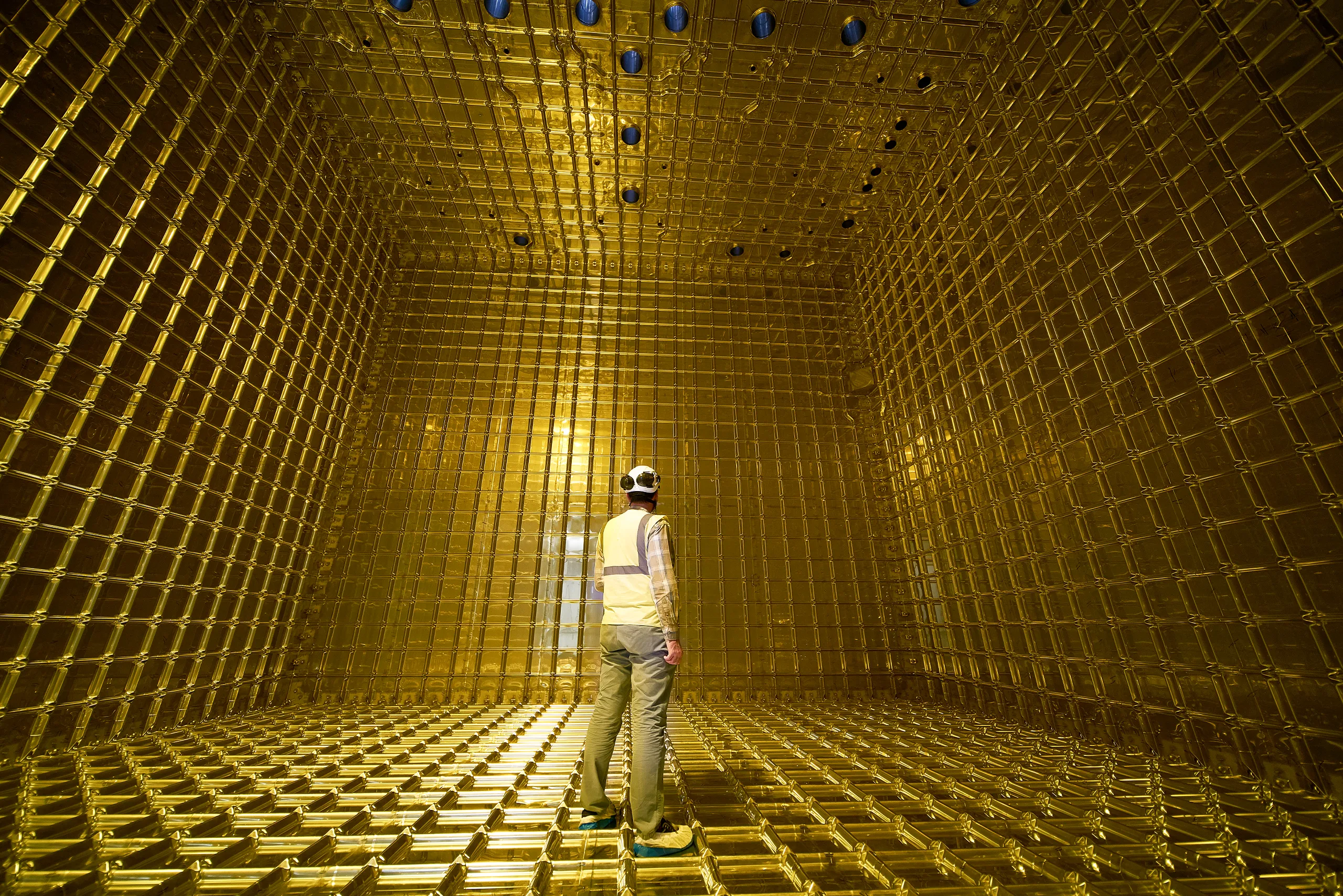
The Deep Underground Neutrino Experiment (DUNE) will generate trillions of neutrinos and send them 1,300 kilometers through the earth to study them when they interact with two detectors — a “near” one 60 meters underground at the Fermi National Accelerator Laboratory, and a “far” one 1.5 kilometers beneath the surface at Sanford Underground Research Facility in Lead, South Dakota (top). Smaller-scale prototypes of the detectors (bottom), called ProtoDUNE, are being tested at CERN, the particle physics lab on the border of Switzerland and France.
The Deep Underground Neutrino Experiment (DUNE) will generate trillions of neutrinos and send them 1,300 kilometers through the Earth to study them when they interact with two detectors — a “near” one 60 meters underground at the Fermi National Accelerator Laboratory, and a “far” one 1.5 kilometers beneath the surface at Sanford Underground Research Facility in Lead, South Dakota (left). Smaller-scale prototypes of the detectors (right), called ProtoDUNE, are being tested at CERN, the particle physics lab on the border of Switzerland and France.
Matthew Kapust, Sanford Underground Research Facility (left); Maximilien Brice/CERN