A Dark Dimension Could Link Two of the Universe’s Great Unknowns
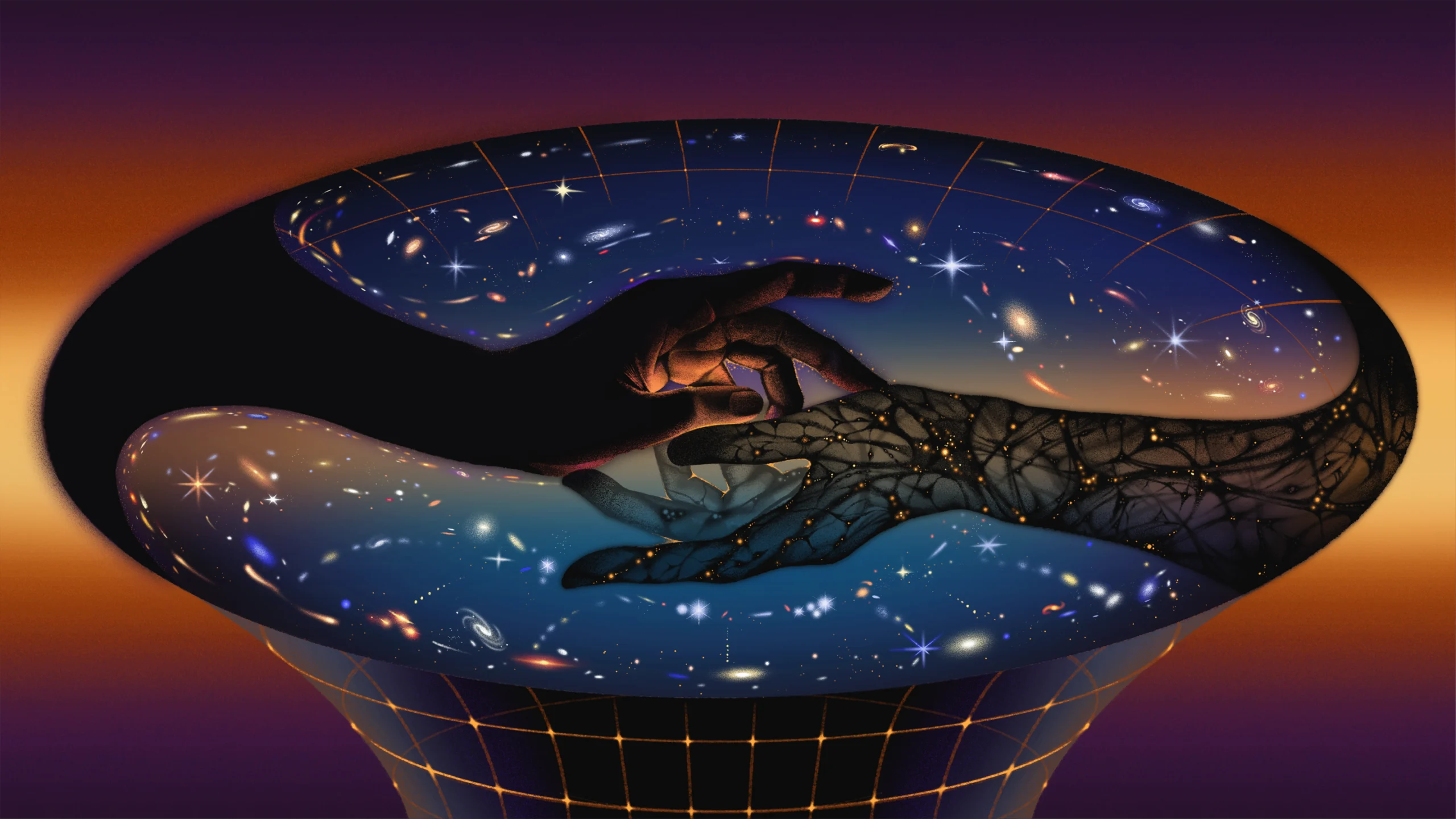
Ada Zejun Shen/Quanta Magazine
Introduction
For those who see the world as a dark place, the universe seems to offer little solace. According to current estimates, approximately 70% of the stuff that makes up the cosmos consists of dark energy, an unknown force that pushes space to expand. And another 25% consists of dark matter, a mysterious material that holds galaxies together.
But semantically speaking, dark energy and dark matter are not so much “dark” as they are invisible. They do not emit, reflect, nor absorb light, and they have so far proven impossible to observe directly.
Generally, dark energy and dark matter are regarded as separate entities, their elusiveness their primary link. But recent astronomical observations have spurred scientists to look further into a less popular idea — that the two are in fact physically intertwined.
In 2024, the research team known as DESI, for Dark Energy Spectroscopic Instrument, found evidence that the strength of dark energy, sometimes referred to as the “cosmological constant,” had lost its presumed constancy. A 2025 study based on more than twice as much data also concluded that dark energy was changing over time.
These results indicate that after attaining a maximum value about 2 billion years ago, dark energy may have begun to weaken. But the results also suggested that in an earlier era, dark energy could have grown stronger, in seeming defiance of the law of energy conservation.
Researchers describe this as dark energy entering the “phantom regime.” They liken the situation to a ball rolling uphill. It’s certainly possible, but only if the ball is under the influence of something other than gravity.
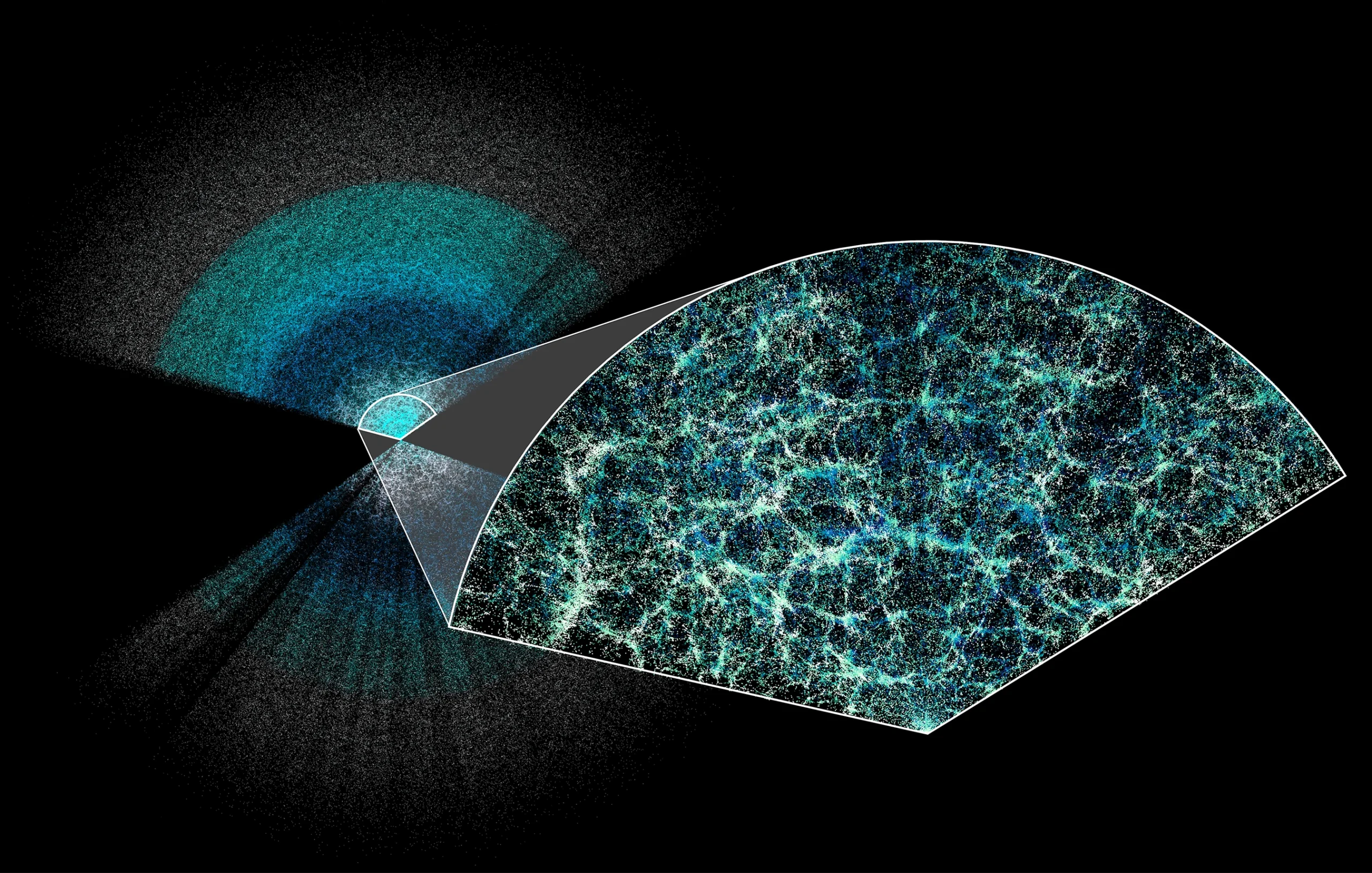
A slice of a 3D map produced by the Dark Energy Spectroscopic Instrument team shows connected strands of galaxies forming the structure of our universe.
Claire Lamman/DESI collaboration; custom colormap package by cmastro
A growing number of theorists are looking into the possibility that what’s influencing dark energy are its ties to dark matter.
Even though scientists have assumed that dark energy and dark matter “don’t have anything to do with each other,” said Tim Tait, a particle physicist at the University of California, Irvine, “you can imagine a case where one influences the other. And it would not be surprising if [they] were manifestations of a kind of unified theory of the dark universe.”
Dark Interactions
The idea that dark energy and dark matter interact is not new. For example, Justin Khoury, a physicist at the University of Pennsylvania, investigated the prospect in 2005.
Khoury explained that in that study, he and two coauthors posed a hypothetical question: Could there be a form of dark energy whose energy density increased over time? He and his collaborators found that if dark energy and dark matter could affect one another, they could produce what looked like (but was not) phantom behavior. “It is the most natural, simplest way of achieving this,” Khoury said.
Two decades later came the DESI finding that dark energy might actually be changing over time. The result spurred Khoury and two Pennsylvania colleagues, Meng-Xiang Lin and Mark Trodden, to construct a model of dark interactions based on a dark-sector analogue of quantum chromodynamics, a cornerstone theory of particle physics. In the new model, both the energy density of dark energy and the mass of dark matter change in concert.
Another recent study imagines something similar. According to this model, which was published in January in the journal Physical Review D, dark matter could have transferred a small fraction of its energy to dark energy during a previous era of cosmic history. “Dark matter is the main brake on [the universe’s] expansion,” said one of the authors, Elsa Teixeira, a cosmologist at the University of Montpellier in France, so easing up on that brake would have caused the expansion of the universe to accelerate.

Elsa Teixeira, a cosmologist at the University of Montpellier in France, investigated a cosmological model in which dark energy and dark matter interact.
Courtesy of Elsa Teixiera
The appearance of phantom behavior is basically the result of bookkeeping, said David Andriot, a physicist at CNRS, the French National Center for Scientific Research. “Any change or evolution of the mass of dark matter has been put into the box of dark energy,” said Andriot, who presented his own coupled dark energy-dark matter model in May 2025.
Cumrun Vafa, a physicist at Harvard University, agreed. “The notion that you can compute dark energy independently of dark matter is wrong,” he said. “That assumption, often made by cosmologists and also followed by the DESI team, led to the physically unacceptable phantom behavior.”
The DESI findings are not the only reason to consider an association between dark energy and dark matter. Teixeira and colleagues’ recent study shows how allowing the two to interact can, at least in some scenarios, ameliorate one of the most persistent problems in cosmology: the Hubble tension.
At issue is the current expansion rate of the universe, known as the Hubble constant. Its value can be measured by using light from the early universe, which provides a view of how the cosmos was growing in its earliest days. It can also be measured by drawing upon more recent phenomena, such as exploding stars called supernovas, which reveal how the universe is growing now.
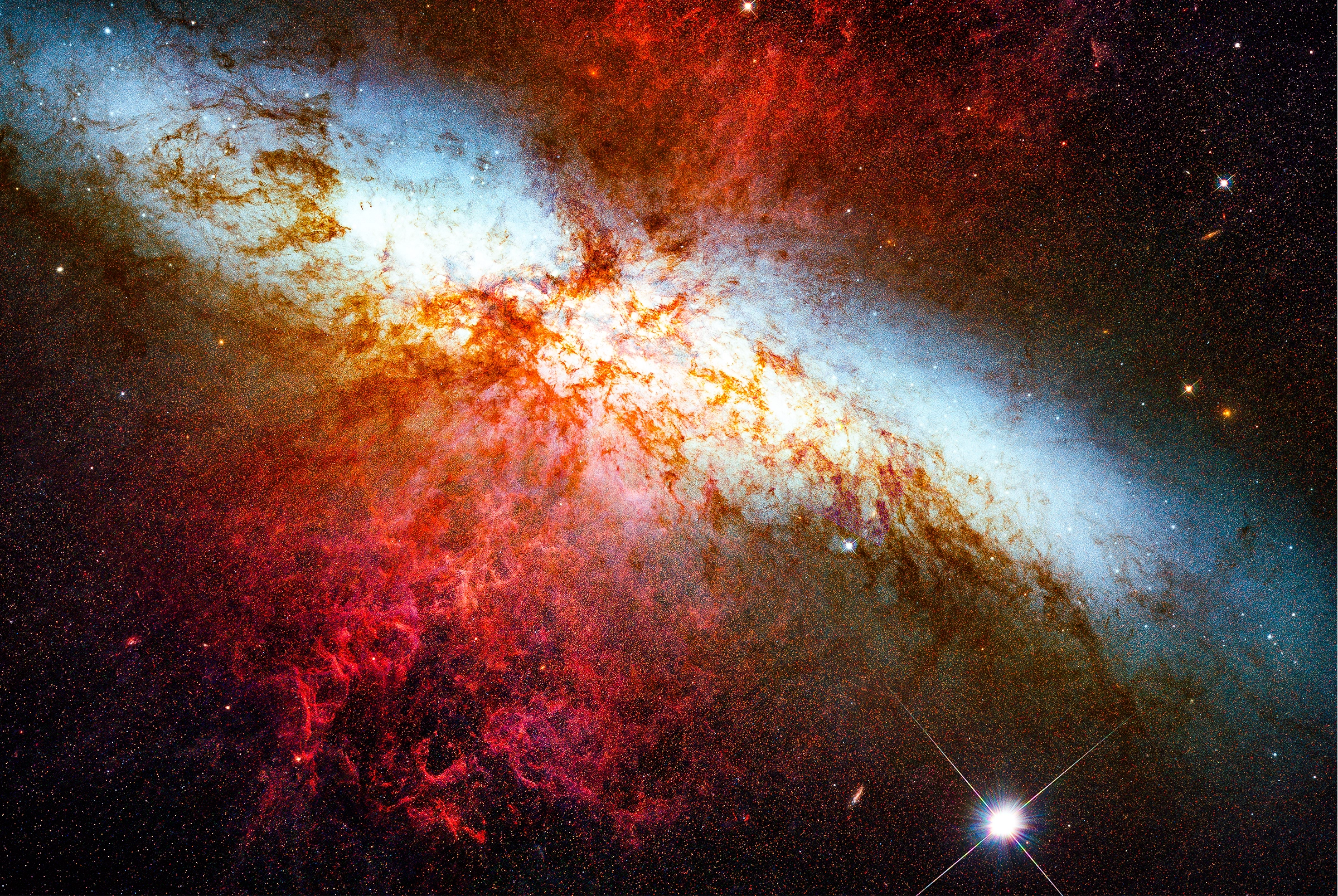
Studying the light from supernovas like this one — the flash of light in the bottom right of an image from the Hubble Space Telescope — can tell us about the expansion rate of the universe.
NASA, ESA, A. Goobar (Stockholm University), and the Hubble Heritage Team (STScI_AURA)
According to the standard model of cosmology, that expansion rate should be the same no matter how you measure it. But in recent years, scientists have found that the expansion rate of the early universe and that of the more recent universe vary by approximately 9%.
That discrepancy, or tension, “has provoked heated debates in the cosmology community about whether this difference could be due to systematic errors or whether it is a signal of new physics,” Teixeira and her co-authors wrote. Their model posits that in a world where dark energy and dark matter interact, what seemed to be a crisis caused by disparate expansion rates instead becomes something to be expected.
A Dark Dimension
If dark energy and dark matter do interact, it could mean that they have a common origin, Khoury said.
Ongoing work in string theory — the idea that our universe, at its smallest, most fundamental level, is made up of vibrating strings — suggests a way these concepts might be connected. In 2019, building on the idea in string theory that dark energy is naturally varying, Vafa and two collaborators concluded that the mass of dark matter particles may also vary over time. This led them to propose in 2022 that dark matter and dark energy could share a link with a so-called dark dimension.
String theory posits the existence of six or seven extra dimensions in addition to our familiar three dimensions of space and one of time. All of these dimensions are thought to be as small as physically possible — close to the Planck scale (10-35 meters) — but the researchers proposed that the dark dimension could be significantly bigger than the others — on the order of a micron (10-6 meters).
Gravitons, theoretical particles that impart the force of gravity, could leak into this enlarged dark dimension. If they did, they would pick up mass and become what are called dark gravitons. These massive gravitons would reside in the dark dimension, but their gravitational effects could be felt in other dimensions, allowing them to fulfill the role that is normally ascribed to dark matter.
In this scenario, “there is a very natural coupling between dark energy and dark matter,” said Georges Obied, a physicist at the University of Chicago. Changes in the size of the dark dimension would affect both dark energy and dark matter.
In a July 2025 paper, Obied and Vafa, along with Alek Bedroya of Princeton and David Wu of Harvard, found that the scenario proposed in 2019 was consistent with the DESI data. Their model predicts that the strength of dark energy and the mass of dark matter will decrease over time and that the rate at which dark energy changes will be proportional to its energy density. Because astrophysical measurements tell us that the energy density of dark energy is extraordinarily small, “it won’t change fast,” Vafa said.
“It’s not surprising that we didn’t see it until now,” he said, because the rate of change is so tiny. “We had to wait the entire age of the universe to detect something that small.”
If dark matter is coupled to dark energy, dark matter particles could interact with one another through a new, long-range force that is separate from gravity. The good news, Obied said, is that “there could be astrophysical ways of testing this.”
Coincidentally, two physicists — Marc Kamionkowski, now at Johns Hopkins University, and Michael Kesden, now at the University of Texas at Dallas — have already looked into one such test. In a paper published in 2006, they imagined a sequence of events in which two galaxies come close to each other and the gravity of one galaxy tugs at the other. If dark matter has a stronger gravitational attraction to other dark matter than it does to ordinary matter, a special kind of “tidal tail” — an extended stream of stars, gas, and dust — would form behind one of the galaxies.
Kesden and Kamionkowski looked for this effect and didn’t find it, which enabled them to set an upper bound on the possible strength of the extra attractive force. The upper bound was about 20 times bigger than the number Vafa’s team proposed, so the predicted value fell well within the observational bound. “It is interesting that we are now finding connections between that fairly abstract work and observational and experimental work,” Kamionkowski said.
The fact that a prediction based on calculations from string theory roughly agreed with the astrophysical evidence does not confirm the validity of these “stringy” models. But any correspondence between string theory and experiment is gratifying to Vafa, who has spent the past four decades trying to wrest the theory from the purely conceptual realm to the point of generating testable predictions.
Obied, one of Vafa’s former Ph.D. students, is driven by the same goal. Understanding dark energy and dark matter and the relationship they may share is a daunting problem, he said. “And I think it’s very beneficial to come at this in different ways” — be it from observational cosmology, from particle physics, or from string theory.
“This is how people should do science,” Obied said. “I mean, it’s the job of theoretical physicists to explore everything that’s possible, to get all the possibilities on the table. And eventually, the data will help us decide.”