In an Age of AI, a Physicist Seeks What Endures
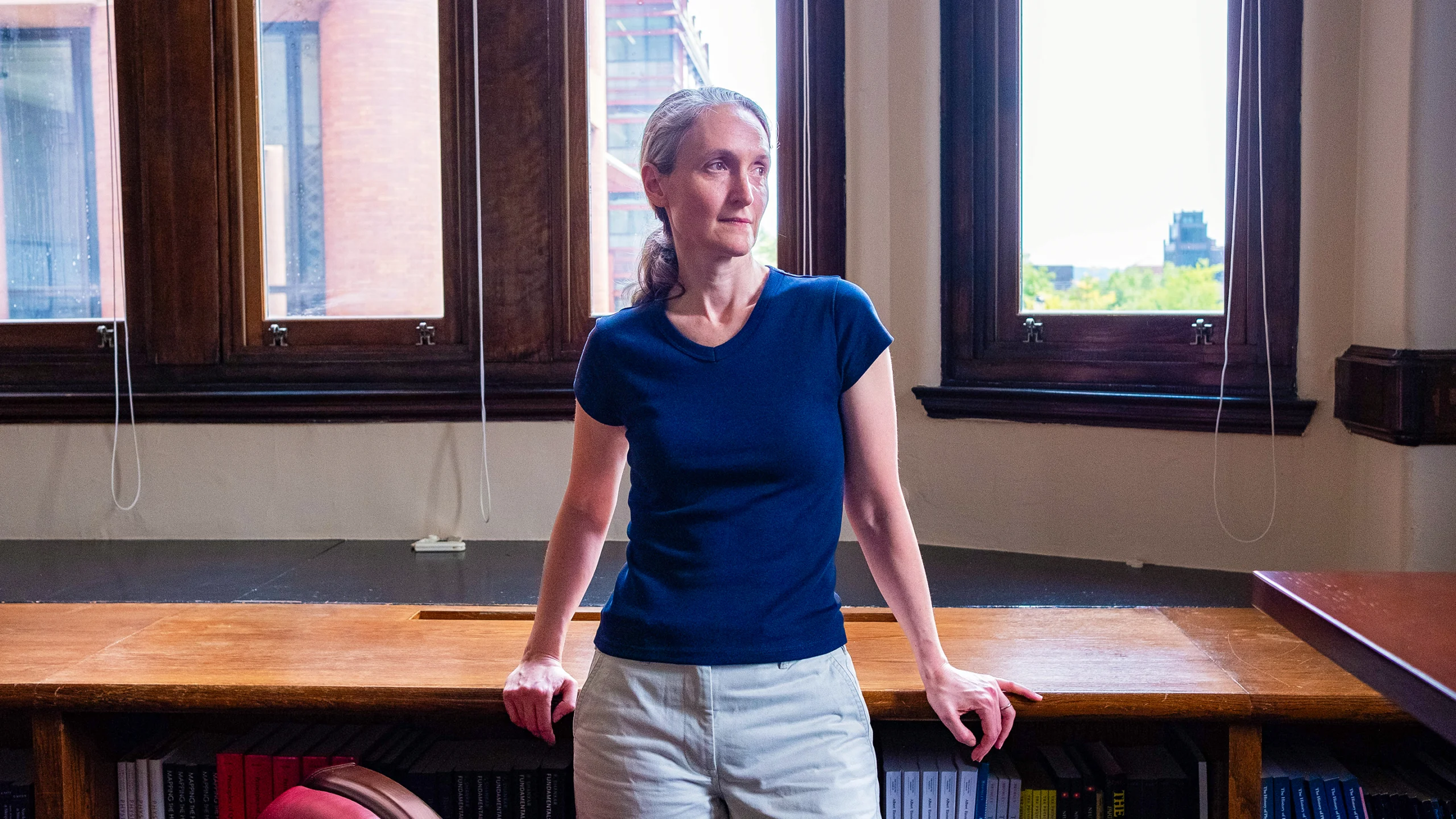
Sarah Demers, who is co-authoring a policy statement about the use of AI in physics, has never typed anything into Claude or ChatGPT.
Karen Dias for Quanta Magazine
Introduction
In July 2026, the U.S. Department of Energy selected 278 projects to fund as part of its Genesis Mission, meant to incorporate artificial intelligence into the scientific process. One project will use AI to help physicists search for a vanishingly rare particle transformation — a muon becoming an electron — by controlling different aspects of the Mu2e experiment at Fermi National Accelerator Laboratory near Chicago.
“We have all of these knobs that we can turn to optimize our experiment,” said Sarah Demers, who works on Mu2e. “For example, how long do we run with our magnetic fields on? And at what strength do our magnetic fields run? Where is our target placed? Which ones of our systems need to be online?”
Demers appreciates how AI may help to make quick adjustments to the experimental setup. “Sometimes it can feel like it’s more of an art than a science, to tune these machines,” she said. “Having AI capabilities help us populate that space is a godsend.”
But Demers, the chair of the physics department at Yale University, does not welcome AI into other areas of her work, or her life. Some of her reservations about the technology stem from the fact that popular large language models (LLMs) are trained on datasets full of others’ intellectual property — likely including Demers’ own writing — and don’t properly credit their sources.
In light of new developments in AI, physicists are having existential conversations about what it means to do physics research. “Confronting that — what is physics, really? What is enduring about the practice of physics itself? — that does not change with AI,” said Demers, who is leading an effort through the American Physical Society (APS) to produce an AI policy statement. “Coming to terms with that, and articulating that, is useful.”
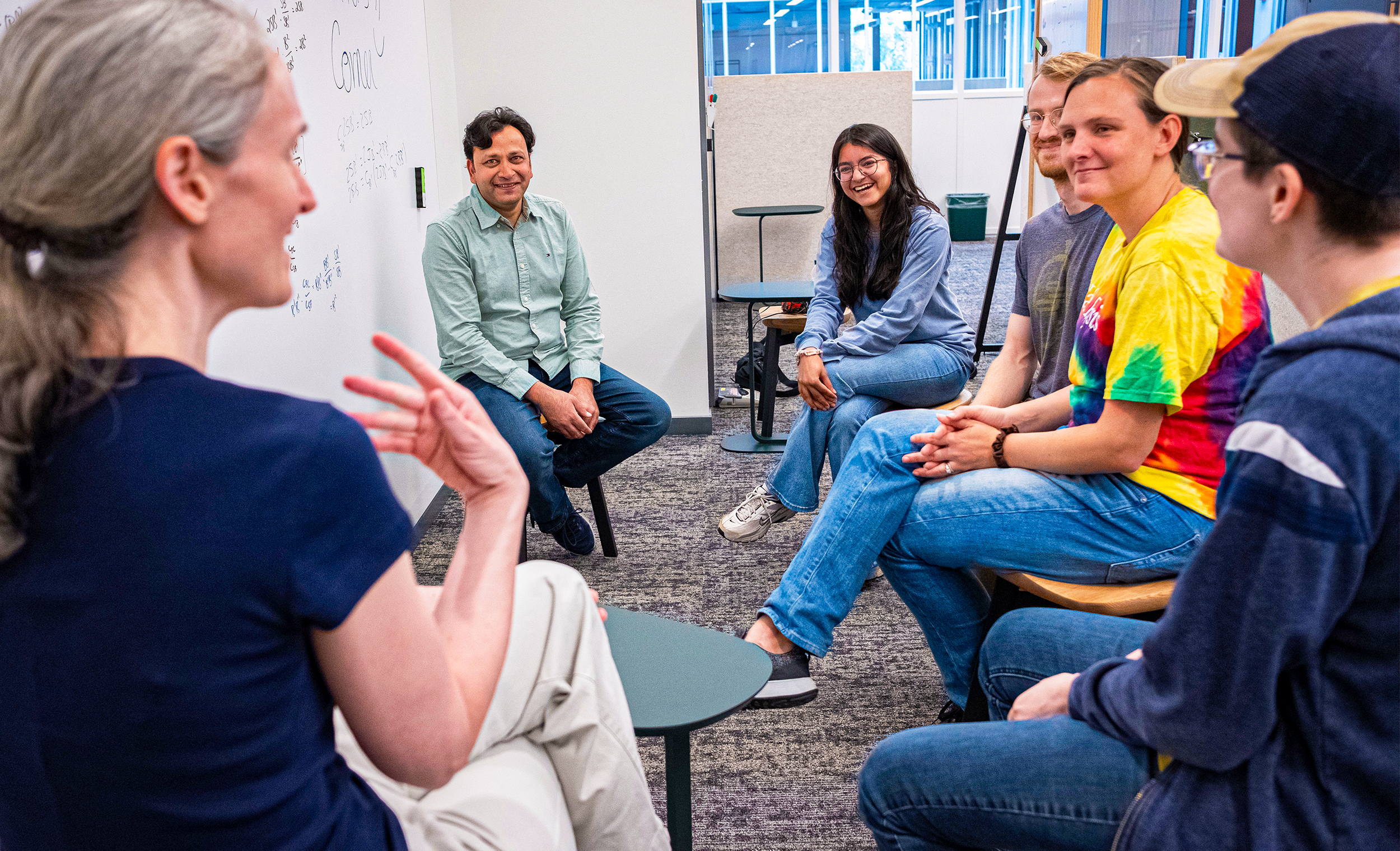
Demers (left) talks with colleagues and students at Yale University.
Karen Dias for Quanta Magazine
Quanta spoke to Demers about AI in physics, how physicists can benefit or suffer from it, and why Demers refuses to use it to write her emails. Multiple interviews have been condensed and edited for clarity.
Your research has long used what is now called AI. What is actually new about the AI systems that people are using in particle physics today?
I would say right now in the field of particle physics, we’re seeing the fastest changes in the theoretical physics realm. The newest LLMs are massively speeding up calculations and changing the skill sets that people need in order to get from A to Z, in terms of solving a problem or answering a question.
What skills do people now need to have?
We haven’t really figured out what all of those skills are. In some physics Ph.D. programs in the U.S., if you go back enough decades, you’ll find that there was a requirement for people to learn to read German. You had to be able to do that, because if you weren’t able to read German, you couldn’t read the important papers that were a critical part of your training.
It’s clear that moving forward with AI on the scene, we’re not going to be requiring all of the same skills. So I’m trying to be open-minded about which of these skills really are crucial to physics of the present and the future, and which of the skills are not as central.
What kinds of questions are you asking about what it means to do physics in the current age of AI?
I think that everyone who is a practicing physicist right now needs to think about what good physics looks like: What does it mean to learn about our universe through the kinds of experimental interrogations that we’re doing? We have to think about keeping the field alive in the future: How are we training the next group of physicists? We have to think about the design of an experiment, the optimization of an experiment. We have to balance the resources that we’re using, which includes the cost of doing the AI investigations.
We need to remember our skepticism and be careful about the hype that we’re hearing. Human physics is not over.
It’s also part of the scientific process that we correctly give attribution to the ideas. If we lose that, if we lose this conversation among everyone who’s contributing, we’re attacking our foundation. We will lose track of what’s valid and what isn’t.
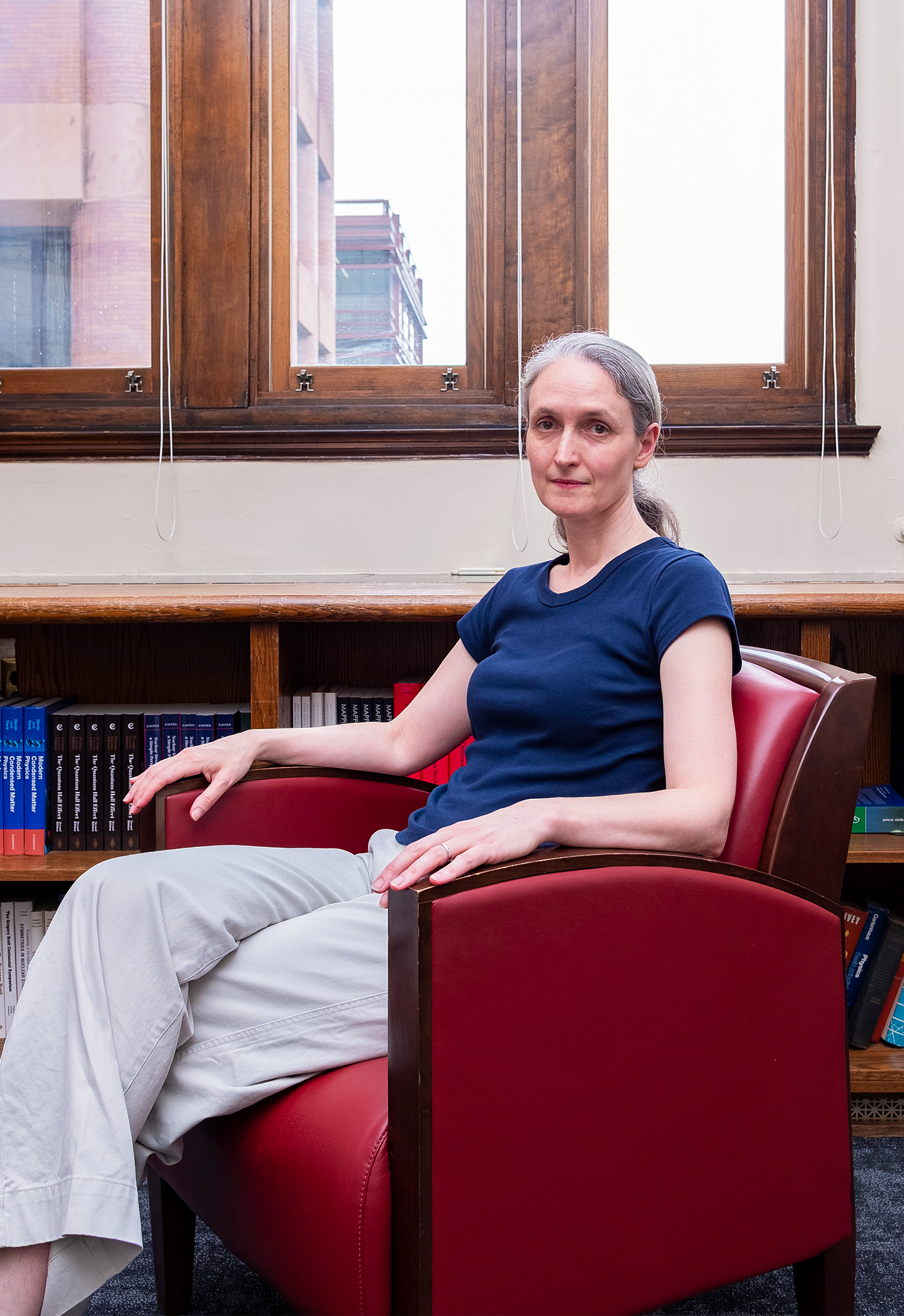
Demers, pictured in her office at Yale, partnered with Emily Coates, a fellow professor and former member of the New York City Ballet, to write a book about physics and dance, which was published in 2019.
Karen Dias for Quanta Magazine
How are LLMs changing things on the experimental side?
On the experimental side, we’re still playing, I think, and still trying to wrap our heads around what the potential is.
On the ATLAS experiment [at the Large Hadron Collider], we take the output from hundreds of millions of electronic channels and have to reconstruct what we think happened, in terms of particles interacting with the detector. It requires the data to be in certain formats, and it can be very finicky. So the fact that we can now have data massaged for us, or get a first-draft data access framework from a coding assistant, has potential to really accelerate our analysis processes.
One of the most exciting uses of AI in my field has been going back and looking at previous experiments. If I want to go back and ask a question about data from one of those experiments, I have to bring back from the dead some long-gone computing system, resurrect some code that is no longer with us, so it’s not something that made any sense to do. But now you’re able to take in all of the digested data, the plots that were created, or maybe even work with a dataset that’s not massaged well enough. You have to ask questions carefully to make sure that it’s safe to use, but then we’re able to ask and answer questions we otherwise couldn’t.
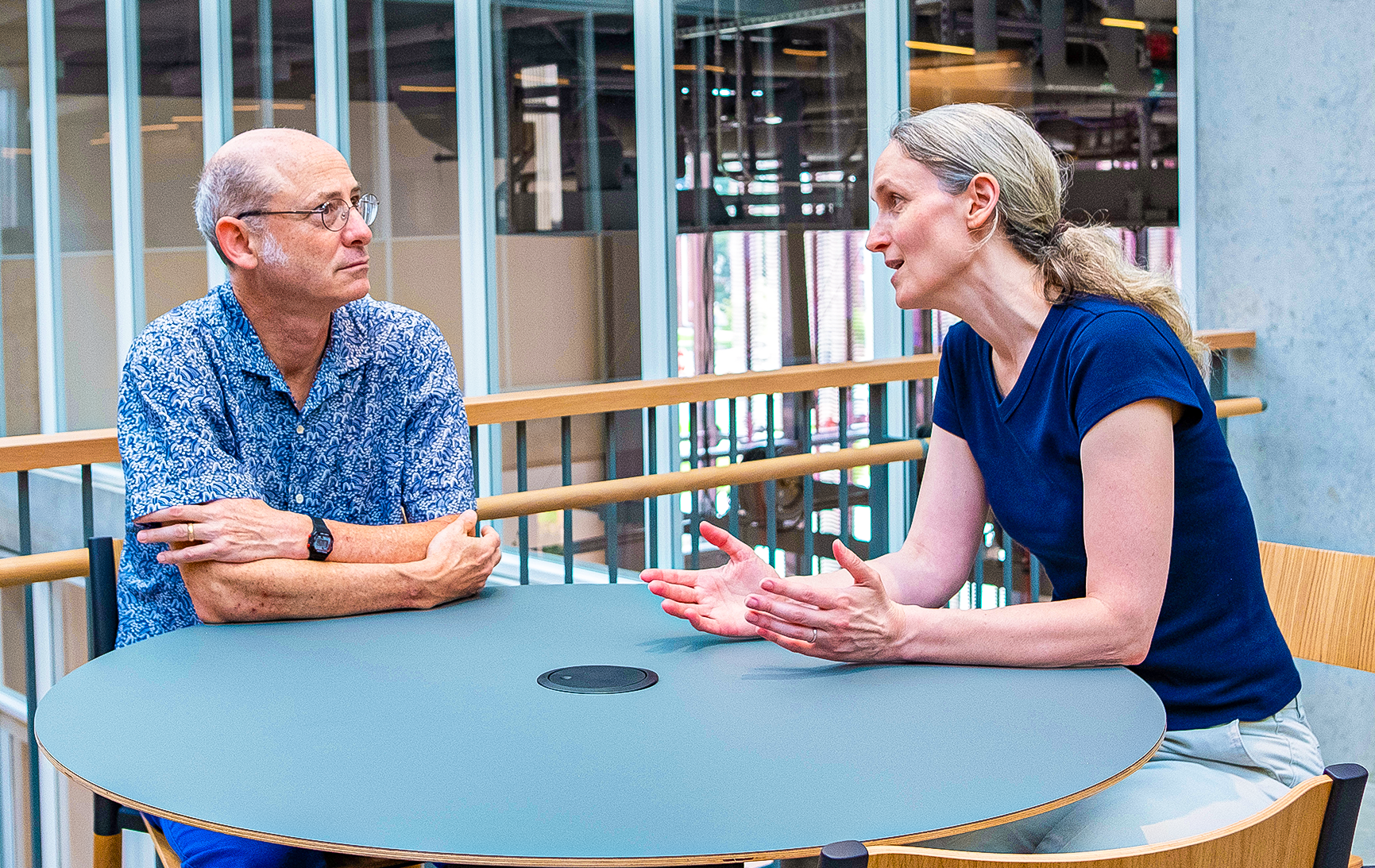
Demers and her colleague Jack Harris at the Yale Wright Laboratory.
Karen Dias for Quanta Magazine
You’re working with colleagues on a policy statement regarding AI in physics. What sorts of things are you hearing from peers about physics and AI?
There are quite a few people, and I’m one of them, who are worried about intellectual property and worried about attribution. It’s outrageous what’s happened, right? This is a moral hazard. We can’t let this stand.
At the same time, there is so much excitement about the fact that you can type on your computer, and it’s like you have the halo of every thinker who’s written something surrounding you, giving you their words. It’s so wrong, and it’s so incredible, simultaneously.
I think the area where we have the most agreement as a field is that a physicist is responsible for what is in their publication if they’re going to sign their name. You may not understand all of the details about how a model works — though there’s disagreement about that — but you certainly have to have a way to validate the information that comes out of it. Otherwise, we’re just not playing in the realm of making progress in science anymore; we’re just adding noise to the system.

The AI policy statement from the APS is expected to come out around spring 2027.
Karen Dias for Quanta Magazine
How are LLMs changing the experience of being trained in particle physics? What will the next five or 10 years look like for someone coming in now as an undergraduate?
A best-case scenario is that they are able to ask and answer questions more quickly than we would have dreamed they could before. It used to be that a new undergraduate who would come into my group might spend five months before they made a meaningful plot. I think we can engage new researchers more quickly, in terms of interacting with the bleeding edge of the data.
In a perfect world, we’ll have more time to do training on: What are the interesting questions? How do you go about answering those questions? Maybe those big questions that people wrestle with, maybe that can come earlier in someone’s research career, if people spend less time fighting over bugs in their code or accessing the data. The potential for interdisciplinarity can expand even further if we manage to stay in conversation with each other, if we manage to still train people to think like physicists.
How does that differ from your experience?
I remember being in grad school and having a question, and this was before you could Google an answer. The downside was, I felt humiliated all the time. I was always having to ask somebody, “How does this work?”
Karen Dias for Quanta Magazine
But the relief when I admitted to somebody that I didn’t know something was palpable. It was amazing. I came clean, and then we had a great conversation, and I actually learned something. It made me make connections, both with humans, but also in my internal wiring. It helped me learn.
What’s the flip side of that? You can throw anything at an LLM, and there’s no one there to judge you. Is there an upshot, where maybe some really unorthodox ideas come out of asking questions of LLMs?
This is a place where I think the more advanced researchers are having more fun than people who are more junior. If you really have enough experience, I’ve heard that an LLM can be a thought partner — a “thought partner” in quotes. I don’t do this, but I have colleagues for sure who find that fruitful and productive. They can very quickly get references, and they can make some progress, they can refine ideas.
That’s for an expert-level user. You have to understand enough to know when you’re going off the rails. I think there are risks for more junior researchers, or people with less experience, to try to use LLMs as a thought partner. That sounds dangerous to me.
Why don’t you use LLMs that way?
I’ll just come clean with you and tell you that I have enough objections that I’ve never typed anything into Claude or ChatGPT. So I’m in a very weird space, personally, with this.
As a chair of a department, as a director of graduate student research, somebody who’s advising graduate students, and chairing the Panel on Public Affairs for APS, I feel like I have an obligation to understand enough about the landscape so that I can comment on it, and advocate for people and help educate people. I find that I’m consuming a lot of content and reading a lot of papers.
My group is involved in the Genesis Mission, so we have funding for Mu2e for experimenting with AI agents. You could say we’re on the bleeding edge; we’re doing all these things. So I don’t want to make it seem as if in terms of physics research, we’re Luddites. I would say we’re the opposite. We’re trying to push as much as we can.
If I were a postdoc, I think my use of this would be massaging the data, writing the foundational first version of the code. But because I’m not in a position to use it in that way, those LLM prompts are not solving my problems right now.
In my personal life, I have not opened up the prompt. An LLM is not writing my emails; it’s not planning my vacations. Why are some emails difficult to write? Because I’m navigating something that’s tricky, that I need to figure out. So having a large language model write it is me ignoring the root of the challenge that I am trying to solve. So I don’t find that a time-saver.
The other thing is that I co-wrote a book on physics and dance with a colleague. The fact that people can ask an LLM a physics and dance question, and that it can be answered with our ideas, without any engagement with us, it means that we’re not going to get those emails from people who came across something in our book and want to have a conversation. And that’s a conversation where I can learn, too.