Physicists Discover the Most Complex Forms of Ice Yet
Richard Drury for Quanta Magazine
Introduction
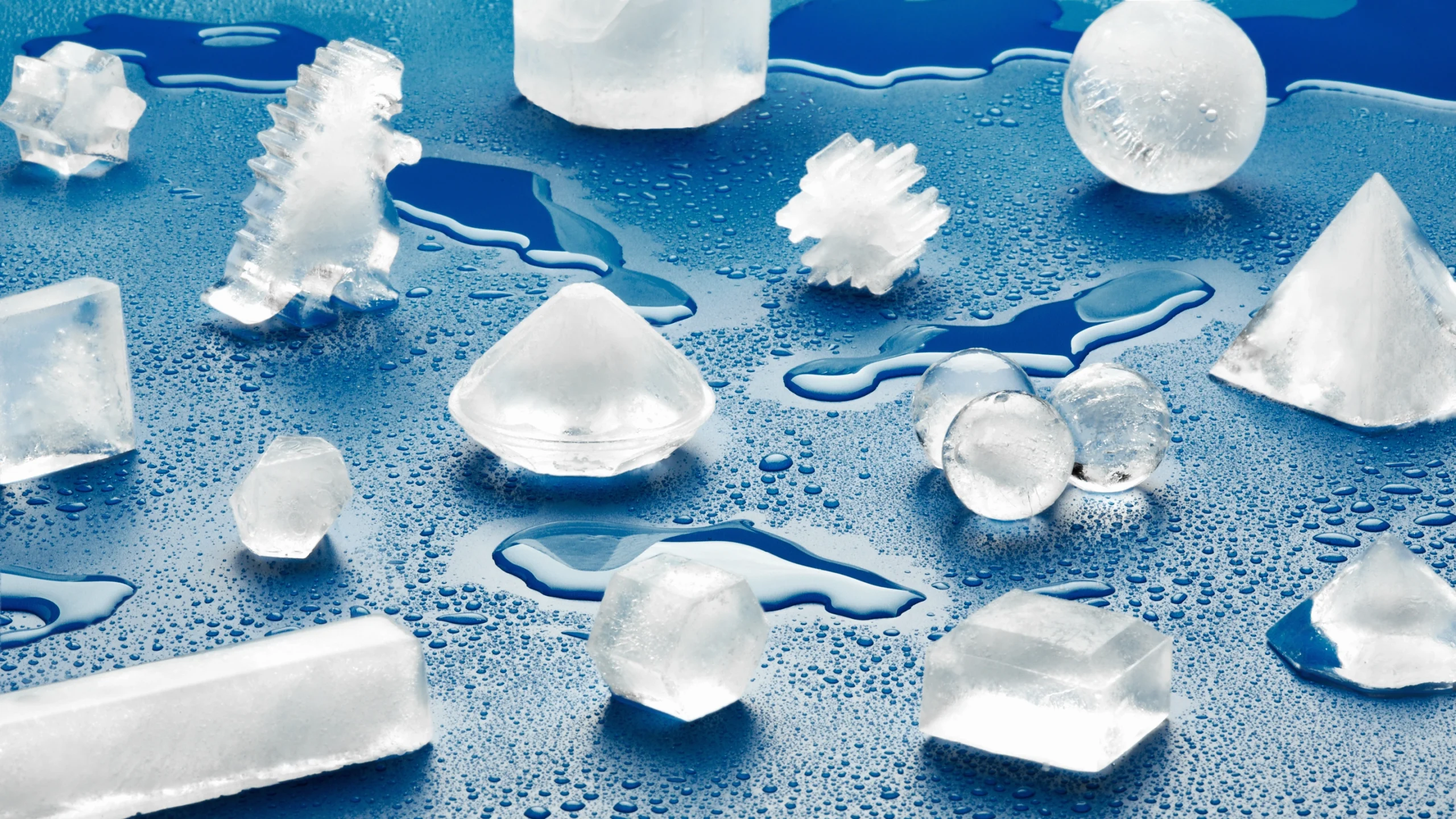
Ice comes in more forms than what you’ll find in a freezer or a glacier. Since 1900, scientists have observed more than 20 phases of ice, many of them shaped under extreme conditions. The growing list includes hot ice and even ice that conducts electricity.
Ice is the name for any phase of water that is solid and crystalline, meaning that it has a repeating molecular structure. Over the past decade, computer simulations have predicted tens of thousands of possible forms of ice. Though uncommon on our planet, exotic ice may exist in off-Earth environments, from cold and amorphous comet tails to the hot and crushing cores of icy planets.
As physicists put water to the test with improved experimental techniques, they keep finding surprises. “You take water, and just the way you compress it — a little bit faster, a bit slower, up and down, at the right timescale — and then you can find this completely unexpected behavior,” said Marius Millot, a research scientist at Lawrence Livermore National Laboratory (LLNL) in California.
Abandoning old assumptions and applying new techniques, scientists have discovered three new kinds of ice in the past year, including two of the most complex ice phases ever seen. “It seems a remarkable time at the moment,” said Chris Pickard, a physicist at the University of Cambridge. “They’re really finding a lot more of these structures.”
Space Oddity
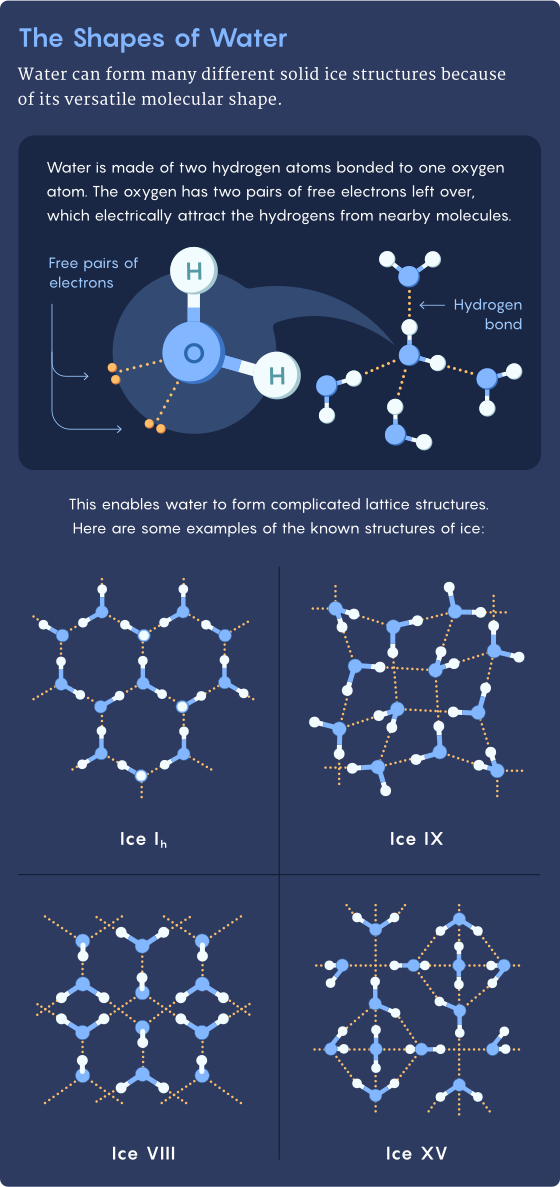
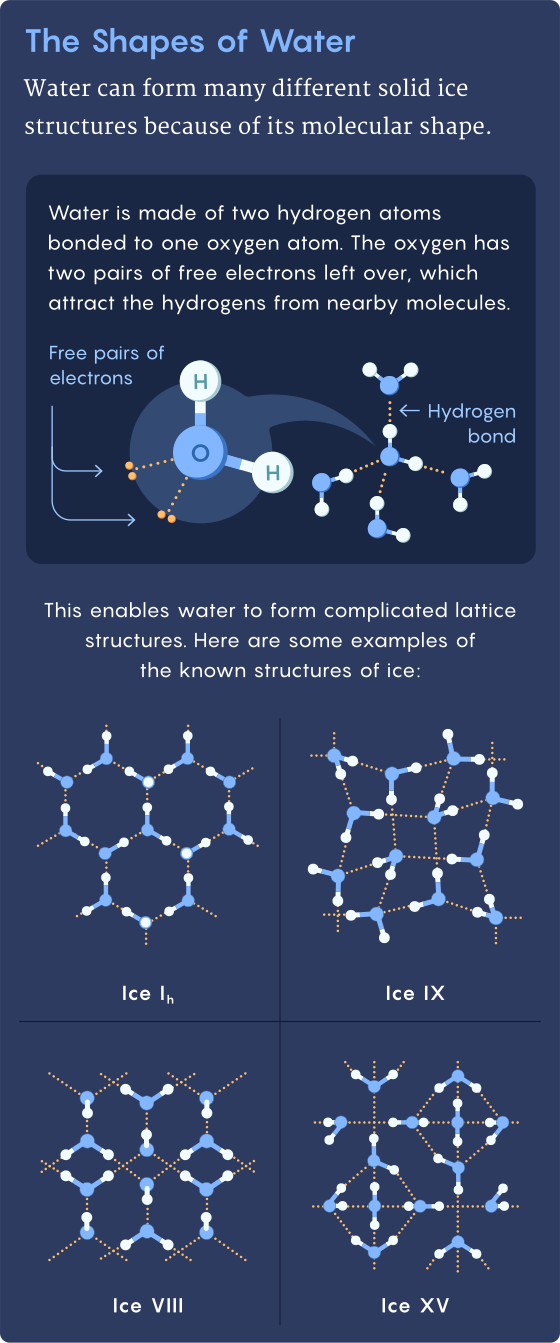
The shape of water makes it exceptionally versatile. Its molecular structure can assemble in many possible configurations.
Each water molecule looks like a central unit with four arms spread apart by the electromagnetic force. The central unit is an oxygen atom. Bonded to it are two hydrogen atoms, and sticking out like extra limbs are two pairs of leftover free electrons.
Mark Belan/Quanta Magazine
In the most common form of ice, these building blocks combine to form a cagelike hexagonal structure. The spaciousness of this arrangement makes typical ice less dense than liquid water. This is why ice floats, and why bodies of water freeze from the top down, allowing underwater life to survive the winter.
Put water under pressure, though, and its shape can compress and overlap in a seemingly endless bounty of possible patterns. Because it can take so many different forms, “the physics and the chemistry of water can be completely different” from one environment to the next, said Livia Bove, a physicist at the Swiss Federal Institute of Technology Lausanne. “It’s topologically beautiful.”
In 2018, an international research group from Europe and Japan created an ambitious computer simulation of the dynamics of water molecules that aimed to predict undiscovered forms of ice. The result was a catalog of over 75,000 phases, each characterized by a slightly different way that the water molecules could fit together when subjected to a different combination of temperature and pressure.
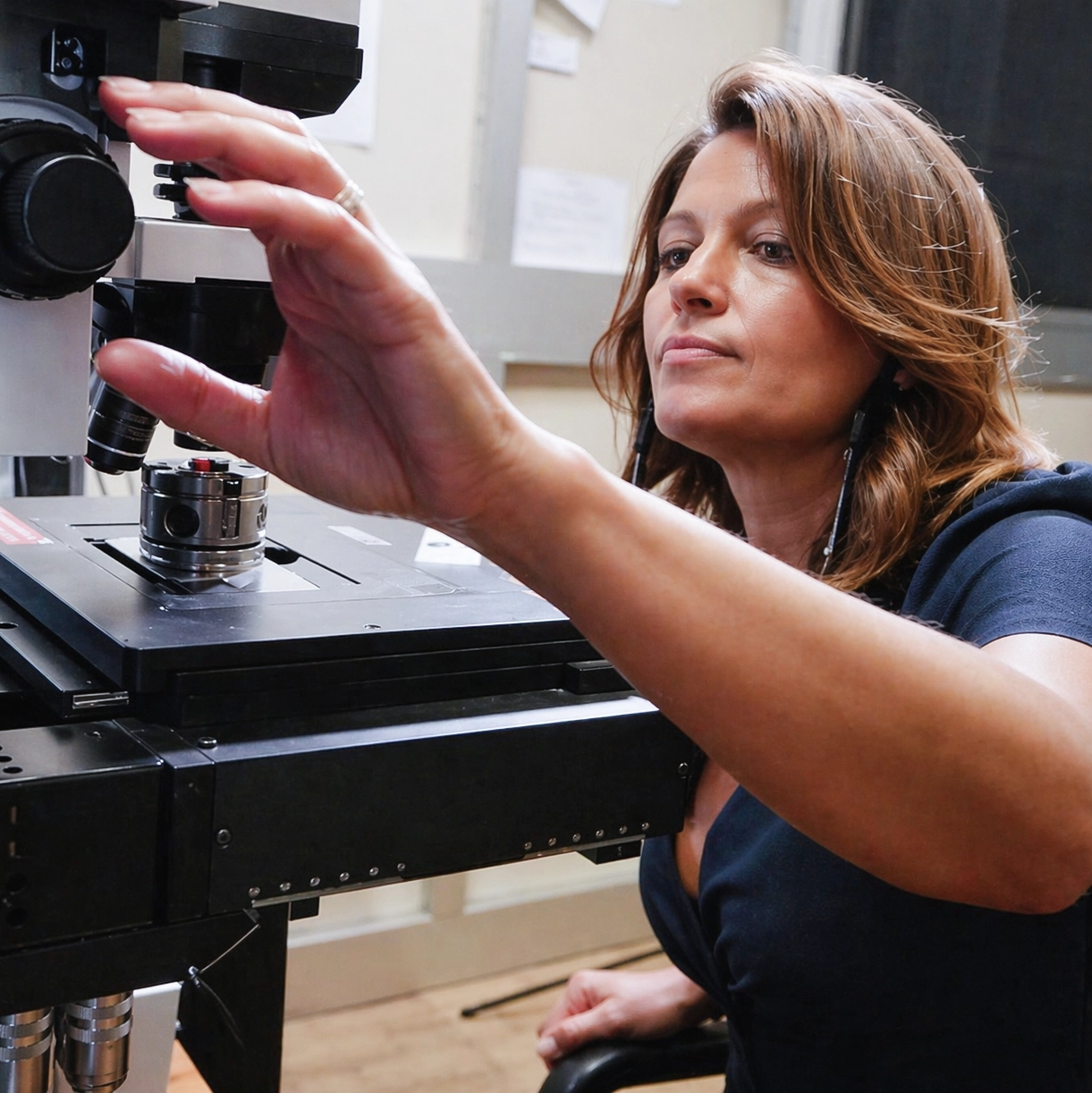
Livia Bove’s team recently discovered a type of “plastic” ice that’s thought to exist in the cores of icy moons.
Courtesy of Livia E. Bove
In reality, scientists don’t expect to find anywhere near that many phases; just because a structure is mathematically possible does not mean that it will form in nature. “There is always a bit of uncertainty associated with claims of the existence of new phases when they are solely based on simulations,” wrote Federica Coppari, a physicist at LLNL, in an email.
Some phases would require a ridiculous amount of energy to form. Others are so fragile that they would collapse immediately. Scientists try to narrow their predictions down to just those that seem viable. “It filters down to fewer of them,” said Pickard, who worked on the simulation. “But the reality is, we don’t exactly know how to place that filter.”
To discover the forms that ice actually takes, scientists head to the laboratory.
Under Pressure
In 2018, Yong-Jae Kim was a postdoc at the Korea Research Institute of Standards and Science (KRISS) studying how room-temperature water turns to ice under extreme pressure. The experiment involved squeezing a drop of water between two diamonds and studying its changing molecular structure with high-speed imaging and other analysis techniques.
Going through the data from the experiment, Kim noticed what at first looked like a mistake. For just a few tens of milliseconds, the ice seemed to lose its structure, dissolving into a mess of molecules before transitioning to its next phase. Kim worried that sweat or dirt had contaminated the water. “At that stage, I felt more anxious than excited,” he said. He shared the observation with the rest of his team, but he ran out of time to follow up on it.
In 2025, researchers at KRISS ran an improved version of the same experiment using Kim’s diamond system and managed to re-create the strange structure. It was so complex that at first it looked almost random. “But step out,” Kim said, “and we see the structure macroscopically. It has a periodicity.”
The researchers took their setup to the European X-Ray Free-Electron Laser Facility in Germany, which houses a laser that accelerates electrons through a 3.4-kilometer-long tunnel and then sends them through special magnets to produce bursts of X-rays. “The brighter the beams of X-rays, the better pictures you get of your crystal structures,” Pickard said.
The scientists shone high-powered X-ray laser beams through the ice and measured how the beams scattered. Most phases of ice send the rays bouncing in just a couple different directions, since their crystal patterns repeat after a few molecules. But this sample sent the light along roughly 15 different paths. When the scientists analyzed the images, the number of molecules in the crystal pattern came to a whopping 152. The team’s observation of the structure earned the phase of ice an official Roman numeral name, ice XXI.
What’s more, the new phase was a total surprise. The team scoured the tens of thousands of phases predicted by Pickard’s group in search of a match, but they didn’t find one. The repeating structure of ice XXI, it turned out, was beyond the size at which the simulation capped its search. “They basically found something much more complicated than we did,” Pickard said.
Unbeknownst to the KRISS team, a group from Okayama University had actually predicted the structure in a different, narrower simulation also created in 2018. The more focused simulation predicted two additional phases of ice that are still undiscovered.
Changes
The researchers at KRISS and Kim, now at LLNL, had not set out to discover a new phase of ice. Rather, they wanted to investigate another of water’s strange properties, related to how it transitions from phase to phase. The classical theory of phase transitions predicts that any system will return to its lowest-energy state. But water does not always follow predictions.
For example, Kim’s sample did not respond to being squeezed by the diamond device by jumping straight to its most stable state, which at that level of pressure would be a form called ice VI. Instead, it hopped from water to ice XXI, and then to ice VII. These in-between phases are called metastable states, and their existence demonstrates that some phase transitions happen in steps, rather than all at once.
Water’s metastable states support a theory of phase transitions called Ostwald’s step rule, named for Wilhelm Ostwald, a German physical chemist and a peer of Albert Einstein. (Einstein was initially rejected for a job in Ostwald’s laboratory, but the two later became friends, and Ostwald eventually nominated Einstein for the Nobel Prize.) Ostwald’s step rule suggests that systems transition to the closest and easiest-to-reach phase state rather than the most thermodynamically stable one — and that they sometimes then get stuck. “It’s a nicely paradoxical thing that sometimes the easiest [state] to form is the one that’s the least stable,” Pickard said.
A group led by Hiroki Kobayashi of the University of Tokyo has already followed up on the discovery of ice XXI, as reported in a preprint article, by re-creating it using different techniques. In the process, they discovered a nearby phase — now dubbed ice XXII — that is even more complex, repeating its pattern only every 304 molecules.
At lower temperatures, the group also came up with a way to reliably produce ice IV, a metastable phase of ice so elusive that it has earned the name “will-o’-the-wisp,” after the ghostly lights that lure travelers in folk tales.
As scientists observe more metastable states, they are collecting evidence that this application of Ostwald’s theory accurately describes how phase transitions work, not just in ice but in other kinds of crystals, including those used in medicine. Changing the phase of a pharmaceutical drug can change its effectiveness, something factories need to protect against. “Sometimes drugs can turn from one [phase] to another and then ruin the whole batch,” Pickard said. Ostwald’s theory helps predict when that might happen.
Let’s Dance
In 2025, Bove’s team in Lausanne discovered a smaller but in some ways stranger metastable phase of ice. In a study published in Nature, they reported the first observation of plastic ice VII. This is a variation of ice VII, a high-pressure phase of ice, that appears when the ice is heated to around 500 degrees Celsius.
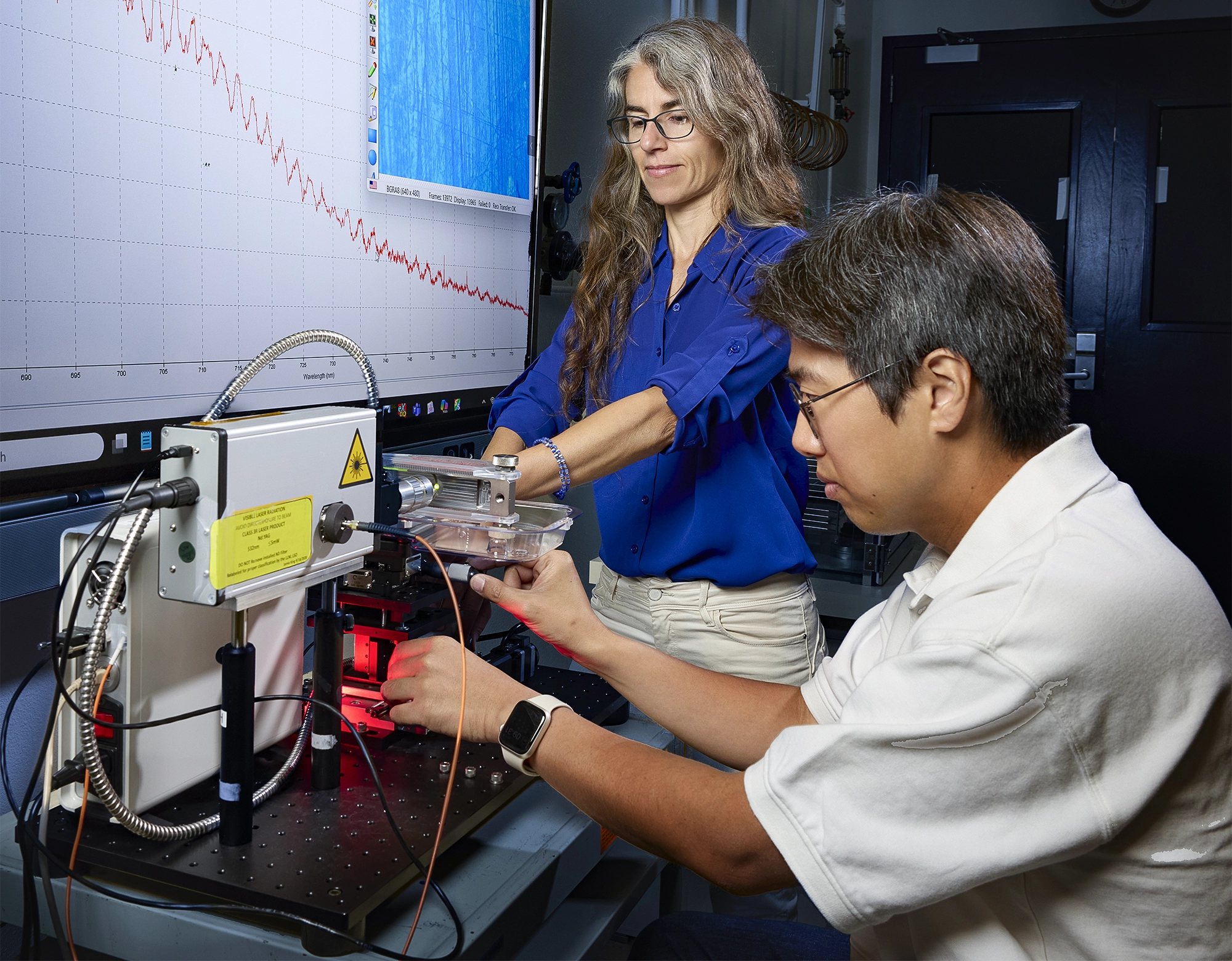
Federica Coppari and Yong-Jae Kim study the properties of matter under extreme conditions.
Garry McLeod/LLNL
In plastic ice, water molecules retain their solid crystal structure but spin rapidly in place. This motion is difficult to observe; hydrogen is practically invisible to X-rays, which in water molecules deflect only off the atoms of oxygen. “If you can’t see the hydrogens, then you can’t really tell if the water molecule is rotating,” Pickard said.
So in addition to using X-rays, Bove’s team adopted a different technique: They sent a stream of neutrons into the hot ice. “Those neutron techniques are so powerful,” Millot said. “You can look at the molecules and see if they vibrate, if they rotate, if they vibrate and rotate.”
The rotating molecules in plastic ice VII give the ice some elasticity, like a gentle trampoline. Plastic ice VII is believed to exist inside the cores of icy moons and is thought to be an intermediate state that ice passes through before becoming a hotter form called superionic ice (or ice XVIII), first discovered in 2019. In this form, hydrogens fully break free of their bonds to oxygens, allowing the ice to conduct electricity.
Research like Bove’s shows that observing more of water’s phases might require using new experimental techniques or combining several different ones. Scientists are currently working on new methods to up the pressure they can apply to water. “The final pressure that we are aiming for is really high,” Coppari said, “more than twice the pressure at the center of the Earth.”
We live on the planet of water, but we’re still learning what water can do. “The more we look and the better the experiment becomes, the more surprises we find,” Millot said.