Physicists Make Electrons Flow Like Water

Water molecules flow together; electrons usually do not.
Myriam Wares for Quanta Magazine
Introduction
If you were asked to picture how electrons move, you could be forgiven for imagining a stream of particles sluicing down a wire like water rushing through a pipe. After all, we often describe electrons as “flowing” in an “electric current.”
In reality, water and electricity flow in completely different ways. Whereas water molecules move together to form a swirly, coherent substance, electrons tend to fly past one another. “Water is seeing nothing but other water,” said Cory Dean, a physicist at Columbia University, “but in an electronic system, in a wire, that’s manifestly not the case.” Water molecules unite to flow, but each electron acts on its own.
This every-particle-for-itself movement serves as the foundation for all of electronic theory. It explains why a warm wire resists more than a cold wire, and why a round wire conducts as well as a square wire.
But since the 1960s, theorists have suspected that electrons can be coaxed to act more like their watery counterparts, and to form an electron fluid.
In recent years, a string of experiments has confirmed that prediction. Last fall, in the most dramatic demonstration yet, Dean and his collaborators arranged for electrons to form a type of shock wave that occurs when a quickly flowing fluid crashes into a slowly flowing fluid. It was a surefire sign that electrons were flowing at extremely high speeds. “That’s really the frontier right now,” said Thomas Scaffidi, a physicist at the University of California, Irvine who was not involved in the experiment.
Making electrons behave like water might someday lead to the development of new kinds of electronic devices. And extending the familiar theory of water to electrons could spawn a new way of thinking about quantum materials.
Thudding vs. Flowing
Andrew Lucas, a theoretical physicist at the University of Colorado, Boulder, compares electrons traveling down a wire to pinballs traveling around a pinball machine. Once they enter the playing field, pinballs bounce around in every direction, flying off flippers and bumpers. They travel up the machine, down the machine, and all around it. Similarly, when electrons in a copper wire collide with vibrating copper atoms or with “impurities” in the metal — spots where some other atom has usurped an atom of copper — they ricochet in all directions.
On average, pinballs do tend to travel farther down than up; in this sense they “flow” downward. Analogously, the “flow” of electrons emerges only in an average sense; an electric field, perhaps generated by a battery, establishes an ever-so-slightly preferred direction in the wire.
But this is a peculiar type of flow. An electron collides with an impurity much in the same way a hacky sack collides with the floor: It thuds more than it bounces. The impurity saps the electron’s energy, preventing it from building up much momentum. Consequently, electrons move through a wire a bit like water seeping through packed sand, a motion physicists describe as a “dispersive” flow.
In contrast, water molecules flowing down a pipe collide almost exclusively off each other. And when they collide, they bounce like billiard balls: They share their momentum and keep on moving.
This ability of water molecules to “conserve” their momentum defines the nature of liquidity. Since collisions with obstacles don’t drain their momentum, water molecules can engage in complicated collective motions, flowing in faster- and slower-moving zones and in swirling eddies.
In 1963 Radii Gurzhi, a Soviet physicist, was the first to calculate exactly what would happen if electrons found themselves in a situation where they could only knock into each other, conserving momentum like water molecules.
Gurzhi found that the difference would lie in how the electric current reacted to heat. Warming a copper wire typically impedes electric current, since vibrations in the copper atoms intensify and more greatly impede electrons. But Gurzhi calculated that if momentum were conserved, heat would make electrons move more readily — similar to the way warm honey is runnier than cool honey.
His observation became known as the Gurzhi effect, but it didn’t attract much attention at the time. It seemed like a theoretical curiosity, with little relevance to real electrons, trapped as they were in real-world wires “full of dirt and impurities,” Lucas said.
Fifty years later, that would change.
Enter Graphene
In 2004, Andre Geim and Konstantin Novoselov announced the discovery of graphene, a honeycomb sheet of carbon atoms they could peel off a block of pencil lead using only Scotch tape. The effort earned them a Nobel Prize.
A layer of graphene was like a pinball machine with no bumpers; almost every atom was in its place. “It’s just a thermodynamically beautiful crystal. It comes out of the earth well formed, with very few impurities,” said Dean, who specializes in graphene experiments.
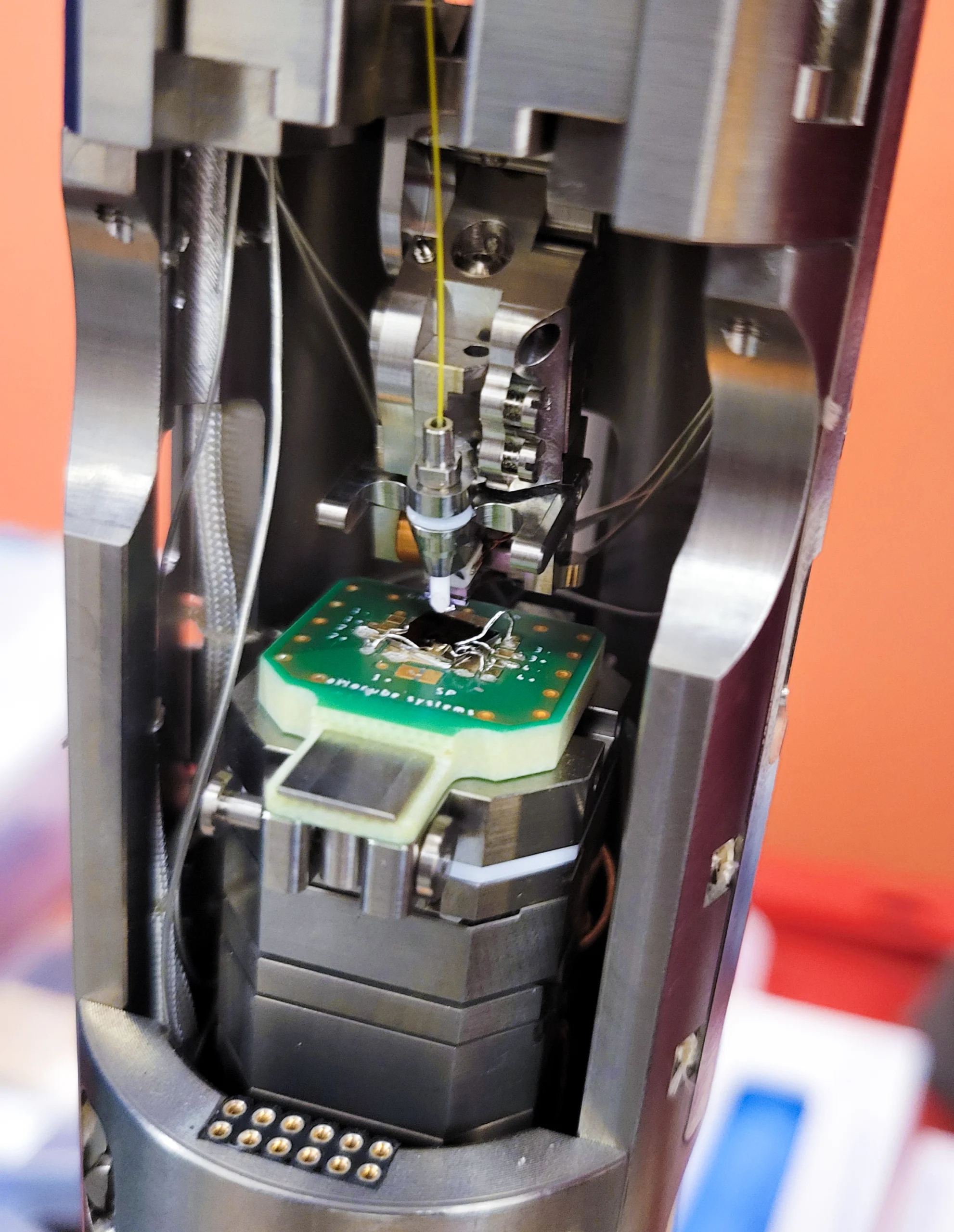
A metallic tip just nanometers across picked up tiny variations in the graphene’s electric field, revealing a fluid shock wave where supersonic electrons suddenly slowed down.
Johannes Geurs
It took physicists about a decade to figure out how to study graphene without interference from other materials. But when they did, they detected electrons truly flowing.
In one early experiment, in 2017, Geim and his collaborators carved a choke point into a strip of graphene, poured electrons through, and measured the resistance. They found that as they turned up the temperature, the resistance fell — the Gurzhi effect in action.
And in 2022, physicists at the Weizmann Institute of Science in Israel managed to directly watch electrons flowing. They shaped a material with some similarities to graphene, called tungsten diselenide, into a vertical wire flanked halfway down by two circles resembling Mickey Mouse ears. As electrons flowed into the ears on their way down the wire, the group monitored their motion by measuring the magnetic field the electrons generated when moving around the wire. In doing so, they saw fluidic electric currents swirling backward into the ears — electron whirlpools. The whirlpools resembled the eddies that form when part of a river’s current runs into a bend and turns upstream.
“They can really see these vortices,” said Scaffidi, who collaborated with Geim’s group on another electron fluid experiment, also in 2022.
Going Supersonic
In 2025, Johannes Geurs, a postdoc in Dean’s lab, decided to push the idea of electron fluids “to the extreme,” Dean said.
Slowly moving fluids act differently from quickly moving fluids. We can see this in the air, which is as much a fluid as water, because air molecules conserve momentum when they collide. When a plane accelerates past the sound barrier in the air, it generates a shock wave known as a sonic boom. Geurs wondered if it was possible to break an analogous sound barrier with electrons themselves, which would lead to another sort of supersonic shock wave.

Johannes Geurs proposed the idea to attempt to create an electron fluid shock wave.
Daniela Tabrea
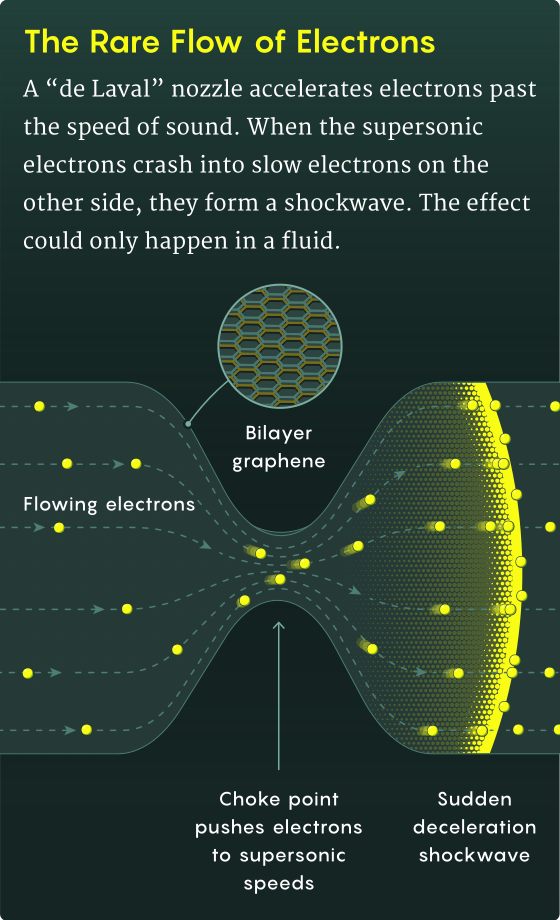
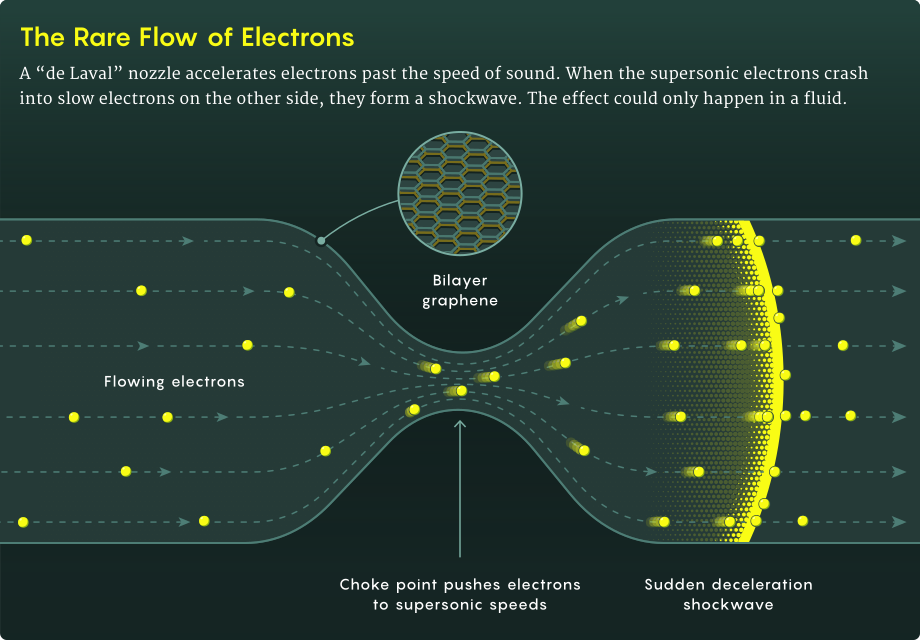
To produce the speediest electron fluid possible, he carved a strip made from two sheets of graphene into a sleek shape known as a de Laval nozzle — a shape that rocket engines use to accelerate their exhaust.
Then he sent electrons through the constriction formed by the nozzle, which boosted their speed beyond the rate at which ripples travel through the electron fluid. That’s the “speed of sound” for an electron fluid, a few hundred kilometers per second. When the accelerated electrons crashed into other electrons lingering in an open region downstream of the nozzle, the slower, subsonic electrons couldn’t get out of the way fast enough, and the liquid compressed. The researchers swept a metallic tip back and forth over the sample, measuring minute changes in the electric field, and detected the pileup. The shock wave indicated that they had in fact broken the electron fluid’s sound barrier.
Mark Belan/Quanta Magazine
Electron Whisperers
Experiments like these allow researchers to flex and extend their control over electrons. This new level of mastery could lead to novel electronics components. For example, when electrons move like fluids, they start to respond to the shape of the channel through which they’re moving, whether it’s Mickey Mouse ears or a nozzle. “By using different shapes for your device, you can realize very different physics,” Scaffidi said.
These experiments could also help theorists develop an entirely new way of talking and thinking about electrons and subatomic systems. It’s “a baby step” toward using what we know about the movement of liquids to understand quantum systems, Scaffidi said.
When electrons flow like fluids, they form coherent patterns. Once you know some high-level properties of the fluid, such as density and viscosity, you can use standard equations to find out what the fluid will do, without needing to keep track of the motion of every last electron.
The hope is that in other complicated quantum or semi-quantum systems, theorists might, for instance, be able to identify conservation laws that will help them recognize similar large-scale flow behavior, as one group was able to do for certain chaotic quantum circuits in 2024.
Perhaps by continuing to cook up electron fluids in the lab, and by using hydrodynamics to describe the way they swirl, theorists will find a way to describe other, more enigmatic situations where electrons seem to melt away, said Lucas, who helped with some of the theory calculations for the Columbia experiment. “It’s a very appealing showcase of something that can’t be explained in any textbook paradigm,” he said.