Two Twisty Shapes Resolve a Centuries-Old Topology Puzzle
Introduction
Imagine if our skies were always filled with a thick layer of opaque clouds. With no way to see the stars, or to view our planet from above, would we have ever discovered that the Earth is round?
The answer is yes. By measuring particular distances and angles on the ground, we can determine that the Earth is a sphere and not, say, flat or doughnut-shaped — even without a satellite picture.
Mathematicians have found that this is often true of two-dimensional surfaces more generally: A relatively small amount of local information about the surface is all you need to figure out its overall form. The part uniquely defines the whole.
But in some exceptional cases, this limited local information might describe more than one surface. Mathematicians have spent the past 150 years cataloging these exceptions: instances in which local measurements that usually define just one surface in fact describe more than one. But the only exceptions they managed to find weren’t nice, closed-up surfaces like orbs or doughnuts — instead, they stretched on forever in some direction, or had edges you could fall off of.
Nobody could find a closed-up surface that broke the rule. It began to seem as though there simply weren’t any. Perhaps such surfaces could always be uniquely defined by the usual local information.
Now, mathematicians have finally uncovered one of those long-sought exceptions. In a paper published in October, three researchers — Alexander Bobenko of the Technical University of Berlin, Tim Hoffmann of the Technical University of Munich, and Andrew Sageman-Furnas of North Carolina State University — describe a pair of very twisty, closed-up surfaces that, despite having the same local information, have completely different global structures.
Finding them took years of toil, a few very overheated laptops, and an unexpected clue from a seemingly unrelated corner of geometry.
Geometric Misfits
Mathematicians have all sorts of ways to describe a surface locally, but two are especially useful.
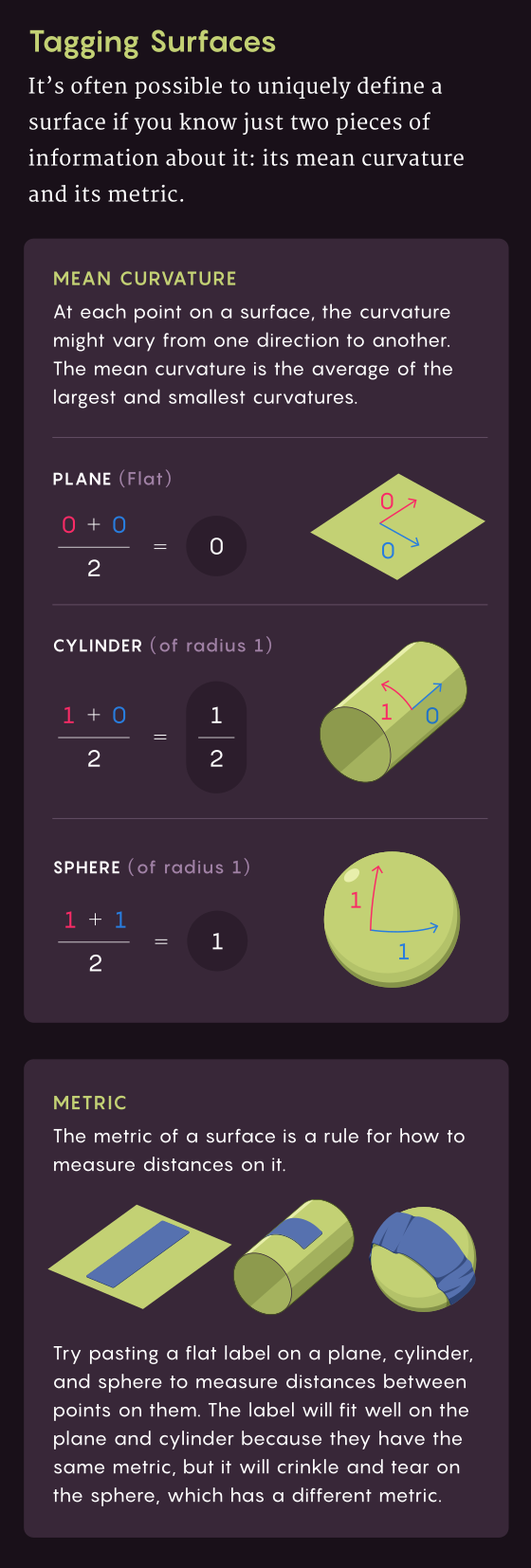
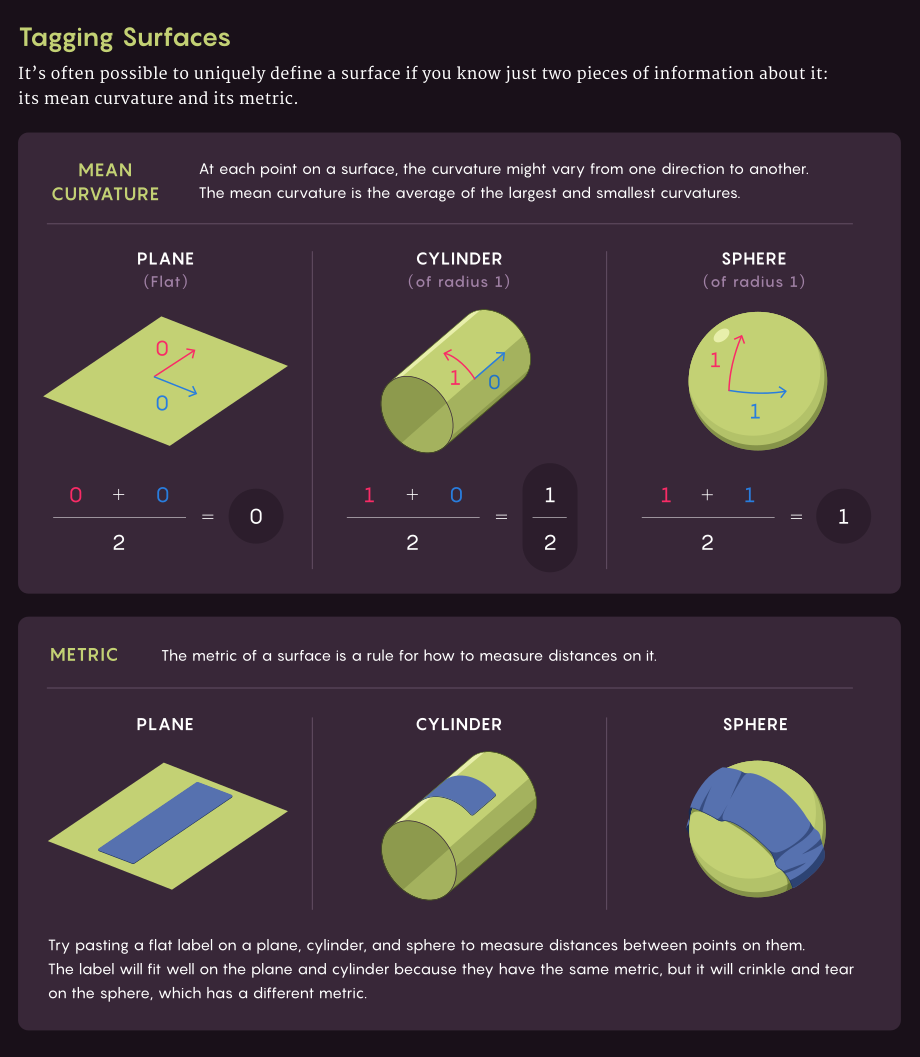
One captures information about the surface’s “extrinsic” curvature. Choose a point on your surface. At that point, there are infinitely many directions in which you can calculate how quickly the surface bends in space — what’s known as its curvature. Focus only on the directions where you get the biggest and smallest curvature values, then take the average of the two. The number you get is called the mean curvature. You can compute the mean curvature for any given point on the surface to gain a better understanding of how it’s situated in the space surrounding it.
Another kind of measurement captures information about the surface’s “intrinsic” curvature — a geometric property that doesn’t depend on the space that the surface lives in. Consider a flat sheet of paper. You can wrap it into a cylindrical tube without stretching or tearing it. If two points are connected by a curve on the sheet of paper, that curve will have the same length on the cylinder. This means that the sheet of paper and the cylinder have the same “metric,” or notion of distance. But try to wrap the sheet of paper around a sphere, and that’s no longer the case. You’ll have to stretch, cut, or crinkle the paper, and the lengths of curves between points will change. The two surfaces therefore have different metrics.
Mark Belan/Quanta Magazine
In 1867, the French mathematician Pierre Ossian Bonnet showed that if you know both the metric and the mean curvature at every point on a surface, that’s enough to tell you what the surface is. Most of the time.
But most of the time is not all the time, and that’s the kind of caveat that makes mathematicians itch.
In the 150 years since Bonnet’s proof, mathematicians have discovered various kinds of surfaces that defy his rule of thumb. These surfaces have the same metric and mean curvature, yet they don’t have the same global structure.
But all these surfaces are what mathematicians call non-compact. They don’t wrap up nicely the way spheres, doughnuts, and other “compact” surfaces do. Rather, a non-compact surface might stretch out infinitely in some direction (like a plane or cylinder), or have edges where it suddenly ends (like a piece cut out from a larger shape).
Compact surfaces are more restricted. They have to satisfy various constraints to twist back on themselves and close up perfectly. So it seemed reasonable to think they might be uniquely defined by their metric and mean curvature. In 1981, the mathematicians Blaine Lawson and Renato de Azevedo Tribuzy proved that this is true for the sphere and any surfaces topologically equivalent to it — that is, any compact surfaces that have no holes.
When it came to compact surfaces with a hole (topological doughnuts called tori), there was a bit more wiggle room. The mathematicians showed that a given metric and mean curvature could correspond to at most two different tori.
No one could find examples of such “compact Bonnet pairs,” however, and so for decades, the prevailing view was that tori were like spheres, and that a given metric and mean curvature would define a single torus. “People believed that for a long time,” said Robert Bryant of Duke University, “because they couldn’t construct any examples.”
But they were wrong.
A Pixelated World
Alexander Bobenko has spent the past 20 years chewing on mathematical doughnuts. In the 2000s, he tried to prove that compact Bonnet pairs do indeed exist. But after realizing that the problem would take him more than a few months to solve, he set it aside to focus on questions he thought he could make faster progress on.
He turned to an area of mathematics that seemed unrelated to the Bonnet problem. But that area would end up being the key to solving it.
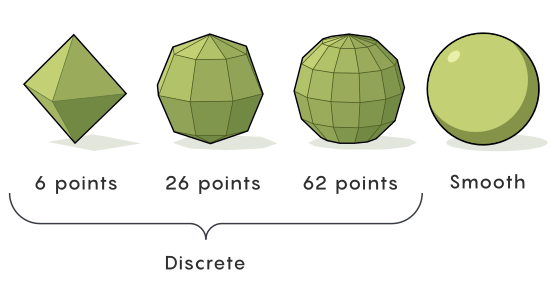
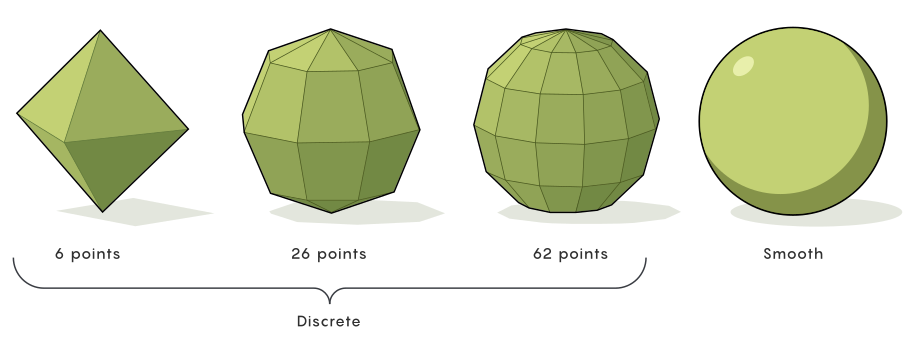
Bobenko started to think about “discrete” surfaces, which are a bit like pixelated low-resolution versions of smooth surfaces. Mathematicians study discrete surfaces because they have important geometric properties in their own right, as well as practical applications in computer science, physics, engineering, and more.
To get a discrete surface, take a finite collection of points and connect them by lines to form a shape with flat faces. By choosing different points, you can represent a given smooth surface in different ways. Here are some examples of how you might represent a sphere, for instance:
Mark Belan/Quanta Magazine
Some discrete surfaces are better representations than others. Bobenko and his frequent collaborator Tim Hoffmann have dedicated nearly two decades to developing a theory for how to preserve the most salient geometric features of smooth surfaces using discrete ones.
In the 2010s, Andrew Sageman-Furnas, then a doctoral student at the University of Göttingen, joined the effort — and brought the Bonnet problem back into the mix.
Sageman-Furnas had been drawn into discrete mathematics through his interest in the mechanics of woven fabrics like fishing nets, which are essentially discrete surfaces. Along the way, he’d asked a discrete version of the Bonnet question: When will local information uniquely define a discrete surface, and when won’t it? By adapting a known method for generating exceptions to Bonnet’s rule, Sageman-Furnas, along with his adviser Max Wardetzky and Hoffmann, found a recipe for concocting exceptions in the discrete case.
As in the smooth case, these exceptions were always non-compact. But because discrete surfaces don’t contain infinitely many points, it’s possible to study them using computers. Might it be possible, Sageman-Furnas wondered, to use computational brute-force methods to find a compact Bonnet pair in the world of discrete geometry? If so, then perhaps the discrete case could lead the way to a smooth solution as well.
And so he joined Bobenko and Hoffmann in Berlin as a postdoctoral researcher in Bobenko’s group and got to work.
Surface Safari
In the spring of 2018, Sageman-Furnas began a computer search for a special type of surface — one that could be transformed into a Bonnet pair, akin to how a sourdough starter acts as a base for whipping up different kinds of bread. This “starter” surface would be like the ones he had used to make discrete Bonnet pairs as a graduate student. Except this time, he required it to be a torus. That is, it had to be compact with one or more holes.
He disappeared for weeks, if not months, Hoffmann recalled. When the younger mathematician finally reemerged, he had found what he’d been looking for: a very spiky shape that looked more like an origami rhino than a torus.
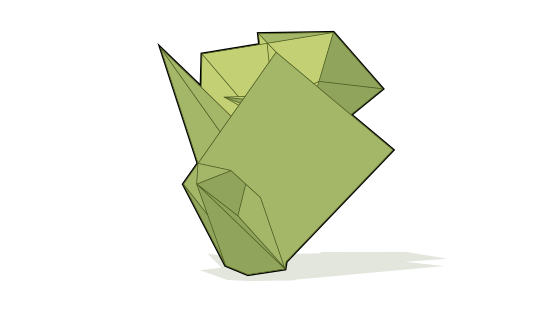
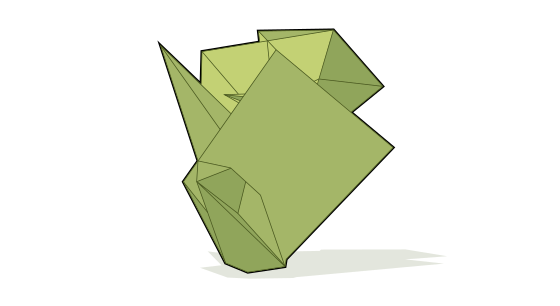
The “rhino.”
Mark Belan/Quanta Magazine; source: Publications mathématiques de l’IHÉS 142, 241–293 (2025)
But a torus it was. And according to Sageman-Furnas’ computer program, it had all the other properties required of a starter surface that would generate Bonnet pairs. Even more important, when Sageman-Furnas generated those pairs on his computer, they were also tori. The transformations from the rhino to the Bonnet pair didn’t seem to twist the rhino open into non-compact surfaces. The surfaces stayed compact.
“When you start to do computational exploration and design,” Sageman-Furnas said, “you can get new examples that are far outside of what you thought was possible.”
But was it too good to be true? Computer programs make rounding errors: Sageman-Furnas’ rhino might appear to meet the desired criteria, and the Bonnet pair it generated might appear to be tori, but that could all be a mirage, an artifact of small computational errors. Without a rigorous proof, the mathematicians couldn’t be sure.
“He showed up, and he showed us some weird-looking geometric object that really looked like it could have been numerical crap,” Hoffmann said. “Tongue in cheek, probably my most precious contribution to the whole project was that at the time I said, ‘I’ve seen worse.’”
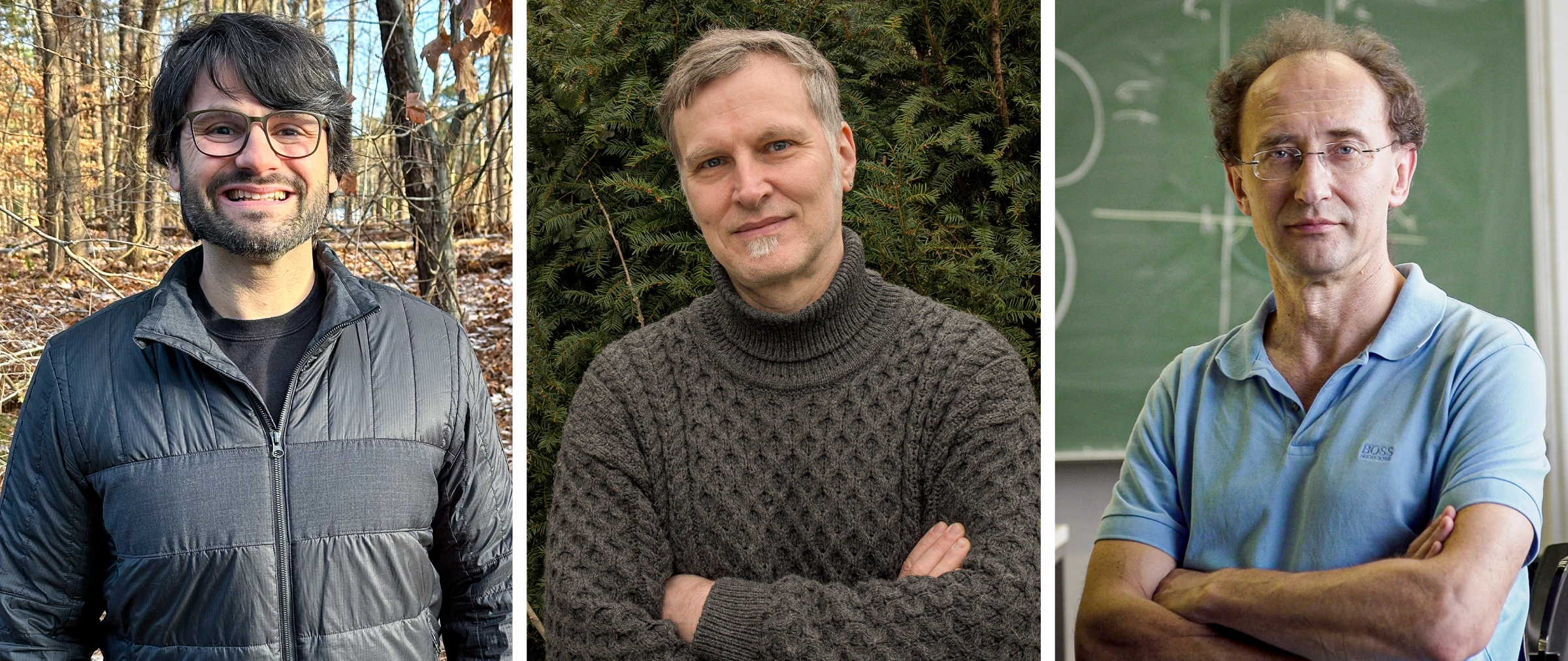
Andrew Sageman-Furnas (left), Tim Hoffmann (center), and Alexander Bobenko constructed a pair of novel shapes that settled a long-standing conjecture.
From left: Courtesy of Andrew Sageman-Furnas; N. Kutz; Courtesy of Alexander Bobenko
It took some time, but Hoffmann and Sageman-Furnas were eventually able to convince themselves that the rhino was worth taking seriously. And if it was possible to find such a likely example of a discrete Bonnet pair, maybe the smooth case wasn’t so hopeless after all. Hoffmann and Sageman-Furnas spent that sweltering summer scouring the rhino for clues, sometimes sitting in video chats for eight to 12 hours at a time, searching for unusual properties and geometric constraints that might help them narrow down where to look for smooth Bonnet tori.
As September rolled around, they finally found a new lead that felt so promising that it drew Bobenko back into the problem he’d abandoned decades earlier.
Closed Loops
The clue had to do with particular lines that loop around the rhino along its edges.
These lines were already known to provide important information about the rhino’s curvature — tracing out the directions in which it bent and folded the most and least. Since the rhino is a two-dimensional surface that lives in three-dimensional space, the mathematicians had expected these lines to carve out paths throughout 3D space as well. But instead, they always lay either in a plane or on a sphere. It was exceedingly unlikely that these alignments had happened by chance.
“That suggested to us that there was really something special happening,” Sageman-Furnas said. It was “spectacular.”
Unlike discrete surfaces, smooth surfaces don’t have edges. But you can still draw “curvature lines” that trace out the paths of maximum and minimum bending. Sageman-Furnas, Bobenko, and Hoffmann decided to look for a smooth analogue of the rhino whose curvature lines were similarly restricted to living in planes or on spheres. Perhaps a starter surface with those properties could give rise to smooth Bonnet tori.
But it wasn’t clear if such a surface even existed.
Then Bobenko realized that more than a century ago, the French mathematician Jean Gaston Darboux had laid out almost exactly what the mathematicians now needed.
Darboux had come up with formulas for generating surfaces that had the right kinds of curvature lines. The problem was that his formulas wouldn’t produce curvature lines that looped back on themselves. Instead, they “look like spirals and go to infinity,” Bobenko said. “No chance to get them closed.” Which meant that while the curvature lines might live on planes and spheres, the overall surface wouldn’t be a torus.
After years of toil, the mathematicians — using a combination of pen-and-paper techniques and computational experiments — figured out how to adjust Darboux’s formulas so that the curvature lines would close up. They’d finally found their smooth analogue of the rhino (although the two didn’t look much alike).
Moreover, as they’d hoped, this smooth rhino could generate a pair of new tori that had the same mean curvature and metric data but different overall structures. The team finally had their answer to the original Bonnet problem: Some tori can’t be uniquely defined by their local features after all.
But when they worked out what this Bonnet pair actually looked like, they found that the two tori were mirror images of each other. “Technically, this wasn’t an issue,” Sageman-Furnas said. “Formally, it solved the problem.” But, he added, it was still unsatisfying.
And so over the next year, they tried to tweak their smooth rhino in various ways. Ultimately, they realized that if they dropped the requirement that one set of curvature lines had to sit on spheres, they could construct a new smooth rhino that did what they wanted. They then used this surface to generate a new Bonnet pair — this time, two very twisty tori that were much more obviously different surfaces but still had the same metric and mean curvature.
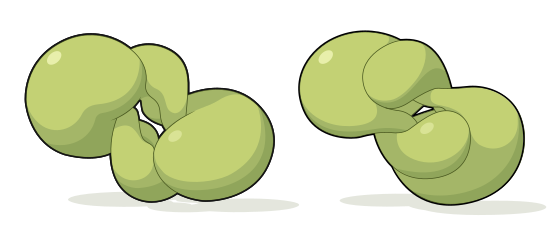
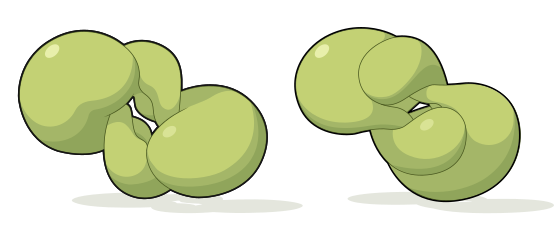
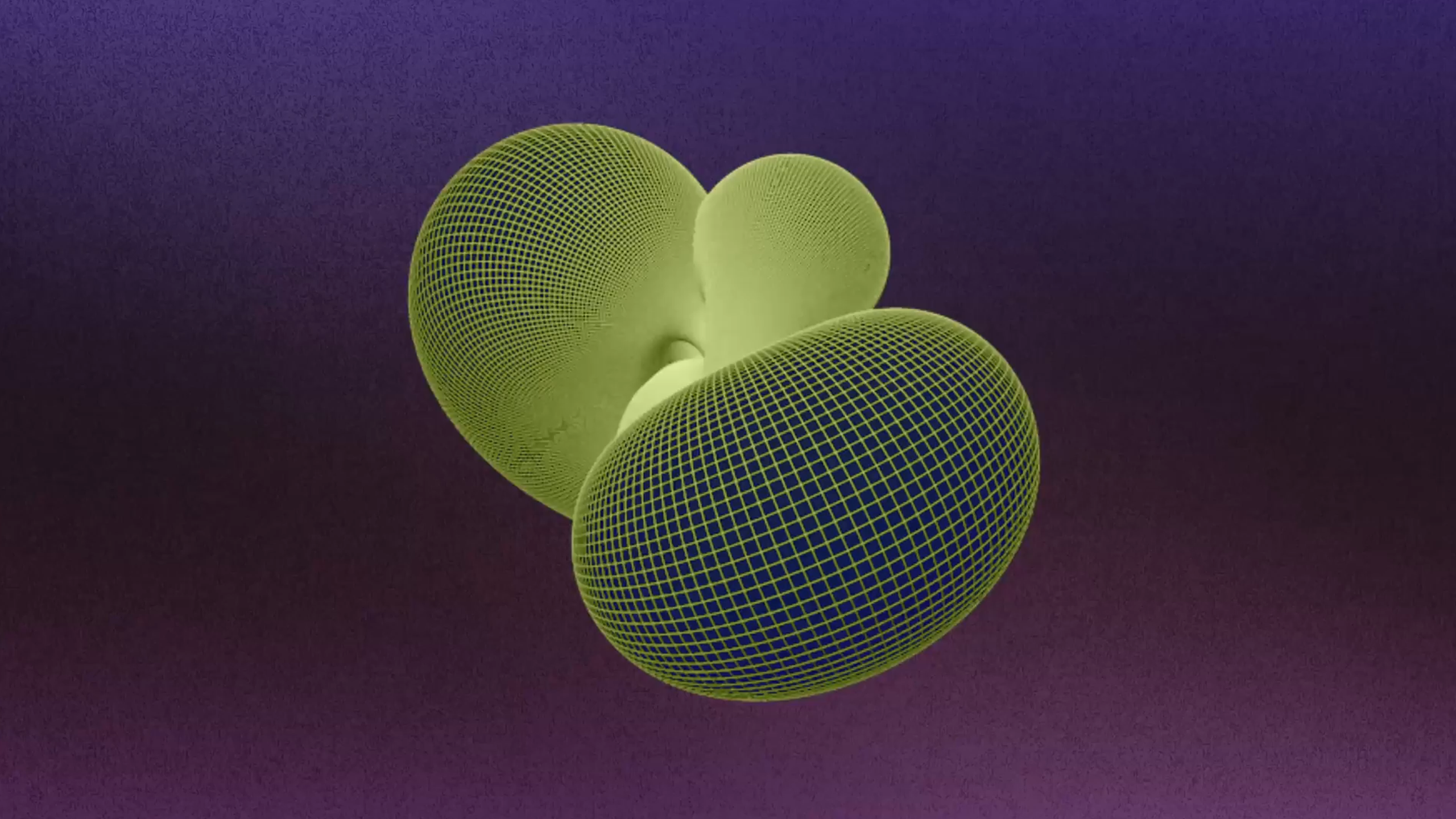
The team’s final compact Bonnet pair.
Mark Belan/Quanta Magazine; source: Publications mathématiques de l’IHÉS 142, 241–293 (2025)
The result came as a surprise to Rob Kusner, a mathematician at the University of Massachusetts, Amherst. According to him, it demonstrates that even tori — some of the nicest, best-studied surfaces — can’t always be perfectly described by their local characteristics.
“It’s an example of something where our intuition wasn’t good enough,” said Bryant, the Duke mathematician.
Still, the two tori that the mathematicians found are a bit strange: They pass through themselves like figure eights. Bobenko now hopes to prove that there are Bonnet tori that don’t intersect themselves.
The Bonnet tori are a welcome validation of Bobenko and Hoffmann’s decades of work on discrete surfaces. Traditionally, the geometry of smooth shapes has advanced much faster, dragging the less developed theory of discrete geometry along behind it. But in this work, the discrete theory charged ahead and was ultimately what made progress on the smooth side possible.
According to Hoffmann, this highlights the fact that while discrete surfaces might seem like less sophisticated models of their smooth counterparts, they have a mathematical life of their own. The discrete world can be just as rich as the smooth one, if not richer, revealing extra symmetries and connections that might otherwise get lost.
“People sort of forgot about this discrete aspect,” Hoffmann said. But “there are still things to gain from it.”