Are Memories Transferable — or Edible?
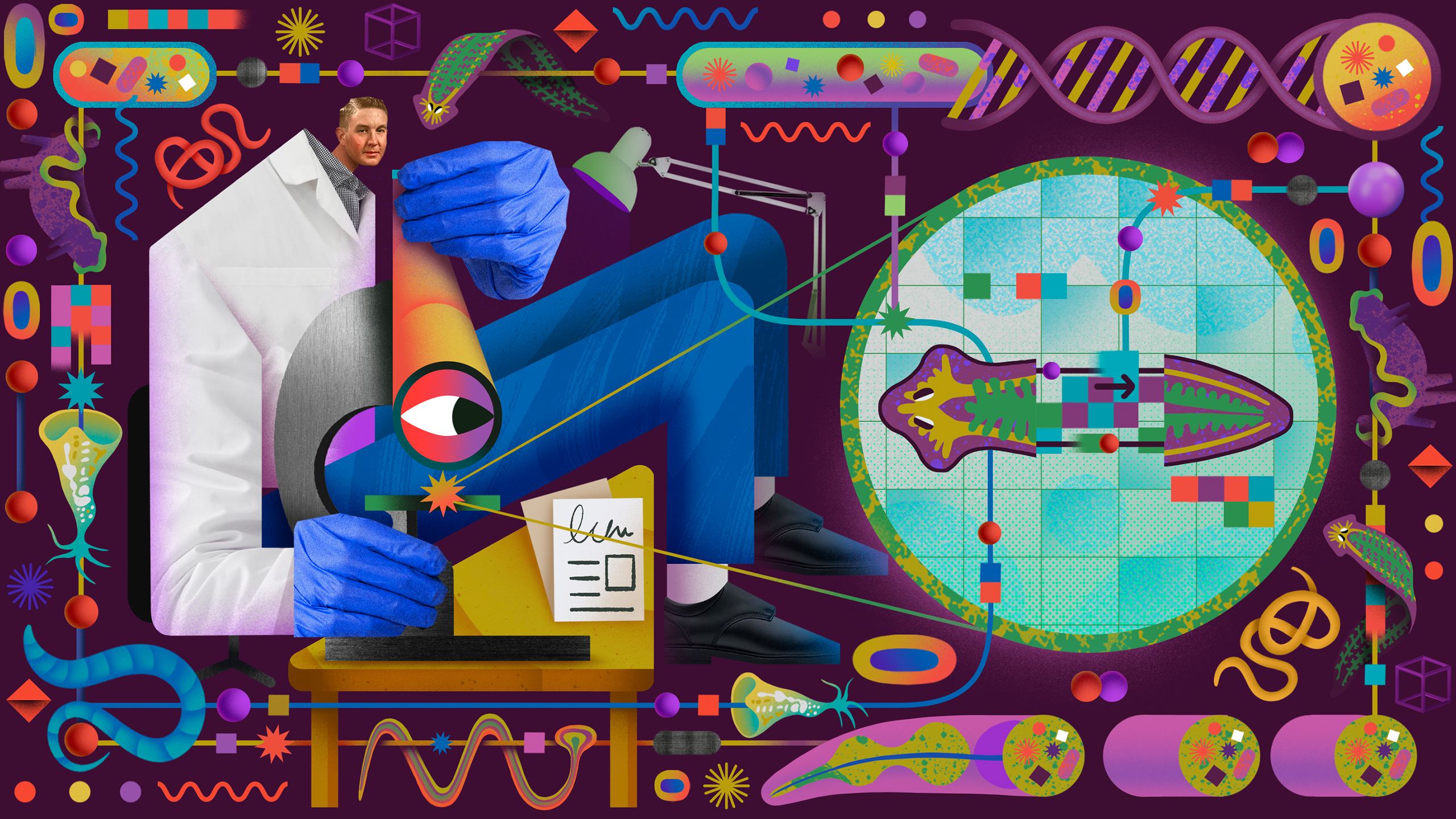
Lisett Ledón for Quanta Magazine
Introduction

I
t was the dead of winter in Boston. The surface of the Charles River was frozen solid. But Zachary Kelso braved the biting cold to finally put to rest a mystery that has haunted neuroscience labs for over half a century.
To do that, Kelso, a research assistant in the Harvard lab of the neuroscientist Sam Gershman, needed some worms. Specifically, planarians: arrow-headed flatworms, which are among the simplest creatures to possess a brain and a nervous system with bilateral symmetry like ours. Normally, labs order these widely used model organisms from biological supply companies. But the mail-order worms weren’t up to snuff. So Gershman had dispatched Kelso to the Charles’ icy banks to catch some wild ones. “I thought, ‘I’m going to look crazy because I’m using a hammer to beat through the ice,’” Kelso recalled. “So I wore the more business end of business casual.”
It wouldn’t be the last time Kelso found himself in this situation. The Charles River planarians, it turned out, didn’t cut it either. Neither did the worms he sourced while stream-hopping around Eugene, Oregon, in March 2025. Nor did the ones he fished from Michigan lakes that June — this time in thigh-high waders — while picnicking families gawked from shore. Kelso diligently turned over rocks, angled with bits of meat tied to a string, and even followed maps from a vintage guidebook called The Fresh-Water Triclads of Michigan. But his adventure was fruitless. Sure, he caught plenty of planarians. But back in Gershman’s lab, none of them would do what they were supposed to do.

In the 1960s, an eccentric behavioral psychologist named James McConnell convinced the scientific establishment that planarian worms, like Pavlov’s dogs, could be classically conditioned — and that memories of this training could be transferred from worm to worm through cannibalism. These bizarre findings were replicated by other scientists, and worm training became a staple of high school science fairs. Now, 60 years later, the worms have stopped learning, and nobody knows why.
I first learned about this scientific mystery while reporting another piece for this magazine about what a cell can remember. As I dug into the historical literature on memory research, I kept coming across McConnell’s strange worm experiments, which captivated a generation of scientists before disappearing entirely. Planarian memory had itself been forgotten. I was content to dismiss it as a fluke of history until Gershman mentioned, in passing during an interview, that in addition to their work with the unicellular ciliate Stentor coeruleus, his lab was attempting to reproduce some wacky worm experiments from the 1960s. Had I heard of them?
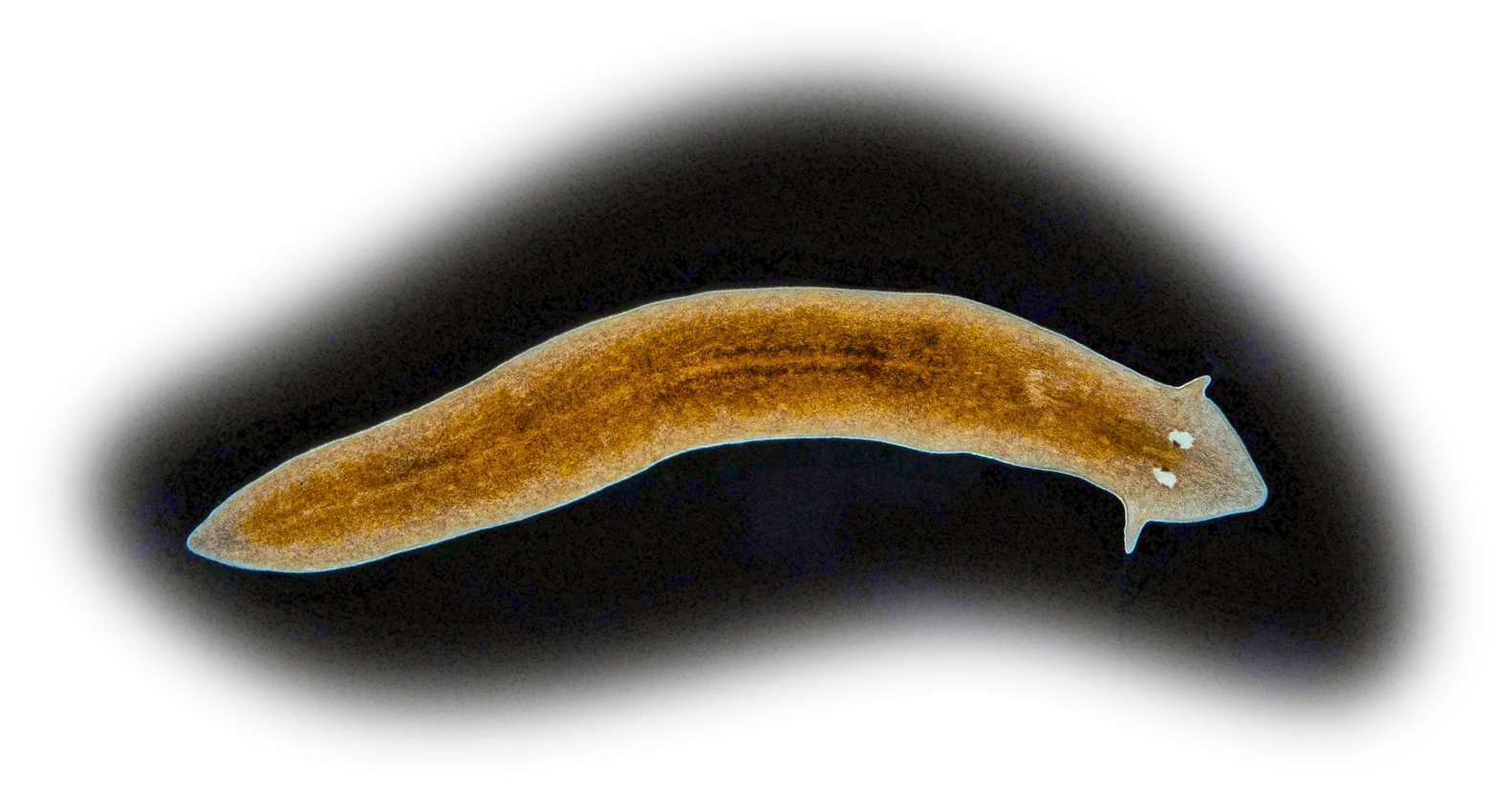
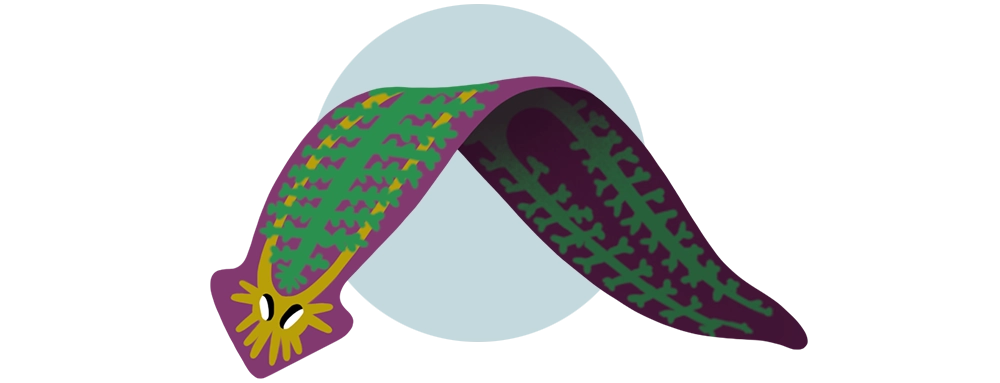
Planarian worms have remarkable regenerative capacity. A fragment that’s 1/279 of the original worm can regrow into a normal adult in weeks.
Ernest Cooper
Gershman, I learned, was keen to pick up where McConnell had left off. As part of a growing cohort of cognitive scientists looking beyond the brain for clues to the origins and basis of memory, he’s fascinated by any creature that seems to remember without the benefit of neural, synaptic networks. Little Stentor coeruleus, for example, can modify its behavior based on previous experience — quite a feat for a single-celled creature that can’t possibly have a neuron. Planarian worms, if McConnell’s findings were to be believed, might be the next great model organism for memory research.
The trouble was, it wasn’t going well. In fact, no matter how hard Gershman tried to train them, none of his planarians would learn a thing.
Can a worm learn? When McConnell posed the question in the early 1950s, the notion that memory had something to do with synaptic associations between neurons in the brain was just beginning to gain currency. McConnell, then a graduate student in psychology at the University of Texas, reasoned that planarians — among the simplest creatures with true neurons — should therefore be able to learn.
His early worm experiments were not particularly novel. He simply substituted worms for rats in what were, at the time, standard classical conditioning studies: repeatedly shocking the worms while exposing them to a bright light. After a period of this training, the worms came to associate the light with the shock and scrunched their bodies in anticipation whenever the light flashed. Voilà: worm learning!
Planarians have stranger features to offer for experiments. If a planarian is chopped in half, both halves will regrow into a new worm — the tail will grow a new head, and the head will grow a new tail. A fragment as small as 1/279 of the original worm can regrow into a completely normal adult worm in a matter of weeks, a regenerative capacity so powerful that, as one early naturalist put it, planarians are effectively “immortal under the edge of the knife.” For McConnell, this ability begged the question: When you chop a worm in half, do both halves remember?
This is where the real worm torture began.
In the ’60s, McConnell, by then a young professor at the University of Michigan, started beheading his trained planarians. The worms that grew back from the severed heads behaved as the originals had, associating the light with the shock — a result he expected, given the preservation of their primitive brains. What surprised McConnell was that the worms that regenerated from headless tails remembered, too. This meant that whatever form the worms’ memories took, they weren’t the exclusive purview of the brain. “It appeared that the memories were laid down throughout the animal’s body,” McConnell later reflected.
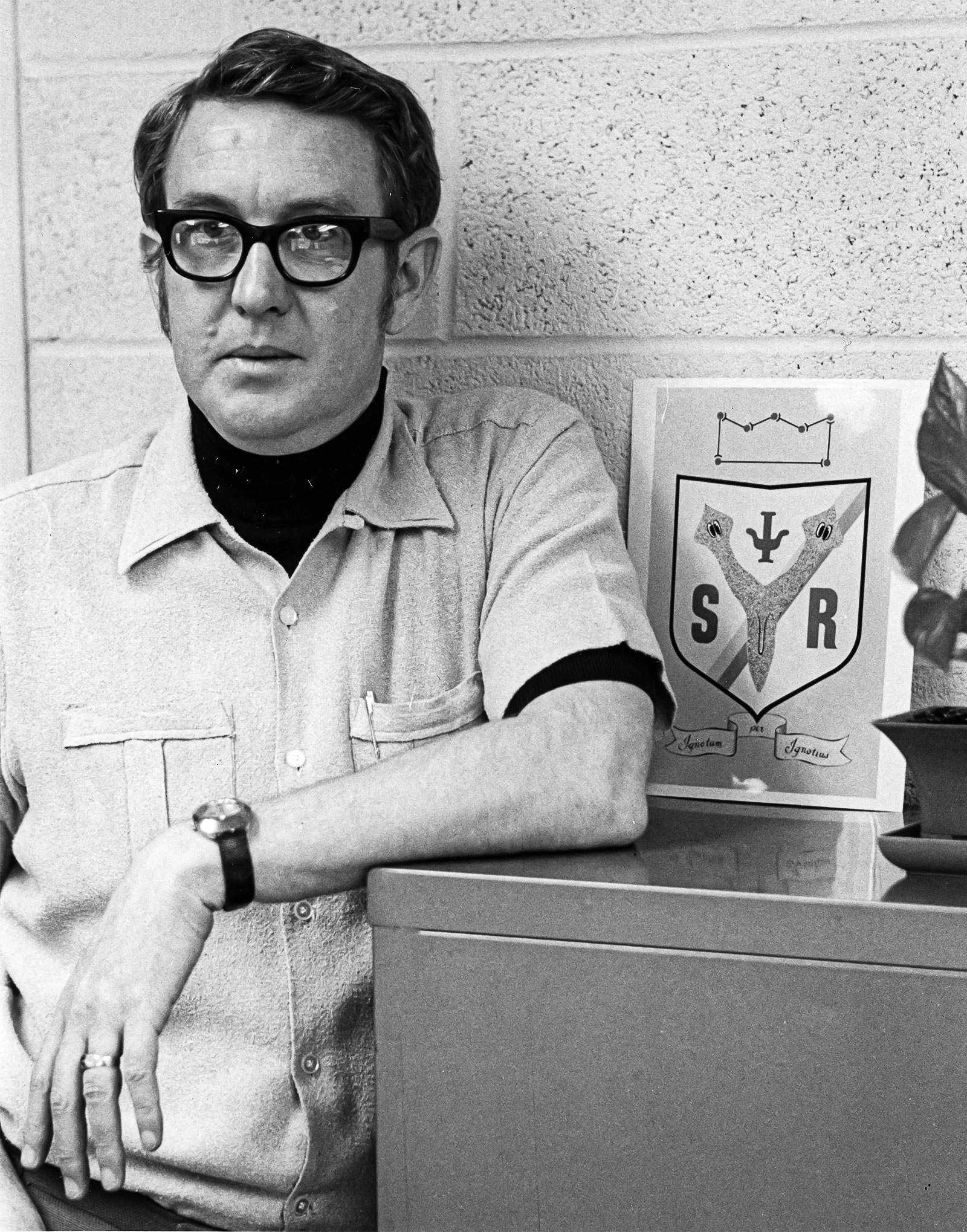
James McConnell stands next to a printed logo of The Worm Runner’s Digest, the half-satirical scientific journal he published from his lab at the University of Michigan.
University of Michigan News and Information Services
Thrilled, McConnell pushed his experiments further. He cut the worms into smaller and smaller pieces; each time, the regenerated segments retained the memory. He stitched the heads of trained worms onto untrained tails, but they kept falling off. He pureed trained worms and injected them into naïve recipients, a delicate process that the historian Larry Stern has compared to “impal[ing] a prune with a javelin.” Finally, remembering that some planarians are cannibals, he fed trained-worm puree to their brethren. In subsequent trials, the “cannibal” worms picked up the light response right away, as though they were remembering, rather than learning, what to do.
If McConnell’s experiments appear gruesome, his line of inquiry was of his time. The discovery of the DNA helix in the 1950s had revealed just how much information is packed into proteins and nucleic acids. The notion that the physical traces of memories, or “engrams,” might have some chemical basis seemed plausible enough to many scientists. Could McConnell’s cannibal worms have eaten an engram? McConnell certainly thought so. He was convinced that their memories were encoded in the structure of their RNA — and could be transferred from worm to worm.
“In the jargon of computer engineering, information is always ‘fed’ into a computer,” the journalist Arthur Koestler later wrote in an appreciative survey of McConnell’s work. “Here the metaphor became flesh.”
These were sensational findings, and McConnell took every advantage of the media attention they generated. Before becoming a scientist, he had had a brief career in radio, and he knew how to repackage nuanced ideas as pithy soundbites. In magazines such as Time and Esquire, he spoke grandly of a future of memory consumption — of “piano lesson pills” and “professor burgers.” He brought his trained worms onto The Steve Allen Show, and, belying his clean-cut hair and horn-rimmed glasses, dubbed himself “McCannibal.”
Students began writing to McConnell’s lab at the University of Michigan to ask for worm-training tips for their school science fairs, and McConnell shared advice. Science, he believed, should be for the people; he saw himself as a latter-day David pitching stones at institutional Goliaths. This made him one of the most famous public scientists of his era, but it did not endear him to more serious peers. It also didn’t help that he published all his research in The Worm Runner’s Digest, a countercultural journal he distributed from his lab.
The Worm Runner’s Digest was “sort of Mad Magazine meets a serious scientific journal,” Gershman told me recently. At its peak, it had some 2,500 subscribers around the world. The hand-drawn shield on its cover featured a two-headed planarian and the Latin motto ignotum per ignotius, which roughly translates to “the unknown explained through the even more unknown.” Its 1959 inaugural issue consisted of only 14 mimeographed pages about the care and feeding of planarians, but it quickly grew. In addition to publishing dozens of memory transfer papers and related scholarship, McConnell welcomed humor and printed science fiction stories, rousing editorials, student-drawn planarian cartoons, spoof articles, and poems.
While the Digest is now something of a cult classic, the mix proved confusing for many readers. McConnell eventually cut the publication in half, not unlike a planarian worm, and renamed the serious half The Journal of Biological Psychology (no relation to the current peer-reviewed journal Biological Psychology, founded in 1973). But McConnell’s reputation as a heretic and prankster was well established.
The wheels started to come off in the mid-1960s. Although McConnell enjoyed a period of fame and funding — including an accelerated path to tenure at the University of Michigan — attempts to replicate his memory transfers yielded inconsistent results. While many apparently succeeded, the failures were more visible. In 1965, the Nobel Prize–winning biochemist Melvin Calvin tried to replicate McConnell’s worm experiments and failed, even with the help of some of McConnell’s former assistants and using the same device. His high-profile publication of the results sparked an acrimonious debate about, among other things, proper worm handling.
By the 1970s, the planarian memory fad had come and gone. Scientists had moved on to rats, cats, goldfish, and even praying mantises. Researchers showing successful memory transfers in rats — by injecting brain RNA from one animal to another — had published their findings in prestigious journals such as Nature and Science, making the planarian model seem unimpressive in comparison. But when further experiments proved inconclusive, interest in the question of memory transfer petered out. As the science historians Harry Collins and Trevor Pinch put it, “memory transfer was never quite disproved; it just ceased to occupy the scientific imagination.”
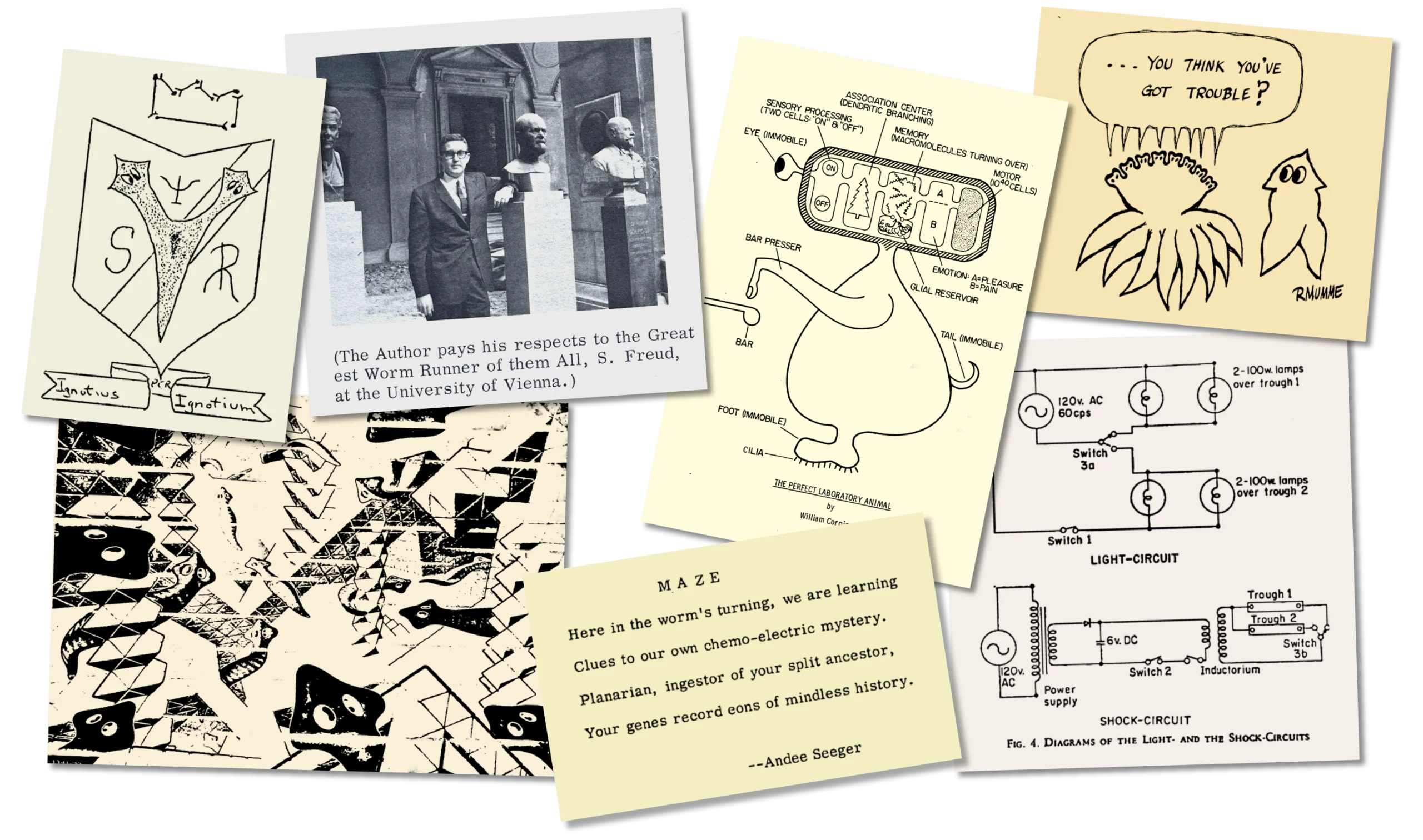
In addition to worm-related scholarship, The Worm Runner’s Digest, a scientific journal published by James McConnell, featured cartoons, poetry, editorials, spoof articles, and other humorous or satirical items.
Courtesy of Sam Gershman and Zachary Kelso
McConnell closed his laboratory in 1971, and his long period of subsequent obscurity was broken only once, in 1985, when he became a victim of the Unabomber. (He lost his hearing temporarily after the blast.) He died in 1990. If a younger generation of scientists is familiar with his cannibal planarians, it’s as “a cautionary tale that neuroscientists tell to their students at bedtime to scare them away from ill-fated projects,” Gershman said.
Still, McConnell’s unconventional work and contrarian attitude has lingered in neuroscience lore, and the idea of memory transfer remains a subject of private fascination. What if McConnell really did manage to feed a memory to a worm? For Gershman, who is searching for a way to study memory at a molecular level and connect it to observable behavior, the question was an itch that had to be scratched. He decided to settle the matter once and for all.
It all seemed straightforward enough. In the spring of 2025, Gershman and Maddie Snyder, one of his postdocs, set out to reproduce the worm-training protocol of one of McConnell’s students, Alan Jacobson. Jacobson’s papers were the most rigorous of the planarian memory transfer era, and Gershman and Snyder followed them to the letter. “We wanted a behavioral basis to be able to study the circuits that are driving memory in these extremely unstable animals,” Snyder said. “Are those circuits at all being used for memory consolidation or storage? Because if you lose your head and all those circuits are gone, then what is the mechanism of storing memory?”
Despite their best efforts, however, they couldn’t do what Jacobson, McConnell, and so many others had done back in the 1960s: condition the worms to scrunch their bodies in response to light. (They reported the results on biorxiv.org in April 2026.) “I was really scratching my head about this,” Gershman said. He’d assumed that the memory transfer would be the dodgy part of the experiment — not getting the worms to form a memory in the first place.
They talked to other planarian labs. They tried different stimuli. They ran the planarian footage through a machine learning pipeline. In desperation, Kelso and Snyder even visited the Harvard Science Museum to examine a vintage “inductorium,” an electric-shock contraption used in midcentury worm science. But it offered no clues.
Kelso searched for any of McConnell’s former collaborators who might still be alive, and through a stroke of luck he found contact information for Daniel Kimble and his wife, Reeva, who had both worked in McConnell’s lab. Now in their 90s, they live in Eugene, Oregon. When Kelso called them, he discovered that not only did they run many of McConnell’s experiments in the 1960s, but they’d also kept the entire print archive of The Worm Runner’s Digest in a box in their basement.
Kelso and Snyder bought tickets to Eugene. Over the course of two days, while consuming plates of homemade cookies and countless cups of tea, they absorbed everything they could from the Kimbles. On breaks from hand-scanning back issues of the Digest, they went stream-hopping nearby and filled casserole dishes with silty fresh water. Back at the Kimbles’ kitchen table, the two generations of scientists watched the silt settle to see what worms might emerge.
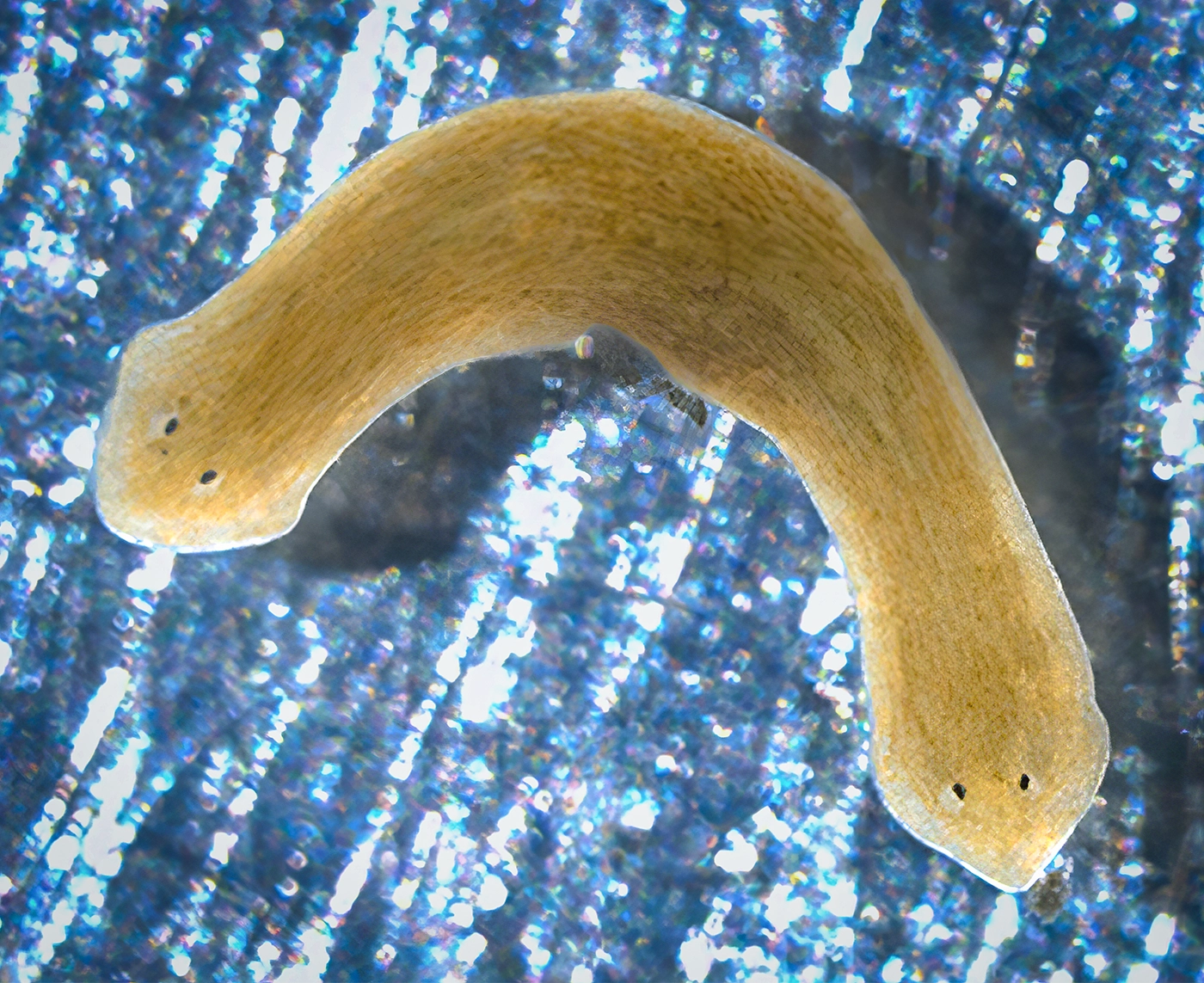
Planarian worms have been subjected to extensive experimentation exploring their regenerative abilities, performed by professional researchers and high school students alike. Here, a worm has been induced to grow an additional head where its tail should be.
Taisaku Nogi, Dan Zhang, John D. Chan, Jonathan S. Marchant
This, after all, is what McConnell did. Rather than using laboratory strains of planarians, he sourced his from a lake near the University of Michigan. And so, not wanting to leave any stone unturned, Kelso made one final trip to McConnell’s former fishing grounds in Michigan. He returned with plastic tubes full of worms, but not a single one was a learner. “At some point, we had like 12 different strains of planaria, none of which showed any learning,” Gershman said.
As Snyder tells it, the Kimbles were absolutely convinced that their conditioning experiments in the 1960s had worked. The worms learned — they were sure of it. The literature of the era seems to support their certainty; at least 36 labs reported similar results. So why is it that when the exact same experiments are done today, using the same laboratory protocol and even the same worms, fished from the same Michigan waters, planarian worms are utterly uneducable?
One explanation, Snyder said, is that McConnell, the Kimbles, and all the other “worm runners” were inconsistent in how they scored the planarians’ behavior and may have misinterpreted more anodyne worm “turns” for the definitive “scrunch” of the light reaction. Every scientist is a product of their time, after all, influenced in myriad, often invisible ways by sociological conditions, funding pressures, and, in this case, a highly charismatic leader. This interpretation made Snyder hyperaware of her own potential biases. “Throughout this entire project,” she told me, “I was like, ‘What are the things that I am taking for granted now in our models of neuroscience, and our assumptions of what is known and unknown, that I should really notice?’”
A more remote possibility is that planarian worms themselves have somehow changed over the last six decades — falling victim to pollution or genetic drift. Gershman finds this scenario unlikely. “What are the chances that a bunch of researchers just happened to do these studies at the particular time when this phenomenon happened?” he asked, incredulous. “They just got extremely lucky, in the millions of years of planarian evolution? And then our luck ran out?”
No matter the reason, in 2026, despite their nervous system and simple brains, planarians don’t learn. From an evolutionary perspective, this might actually make sense. “The reason that we learn associations, to some degree, is so that we can predict danger and avoid it,” Snyder said. But planarians have a different relationship to danger. Their regenerative physiology, so key to McConnell’s experiments, protects them from blunt trauma. Bitten in half, they simply grow back. What use is memory to such a creature? “That’s a whole other philosophical conundrum,” she said.
It’s a great time to be wrestling with such conundrums. Planarian learning may be a dead end, but memory transfer experiments with other organisms are back in scientific vogue — and those experiments appear to be working. In 2018, the neuroscientist David Glanzman of the University of California, Los Angeles performed a memory transplant on the sea slug Aplysia californica, a darling model organism for memory research owing to its relatively simple nervous system and gigantic neurons. After training the slugs to respond to a shock to their tails, Glanzman was able to transfer the sensitization from one slug to another via a direct injection of genetic material. This suggested that some aspect of the memory was stored in RNA, which was McConnell’s contention.
Then, in 2021, the Princeton University geneticist Coleen Murphy found that Caenorhabditis elegans worms — microscopic roundworms with 302 neurons to their name — could learn to avoid a pathogenic bacterium by eating, or even just swimming around in, pureed worms who had learned the hard way. Murphy’s group identified a retrotransposon, a jumping segment of genetic material, called Cer1, that appears to “carry a memory” between individuals, she said. A few years later, a group at the Indian Institute of Science published a paper suggesting that trained C. elegans worms release extracellular vesicles — small lipid particles containing genetic information — that can impart their training to their naïve counterparts.
None of these researchers are half as flashy as McConnell was, but their work indicates that he may have been right about worm memory after all. He just bet on the wrong kind of worm — and doubled down on it, despite inconsistent evidence. In the end, he lost his reputation, but his sheer gusto sparked the curiosity of another unconventional scientist. Fortunately, this one’s following the evidence.
At Harvard, Gershman is shifting his focus from the inscrutable planarian to the more legible C. elegans. It may not regenerate when it’s cut in half, but C. elegans is a long-standing model organism in neuroscience — and it’s been consistently shown to learn. With new experiments underway, Gershman is cautiously optimistic. “I just hope we’re not going down another rabbit hole,” he told me. A wormhole, on the other hand — that’s for certain.