Astrophysicists Puzzle Over Webb’s New Universe
Kristina Armitage/Quanta Magazine
Introduction
When Charlotte Mason ponders cosmic mysteries, she likes to doodle. “I am quite a visual person,” she said. “I usually draw a lot of pictures trying to understand what’s going on.”
Mason, an astrophysicist at the Cosmic Dawn Center in Copenhagen, has lately been filling pages with sketches of “little red dots,” perplexing objects discovered by the hundreds in images from the James Webb Space Telescope (JWST). Little red dots were never seen before the telescope came online in 2022. But we now know that they started to appear in significant numbers roughly 650 million years after the Big Bang.
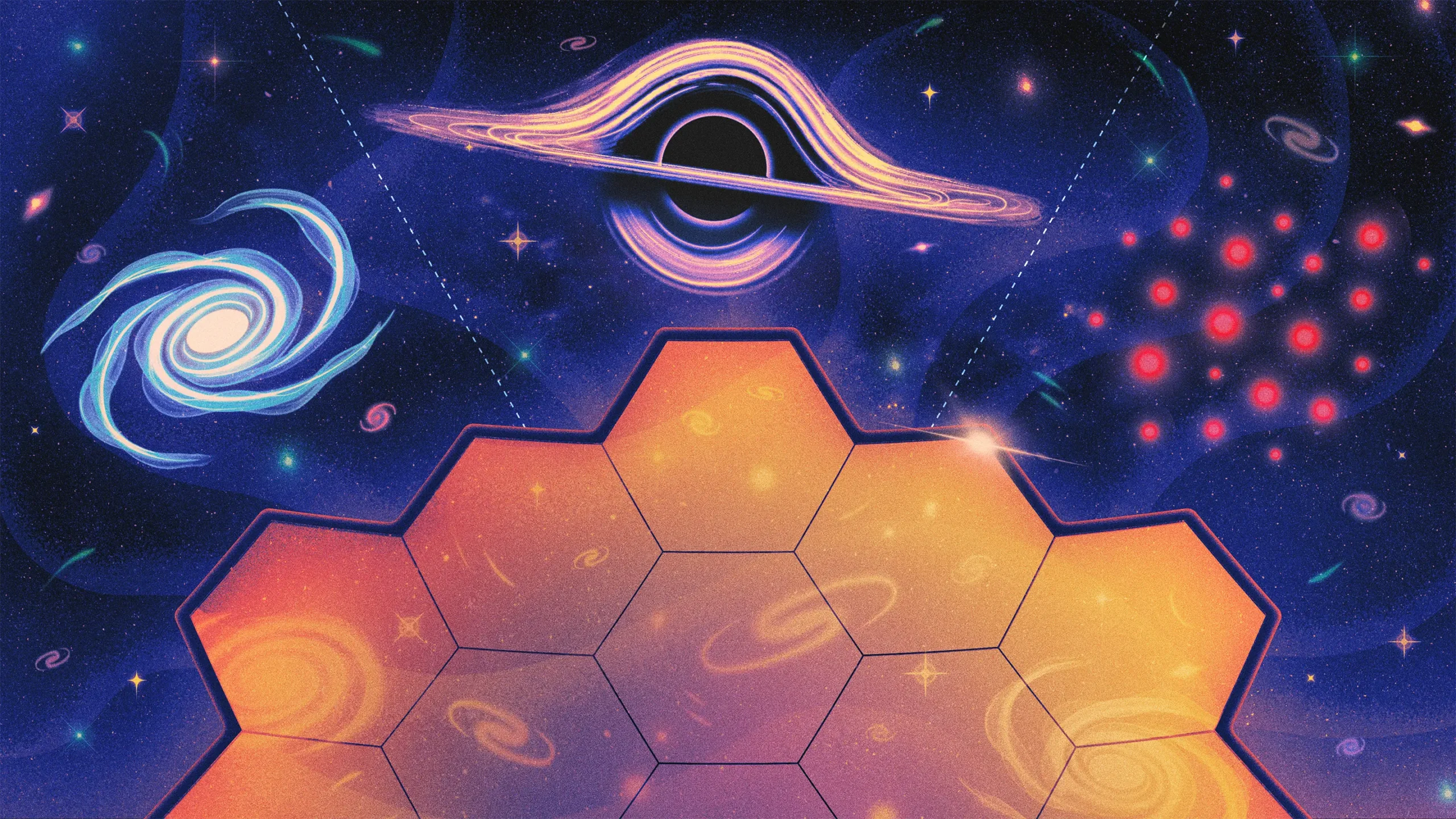
These dots are just one of the thrilling mysteries that have emerged from JWST’s observations of the early universe. Others include black holes that seem impossibly large for their age, as well as ancient galaxies that defy what we thought we knew about the first billion years after the Big Bang. At first, scientists were astounded: The universe revealed by JWST simply didn’t square with our understanding of astrophysics. Now, a wave of new theories offers tantalizing solutions — but which ones portray reality is an open question.
Recent ideas suggest that little red dots could be black holes cocooned in thick gas, possibly representing a completely new type of object called a black hole star, in which the tight shroud of gas emits light like a stellar atmosphere.
“This would be my black hole,” Mason said, drawing a small circle and filling it in. “I might put a disk on it, because we think that’s where some of the emission comes from.” She slashed a line through the circle’s center. “Then the kind of naïve picture is just this dense gas cloud around the black hole.” She drew a larger circle surrounding the object.
But Mason thinks there may be more to these cosmic enigmas. She and colleagues recently analyzed the spectrum of light emitted by one little red dot. If the dense-cloud picture is correct, then some of the light should have been altered from passing through the gas — but that’s not what they saw.
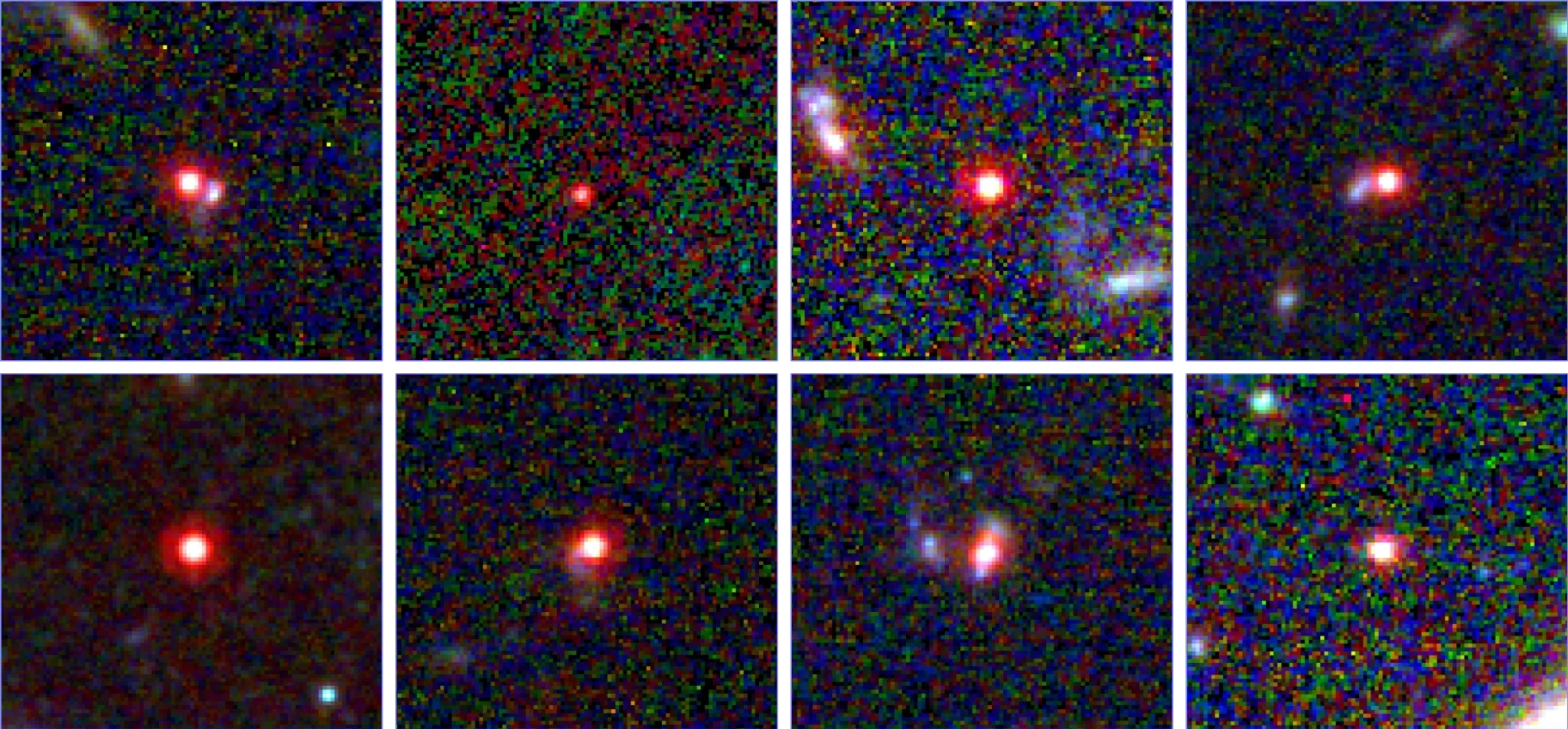
A sampling of the enigmatic little red dots that JWST has spotted in the early universe.
Courtesy of Jorryt Matthee. Data from the EIGER/FRESCO surveys
“Now what do I do? Start again. But now if I make my gas clumpy,” Mason said, drawing a new diagram with holes in the clouds surrounding the black hole, “I should be able to get [a signal] that looks closer.”
All around the world, researchers like Mason are eagerly piecing together JWST’s glimpses of the ancient cosmos to create a clearer picture of our universe’s beginnings. And like the photons that travel billions of light-years to reach us, new fragments are constantly falling into place.
The Universe’s Bottomless Pits
The story of black holes has become more complicated thanks to JWST, which keeps spotting ancient black holes that are too big to explain with established theories — much too big.
Shortly after the Big Bang, the universe was largely featureless and smooth. Then, just a few hundred million years later, “we already see billion-sun black holes growing,” said Jenny Greene, an astrophysicist at Princeton University. “In order to get them that big so quickly, you have to do some gymnastics.”
Scientists look at two key factors that influence a black hole’s size: how massive a black hole “seed” was when it originated, and how quickly these seeds grew after that. But it’s hard to explain how black holes either formed already big enough or grew fast enough to reach a billion times the mass of the sun in early cosmic times.
In the modern universe, black holes form when the core of a massive star runs out of fuel and collapses. Considering the first stars were quite massive, they could have left behind black hole seeds of up to about 100 solar masses, Greene said.
“We know that happens, but it’s really, really hard to get them to a billion so quickly,” she said. “You really have to force-feed them.”
Scientists have historically believed there’s a hard limit to how fast black holes can grow. As material falls toward the black hole, it gets hot as it spins around like water going down a drain. The radiation that this “accretion disk” produces pushes back against more stuff flying in, preventing the black hole from consuming more. This intake limit, called the Eddington limit, should make it impossible for black holes to grow tens of millions of times larger in the time available.
But recent computer simulations suggest that black holes might have something of a back door. If the accretion disk puffs up in just the right way, the incoming gas can overwhelm the radiation pressure. Such “super-Eddington” accretion would lead to gas funneling in at extraordinary rates.
Even so, astronomers don’t know if there would have been enough gas around to produce the biggest black holes. Some researchers think that ancient, dense star clusters may have created lots of black hole seeds that rapidly merged.
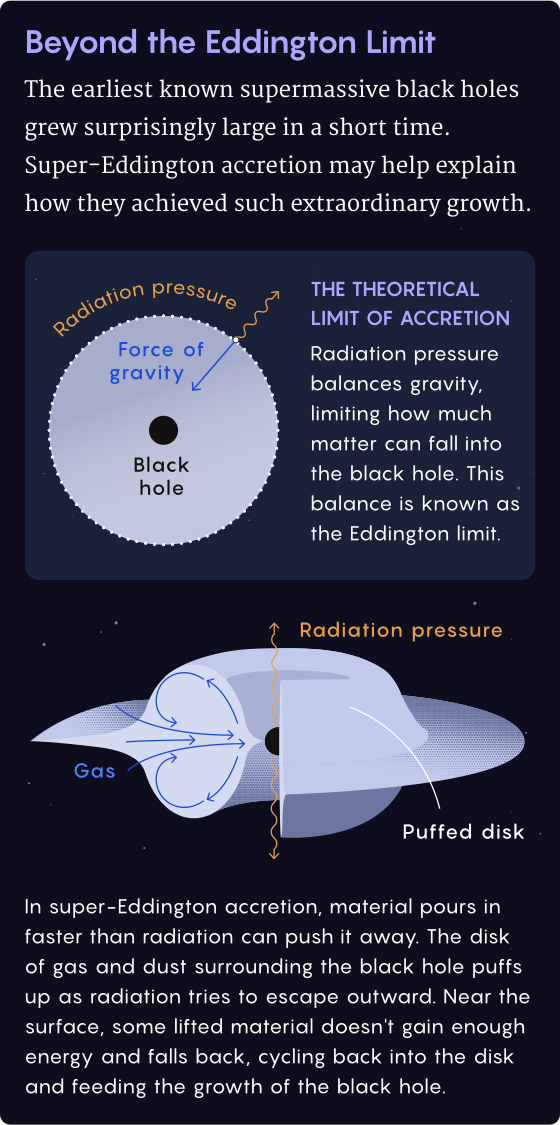
Mark Belan/Quanta Magazine
Or perhaps supermassive black holes never started as stars at all. In this case, colossal clouds of gas would have plunged directly into a black hole. This “direct collapse” mechanism can form a seed some 10,000 times the mass of the sun.
“The problem with the direct-collapse picture is that it requires really Goldilocks conditions,” Greene said. For direct collapse to work, a gargantuan cloud needs to compress into a black hole all at once, without first fracturing into smaller clouds that would form stars. This requires specific gas chemistries, and the cloud must rotate slowly.
“When people try to do this in a computer, they can make these direct-collapse black holes, but they can’t make enough of them to explain all the black holes that we see,” Greene said.
There’s some evidence to support each of these theories. In 2024, JWST saw a black hole from about 1.5 billion years after the Big Bang gobbling up material at about 40 times the Eddington limit. If black holes earlier in cosmic time also stuffed themselves in this way, perhaps the biggest among them started as relatively small seeds.
Recently, however, researchers took a long look at a little red dot from about 750 million years after the Big Bang that is gravitationally lensed by a cluster of galaxies in the foreground. They concluded that the object is a “naked” supermassive black hole, an estimated 50 million times the mass of the sun, without any discernible stars surrounding it. If that mass estimate is correct, the implication is that the black hole may have formed as a large seed, possibly via direct collapse, before any galaxy was present.
“There’s clearly differences in how the black holes are growing that we don’t fully understand yet,” Greene said. “So for me, the most exciting thing to do right now is try to understand, physically, what’s different?”
Building a Galaxy
Like early black holes that seem too big, many early galaxies spotted by JWST seem too bright. To figure out why, researchers are reassessing their ideas about how galaxies form.
Some 200 million years after the Big Bang, the infant universe was small, dense, and hot compared to today. As it expanded and cooled, dark matter coalesced in great clumps that scientists call halos. The gravity of these lightless halos pulled hydrogen and helium gas into vast filaments that gathered in the cores of the enveloping dark orbs. Once enough gas had accumulated, extreme pressures sparked the fires of nuclear fusion and ignited the first stars, which were drawn together to make the first galaxies.
Astronomers generally describe the timing of these events in terms of redshift, or how much the light from early objects has been stretched by cosmic expansion.
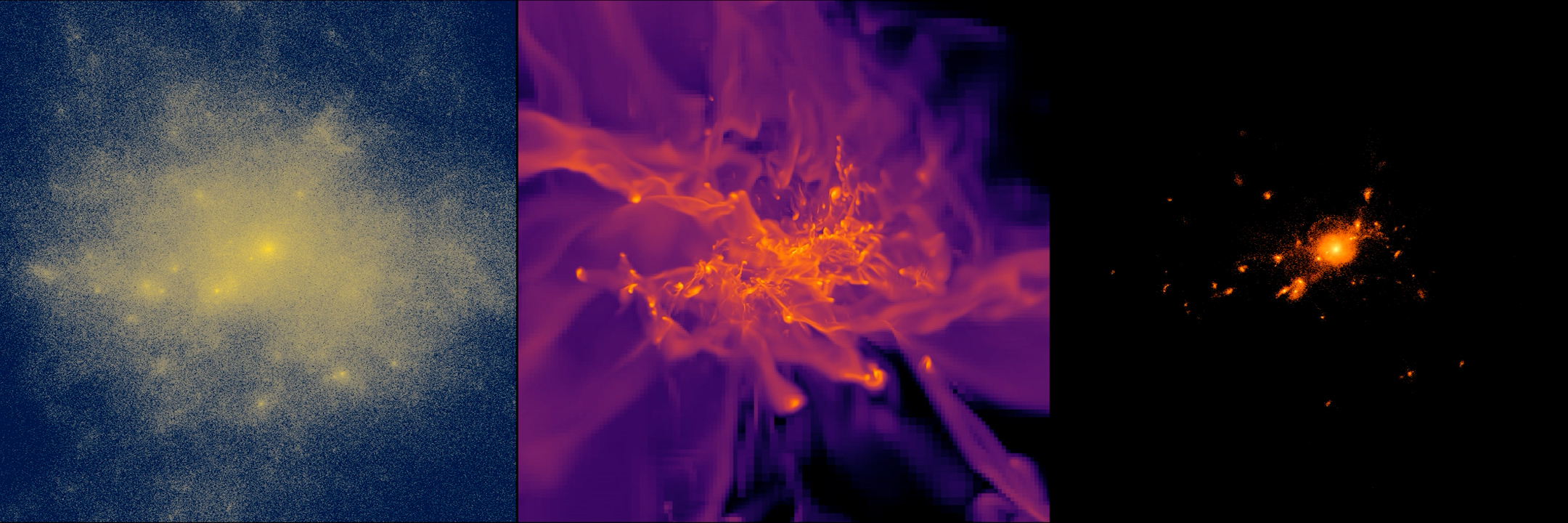
“Not too much happens until about a redshift of 15 [270 million years after the Big Bang], and then lots of gas starts pouring in along these filaments,” said Rachel Somerville, a senior research scientist who studies galaxy formation at the Flatiron Institute in New York. She was presenting new computer simulations at a meeting in April 2026 in Helsingør, Denmark. In a conference room overlooking a strait between the Baltic and North seas, more than 100 researchers from around the world had gathered to discuss the puzzles of the universe’s infancy. Colorful visualizations of dark matter, gas, and starlight danced on a projector screen.
“By about a redshift of 11 [420 million years], the star formation rate starts to really pick up,” she continued. “At redshift nine [550 million years], we make a nice galaxy.”
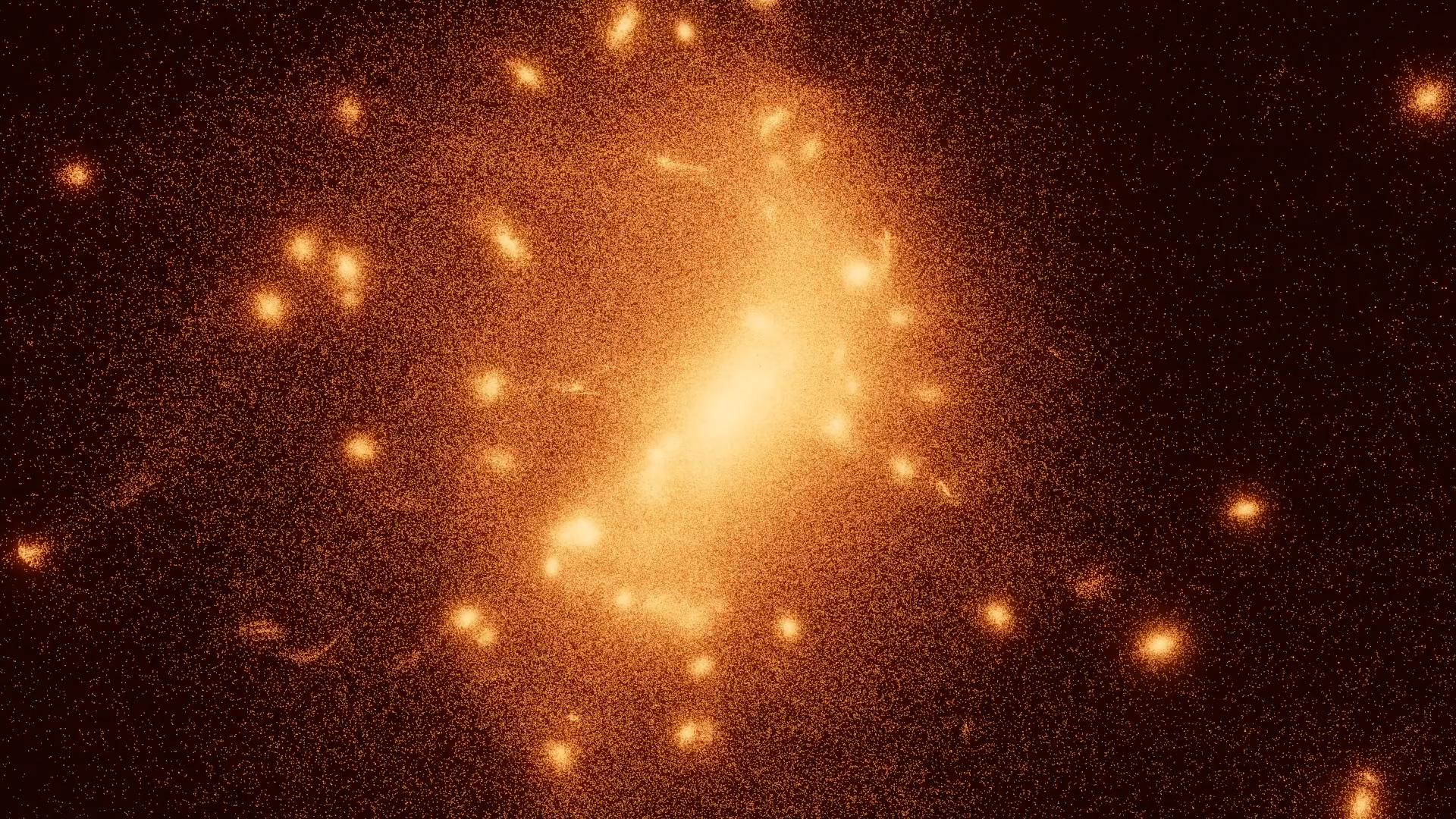
The galaxy on the screen represented an early population, but the most ancient galaxy discovered by JWST so far existed only 280 million years after the Big Bang. The telescope’s bewildering discovery of bright, early galaxies initially led some scientists to suggest that our understanding of fundamental cosmology, the laws that govern the behavior of energy and matter in the early universe, may be flawed. But after a few years of studying these primitive objects, theorists now have several models to explain their brightness and abundance.
“We almost have gone from having too many early galaxies to having too many theories to explain them,” Somerville told the room.
Perhaps the first galaxies converted gas to stars more efficiently than previously thought. Or they experienced periodic bursts of star formation driven by turbulent conditions. Or maybe early star-forming regions preferentially created massive, extremely bright stars. Many astrophysicists think some combination of these factors, and perhaps others, contributed to the galaxies’ development.
To test these new ideas, researchers are exploring the infant universe through simulations. “There’s actually been really remarkable progress since Webb launched, really in the last year or so, on numerical simulations,” Somerville told attendees, adding that these new simulations “perhaps are more appropriate and more informative for interpreting observations in the high-redshift universe.”
As these models improve, JWST is documenting more and more galaxies. By comparing what it sees in the early universe to simulations that attempt to explain why, researchers are inching closer to uncovering the true nature of cosmic dawn.
“We can try to match the best analogue of the observed galaxy to the simulated,” said Hakim Atek, an astrophysicist with the Paris Institute of Astrophysics at Sorbonne University. “Once you have this best match, you can look at the star formation history, because in the simulations you have access to the whole history of the galaxy.”
An intriguing clue has recently emerged from JWST’s Mid-Infrared Instrument (MIRI), a supercooled device that can split apart the light of distant objects. MIRI has revealed that early galaxies do not have the same traits, as scientists assumed.
“The main surprise is the diversity of the properties of galaxies we are seeing at early epochs,” Atek said. “You’re expecting that they would look the same.”
This diversity may be an indication of star formation that occurred in bursts, as galaxies cycled through periods of fusing stars that exploded and expelled gas clouds, halting the creation of stars, only for the gas to gather again and trigger a new wave of stellar birth.
“Some of them, it looks like they cleared all the interstellar medium that is present there, the gas and the dust. It’s like you’re looking only at naked stars,” Atek said. “Another galaxy is the opposite. It has a lot of gas.”
A further clue comes from a group of galaxies with an overabundance of nitrogen. The presence of the element suggests that there may have been a lot of particularly massive stars in the early universe. In simulations, these massive stars generate an excess of nitrogen before exploding in supernovas and scattering the element across their host galaxies.
Someday, researchers may uncover the full picture of galactic formation. Until then, they’ll continue sifting through the traces in new observations and simulations.
The Puzzle of Existence
Once the astral lights switched on, the universe transformed. Radiation from early galaxies and black holes ionized a sea of neutral hydrogen gas, carving out immense bubbles amid the cosmic haze. Researchers call this period reionization, as it was the second time the universe was ionized. It marks the end of the cosmic dark age, when the foggy abyss was devoid of stars.
The first stars, thought to be hundreds or thousands of times more massive than the sun, furiously worked their way through their hydrogen and helium fuel and erupted in powerful supernovas, seeding the universe with new elements such as carbon, nitrogen, oxygen, phosphorus, and iron — the stuff of planets and of life.
In many ways, those first stars are the mothers of the universe. “We’re looking back at what created us,” said Lise Christensen, an astrophysicist with the Cosmic Dawn Center.
Fitting, perhaps, that the recent conference to discuss cosmic origins took place in Helsingør, down the road from the castle that inspired Elsinore in Hamlet. In the play, Shakespeare’s Danish prince laments:
this brave o’erhanging
firmament, this majestical roof, fretted
with golden fire — why, it appeareth nothing to me
but a foul and pestilent congregation of vapors.
What a piece of work is a man, how noble in
reason, how infinite in faculties
. . . . . . . . . . . . . . . . . . . . . . . . . . . . . . . . . . . . . .
yet, to me, what is this quintessence of dust?
Though it’s a mournful rumination on existence — the universe as “a foul and pestilent congregation of vapors,” humanity as the “quintessence of dust” — we now understand that Hamlet’s description is more scientifically accurate than Shakespeare could have known. We are in fact made of elements forged in stars and ejected into the void as gas and dust.
Unlike Hamlet wallowing in Elsinore, however, scientists who study the origins of the universe are exhilarated by these cosmic beginnings.
Editor’s note: The Flatiron Institute is funded by the Simons Foundation, which also funds this editorially independent magazine. Simons Foundation funding decisions have no influence on our coverage.