Rubin Tracks Skyscraper-Size Asteroids, Failed Supernovas, and Interstellar Visitors
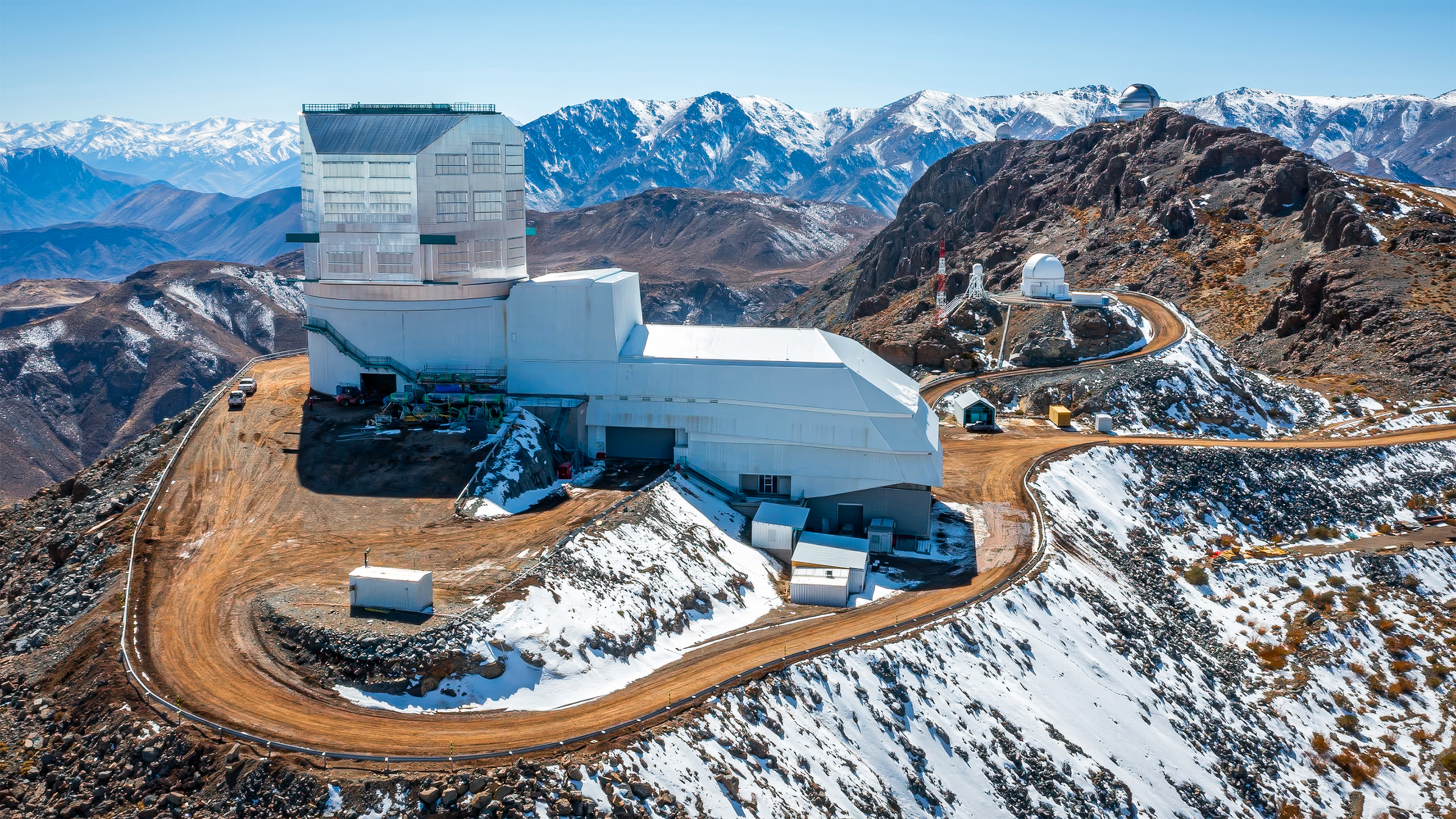
The Vera C. Rubin Observatory sits at the summit of Cerro Pachón, accessible by a 35-kilometer drive on winding mountain roads.
NSF–DOE Rubin Observatory/NOIRLab/SLAC/AURA/A. Pizarro D.
Introduction
Over the years, anticipation has built for the start of observations at the Vera C. Rubin Observatory in the mountains of the Atacama Desert in Chile. Originally imagined in the mid-1990s as the Dark Matter Telescope, Rubin is designed to study our constantly moving and changing universe in greater detail than ever before. Once every few days for a decade, Rubin will take images of the entire night sky over the Southern Hemisphere, creating the world’s largest time-lapse movie.
In Rubin’s first year alone, scientists expect the observatory to find 1 million undiscovered asteroids — as many as have been documented in the previous 200 years of human history — as well as thousands of comets and billions of stars and galaxies.
“We’ve never had this kind of explosion of discovery within astronomy,” said Sarah Greenstreet, an astronomer at the National Optical-Infrared Astronomy Research Laboratory.
A little over a decade after the first stone was laid to build Rubin’s home on the mountaintop of Cerro Pachón, the observatory is now a reality, outfitted with a telescope with three mirrors, the largest of which measures 8.4 meters across, and a car-size digital camera, the largest on Earth. It has begun collecting preliminary images.
“It almost doesn’t feel real that we’re actually getting data from Rubin,” said Matt Nicholl, an astrophysicist at Queen’s University Belfast in Northern Ireland. “To see stuff being found is a dream come true.”
Astronomers are poring over the initial data, and they’re pleased with what they’re finding: rapidly spinning asteroids; myriad exploding stars; and even a rare glimpse of an object passing by from another solar system. “It’s really living up to expectations,” said Michael Frazer, an astronomer at Curtin University in Australia.
Spinning Asteroids
As the observatory goes through its final tuning, Rubin’s images have not yet reached the sharpness that scientists expect. But some Rubin science is less dependent on image quality, including its searches for asteroids and comets. This means that, even in the images taken so far, astronomers have been able to make discoveries.
In June 2025, Rubin released a set of images taken during its “first light,” including photographs of 1,500 new asteroids. In January, researchers announced that 19 of those asteroids were spinning especially rapidly. The quickest of these “superfast rotators,” an asteroid with a diameter almost twice the height of the Empire State Building, called 2025 MN45, completes a revolution every 1.88 minutes.
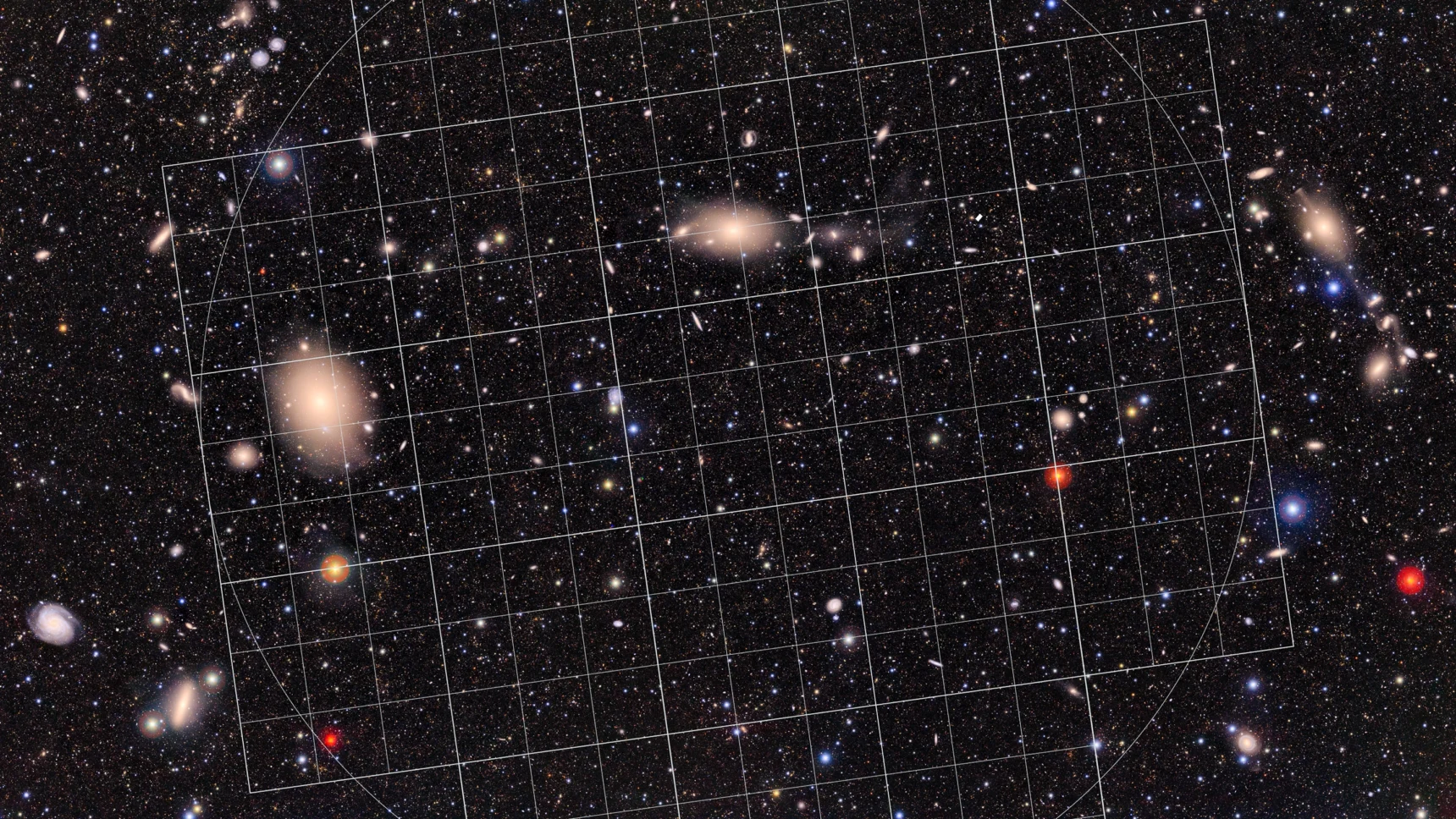
While scientists have spotted asteroids that spin faster, they’ve tended to be much smaller — between 10 and a few hundred meters. For asteroids the size of 2025 MN45, about 700 meters (2,300 feet) across on average, “we didn’t expect we would find something [spinning] faster than 10 minutes,” said Dmitrii Vavilov of the University of Washington, a co-author on the discovery paper.
Most asteroids of this size are thought to be piles of rubble, conglomerations of rock loosely held together by gravity. But 2025 MN45 must have a more solid structure; otherwise its own spin would tear it apart. It might be the fragmented chunk of a long-dead planetary core from the early solar system, broken in a collision and left to spin wildly through space for the last 4.5 billion years, said Greenstreet, the paper’s lead author.
Rubin’s vast pool of asteroids could help scientists piece together the history of our solar system. Astronomers think that the planets were much closer together when they first formed but that they have migrated over time to their current orbits. Finding asteroids in certain patterns of motion, such as an orbit in sync with Neptune’s, could help us trace this migration, Greenstreet said.
Scientists also hope that Rubin will supercharge efforts to spot small asteroids, those that are just a few meters in size, before they hit Earth. These asteroids, known as imminent impactors, mostly burn up in our atmosphere, producing brilliant fireballs in the sky.
Recent simulations show that Rubin might find about one of these a year. What’s more, “it should see them a couple of days in advance, instead of a couple of hours,” as current telescopes do, said Frazer, who led the simulation work. That could give astronomers enough time to travel to the location of the impact and watch it unfold, or to look for any meteorites that make it to the ground. “We can send people out and put a whole bunch of sensors down, from cameras to infrasound,” he said.
It will also be possible to alert members of the public to the event so they can watch the flash in the sky. “We can tell people to go look outside, because we know there’s going to be a beautiful fireball,” Frazer said.
Swarms of Supernovas
Rubin will spend its first year creating a baseline map of the night sky, and scientists will compare subsequent images to this template. An automated alert system will ping them when it comes across a change, such as an exploding star or a flying asteroid.
Rubin tested out its alert system for the first time on February 24, 2026. By photographing a patch of sky for which previous surveys had already built up a sufficient template, Rubin was able to ping 800,000 alerts in a single night.
“Everything that changed, appeared, or disappeared was cataloged and triggered an alert,” said Stephen Smartt of the University of Oxford. Smartt serves as scientific lead for Lasair, one of the seven data brokers that will help astronomers sift through Rubin’s vast data haul for discoveries.
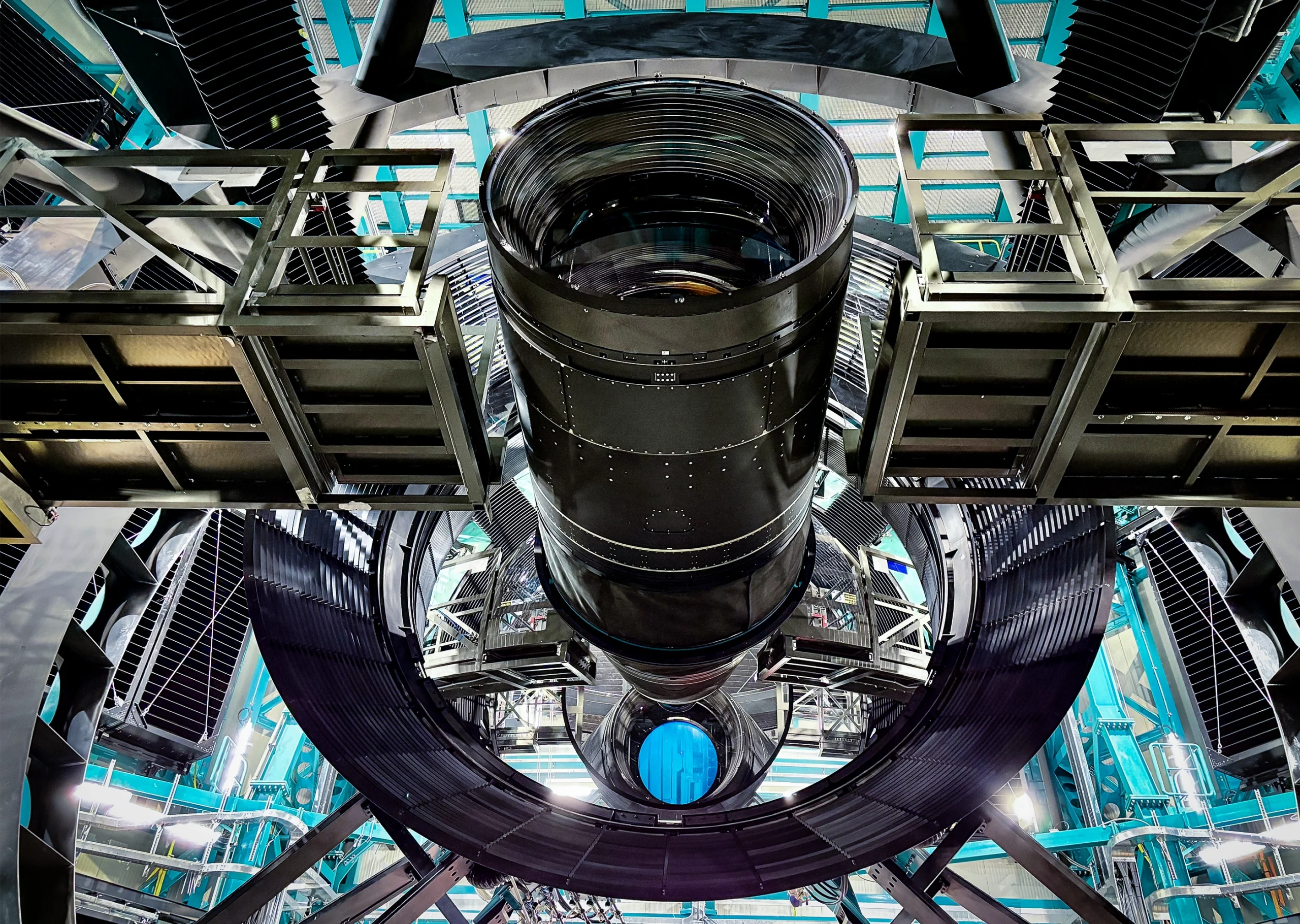
The camera, seen here mounted to the telescope, weighs about 3,000 kilograms. You would need hundreds of ultra-high-definition TV screens to display just one of its images.
RubinObs/NSF/DOE/NOIRLab/SLAC/AURA/T. Lange
Once the full survey begins this summer, Rubin is expected to produce 7 million alerts and 20 terabytes of data a night.
For just one example of how this firehose of data is expected to transform our understanding of the cosmos, consider supernovas, the brilliant death throes of exhausted stars.
Back in the late 1990s, two teams of astronomers used observations of under 100 “Type Ia” supernovas to make a revolutionary discovery about our universe: Its expansion is accelerating due to a still-mysterious force called dark energy. Once Rubin is fully up and running, researchers expect to find 250,000 such supernovas in a year.
Scientists hope that Rubin’s supernova data can help resolve the Hubble tension, the observation that the recent universe appears to be expanding faster than predicted when compared to the early universe. “We want to collect huge samples of Type Ia supernovae to probe this acceleration in much greater detail,” Smartt said.
Smartt is also interested in finding failed supernovas, which occur when stars collapse in on themselves rather than exploding outward. They might have their origins, paradoxically, in the most massive stars. In February 2026, scientists pinpointed a possible candidate in the Andromeda galaxy.
Rubin, with the exquisite detail of its images, is well placed to find these types of events, in which stars disappear in explosions that can be too faint for other surveys to see. “It goes down 100 times fainter than other sky surveys,” Smartt said.
Visitors From Afar
Rubin can also be used to track interesting and unusual objects passing through our solar system. It’s traditionally been difficult to catch such speedy travelers, at least without a survey that can pick out very faint objects at a rapid pace. Scientists have only ever observed three such interstellar objects — asteroids and comets that were ejected from other stars and fired into our vicinity — giving us insight into material from other solar systems. Rubin has already proved its ability to spot them.
Scientists announced the observation of an interstellar comet called 3I/ATLAS on July 1, 2025. They detected it without Rubin, via a network of four other telescopes that forms the Asteroid Terrestrial-Impact Last Alert System (ATLAS), which usually finds objects formed nearby.
Other astronomers followed up by looking through Rubin’s initial data and discovered that the observatory had also detected 3I/ATLAS, 10 days earlier. If a similar visitor from afar appears in Rubin’s data during the survey, astronomers will receive an alert.
Scientists don’t know exactly how many more interstellar objects Rubin will find, but they expect it to find at least some. “It could be five to 500,” depending on how often these objects are ejected from their home systems, said Rosemary Dorsey, an astrophysicist at the University of Helsinki in Finland. “I am optimistic there will be some, but if there aren’t, then that is a really interesting problem.”
Going the Distance
One way that astronomers determine the distance to an object in space is by studying its light. As light makes its way toward Earth while traveling through the expanding universe, it shifts toward the red side of the electromagnetic spectrum. The higher the redshift, the more stretched the light is, and the farther its source is from Earth.
Rubin’s preview data allowed scientists to test how well it could measure this light via a technique called photometric redshift, which will let it map galaxies across the universe to probe dark energy and dark matter. “The preview data tells us how accurate those photometric redshifts are going to be,” said Kristen Dage, an astronomer at Curtin University. Rubin performed at least as well as other cutting-edge telescopes, Dage said, but it will measure the redshift of many more galaxies, about 4 billion of the 20 billion galaxies it will find.
Dage expects that this data will also help scientists study fast radio bursts (FRBs), bright, unexplained flashes of radio waves in the sky possibly linked to highly magnetized stars called magnetars. While Rubin cannot detect radio waves, photometric redshift data will help scientists work out the distances to FRBs if they can be sourced to a host galaxy Rubin can measure, which could help scientists determine the processes that trigger them.
All of this is just a smattering of what scientists are hoping to explore when Rubin comes online. With it, a new era of astronomy is set to begin.
“Rubin is going to be putting out so much data, so many alerts every night, that everybody’s going to struggle to keep up with [the] information,” Frazer said — a challenge, but a delightful problem to have.