What Causes Lightning? The Answer Keeps Getting More Interesting.
Introduction
Before he changed the way we understand lightning on Earth, Joseph Dwyer studied the weather in more cosmic settings. Using the sensors on NASA’s Wind satellite, orbiting a million miles away, he watched flares shoot out from the sun and analyzed the particles that stream from the sun’s surface. But when he relocated to Florida around the turn of the millennium, Dwyer felt ready for something new — something he and his students could investigate on their own. It didn’t take long before the tropical weather delivered a suitable mystery outside his office window. “It was like boom, boom, boom outside,” Dwyer said. “I looked into it and realized lightning was an unsolved problem.”
Thunderstorms have captivated humanity for millennia, and yet their inner workings remain deeply mysterious. Storm clouds are opaque. They’re dangerous to approach. And they’re too big to fit in a lab. Inquisitive researchers have been sending kites, balloons, and rockets up into them for nearly three centuries, and they’ve learned a lot. But every time lightning lovers get closer to the action, they discover major gaps in their understanding. For the past 50 years, researchers have focused on one particular gap: How does the jagged channel of white-hot air we call a lightning bolt get started?
Recently, the field has experienced a sort of renaissance as researchers — many of them astrophysics refugees like Dwyer — have devised new ways to pierce the clouds. They’ve taken a slew of instruments built to study violent cosmic events and trained them on the brutality of terrestrial thunderstorms. They’ve seen lightning shooting out X-rays as it zigs and zags, spotted flickering glows of gamma rays coming from thunderclouds, and, very recently, detected hints of bolts traveling in unexpected directions.
No one has put all the pieces together, but a new understanding of lightning is taking shape. The fearsome flashes look less and less like the supersize electric sparks that physicists once imagined them to be. While electricity plays a central role, lightning bolts are formed and shaped by the whole physics canon — from cosmic blasts to particle physics. In particular, triggering a bolt seems to require extreme events more typically associated with supernovas, black holes, and particle colliders than with fluffy clouds.
“There is a growing consensus in the field that high-energy processes play a critical role in lightning initiation,” said Caitano da Silva, an atmospheric physicist at New Mexico Tech. “It’s an exciting time to be in this field.”
Trigger Point
When lightning bolts split the sky, the ancient Greeks, Scandinavians, and Hindus saw flashes of divine warfare. And when thunderclaps rattled their chests, the Chinese felt a deity punishing wrongdoers. Today, the power of thunderstorms still leaves people awestruck.
“I grew up watching these large cold fronts coming in with a lot of lightning” in Brazil, da Silva said. “I grew terrified of it.”
With fear comes fascination. Yet despite centuries of exploration, fascinated physicists like da Silva are still asking the same question that the ancients did: How does lightning begin?
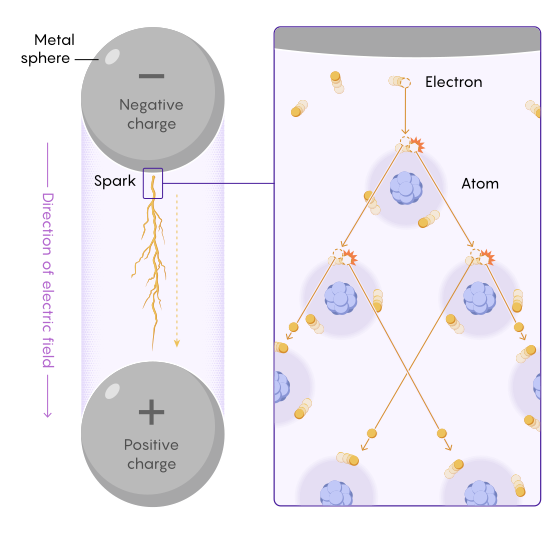
For a time, researchers thought they had an answer. As physicists demystified electricity in the 18th and 19th centuries, they learned how to make sizable sparks on command: pile up electric charge on one metal ball, bring a second nearby, and a spark leaps between them. When researchers eventually worked out the structure of matter, they understood why. The separated charges generate an electric field between the balls. When the electric field reaches a critical strength — roughly 3 million volts per meter — the air starts to come undone. The field flings loose electrons into neighboring atoms, where they knock more electrons loose. Like snow on a steep mountain slope, the electrons “avalanche,” heating up the air until it glows.
Mark Belan/Quanta Magazine
Benjamin Franklin linked sparks in the lab with lightning in the sky in his famous kite-flying experiment in 1752. And for the next 200 years, investigators believed that what happened in storm clouds was exactly the same as what happened between their metallic spheres, just on a larger scale. The mystery of lightning seemed solved.
But when physicists graduated from kites to rockets and truck-size weather balloons in the mid-20th century, they found a problem. Clouds do have electric fields; tiny ice crystals rub against each other like socks against a carpet, and crystals with extra electrons tend to pile up at the bottom of the clouds. But these fields are weak. Typical thunderstorms have just a tenth the electric juice needed to spark, and the strongest fields ever measured reach just a third of the critical intensity. Yet according to NASA satellites there are more than 2,000 thunderstorms across the globe at any given moment — an observation as puzzling as avalanches thundering down bunny slopes.
“You have to increase the electric field all the way above the conventional breakdown threshold,” said Michael Stock, a researcher at the Cooperative Institute for Severe and High-Impact Weather Research and Operations at the University of Oklahoma. “But that doesn’t seem to happen in nature.”
A visible bolt means the air has broken down into a mess of hot, charged subatomic debris. So either something has supercharged the electric field, pushing it past the critical threshold, or some other process must break down the air molecules. The question is: what?
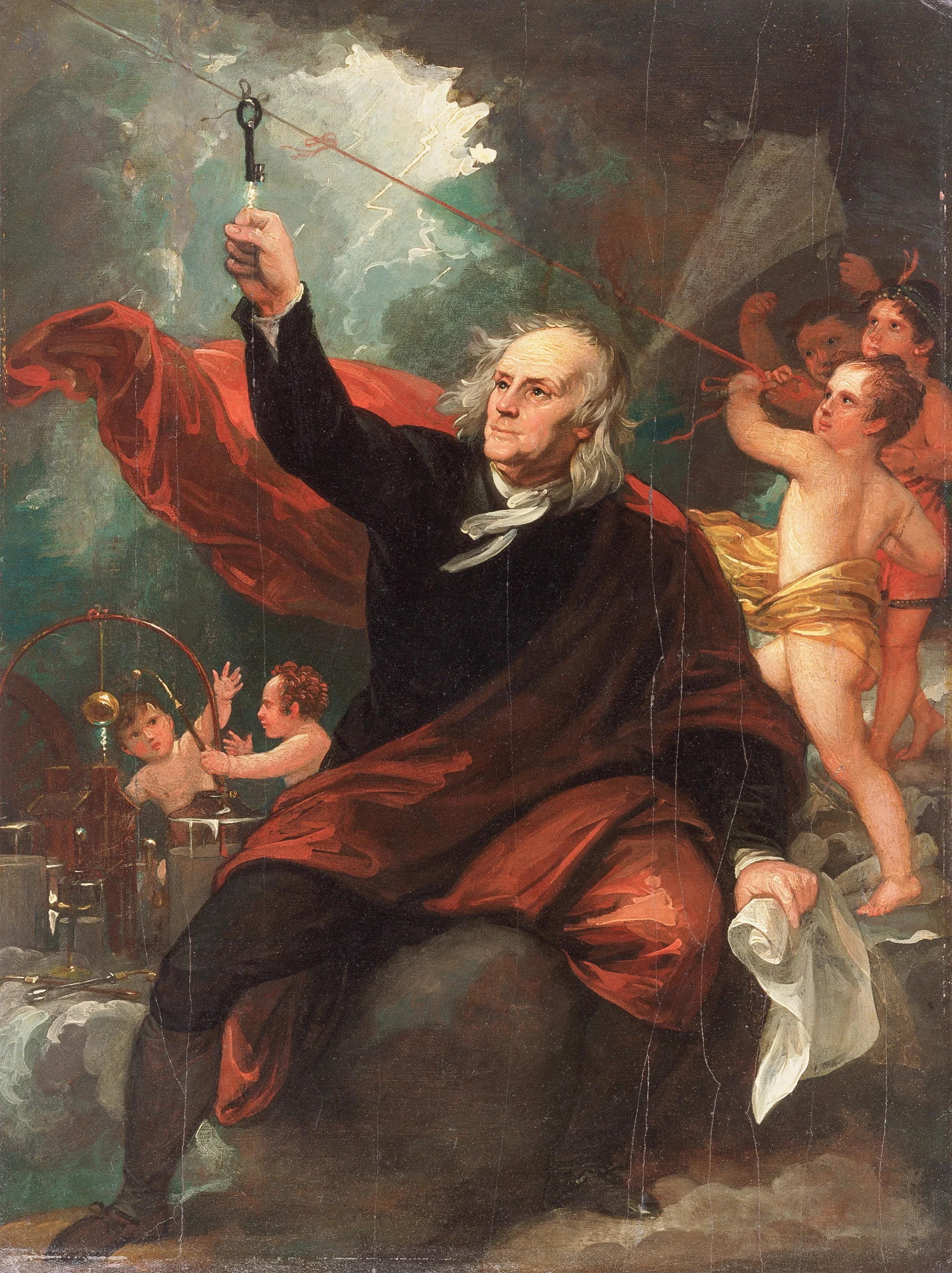
In 1752, Benjamin Franklin conducted his famous kite experiment, as depicted in this c. 1816 painting by Benjamin West. This experiment established the connection between lightning and electricity.
Public Domain
One clue comes again from Franklin. He observed that sharp tips are more likely to start or receive a spark. Physicists now understand that this happens because pointed conductors enhance the nearby electric field. In the 1960s and 1970s, physicists in Florida and France started intentionally setting off lightning bolts by firing small rockets with sharp points into storm clouds. A wire would unspool behind the rocket and guide the bolt to the ground.
Most storm clouds don’t have rocket-mounted darts to help them spark, but they do have ice crystals, some of which can exceed the size of a pencil eraser. These ice chunks, which are also conductors, can stretch into shards. Physicists estimated that sufficiently lengthy ice shards could boost the field strength by a factor of 10 or more, and that a number of these so-called hydrometeors acting together could do even better. Once again, the mystery seemed solved.
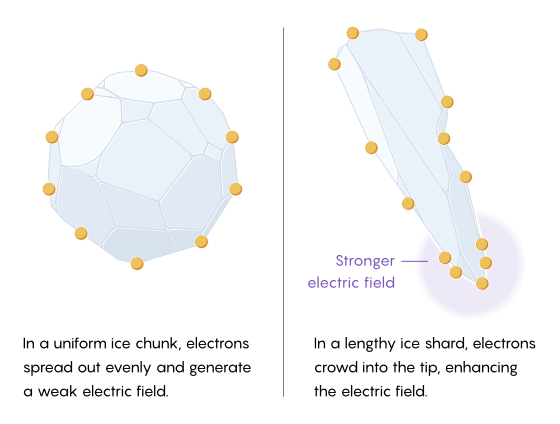
Then physicists started looking at storms from space and learned that thunderclouds were stranger than they had imagined.
Runaway Avalanches
In 1994, a satellite searching for extreme deep-space explosions happened to pick up flashes of gamma rays coming from thunderclouds, often alongside lightning. Gamma rays are the most energetic type of light rays, typically marking the last gasp of a dying star or the cataclysmic clap of two neutron stars. They are not something you’d expect to come out of a cloud, no matter how many sharp ice chips it had. Something was afoot in the fast and intense realm of subatomic particles.
This was around the time that Dwyer witnessed the booming Floridian lightning storms and learned about their mysterious origins. As an astrophysicist, he knew about the subatomic realm. He was familiar with the work of the Nobel laureate C.T.R. Wilson, who had hypothesized that a “relativistic” electron moving at close to the speed of light would barely feel any drag from atoms in the air. (Da Silva likens it to a bullet ripping through a flurry of snowflakes.) A sufficiently speedy electron in an electric field could therefore “run away” faster and faster.
Dwyer knew that a Russian physicist, Aleksandr Gurevich, had shown in 1992 that such a runaway electron could unleash a cascade of perhaps 100,000 electrons, akin to the avalanches that initiate sparks in the lab but playing out over hundreds to thousands of meters. And he also knew that when these relativistic, runaway electrons bounced off air molecules, they could emit gamma rays.
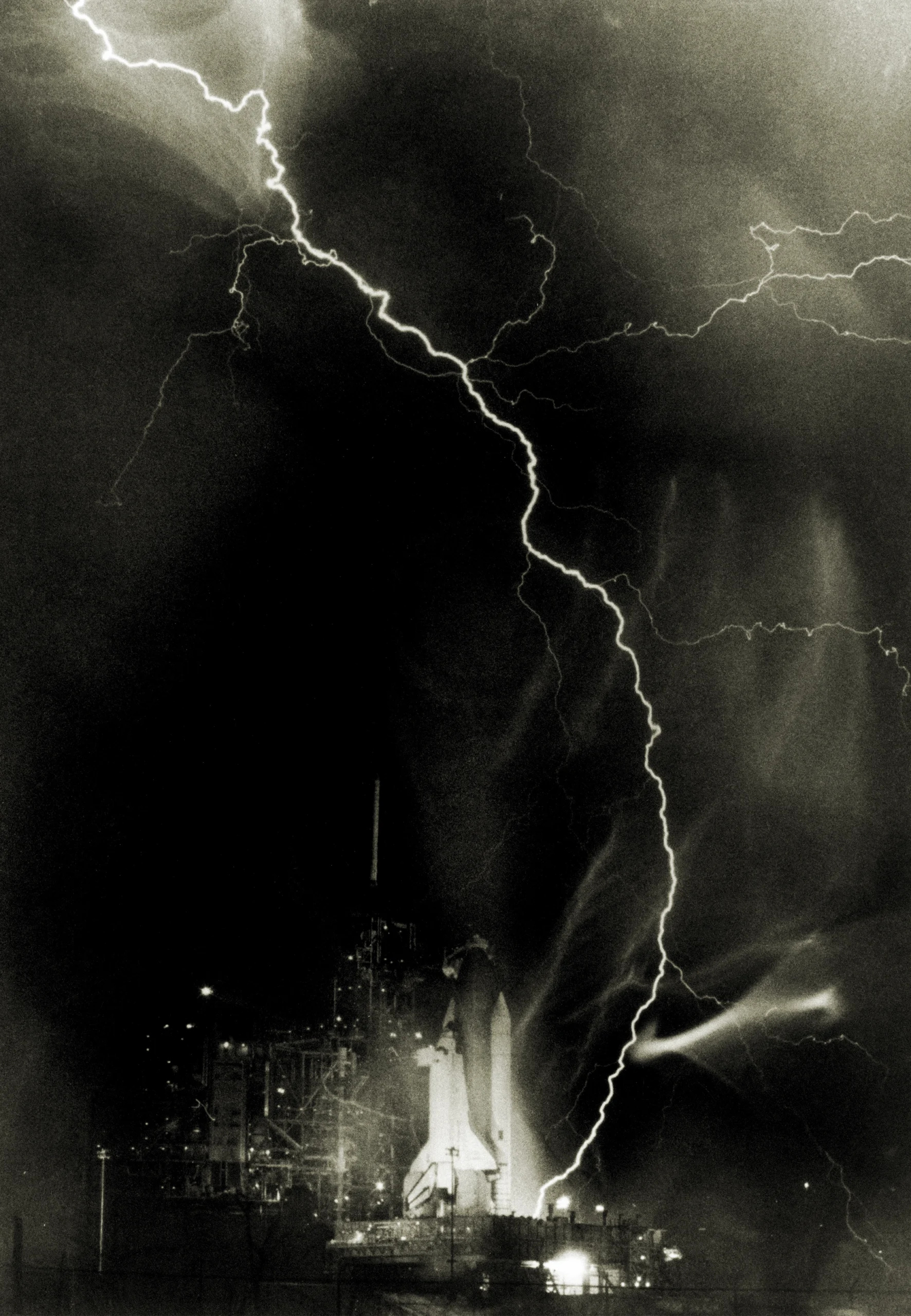
Lightning is common in Florida. This strike hit the launchpad of the Space Shuttle Challenger at Kennedy Space Center on Aug. 30th 1983.
NASA
By themselves, these extreme subatomic affairs didn’t seem to be abundant enough to account for the brilliant gamma rays lighting up storm clouds. But then Dwyer imagined a baroque process that could allow one avalanche to set off another, and another, and another, all right on top of each other.
According to Dwyer’s process, when one electron in the avalanche collided with an atom, the electron could ricochet and emit a gamma ray. That gamma ray would transform into an electron and its antimatter twin, a positron. The cloud’s electric field would push the positron backward close to where the avalanche began. There it could crash into another atom, setting off another avalanche, which would make more gamma rays, more positrons, more avalanches, and so on, until you got a flash visible from orbit.
“It’s like taking a microphone and sticking it next to a speaker,” said Dwyer, who is now at the University of New Hampshire. “It can get really loud quick.”
The stack of runaway relativistic avalanches could explain the gamma rays. And it could also contribute to lightning initiation. As the avalanche cascades, electrons pile up at the front while leaving positively charged ions in their wake — boosting the cloud’s electric field.
In computer simulations, Dwyer showed that this chain of events amplified avalanches, radiated gamma rays, and ramped up the electric field. Around the same time, detailed simulations of ice shards revealed how sharp they were likely to get — not very sharp — which also began to weaken the hydrometeor theory.
So, were Dwyer’s runaway relativistic avalanches really happening inside clouds? And could this boost the electric field enough to produce lightning? His colleagues were divided.

Researchers needed to get closer to the action. In July 2023, daredevil physicists outfitted a high-altitude NASA plane with gamma-ray detectors and flew it straight over the core of some of the most ferocious storms on the planet — tropical storms in the Gulf of Mexico, the Caribbean, and Central America. The plane reached stratospheric perches that “most people would like to avoid at all costs,” da Silva said. The campaign was called ALOFT, an acronym made in part from other acronyms. Its observations delivered the biggest bonanza of new data in a generation.
Storm clouds, ALOFT revealed, are bubbling cauldrons emitting all sorts of gamma rays that are too faint to see from space. The project confirmed the soft glows and sudden flashes around lightning that space-based instruments had also detected. But ALOFT also detected that clouds flash even when no lightning is visible. Most curiously, they also flicker.
“They discovered there’s a whole zoo of other phenomena,” said Ute Ebert, a lightning physicist at Eindhoven University of Technology in the Netherlands.
One person who wasn’t completely surprised by the ALOFT observations was Dwyer. In anticipation of the ALOFT team’s announcement, he had rerun his simulations to predict what their gamma-ray detector would see as it flew above the storms. He had long known that the relativistic avalanches unavoidably piled up in a flickering pattern, so he calculated exactly what kind of flicker the particle collisions would produce. Both teams presented their findings in San Francisco at the American Geophysical Union’s annual meeting in December 2023, and the results lined right up — the strongest evidence yet that Dwyer’s subatomic collisions are playing out inside real thunderstorms.
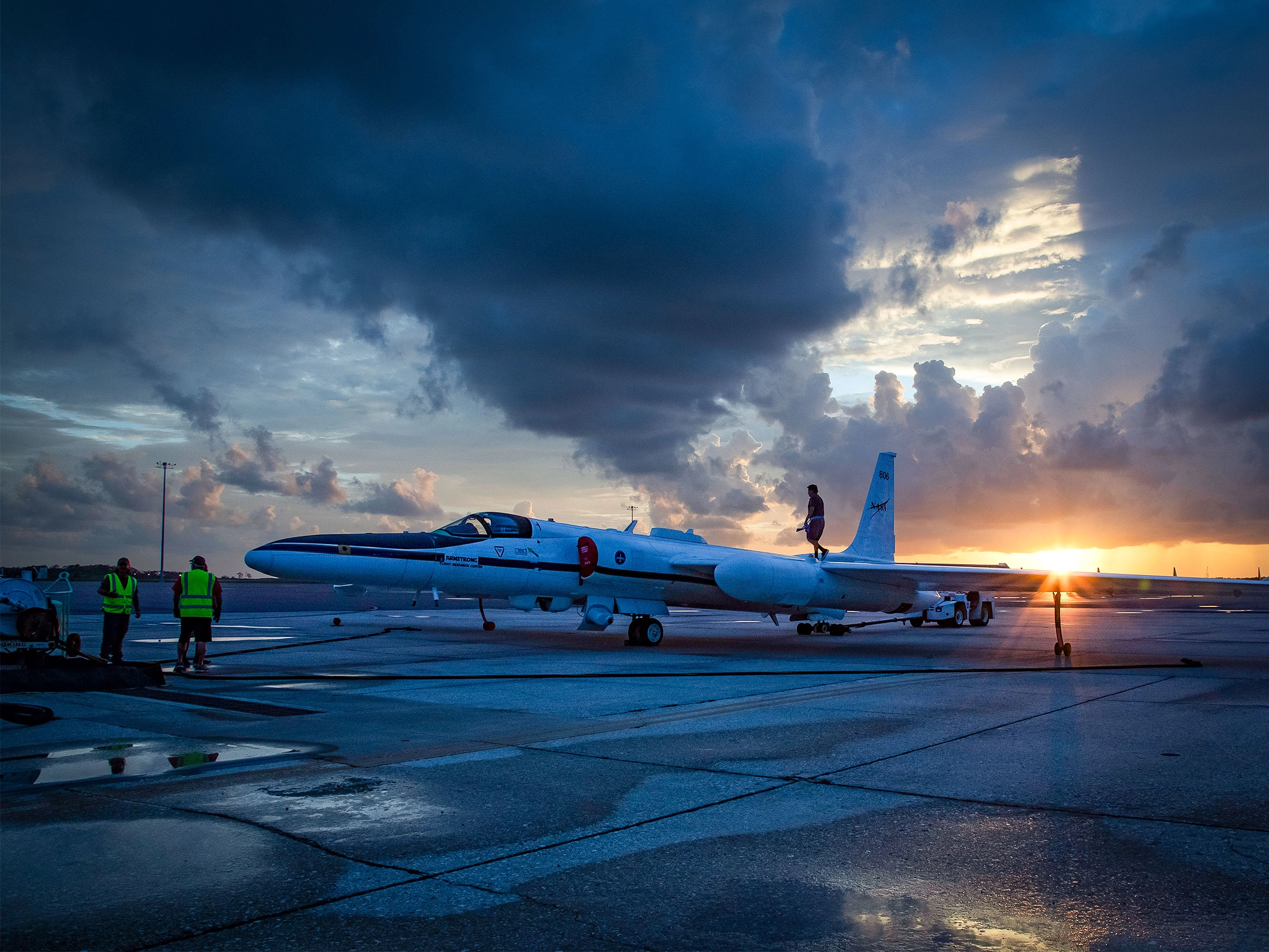
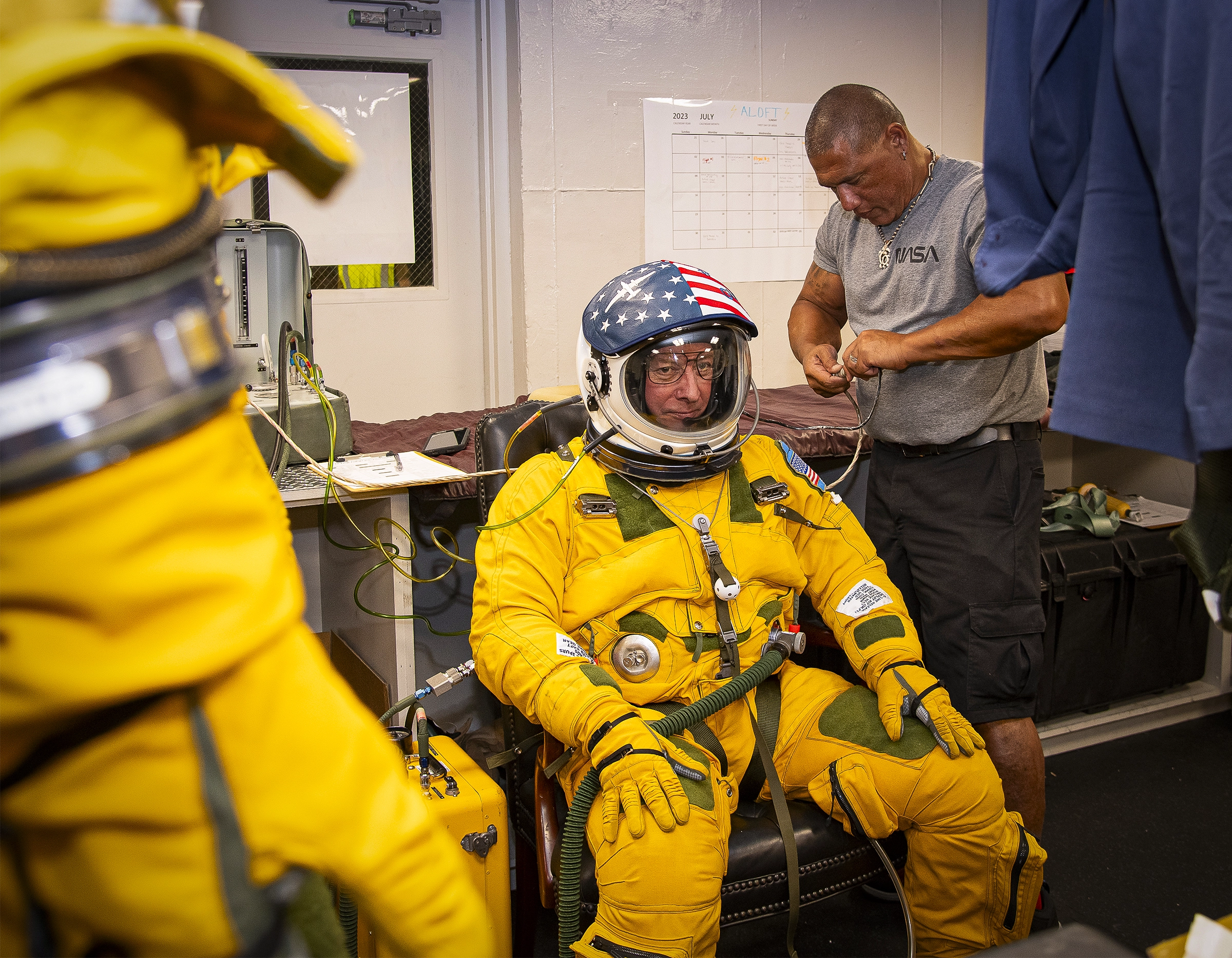
The NASA ALOFT mission used a high-altitude ER-2 aircraft (left) with pilots (right) flying directly over tropical thunderstorms to detect high-energy particles and radiation associated with lightning.
NASA/Carla Thomas
Now other theorists are building upon this theory. Last summer, Victor Pasko, an electrical engineer at Pennsylvania State University, studied the chain of events set off under other circumstances, such as higher electric fields, and found that in these cases too avalanches can pile up and initiate lightning, lending additional support to the whole framework.
“It’s consolidating this idea that the energetic electrons are playing a role here,” da Silva said. “Until very recently, essentially just Dwyer was talking about this.”
At Odds With The Field
Chains of high-energy electron avalanches may very likely be making clouds glow, flicker, and flash with gamma rays. But researchers can’t say with certainty that they are also sparking lightning. One puzzle is that lightning seems to start from one point in the cloud, while the avalanches take place over a much larger region. The avalanches bring the cloud close to the conditions that are expected to lead to lightning. But no one has fully connected them to the triggering of a lightning bolt.
Even as Dwyer’s theory has gained support, observations from early 2025 have revived yet another theory of lightning creation.
In the New Mexico desert, a pair of stations bristling with antennas captured radio waves coming out of a dozen separate lightning strikes. Using this data, Xuan-Min Shao, a researcher at Los Alamos National Laboratory, was able to reconstruct the way the overall current moved during the start of these strikes. He found that something was off. If one of Dwyer’s cascades, or any other process driven purely by the electric field, was seeding the lightning bolt, the proto-bolt would move perfectly in line with the electric field from the very beginning of the process. But Shao found that in these cases, the two directions were slightly at odds. In the slant, Shao sees evidence for an extraterrestrial, even extragalactic origin for lightning — a cosmic-ray shower.
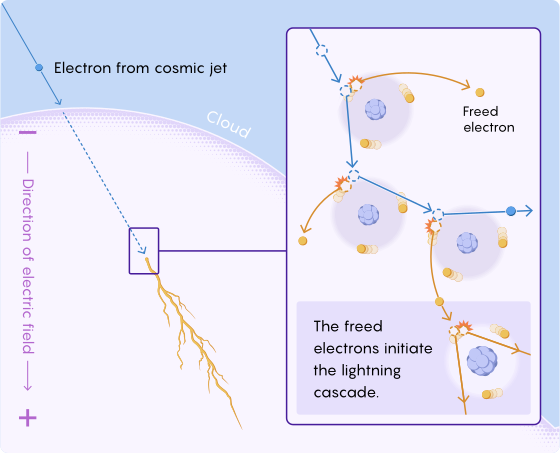
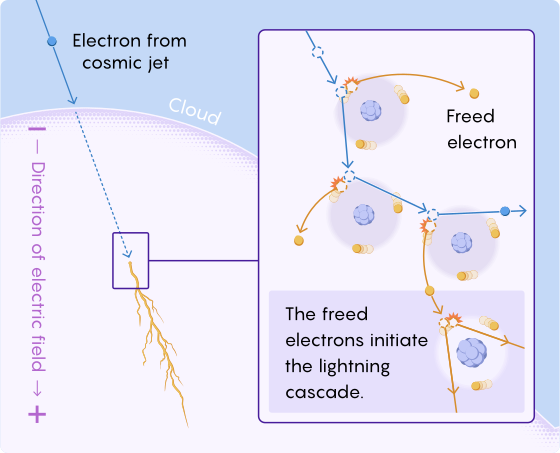
Cosmic-ray showers are the end result of violent events in deep space, such as the expulsion of particles from feeding black holes or stellar explosions that fire off a piece of atomic shrapnel — perhaps a proton from an exploding star, or a denuded iron atom expelled from a supermassive black hole. These shards travel billions of light-years across the universe and slam into Earth’s atmosphere. The violent collision sprays a jet of electrons, positrons, and other particles down into a cloud at a random angle. These electrons and positrons could have enough oomph to separate the electrons from their molecules and get an avalanche going, even if the electric field stays well below the critical threshold.
To some physicists, Shao makes a strong case. “It has to be mapping the direction of something else, most likely the cosmic-ray ionization,” said David Smith, a physicist at the University of California, Santa Cruz. “I find the data extremely convincing.”
Others say it’s too soon to know what to make of the finding. Shao’s reconstruction technique isn’t fully established, and cosmic-ray showers are full of poorly understood particle physics. That makes it tempting to use them as a “magic wand,” said Brian Hare, a physicist at the Netherlands Institute for Radio Astronomy, to fill an otherwise hard-to-explain gap in a mysterious process.
But if Shao and others start to see more instances of lightning flying askew, that might motivate theorists to work out those details.
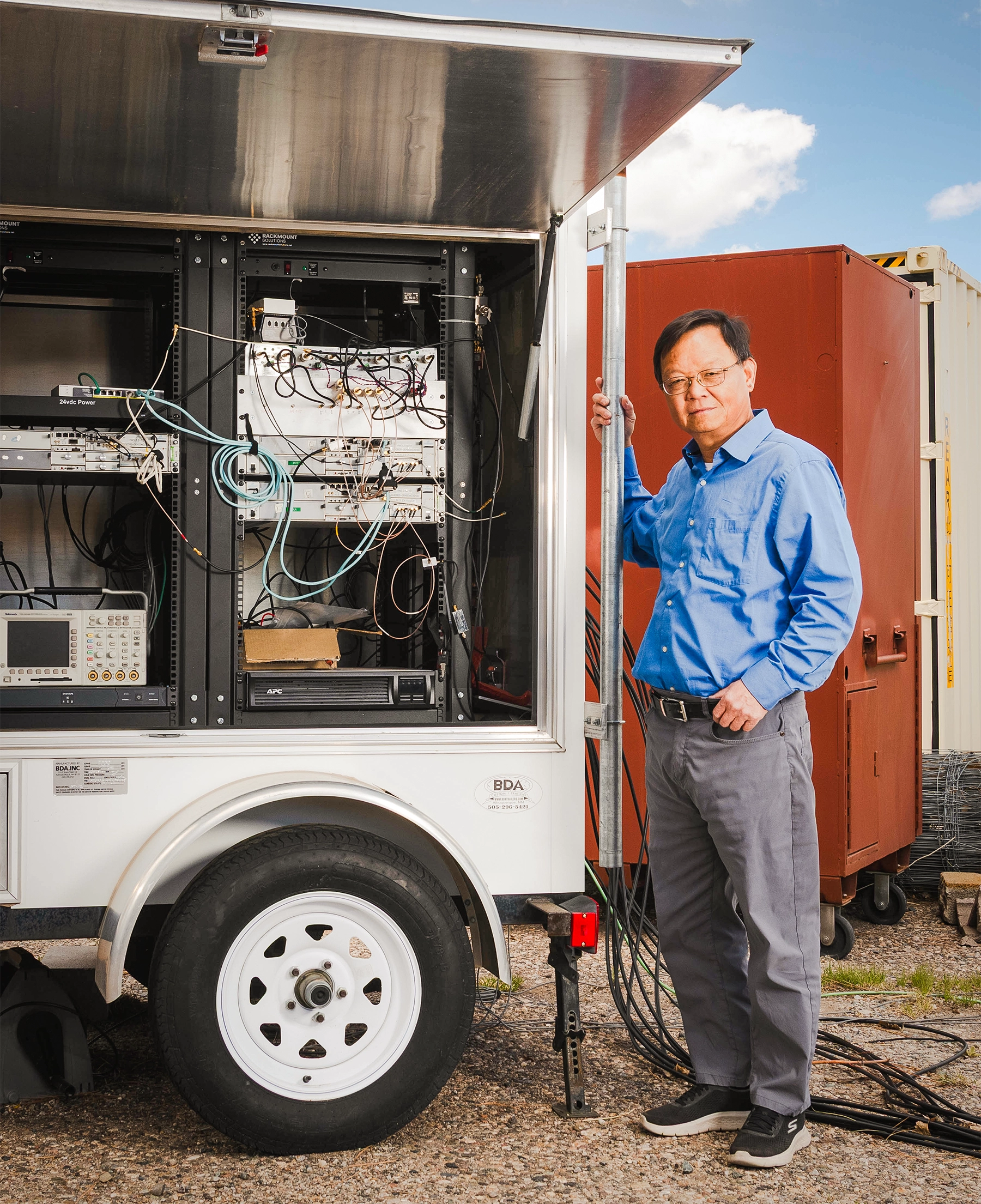
By capturing radio waves from a dozen individual lightning strikes, Xuan-Min Shao has found evidence that cosmic-ray showers may trigger lightning.
Los Alamos National Laboratory
“It’s a really cool idea, and there’s a hint that this might be going on,” Dwyer said. “If this mechanism is true, every time you see a lightning flash, there is a physical connection to a dying star somewhere in the galaxy.”
The last few decades of lightning research have produced a handful of ideas for how nature may coax lightning bolts from clouds with weak electric fields. And while the theories compete in the scientific literature, they likely collaborate in the real world. Long needles of ice may set off bolts in one cloud while a deluge of electrons producing gamma rays does it in another cloud. And multiple mechanisms may work together to push the electric field past the point of no return. Only with more precise measurements of the gamma rays and radio waves that accompany lightning can researchers hope to determine whether one mechanism, or one combination of mechanisms, is the most common.
But as physicists close in on the mystery of what initiates lightning, they’re once again spotting unexpected occurrences that don’t fit any of the theories. There are subtle patterns in the gamma rays ALOFT saw, for instance. And over the last few years, a radio telescope array in the Netherlands has been providing some of the sharpest images yet of lightning as it begins to branch out from its starting point. They show that some parts shoot out quickly, some move relatively slowly, and some sprout needles as they travel.
These features suggest that even as explanations get more comprehensive, the case of how lightning really works will keep getting reopened. “It just gets more and more bizarre the more we look,” Dwyer said. “Clearly our very simple pictures here are really incomplete.”