How the Square Root of 2 Became a Number
Nico Roper/Quanta Magazine
Introduction
The ancient Greeks wanted to believe that the universe could be described in its entirety using only whole numbers and the ratios between them — fractions, or what we now call rational numbers. But this aspiration was undermined when they considered a square with sides of length 1, only to find that the length of its diagonal couldn’t possibly be written as a fraction.
The first proof of this (there would be several) is commonly attributed to Pythagoras, a 6th-century BCE philosopher, even though none of his writings survive and little is known about him. Nevertheless, “it was the first crisis in what we call the foundations of mathematics,” said John Bell, a professor emeritus at Western University in London, Ontario.
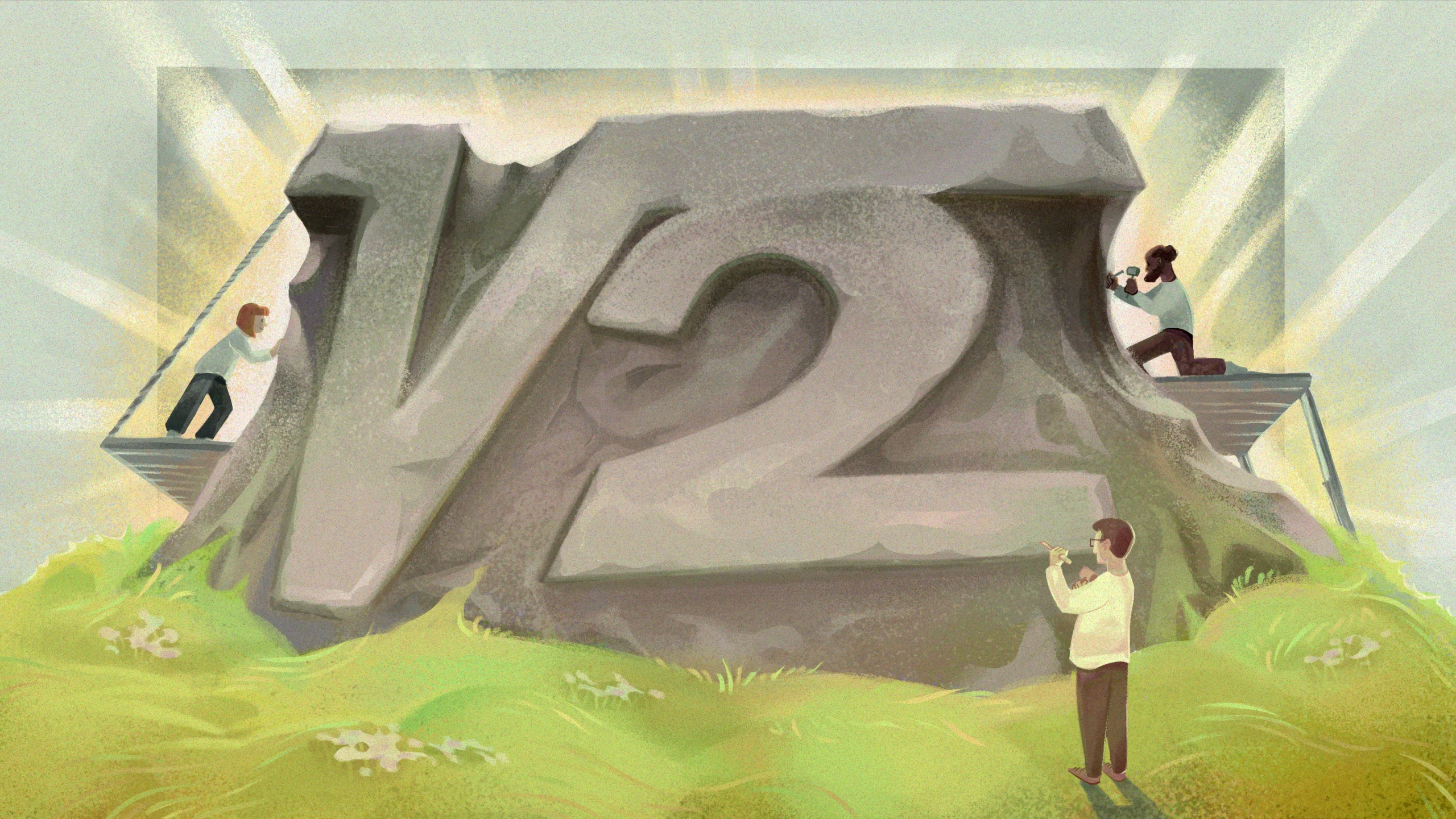
That crisis would not be resolved for a long time. Though the ancient Greeks could establish what $latex \sqrt{2}$ was not, they didn’t have a language for explaining what it was.
For millennia, this sufficed. Renaissance mathematicians manipulated what they came to call irrational numbers while trying to solve algebraic equations. The modern notation for square roots came into use in the 16th and 17th centuries. But still, there was something slippery about them. Does $latex \sqrt{2}$ exist in the same way that 2 does? It wasn’t clear.
Mark Belan for Quanta Magazine
Mathematicians continued to live with that ambiguity. Then, in the mid-1800s, Richard Dedekind, among others, realized that calculus — which had been developed 200 years earlier by Isaac Newton and Gottfried Leibniz — stood on a shaky foundation. A reserved but gifted mathematician who worked slowly and published relatively little, Dedekind was preparing to teach his students about continuous functions when he realized that he couldn’t give a satisfactory explanation of what it meant for a function to be continuous.
He hadn’t even seen functions properly defined. And that, he argued, required a good understanding of how numbers worked — something mathematicians seemed to have taken for granted. How, he asked, could you know for sure that $latex \sqrt{2}$ multiplied by $latex \sqrt{3}$ equals $latex \sqrt{6}$? He wanted to provide some answers.
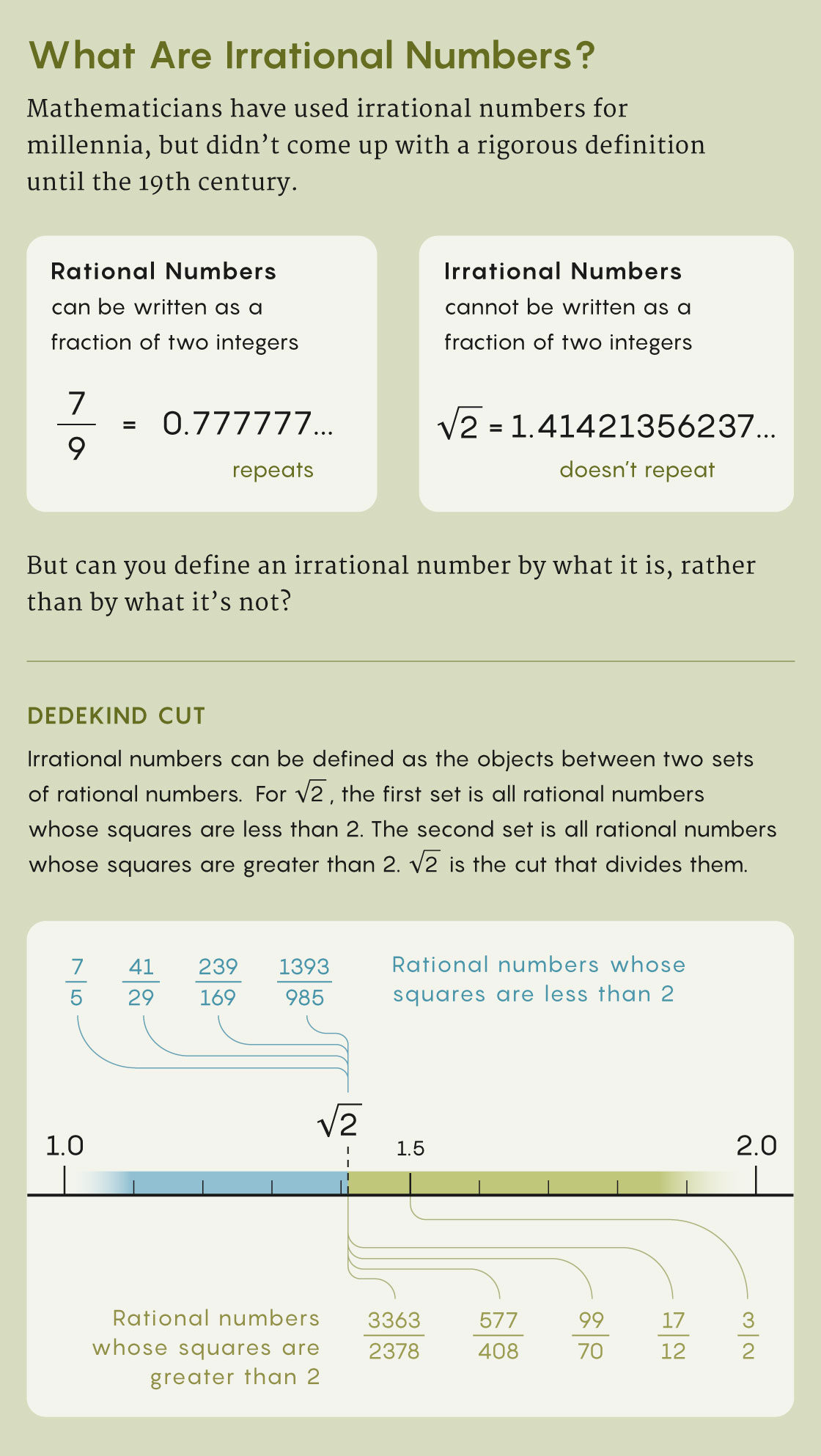
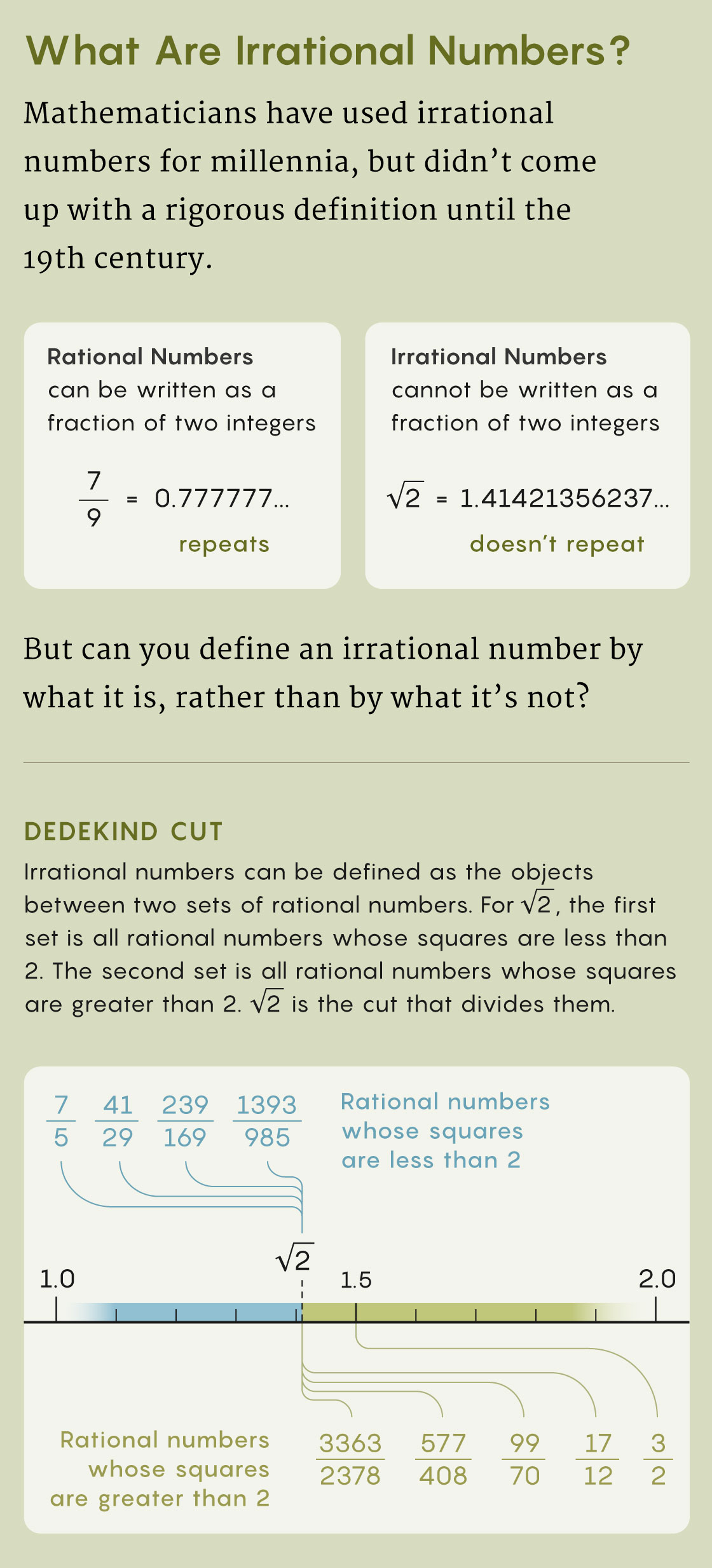
And so he introduced a way to define and construct the irrational numbers using only the rationals. Here’s how it works: First, split all the rational numbers into two sets, so that all of the fractions in one set are smaller than those in the other. For instance, in one group, collect all rationals that, when squared, are less than 2; in the other, put all rationals whose squares are greater than 2. Exactly one number plugs the hole between these two sets. Mathematicians give it the label $latex \sqrt{2}$. For Dedekind, then, an irrational number is defined by a pair of infinite sets of rational numbers, which create what he called a cut. “It’s a very lovely idea,” said Ian Stewart of the University of Warwick. “You can pin down the missing irrational numbers not by describing them, but by describing the gap in which they have to sit.”
Dedekind showed that you can fill in the entire number line this way, rigorously defining for the first time what are now called real numbers (the rationals and the irrationals combined).
At around the same time that Dedekind introduced his cuts, his friend and collaborator Georg Cantor also began to think about irrational numbers. The overlap made their relationship complicated. “They were good friends, and they hated each other. They cooperated, and they ignored each other,” said Leo Corry, a historian of science who is the president of the Open University of Israel.
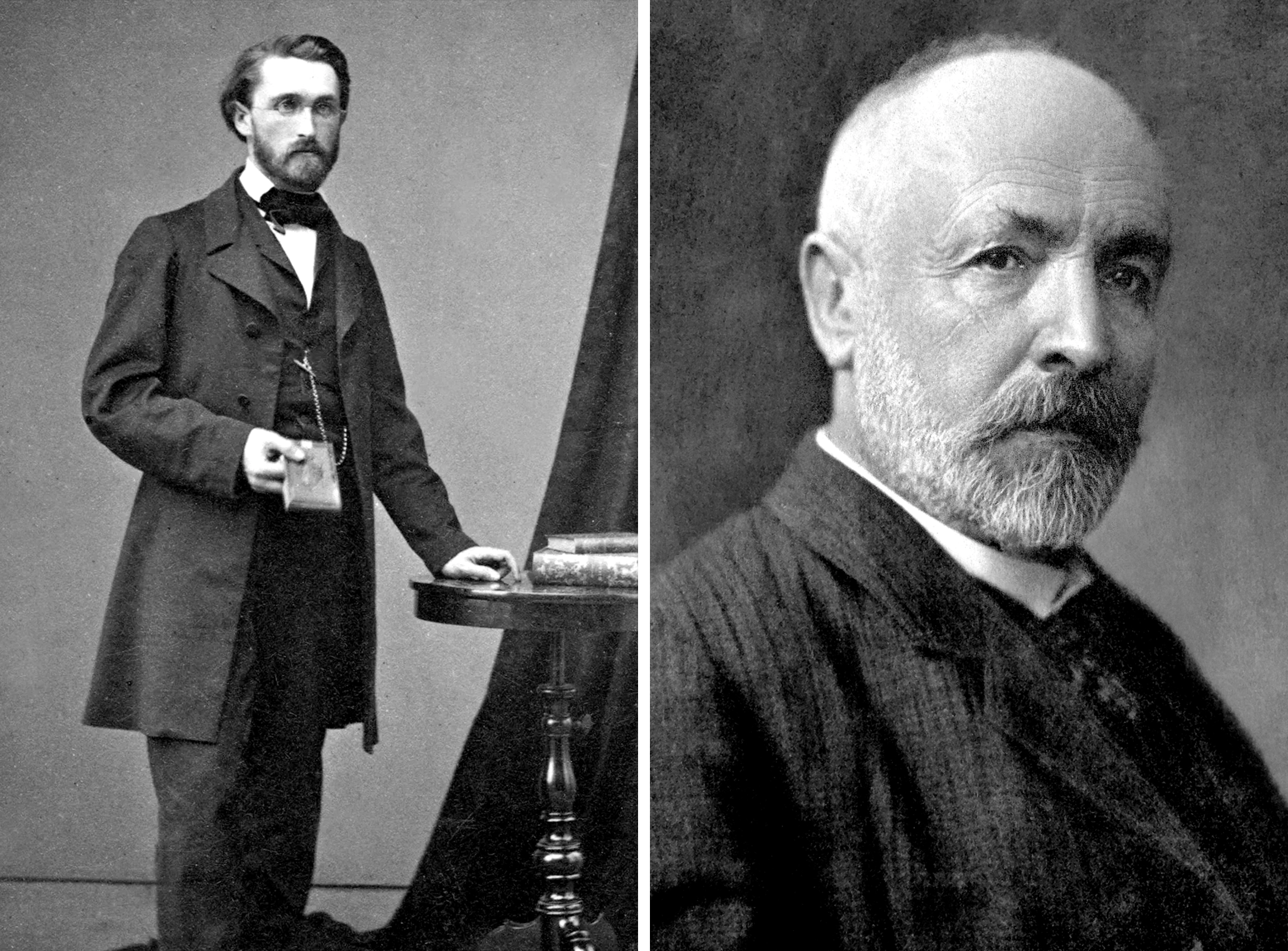
Friends and rivals, 19th-century mathematicians Richard Dedekind (left) and Georg Cantor came up with new, rigorous ways to define numbers.
History and Art Collection/Alamy
Cantor came up with a different definition of irrational numbers. He expressed each in terms of sequences of rational numbers that approached, or “converged” to, a particular irrational value. Though Cantor’s irrational numbers initially looked different from Dedekind’s, later work proved that they are mathematically equivalent.
Cantor’s work led him to ask how many numbers exist. The question might at first seem strange. There are infinitely many whole numbers — you can always keep adding one more. Presumably, that’s as big as a set of numbers can get. But Cantor showed that, paradoxically, though the number of fractions is the same as the number of integers, there are demonstrably more irrational numbers. He was the first to realize that infinity comes in many sizes.
The number line was more crowded, and weirder, than anyone had imagined. But mathematicians were only able to see that after a change in perspective.
Dedekind’s cuts are arguably the beginning of modern mathematics. “It’s really the first point in the history of mathematics where mathematicians actually know what they’re talking about,” Stewart said. Dedekind and others used his definition to prove major theorems in calculus for the first time — which allowed them not just to strengthen the edifice that Leibniz and Newton had built, but to add to it. Dedekind’s work enabled mathematicians to better understand sequences and functions. His influence ranged across many fields of math. Emmy Noether, a prolific mathematician who helped shape the field of abstract algebra in the early 20th century, is said to have told her students that “everything is already in Dedekind.”
A formal definition of $latex \sqrt{2}$ opened new horizons for exploration beyond the topics in calculus that initially motivated Dedekind. As Stewart put it, “After Dedekind, mathematicians started to realize that you can invent new concepts altogether. … The whole idea of what mathematics is about becomes much broader and more flexible.”
Clarification: June 24, 2024
Emmy Noether’s remark about Richard Dedekind was in reference to his work in algebraic number theory. This article has been revised to eliminate the implication that it was in connection to his work on defining real numbers.