Is Particle Physics Dead, Dying, or Just Hard?
The Large Hadron Collider hasn’t found any new physics. Now what?
Kristina Armitage/Quanta Magazine
Introduction

In July 2012, physicists at the Large Hadron Collider (LHC) in Europe triumphantly announced the discovery of the Higgs boson, the long-sought linchpin of the subatomic world. Interacting with Higgs bosons imbues other elementary particles with mass, making them slow down enough to assemble into atoms, which then clump together to make everything else.
A couple of months later, I took a job as the first staff reporter at the nascent science magazine that would become Quanta. Turns out I was starting on the physics beat just as the drama was picking up.
The drama wasn’t about the Higgs particle; by the time it materialized at the LHC there was already little doubt about its existence. The Higgs was the last piece of the Standard Model of particle physics, the 1970s-era set of equations governing the 25 known elementary particles and their interactions.
More striking was what did not emerge from the data.
Physicists had spent billions of euros building the 27-kilometer supercollider not only to confirm the Standard Model but also to supersede it by uncovering components of a more complete theory of nature. The Standard Model doesn’t include particles that could comprise dark matter, for instance. It doesn’t explain why matter dominates over antimatter in the universe, or why the Big Bang happened in the first place. Then there’s the inexplicably enormous disparity between the Higgs boson’s mass (which sets the physical scale of atoms) and the far higher mass-energy scale associated with quantum gravity, known as the Planck scale. The chasm between physical scales — atoms are vastly larger than the Planck scale — seems unstable and unnatural. In 1981, the great theorist Edward Witten thought of a solution for this “hierarchy problem”: Balance would be restored by the existence of additional elementary particles only slightly heavier than the Higgs boson. The LHC’s collisions should have been energetic enough to conjure them.
But when protons raced both ways around the tunnel and crashed head-on, spraying debris into surrounding detectors, only the 25 particles of the Standard Model were observed. Nothing else showed up.
The absence of any “new physics” — particles or forces beyond the known ones — fomented a crisis. “Of course, it is disappointing,” the particle physicist Mikhail Shifman told me that fall of 2012. “We’re not gods. We’re not prophets. In the absence of some guidance from experimental data, how do you guess something about nature?”
Once the standard reasoning about the hierarchy problem had been shown to be wrong, there was no telling where new physics might be found. It could easily lie beyond the reach of experiments. The particle physicist Adam Falkowski predicted to me at the time that, without a way to search for heavier particles, the field would undergo a slow decay: “The number of jobs in particle physics will steadily decrease, and particle physicists will die out naturally.”
The crisis and its fallout made for years of interesting reporting, but sure enough, the frequency of news stories related to particle physics diminished. I fell out of touch with sources. More than 13 years on, in this first column for Qualia, a new series of essays in Quanta Magazine, I’m taking stock. Is particle physics dying, as Falkowski predicted? Can new physics still be found? What’s the future for particle physicists? Will artificial intelligence help? How much hope is left in the search for answers to the many remaining mysteries of the universe?

Some particle physicists act as if there’s no crisis at all. The LHC is still running and will for at least another decade, and its operators are finding new sources of enthusiasm.
In the last couple of years, data handling at the collider has improved with the use of AI. Pattern recognizers can sort through the outgoing debris of proton collisions and classify collision events more accurately than human-made algorithms can. This helps the physicists to more accurately measure the “scattering amplitude,” essentially the probability that different particle interactions will occur. For instance, AI systems can determine more precisely how many top quarks arise in the aftermath of collisions versus the number of bottom quarks. Any statistical deviations from the predictions of the Standard Model could signify the involvement of unknown elementary particles.
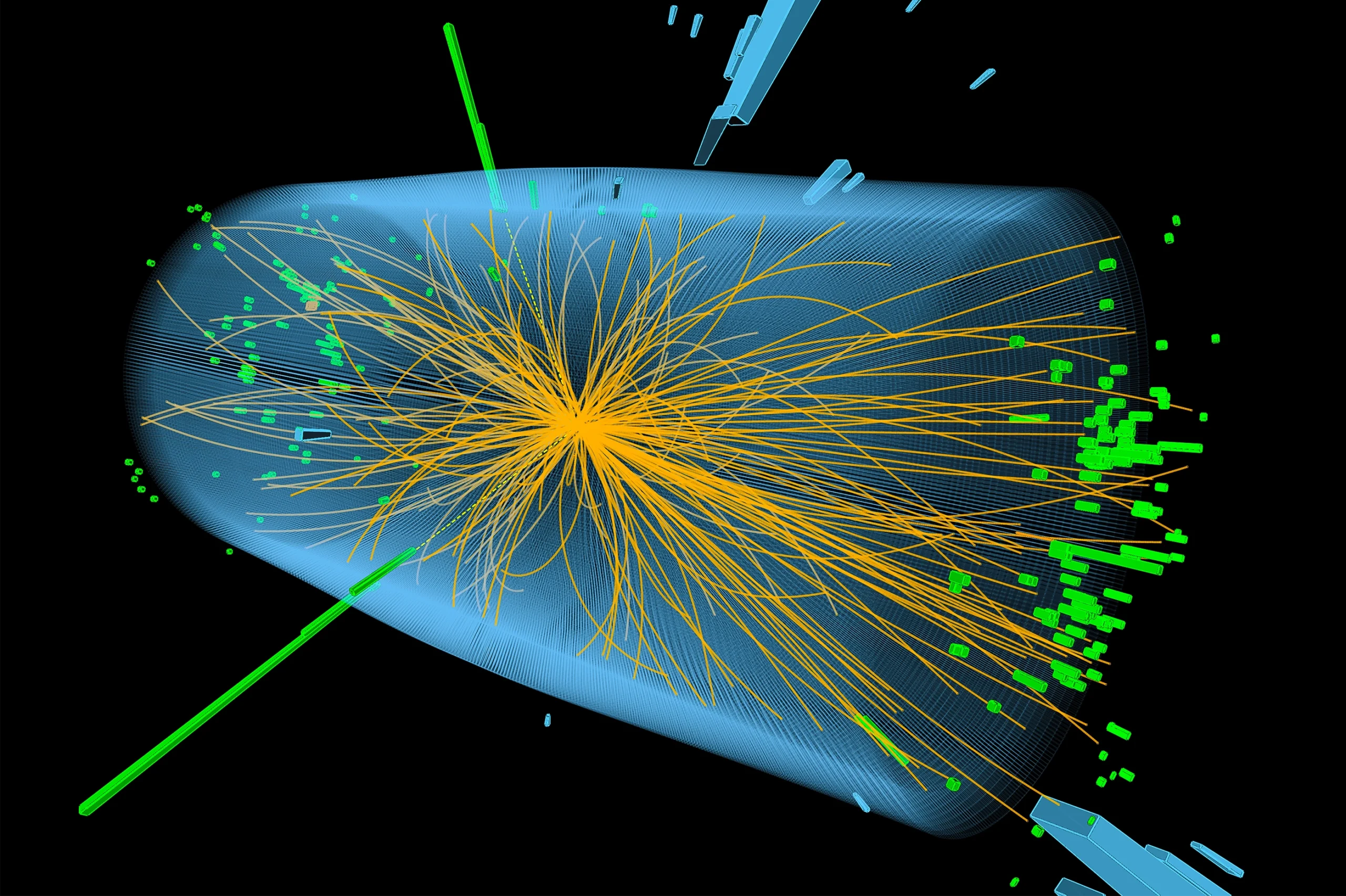
A proton-proton collision documented by the Compact Muon Solenoid at CERN in 2012 shows evidence of the decay of the Higgs boson.
CMS Collaboration; Mc Cauley, Thomas
Novel particles as hefty as Higgs bosons would not be so subtle; they would have shown up already as pronounced bumps on data plots. But as Matt Strassler, a particle physicist affiliated with Harvard University, explained to me, the traces of lighter novel particles could still lie in so-called hidden valleys in the data. “There’s a huge amount of unexplored territory there,” he said. There might exist, for instance, an unstable type of dark matter particle that leaves its mark by occasionally arising and immediately decaying into an excessive number of muon-antimuon pairs. Detecting such an excess would point indirectly to the unstable particle’s existence. “For people who thought all the new physics is at high energies — they’re very disappointed right now,” Strassler said. “I don’t share that view. There are many opportunities for nature to provide clues at low energies.”
So far, though, no such indirect evidence of new physics has been detected. The more accurate the statistics have become at the LHC, the better they match the Standard Model. Michelangelo Mangano, a particle physicist at CERN, the laboratory that houses the LHC, said the collider today is like a tool for exploring the Standard Model’s predictions, and he considers this exploration worthwhile because not all consequences of the equations are easy to calculate. The search for new physics beyond the Standard Model is ongoing, Mangano said, but “the fact that it’s not giving positive results does not mean we are stuck, dead, or wasting our time.”
These questions are so fundamental that of course it’s worth nailing down every amplitude and checking every hidden valley, since we have the tool for the job. But for hunters of new physics, does the game end there?
The community wants to go bigger. CERN physicists want to build a Future Circular Collider, tripling the circumference of the LHC with a 91-kilometer tunnel beneath the Franco-Swiss border, to both probe higher energies and look for subtler signals. This FCC would initially collide electrons, which, unlike protons, are themselves elementary particles, with no substructure. Their clean collisions would allow more precise measurements of scattering amplitudes, making the FCC ultrasensitive to indirect signs of new physics. By the end of the century, the mega-collider would be upgraded to collide protons, as the LHC does now. Proton collisions are messier, but at the FCC they would achieve unprecedented energies — about seven times higher than the LHC can currently muster — so they have a chance, however slim, of revealing heavy particles beyond the LHC’s reach. (In theory, particle masses could range up to a million billion times greater than what the LHC energy scale can produce directly, so there’s no reason to expect them around the next bend.)
As of now, the FCC’s fate is unknown; formal approval and funding commitments by member countries won’t come before 2028.
Meanwhile, U.S. particle physicists are aiming to complement the European strategy by constructing a brand-new type of machine: a muon collider. Muons are elementary like electrons, but they’re 200 times heavier, so their collisions would be both clean and energetic (albeit not reaching the collision energies of the LHC). Both the selling point and the challenge of this newfangled type of machine is that it will require major technical innovations (with all the spin-off potential that can bring), because muons are highly unstable. They must be accelerated and collided mere microseconds after they’re created.
Demonstrating the technology and then constructing the collider would take roughly 30 years, and that’s with federal funding. “We have to figure out how to do it in between 10 and 20 billion [dollars],” said Maria Spiropulu, a physics professor at the California Institute of Technology and co-chair of the committee behind a national report endorsing a muon collider program that came out in June 2025. Over the coming years, the Department of Energy will weigh whether to fund the proposal rather than competing science projects. What hurts its case is the lack of a “discovery guarantee,” which the LHC had with the Higgs boson.
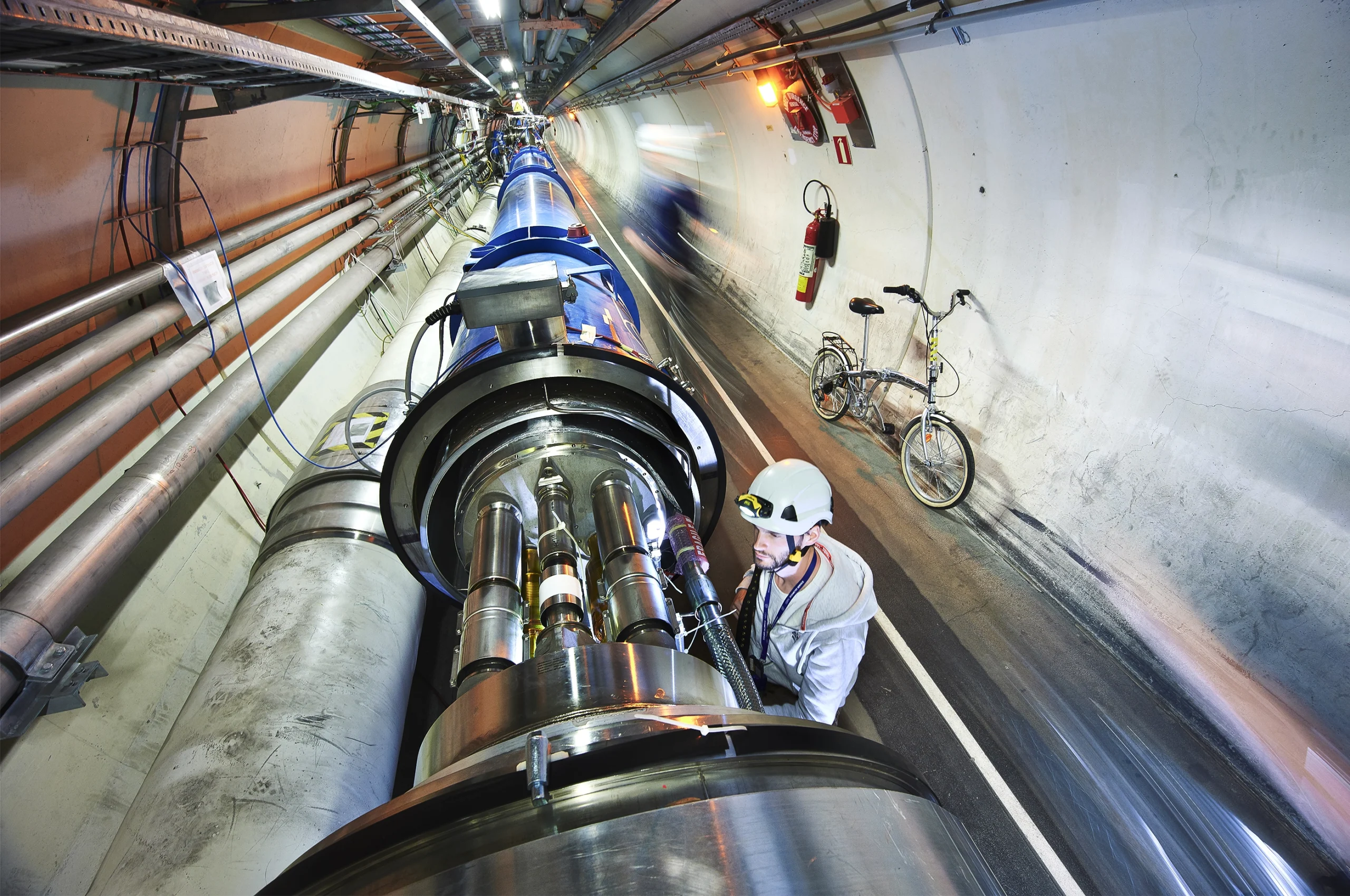
Scientists and technicians inspected and upgraded systems at the Large Hadron Collider during the Long Shutdown 2, which began in 2018.
Maximilien Brice/CERN
Then again, as the mathematical physicist Peter Woit mused on his blog, “Perhaps in our new world order where everything is controlled by trillionaire tech bros, the financing won’t be a problem.”
Deliberations about a Chinese supercollider have come to naught, I’m told. Instead, China has decided to pursue a “super-tau-charm facility”: a lower-energy particle scattering experiment that would cost mere hundreds of millions of dollars instead of tens of billions. The facility will produce a lot of tau particles and charm quarks, partly to study whether taus ever shape-shift into muons or electrons. This kind of switching isn’t predicted by the Standard Model, but it does happen in some theoretical extensions of it.
Okay, we might as well check. We’re desperate for new physics, and the price is good. But by definition it’s very difficult to know which shots in the dark are worth taking.

Adam Falkowski, who sounded the death knell for particle physics back in 2012, used to be known for the sharp commentary he supplied on his blog Résonaances. But the Paris-based particle physicist hasn’t posted anything since 2022. He said that’s partly because he’s been tied up with fatherhood and partly because there hasn’t been much to say.
When we caught up on a video call, Falkowski told me, “I am very skeptical about future colliders. For me it’s very difficult to get excited about it.” He sees momentum behind CERN’s FCC campaign, but personally he worries about the huge costs and timescales, and the fact that “there are absolutely no hints that something is there within the reach of the next collider.”
For his part, Falkowski has turned to the theoretical study of scattering amplitudes, a growing research area focused on the geometric patterns underlying particle interaction statistics, patterns that could point toward a truer perspective on the quantum world. The field seeks to reformulate the equations of particle physics in a different mathematical language in hopes that this language might extend to quantum gravity. “There is a very vibrant program in trying to understand the structure of the physical theories,” Falkowski said. “The hope is that with the help of machine learning, that there can be very fast progress in the coming years. I think that’s where the best things have happened.”
But amplitudeology, as this field is known, is abstract — it’s no atom-smashing experiment. Falkowski said he does think experimental particle physics is dying. He has watched talented postdocs switch to other research areas or take data science jobs. “I’m not sure they are getting the best of the best as they used to,” he said, “because the prospects of returns are so distant. If you want to change the world now, you will do AI; you will do something different from particle physics.”
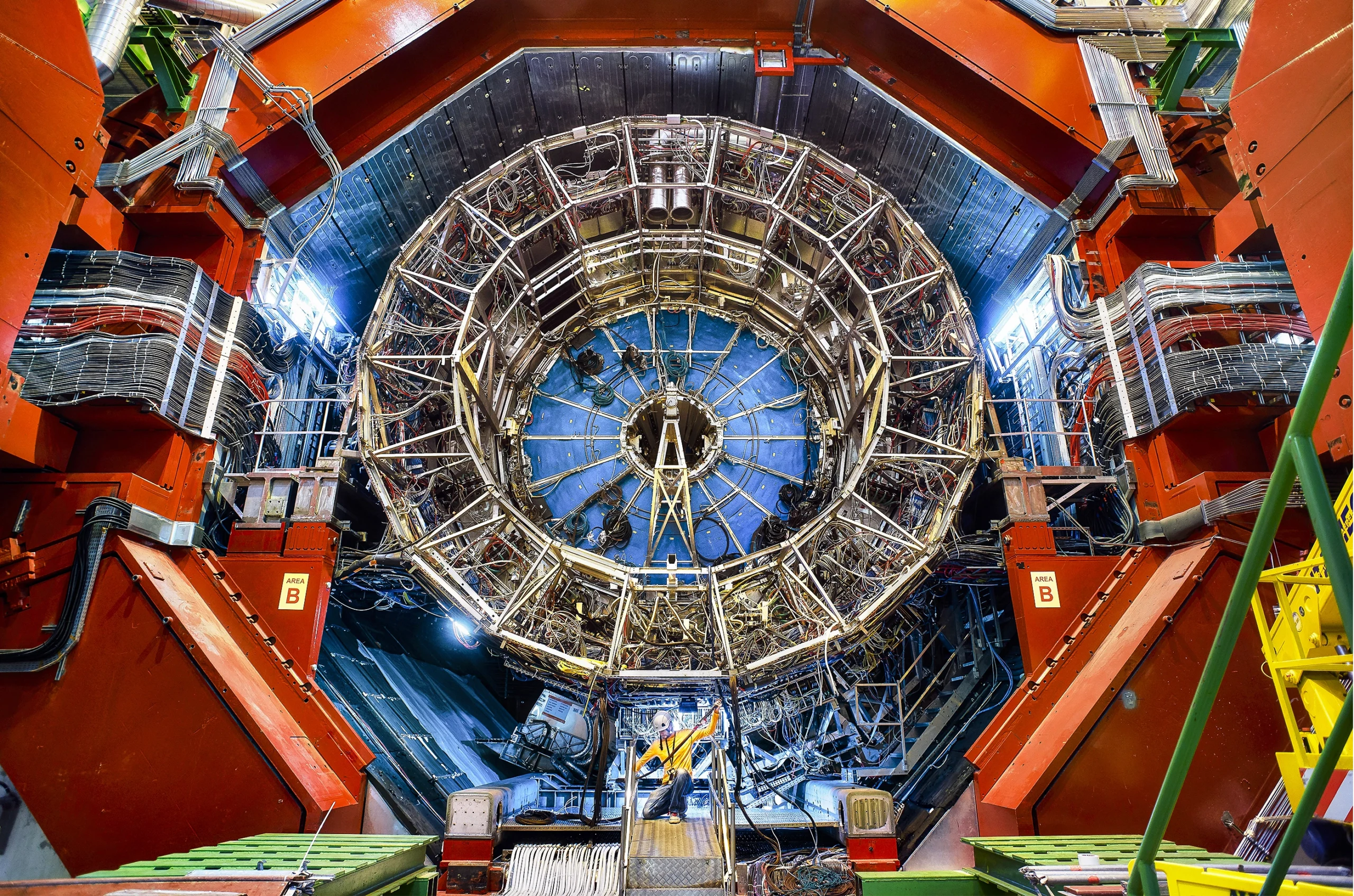
The ALICE (A Large Ion Collider Experiment) detector at the Large Hadron Collider was designed to study quark-gluon plasma.
CERN, Julien Marius Ordan/Science Source
This brain drain appears to be real. I spoke to Jared Kaplan, co-founder of Anthropic, the company behind the chatbot Claude. He was a physicist the last time we spoke. As a grad student at Harvard in the 2000s, he worked with the renowned theorist Nima Arkani-Hamed to open up the new directions in amplitude research that are being actively pursued today. But Kaplan left the field in 2019. “I started working on AI because it seemed plausible to me that … AI was going to make progress faster than almost any field in science historically,” he said. AI would be “the most important thing to happen while we’re alive, maybe one of the most important things to happen in the history of science. And so it seemed obvious that I should work on it.”
As for the future of particle physics, AI makes worrying about it now rather pointless, in Kaplan’s view. “I think that it’s kind of irrelevant what we plan on a 10-year timescale, because if we’re building a collider in 10 years, AI will be building the collider; humans won’t be building it. I would give like a 50% chance that in two or three years, theoretical physicists will mostly be replaced with AI. Brilliant people like Nima Arkani-Hamed or Ed Witten, AI will be generating papers that are as good as their papers pretty autonomously. … So planning beyond this couple-year timescale isn’t really something I think about very much.”

Cari Cesarotti, a postdoctoral fellow in the theory group at CERN, is skeptical about that future. She notices chatbots’ mistakes, and how they’ve become too much of a crutch for physics students. “AI is making people worse at physics,” she said. “What we need is humans to read textbooks and sit down and think of new solutions to the hierarchy problem.”
Cesarotti was a high school junior when the Higgs boson was discovered. She grew up near Fermilab, the U.S. national lab in Illinois that houses the Tevatron, which was the world’s highest-energy particle collider before the LHC. (The top quark was discovered there in 1995.) This proximity taught her that a particle physicist was a thing you could be. Later, it turned out to be her thing. “What are the fundamental building blocks of the universe — those were the questions that I was most interested in knowing the answer to,” she told me. “But what people said was, ‘Particle physics is dead. Don’t do this.’”
It may have been a fair warning; Cesarotti has yet to land a permanent job as a rising particle physicist. The subfield has continued to shrink, she and others said, as faculty hiring committees and grad students go in other directions. “Definitely all this rhetoric that there was nothing to be found and you should give up on it — people listened,” she said. “And of course that means there are fewer people. It becomes a self-fulfilling prophecy. If you’re pushing all these talented people out of trying to solve these problems into a field that it’s easier to make an impact on, then you’re setting yourself up for failure.”
Cesarotti echoed a sentiment I’d heard from others, which sounds correct to me as well: “Particle physics isn’t dead; it’s just hard.” It’s hard to know what to think about or look for. But the most devoted particle physicists are thinking and looking all the same.
“It was easy for 125 years,” Strassler said. “One thing led to the next. That lucky century has, for now, at least in the medium term, come to an end. That could change tomorrow, or next century, or who knows.”
A hint of a new lightweight particle could, in theory, show up at the LHC, or in some other experiment. Strassler is particularly excited about the study of radioactive thorium-229 decay, which could reveal variations in the fundamental constants. I’m slightly partial to experiments looking for “axions,” dark matter candidates that are so lightweight that they can act a little like light itself.
On the theory side, an obvious solution to the hierarchy problem could drop naturally out of the geometry behind scattering amplitudes. Or, if Kaplan is right, AI systems might someday suggest powerful new ideas for how the 25 particles of the Standard Model fit into a more comprehensive pattern — a possibility I didn’t foresee back when the crisis began.
Clearly, further progress toward the truth remains possible in particle physics. But there’s no discovery guarantee. I’ve had more than 13 years to think about it, and it remains a disturbing prospect: All the empirical clues we can glean about nature’s fundamental laws and building blocks might already be in hand. The universe may plan on keeping the rest of its secrets.