String Theory Can Now Describe a Universe That Has Dark Energy
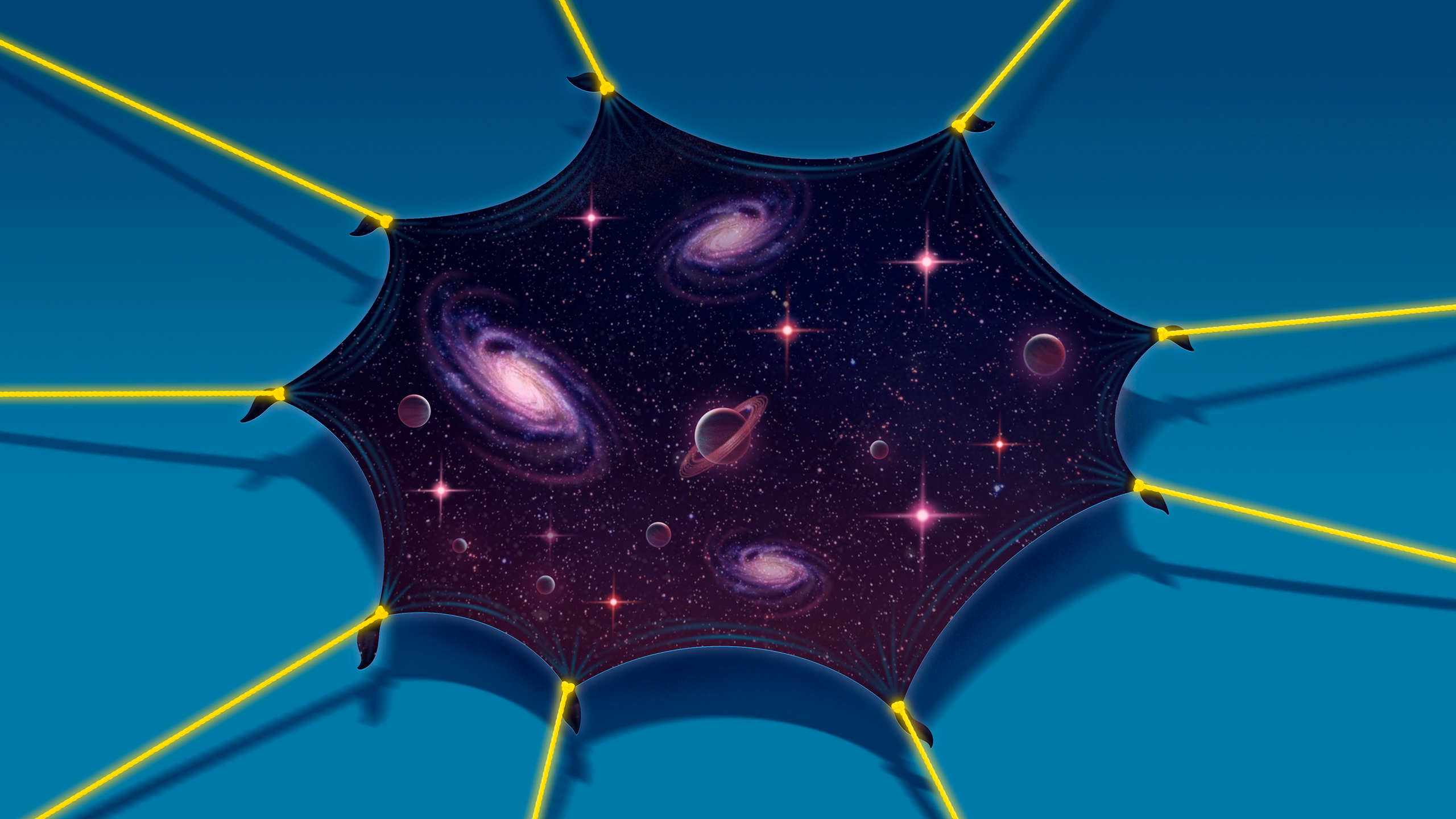
Scientists have struggled to make string theory compatible with the expanding universe.
Nash Weerasekera for Quanta Magazine
Introduction
In 1998, astronomers discovered dark energy. The finding, which transformed our conception of the cosmos, came with a little-known consequence: It threw a wrench into the already daunting task of finding a version of string theory that describes the universe we live in.
Dark energy is a “positive” energy that causes our universe to expand at an accelerating rate. But the best-understood models of string theory describe universes with energy that is either negative or zero.
Of the various criticisms made of string theory through the years — that it only works in a 10-dimensional universe, that its fundamental constituents, tiny strings, are too small to ever be observed — this was perhaps the most troubling. String theory appeared to be useful only for describing a universe with a negative “anti-de Sitter” geometry, whereas we live in a universe with a positive “de Sitter” geometry.
Then last year, two physicists offered a stripped-down but precise formula for how string theory could give rise to a universe similar to ours — a de Sitter universe undergoing accelerated expansion.
“It is the very first example [from string theory] of an explicit de Sitter space,” said Thomas Van Riet of KU Leuven in Belgium.
The new work, by Bruno Bento and Miguel Montero of the Institute for Theoretical Physics in Madrid, describes a universe with a dark energy that should weaken over time — a result that matches preliminary cosmic observations from the past few years.
But the universe they describe is not exactly like ours. While their original hope was to reduce the high-dimensional world of string theory to our own four-dimensional world, they ended up with an extra dimension. “What they have found is a 5D de Sitter solution, and we don’t live in 5D,” said Antonio Padilla of the University of Nottingham.

Bruno Bento (left) and Miguel Montero published work that connects the hidden dimensions of string theory to the positive energy of our universe.
Laura Marcos Mateos
Still, the work is expected to launch a new era in matching the mathematical elegance of string theory to the actual world we live in.
“What they have done,” Padilla said, “is open up a new frontier to finding explicit de Sitter solutions in string theory.”
The Cutoff
The new work was inspired by a bizarre feature of quantum theory first predicted over 75 years ago.
In a vacuum, space is never completely empty. Particles pop in and out of existence, and tiny fluctuations cause quantum fields to do the same.
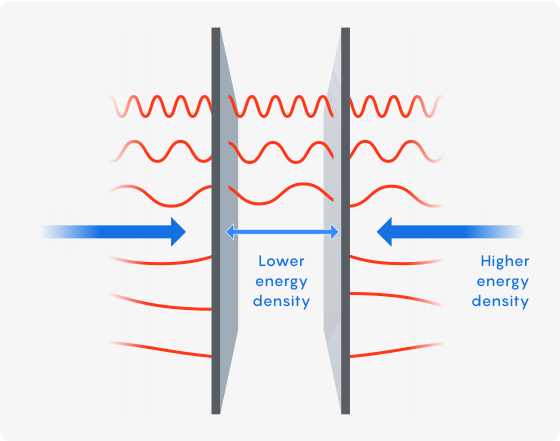
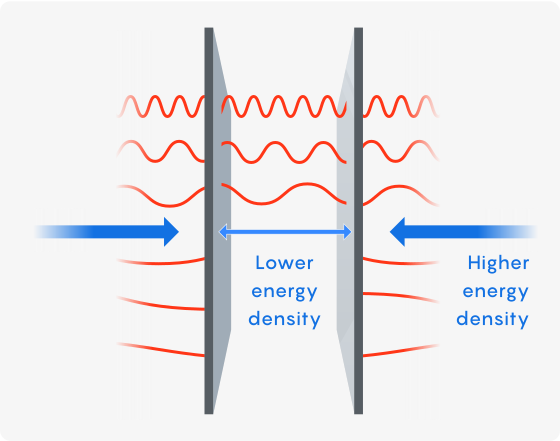
In 1948, the Dutch physicist Hendrik Casimir recognized that in the narrow space between two conducting plates, not all quantum fields can pop into existence. In this region, the long wavelengths get cut off. This leads to a lower energy density inside the plates than outside. The mismatch of energies creates a force that tries to push the plates together.
Mark Belan/Quanta Magazine
Bento and Montero applied this line of thinking to the process of “compactification,” in which the 10-dimensional physics of string theory becomes the four-dimensional realm we inhabit. The basic premise of compactification is that the extra dimensions should shrink down and curl up into a shape so tiny that if you were to travel along one of them, you would almost instantly come back to the starting point. The precise shape of the “manifold” that houses these extra dimensions would dictate the properties of all the particles and forces observed in nature.
In the new scenario, the space enclosed within a six-dimensional manifold takes the place of the space between Casimir’s conducting plates. Inside the manifold’s interior, fluctuations are similarly restricted, which generates a Casimir-like force. “That’s their key ingredient,” said David Andriot of France’s National Center for Scientific Research.
The researchers counterbalanced the Casimir effect with a force generated by a flux. Fluxes are standard elements in string theory compactifications. They’re made up of field lines that wind through string theory’s extra dimensions. Unlike the Casimir force, which works toward reducing the volume of the manifold’s interior, a flux creates a countervailing effect that tries to expand that volume.
Bento and Montero were able to calculate a specific value for dark energy that was both positive and small. The value they arrived at, 10−15 in Planck units, is still far from the actual, even smaller value of 10−120, but it is “going down the right path,” Montero said.
The solution is considered explicit, he explained, which “means we can tell you every detail involved and how it fits together. We can compute a precise value for the dark energy that is close to the exact result.” And if you give your model to other physicists, he said, “they can compute the value of any observable … with precision.”
The original idea to look for a Casimir-like effect came from a 2021 paper by Eva Silverstein of Stanford University and two collaborators. But Bento and Montero’s goal from the outset was to find a simpler recipe for compactification than previous researchers had.

Eva Silverstein, photographed at Stanford University in 2017, co-authored the paper that inspired Bento and Montero’s solution.
Ryan Schude for Quanta Magazine
In selecting a geometry for the compact extra dimensions, for instance, they chose a space that resembles a torus. “It’s a simple shape,” Bento said. A doughnut is an example of a 2D torus; it is considered “flat” because it can be made by rolling a flat sheet into a tube and then fastening the ends. Bento and Montero picked shapes of this general type, called 6D Riemann-flat manifolds, to house the extra dimensions in their model. Using this 6D space for the compactification gave them the physical properties they sought.
In comparison, the Silverstein team selected a much more complicated geometry to work with: negatively curved hyperbolic manifolds. That made their calculations dramatically harder.
Shortly after Bento and Montero published their paper, Gianguido Dall’Agata and Fabio Zwirner of the University of Padua published their own paper, in which they used a similar setup — also involving Riemann-flat manifolds — to compute the strength of the Casimir effect and show how it can be used to produce dark energy. “We use different techniques that are complementary,” Zwirner said.
Bento and Montero took things further than the Padua team, at least in terms of carrying out a full-fledged string compactification. But, Montero said, “it was nice that these two approaches agreed, because that provided a good check on the general idea.”
A Dose of Reality
The work of Bento and Montero comes with some substantial caveats, as the authors acknowledge.
First, their de Sitter solution is unstable; its dark energy, though positive, will diminish over time. A changeable, dynamical dark energy of this sort, Andriot pointed out, “is much easier to get from string theory” than a dark energy that remains fixed — a notion Einstein introduced in 1917 as the “cosmological constant.”
“Unstable,” in this case, has a specific meaning to physicists. It indicates that the period of stability, or constancy, of dark energy shouldn’t last much longer than a Hubble time — the estimated age of the universe, or about 14 billion years.
Until recently, most observations have been consistent with a universe containing a constant amount of dark energy. But recent results suggest that dark energy may be changing. In April 2024, the Dark Energy Spectroscopic Instrument presented tentative evidence that dark energy is weakening, and the finding was bolstered a year later. “If those results are here to stay, they are really hinting that the cosmological constant is not a constant,” Montero said.
In their pursuit of a de Sitter solution, Bento and Montero simplified their task by starting from M-theory (sometimes called “the mother of all string theories”). Whereas most versions of string theory require our universe to have six extra dimensions, M-theory requires it to have seven. Despite the larger number of dimensions, M-theory has fewer ingredients than string theory, so starting with M-theory made Bento and Montero’s calculations markedly easier. But subtracting the six extra dimensions curled into their manifold from the 11 total dimensions of M-theory left the theorists with a universe in 5D — one “D” too many.
The issue of landing on a 5D solution in a 4D universe is no small matter, and Bento and Montero consider resolving it a top priority. “If we cannot find the four-dimensional solution,” Bento said, “our work cannot be the final answer.”
“I hope it works, and they manage to get it [to work] in four dimensions,” Andriot said. However, he cautioned, given the myriad challenges string theorists have faced over the past few decades, he wouldn’t be surprised if the de Sitter problem threw at least a few more obstacles in their path.