
Latest Articles
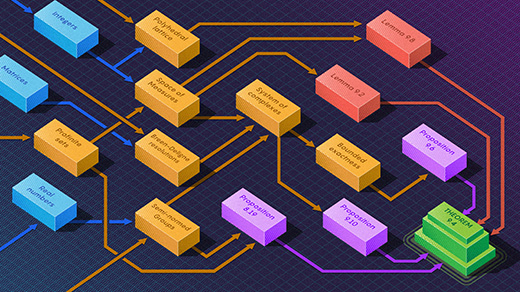
Proof Assistant Makes Jump to Big-League Math
Mathematicians using the computer program Lean have verified the accuracy of a difficult theorem at the cutting edge of research mathematics.

New Shape Opens ‘Wormhole’ Between Numbers and Geometry
Laurent Fargues and Peter Scholze have found a new, more powerful way of connecting number theory and geometry as part of the sweeping Langlands program.

A Video Tour of the Standard Model
The Standard Model is a sweeping equation that has correctly predicted the results of virtually every experiment ever conducted, as Quanta explores in a new video.

Nathan Seiberg on How Math Might Complete the Ultimate Physics Theory
Even in an incomplete state, quantum field theory is the most successful physical theory ever discovered. Nathan Seiberg, one of its leading architects, talks about the gaps in QFT and how mathematicians could fill them.

The Mystery at the Heart of Physics That Only Math Can Solve
The accelerating effort to understand the mathematics of quantum field theory will have profound consequences for both math and physics.

Mathematicians Answer Old Question About Odd Graphs
A pair of mathematicians solved a legendary question about the proportion of vertices in a graph with an odd number of connections.
Matrix Multiplication Inches Closer to Mythic Goal
A recent paper set the fastest record for multiplying two matrices. But it also marks the end of the line for a method researchers have relied on for decades to make improvements.
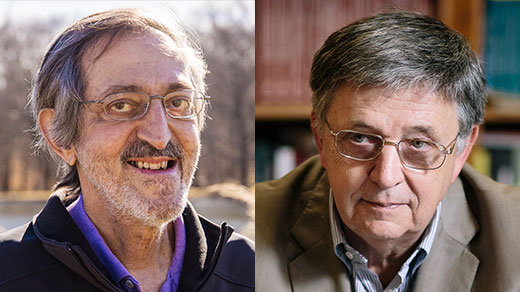
Pioneers Linking Math and Computer Science Win the Abel Prize
Avi Wigderson and László Lovász won for their work developing complexity theory and graph theory, respectively, and for connecting the two fields.

New Algorithm Breaks Speed Limit for Solving Linear Equations
By harnessing randomness, a new algorithm achieves a fundamentally novel — and faster — way of performing one of the most basic computations in math and computer science.