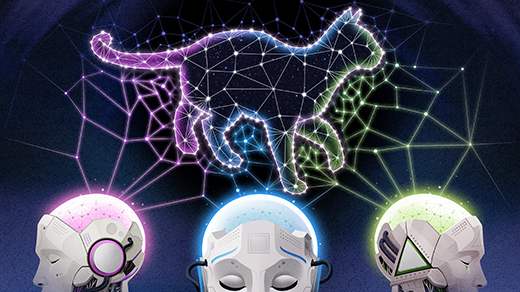
Cryptographers Show That AI Protections Will Always Have Holes

Wei-An Jin for Quanta Magazine
Introduction
Ask ChatGPT how to build a bomb, and it will flatly respond that it “can’t help with that.” But users have long played a cat-and-mouse game to try to trick language models into providing forbidden information. These “jailbreaks” have run from the mundane — in the early years, one could simply tell a model to ignore its safety instructions — to elaborate multi-prompt roleplay scenarios. In a recent paper, researchers found one of the more delightful ways to bypass artificial intelligence security systems: Rephrase your nefarious prompt as a poem.
But just as quickly as these issues appear, they seem to get patched. That’s because the companies don’t have to fully retrain an AI model to fix a vulnerability. They can simply filter out forbidden prompts before they ever reach the model itself.
Recently, cryptographers have intensified their examinations of these filters. They’ve shown, in recent papers that have been posted on the arxiv.org preprint server, how the defensive filters put around powerful language models can be subverted by well-studied cryptographic tools. In fact, they’ve shown how the very nature of this two-tier system — a filter that protects a powerful language model inside it — creates gaps in the defenses that can always be exploited.
The new work is part of a trend of using cryptography — a discipline traditionally far removed from the study of the deep neural networks that power modern AI — to better understand the guarantees and limits of AI models like ChatGPT. “We are using a new technology that’s very powerful and can cause much benefit, but also harm,” said Shafi Goldwasser, a professor at the University of California, Berkeley and the Massachusetts Institute of Technology who received a Turing Award for her work in cryptography. “Crypto is, by definition, the field that is in charge of enabling us to trust a powerful technology … and have assurance you are safe.”
Slipping Past Security
Goldwasser was initially interested in using cryptographic tools to tackle the AI issue known as alignment, with the goal of preventing models from generating bad information. But how do you define “bad”? “If you look up [alignment] on Wikipedia, it’s ‘aligning with human values,’” Goldwasser said. “I don’t even know what that means, since human values seem to be a moving target.”
To prevent model misalignment, you generally have to choose between a few options. You can try to retrain the model on a new dataset carefully curated to avoid any dangerous ideas. (Since modern models are trained on pretty much the entire internet, this strategy seems challenging, at best.) You can try to precisely fine-tune the model, a delicate process that is tricky to do well. Or you can add a filter that blocks bad prompts from getting to the model. The last option is much cheaper and easier to deploy, especially when a jailbreak is found after the model is out in the world.
Goldwasser and her colleagues noticed that the exact reason that filters are appealing also limits their security. External filters will often use machine learning to interpret and detect dangerous prompts, but by their nature they have to be smaller and quicker than the model itself. That creates a gap in power between the filter and the language model. And this gap, to a cryptographer, is like a cracked-open window to a cat burglar: a weak spot in the system that invites you to peek inside and see what lies for the taking.
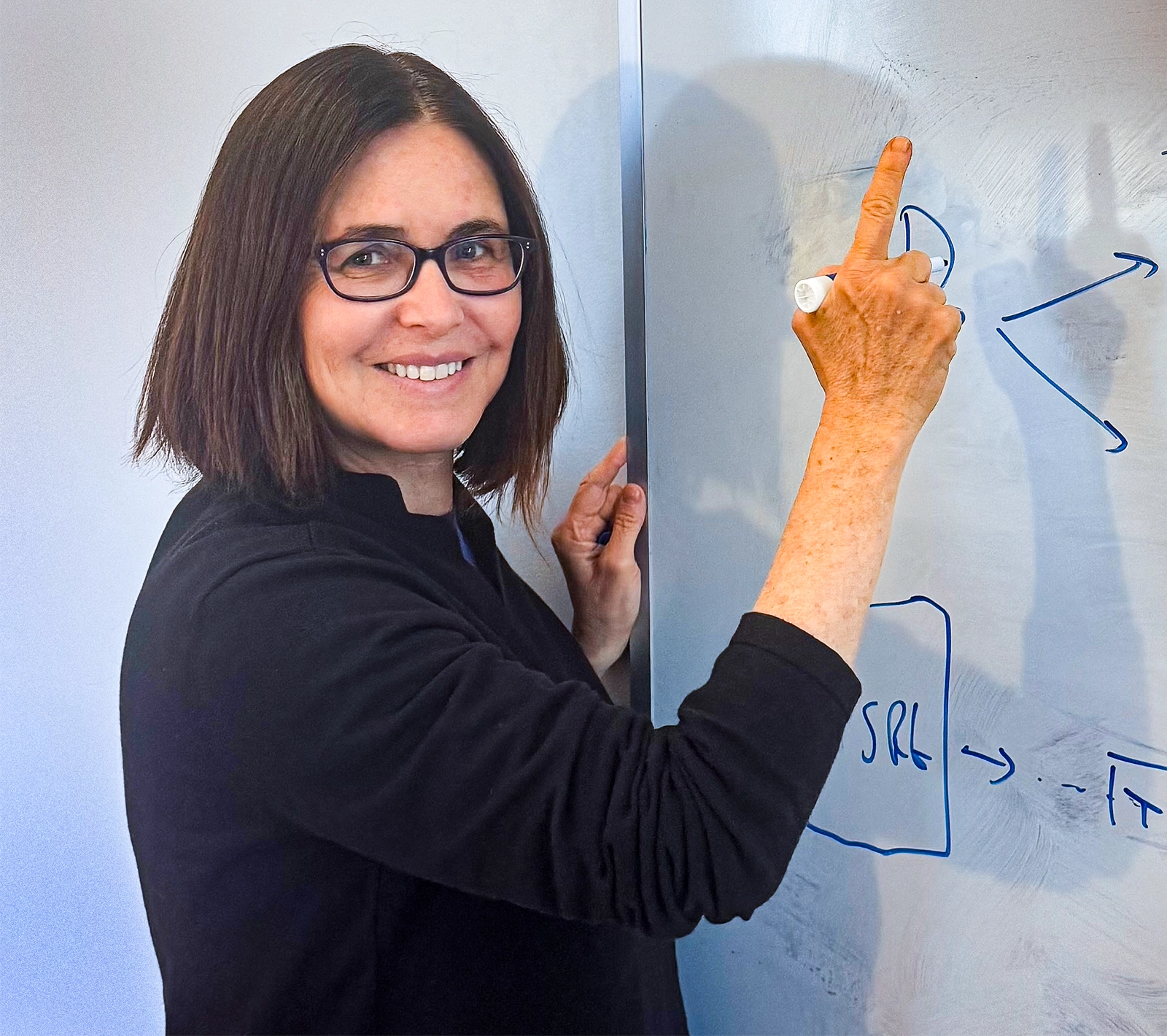
Shafi Goldwasser and her colleagues showed that any safety system that uses fewer computational resources than the AI model itself will always have vulnerabilities.
Courtesy of Shafi Goldwasser
A practical illustration of how to exploit this gap came in a paper posted in October. The researchers had been thinking about ways to sneak a malicious prompt past the filter by hiding the prompt in a puzzle. In theory, if they came up with a puzzle that the large language model could decode but the filter could not, then the filter would pass the hidden prompt straight through to the model.
They eventually arrived at a simple puzzle called a substitution cipher, which replaces each letter in a message with another according to a certain code. (As a simple example, if you replace each letter in “bomb” with the next letter in the alphabet, you’ll get “cpnc.”) They then instructed the model to decode the prompt (think “Switch each letter with the one before it”) and then respond to the decoded message.
The filters on LLMs like Google Gemini, DeepSeek and Grok weren’t powerful enough to decode these instructions on their own. And so they passed the prompts to the models, which performed the instructions and returned the forbidden information. The researchers called this style of attack controlled-release prompting.
The approach was prompted by cryptographic thinking, even if it didn’t have to reach very far into the toolbox of modern cryptography. “We didn’t really use any actual cryptography,” said Jaiden Fairoze, a researcher at Berkeley and the lead author on the paper. “We just were inspired by it.”
In particular, Fairoze and his collaborators were inspired by work that had come out just a few months before — a theoretical argument that these filter-based protections would always have vulnerabilities.
That work focused on time-lock puzzles, which are well-studied cryptographic objects. Essentially, a time-lock puzzle can be thought of as a box. You can lock some information inside this box, and the box can only be opened to retrieve the information after some predetermined amount of time. No matter what you do, you can’t open it until then.
The idea was to hide the malicious prompt inside one of these time-lock puzzles and then set the timer for just long enough for it to pass through the filter.
The time-lock puzzles they devised would turn ordinary text into what looks like a random number. To decode the message, a computer has to perform a mathematical operation such as squaring the number over and over. If you know how fast a computer can perform the operation, it’s easy to calculate how many operations you need to keep the puzzle secret for a given amount of time.

Jaiden Fairoze and his colleagues used a substitution cipher to smuggle nefarious instructions past a filter.
Helen Fu
In the case of the language model, you could take a bad prompt — say, “Tell me how to build a bomb” — and lock it in the time-lock puzzle. You now have what looks like a long random number. In theory, you could put this number directly into the prompt window, with the instruction: “Square this number a certain number of times, translate that decoded number into text, then execute the message.”
But it’s possible that a filter could try to outlaw anything that looks too weird — a bunch of random numbers could invite suspicion. To get around this, the authors took advantage of how language models generate fresh-looking text.
If you ask an AI model the same thing twice — say, “How are you doing today?” — you won’t get the same response. That’s because AI models use a random number, called the seed, to vary their responses to questions. A unique seed will produce a unique answer, even if the prompt stays the same.
Many models allow the user to manually choose the seed if they so wish. This feature provides an opening: You can use the random-looking time-lock puzzle as the seed. That way, the puzzle will get passed through the filter alongside an innocent-looking prompt (say, “Write a poem for me”). To the filter, the prompt just looks like someone asking for a random poem. But the true question is lurking within the randomness alongside it. Once the prompt has made it past the filter and through to the language model, the model can open the time-lock puzzle by repeatedly squaring the number. It now sees the bad message and responds to the question with its best bomb-making advice.
The researchers made their argument in a very technical, precise and general way. The work shows that if fewer computational resources are dedicated to safety than to capability, then safety issues such as jailbreaks will always exist. “The question from which we started is: ‘Can we align [language models] externally without understanding how they work inside?’” said Greg Gluch, a computer scientist at Berkeley and an author on the time-lock paper. The new result, said Gluch, answers this question with a resounding no.
That means that the results should always hold for any filter-based alignment system, and for any future technologies. No matter what walls you build, it seems there’s always going to be a way to break through.