How Animals Build a Sense of Direction
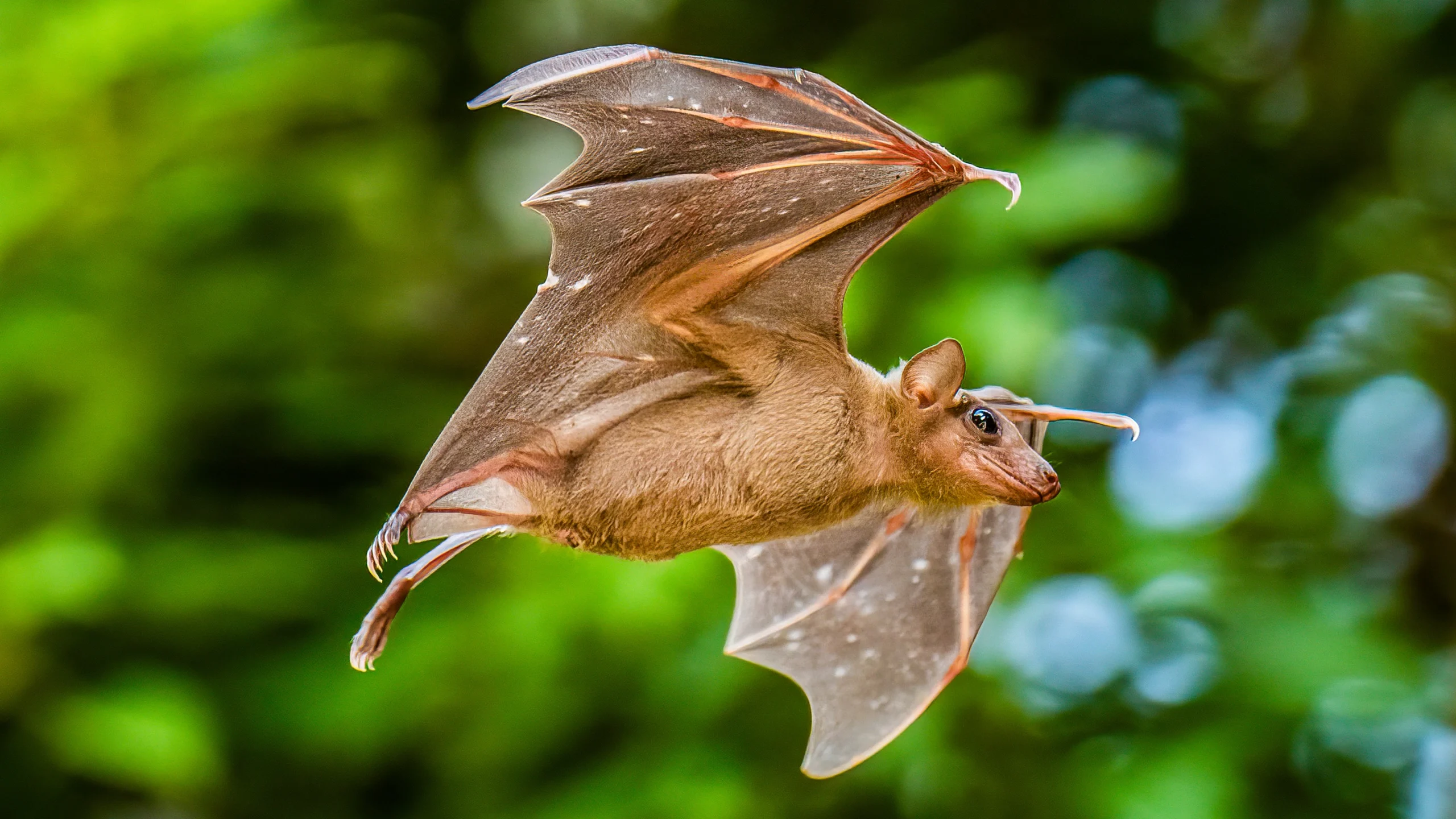
Researchers brought Egyptian fruit bats to a remote island to study how a network of cells in the mammalian brain constructs a directional sense in the wild.
Nachum Ulanovsky
Introduction
On a remote island in the Indian Ocean, six closely watched bats took to the star-draped skies. As they flew across the seven-acre speck of land, devices implanted in their brains pinged data back to a group of sleepy-eyed neuroscientists monitoring them from below. The researchers were working to understand how these flying mammals, who have brains not unlike our own, develop a sense of direction while navigating a new environment.
The research, published in Science, reported that the bats used a network of brain cells that informed their sense of direction around the island. Their “internal compass” was tuned by neither the Earth’s magnetic field nor the stars in the sky, but rather by landmarks that informed a mental map of the animal’s environment.
These first-ever wild experiments in mammalian mapmaking confirm decades of lab results and support one of two competing theories about how an internal neural compass anchors itself to the environment.
“Now we’re understanding a basic principle about how the mammalian brain works” under natural, real-world conditions, said the behavioral neuroscientist Paul Dudchenko, who studies spatial navigation at the University of Stirling in the United Kingdom and was not involved in the study. “It will be a paper people will be talking about for 50 years.”
Follow-up experiments that haven’t yet been published show that other cells critical to navigation encode much more information in the wild than they do in the lab, emphasizing the need to test neurobiological theories in the real world.
Neuroscientists believe that a similar internal compass, composed of neurons known as “head direction cells,” might also exist in the human brain — though they haven’t yet been located. If they are someday found, the mechanism could shed light on common sensations such as getting “turned around” and quickly reorienting oneself. It might even explain why some of us are so bad at finding our way.
A Sense of Direction
How the mammalian brain navigates the environment has been a source of fascination for scientists for at least half a century. Its study has led to the discovery of “extremely interesting phenomena, several of which have won Nobel Prizes,” said Nanthia Suthana, a neuroscientist at Duke University.
In the early 1970s, John O’Keefe, a neuroscientist at University College London, discovered cells in the rat hippocampus, the brain’s memory hub, that responded to specific locations in the rodents’ enclosures. He called them “place cells.” A few decades later, May-Britt Moser and Edvard Moser of the Norwegian University of Science and Technology discovered, in a nearby brain area, cells that create a coordinate system for the brain, which they called “grid cells.” The three researchers were awarded a Nobel Prize for their discoveries.
Together, these two cell types can create a map of an animal’s surroundings. But knowing where you are in space isn’t enough to get you somewhere else. “You also need to know what direction you’re facing,” said Jeffrey Taube, a neuroscientist at Dartmouth College. “You need those two key pieces of information. One without the other doesn’t do you much good.”
In 1984, Jim Ranck, a neuroscientist at the State University of New York Downstate in Brooklyn, New York, was investigating what happens when information from place cells leaves the hippocampus when he accidentally discovered what became known as head direction cells. These cells didn’t seem to care where the animal was located; instead, they responded to the direction the animal was facing. “It was a very serendipitous but obviously wonderful finding,” said Taube, who did his postdoctoral work under Ranck.
In the years since, neuroscientists have characterized how head direction cells work in rodents. The neurons receive inputs from the external world, through the things we see, hear, and touch, and also from the internal world, especially from the vestibular system, a network in the inner ear that tracks head movements. It’s thought that as an animal moves around, it keeps track of its movement relative to the landmarks around it, learns to associate certain landmarks with certain directions, and uses this information to constantly update its mental map. Neuroscientists have come to call this system the head direction circuit, or internal compass.
“It’s not a compass in a magnetic sense, but it is a compass in an absolute sense,” Dudchenko said. “What does a compass do? It keeps orientation relative to where you are, or where you’re standing, or what environment you are in.”
These head direction cells are connected in a ringlike system called a ring attractor network. In mammals, this network is not a physical ring (though it is, strangely, in fruit flies), but it can be schematically represented as such. The ring is always active. When an animal faces a particular direction, certain cells in the ring fire. When the animal turns, those cells turn off and others activate in a continuous fashion.
“As the animal keeps turning its head 360 degrees, a sequence of different cells will fire, each of them tuned to a specific direction,” said James Knierim, a neuroscientist at Johns Hopkins University who was not involved in the new research. (He co-authored an accompanying perspective on the paper for Science.)
The big question, Knierim said, was whether these cells would remain faithful to their assigned directions, as a magnetic compass does, in the real world, where animals live in large territories. Previous work had generated two competing theories. The “global compass” hypothesis claims that each head direction cell commits to a direction during continuous navigation through a large environment: A cell that fires when an animal faces northeast will always fire for northeast. The “mosaic” hypothesis suggests that head direction cells reset and change their compass direction as an animal moves through different regions of a large environment, so that north-indicating cells in one region may represent east in another part.
All the research on this question had been done in small, enclosed spaces. To understand how the compass really works, the scientists needed to go outside.
A Natural Laboratory
Everything we know about what’s going on in the brains of mammals as they navigate their environments comes from lab experiments. But they give an incomplete view. In a small box on a lab bench, an animal sees “immediately everything there is to see,” said Nachum Ulanovsky, a behavioral systems neuroscientist at the Weizmann Institute of Science in Israel. “It’s not real navigation in the challenging sense, like you would navigate in a city.”
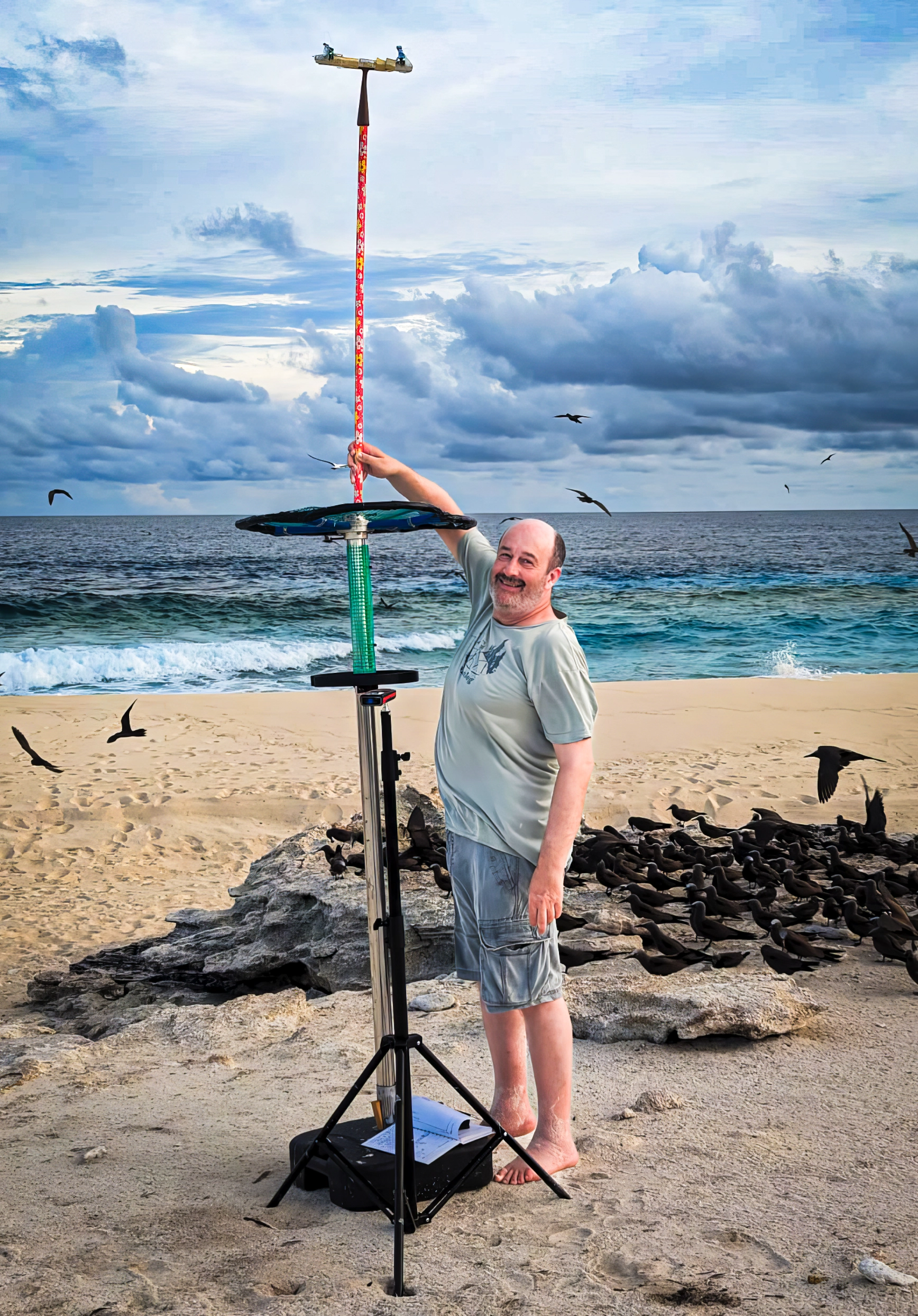
Nachum Ulanovsky calibrates GPS devices (here, mounted to a mop) to specific locations on Latham Island. The system tracks the brain activity of bats in flight as they build a neural map of the novel environment.
Courtesy of Nachum Ulanovsky
When walking around a city, on the other hand, we constantly integrate information about space and time, and from our own memories. We need a mental map, sure, but we also must deal with environmental interference: We need to avoid a cyclist, run across a street before the light turns red, and step over trash without slamming into other people. We need to know how to get from point A to point B, even if we’ve never been there before. And we need to know how vastly different environments — meandering sidewalks, a park with many trails, a fifth-floor apartment — connect to one another.
This kind of complex environment is hard to simulate in the lab. But studying the sense of direction outside the lab, in an uncontrolled setting, can be even harder. So, despite the excitement around the neural basis of navigation, “none of these neurons — neither place cells, nor grid cells, nor head direction cells — had been studied in the real world, outdoors,” Ulanovsky said. “So I had, for many years, this dream that we would like to do that. But for years, it stayed as a dream because how do you even approach this?”
In 2016, his team built a 200-meter-long tunnel at the Weizmann Institute and developed wireless systems to record the brain activity of Egyptian fruit bats as they flew through it. The team reported in Science that place cells behaved differently in the tunnels than they had in the lab — a hint that a more complex experimental environment would be key to really understanding mammalian navigation.
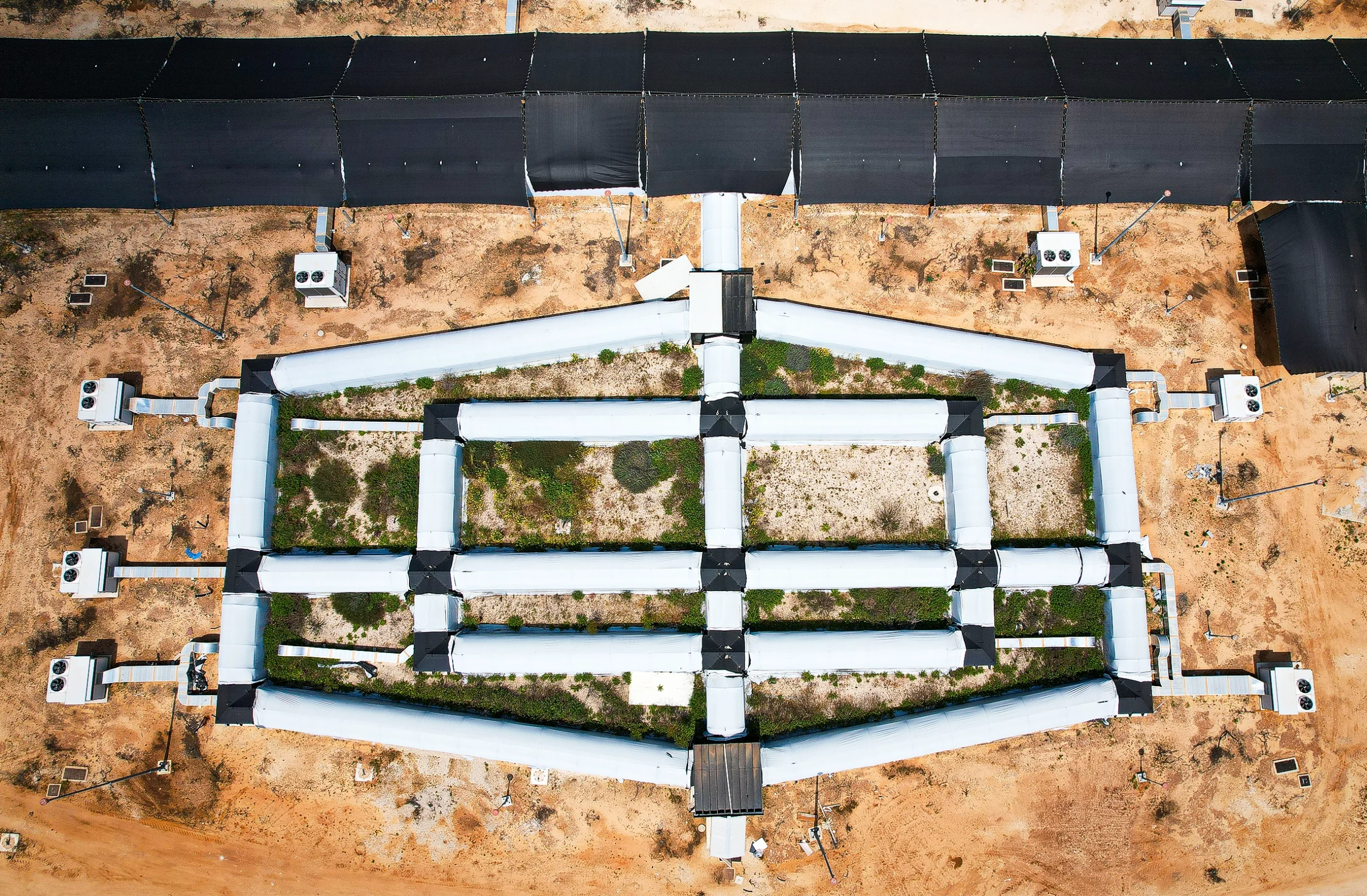
In 2016, frustrated by a small, confining lab, researchers at the Weizmann Institute in Israel built a 200-meter-long tunnel to study bat navigation in a semi-realistic setting.
Nachum Ulanovsky
But a tunnel was still too confined for Ulanovsky. He wanted to create conditions closer to the real world. The answer came to him in 2018 as he was scuba diving on the Great Barrier Reef in Australia. “Being on an island there, it hit me that that’s a solution,” he recalled. “Suppose I find an island somewhere in the world” to use as a wild laboratory.
He searched for an island far away from land (so his bats couldn’t escape and create ecological problems) that was not too big and not too small. It had to be uninhabited by people and mostly barren (so bats wouldn’t hide in tall trees), and it couldn’t be a nature reserve (to avoid permitting issues). “The conjunction of these things is pretty rare,” Ulanovsky said. His team homed in on 30 or 40 islands across the world that might work. Only one was in the home range of the Egyptian fruit bats they study: Latham Island, in the Indian Ocean 25 miles east of Tanzania.
Latham Island, a plot of land the size of about four soccer fields, was small enough for the researchers to contain and track the bats — and big enough to ensure that the bats couldn’t see from one end to the other.
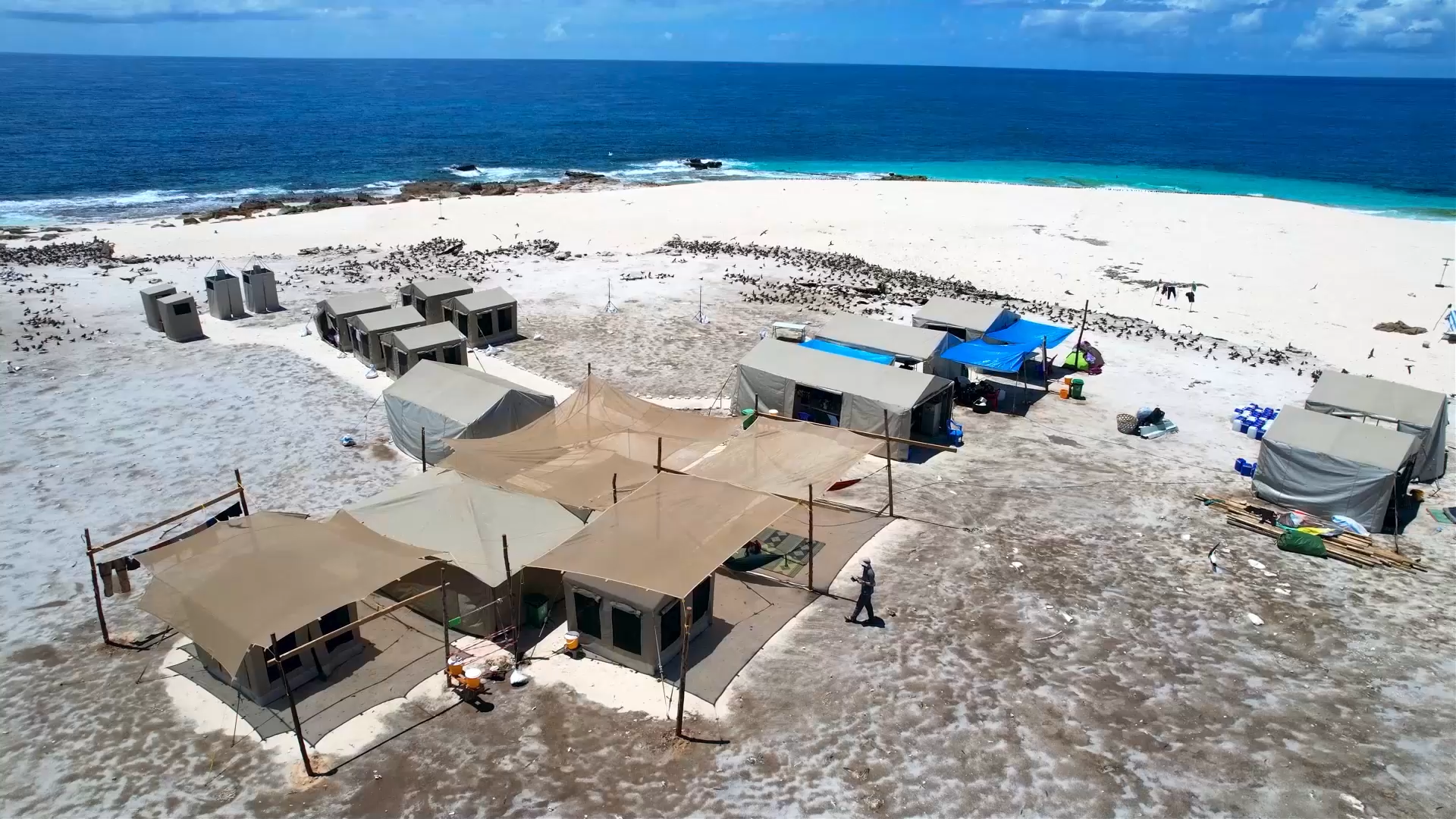
Ulanovsky’s team was ready to watch as bats learned to navigate a complex habitat more like the one they evolved in. They implanted microwires, each a few micrometers thick, in the brains of six Egyptian fruit bats to record neural activity; the wires connected to a data logger, which stored the data. They brought the bats to the island on a boat, along with everything the scientists needed to sustain themselves for a few weeks, including tents, chairs, tables, generators, and refrigerators. They released the bats, usually at night, and tracked their positions as they flew across the island. At the end of every night, the researchers re-captured the bats to download data on the activity of head direction cells and other cells involved in navigation. By the end of the experiments, performed over two seasons in 2023 and 2024, the researchers had data from 301 flights.

Latham Island is a small, treeless plot of land that’s uninhabited aside from seabirds and, sometimes, a few fishermen. In the absence of light pollution, at night the researchers’ camp sat below “the most amazing stars that you can imagine,” Ulanovsky said.
Shaked Palgi and Orian Las
On the first couple of nights, as the bats began to explore Latham Island, their head direction cells fired crudely. Some fired when the bats faced generally south, others while they faced generally east, west or north. But by night five or six, as the place grew more familiar to them, the cells had stabilized to fire in coordination with precise directions and did not change depending on where the animal was on the island.
Because they could not see the entire island at once, their brains seemed to be stitching together small parts of the island into a global whole. The findings suggest that the global compass hypothesis is indeed correct, as some experiments have predicted. This makes sense, as “a compass should be a compass,” Dudchenko said. “If you move to the next room, it should still be pointing in the right direction.”
How did these cells anchor themselves to particular directions? They weren’t adjusting to celestial cues; the bats’ brain activity remained stable as the moon moved across the sky and when the moon and stars were covered by clouds. Nor were the head direction cells anchoring themselves to the Earth’s magnetic field, as some preliminary experiments by Ulanovsky’s team had suggested. The team hypothesizes that the bats anchored themselves to landmarks in their environment, such as the coastline, the experimenters’ tents, and their perches. As they got to know the new space, the landmarks became part of their internal maps and cued the head direction cells to fire.
The findings confirmed decades of lab work suggesting how this head direction cell system worked in smaller environments. “It was an open question, one way or the other, whether the cells behaved the same way in large, natural environments,” Knierim said. He and others applauded the study for recording the activity of these cells out in the wild, in a much bigger and more complex space than experiments could simulate. “In this area of neuroscience, there’s just nothing like that,” he said.
Beyond the Island
Already, this real-world approach is bearing fruit. In November 2025, at the Society for Neuroscience meeting in San Diego, Ulanovsky presented early data showing that the brain cells of bats navigating Latham Island encoded more information than they do inside the lab — for example, place cells not only recorded the bat’s location but also activated based on how fast the bat was going.
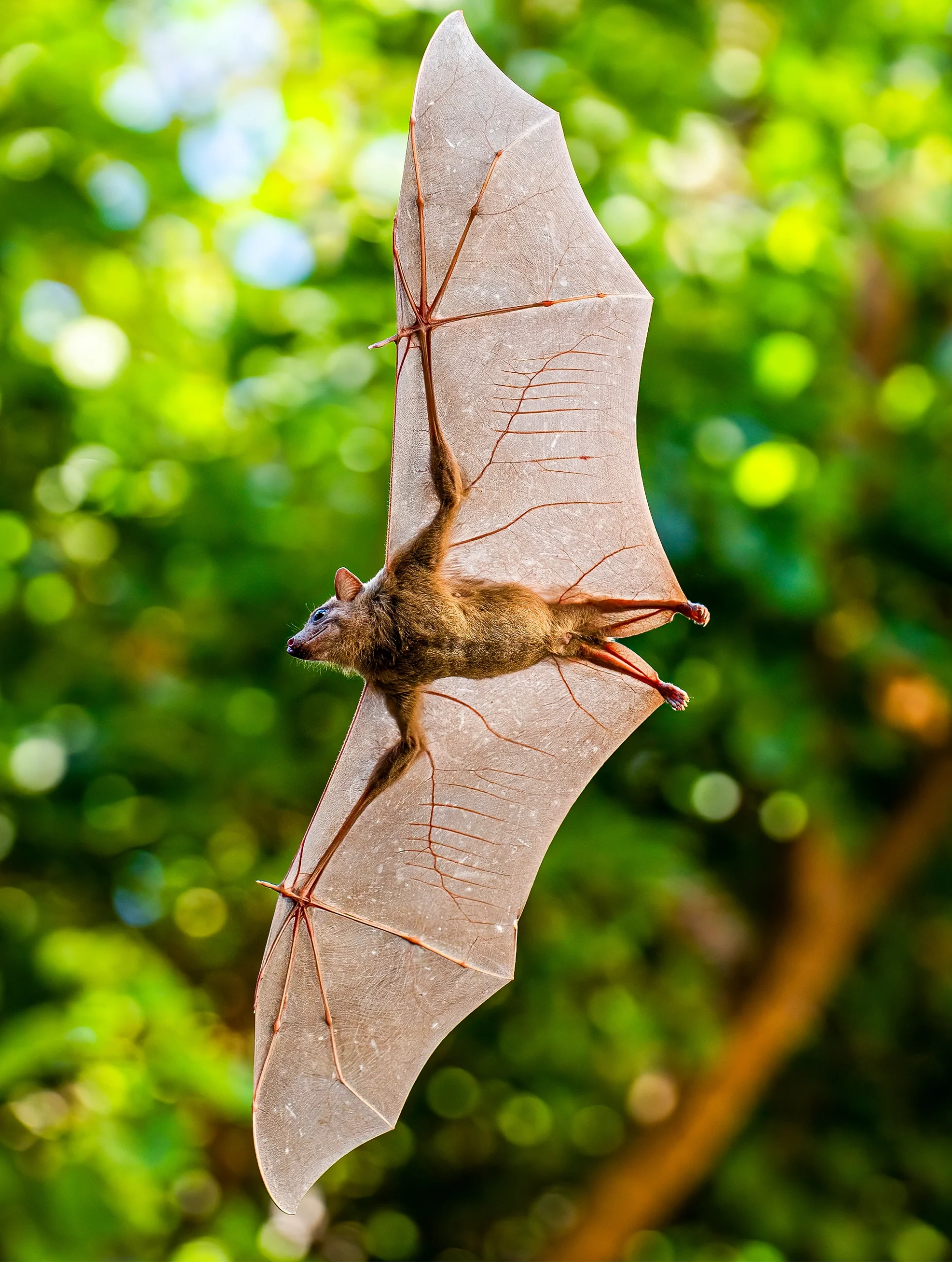
All bat species can see, Ulanovsky said, but the Egyptian fruit bat, his study species, has “excellent vision, much better than rats or mice.” The bats probably use a combination of vision and echolocation to learn the layout of the land and tune their inner compass.
Yuval Barkai
These preliminary findings make an “even better argument for doing natural experiments,” Dudchenko said. “They suggest a new approach to how we do neuroscience.” Instead of crafting experiments that control for complexity, neuroscientists should embrace it, he said.
As neuroscientists look beyond the lab, they’re also hoping to look beyond rats and bats. If you’ve spent any time navigating a city, you’ve surely employed your own head direction system. Knierim recalls walking in Manhattan; he thought he was heading east. “When I hit the corner, and I’m expecting to see Second Avenue, and I see Lexington Avenue [instead] — my whole head, you know, my own perception of the world just spun around,” he said. “I can literally feel it inside.” When he realized his internal map was misaligned, he could feel it twist around him as his mental space caught up with his physical one.
Not much is known about the neural basis of our own sense of direction. Head direction cells have not yet been located in humans, though there is some evidence that they exist. “We do have the same brain structure [as rodents and bats], so it’s not too crazy to think that those brain structures then have similar function,” Dudchenko said. Certainly, our experiences navigating our environments suggest that we have a sense of direction (some more than others).
The lack of human studies is a “major gap that we’re trying to fill,” said Suthana, the Duke neuroscientist. With consent from epilepsy patients, Suthana and her team connected a new device to electrodes already implanted into their brains for presurgical monitoring. Then she recorded navigation cells in humans exploring a seminatural environment — a hospital room and hallway — to collect data on how navigational cells track the body and head as a person moves. This was the first time such a study had been performed in human subjects.
“Moving into these wilder, naturalistic environments really has the ability for us to test things or find things we would never see in the lab,” she said. While 15 minutes wandering a hospital hallway isn’t exactly the wild, her team is working toward the goal of recording high-resolution brain activity in even more complex environments. “Maybe not on a remote island, but who knows?”