In Expanding de Sitter Space, Quantum Mechanics Gets Even More Elusive
Mark Belan/Quanta Magazine
Introduction
In theory, a universe can come in any shape or size, but scientists prefer to think about three basic kinds of universes: one that’s expanding, one that’s collapsing, and one that stays the same. Out of these three simplified models, an expanding universe is the hardest for physicists to understand. Yet it’s exactly the one our real world most resembles.
When physicists calculate what’s going on with particles at the smallest, quantum levels in a universe that is collapsing or static, they can get their results to make sense. Unfortunately for physicists, our real universe is not collapsing or static but expanding — being pushed apart by dark energy.
When scientists try to make sense of quantum theory in an expanding universe, they are met with one confusing paradox after another. In expanding space, physicists cannot square the world we experience with the way things work at the smallest levels.
Now physicists trying to make sense of how the quantum world works within our expanding universe are hoping to learn from an unexpected source: black holes.
The Shapes of Space-Time
In 1915, Albert Einstein’s theory of gravity, called general relativity, introduced the idea that space and time are inextricably linked.
Space and time react to the contents of the universe: If the universe is filled with matter, then over time, the attractive pull of that matter’s gravity should cause space to contract. If the universe is filled with enough dark energy — or what in Einstein’s day was called a cosmological constant — then over time, its push should cause space to expand.
When Einstein first wrote his general theory of relativity, he believed that our universe must be eternal and unchanging. In geometric terms, he believed that the universe should be infinite and flat, and that the forces that push and pull on space-time should exactly cancel out.
But a Dutch physicist named Willem de Sitter was more open-minded. He realized that it was a natural consequence of relativity for the universe to evolve. In 1916-17, de Sitter published three papers exploring relativity’s possibilities. (In the process, he introduced many English speakers to Einstein’s theories, which, originally written in German, had been siloed off because of severed scientific communications during World War I.)
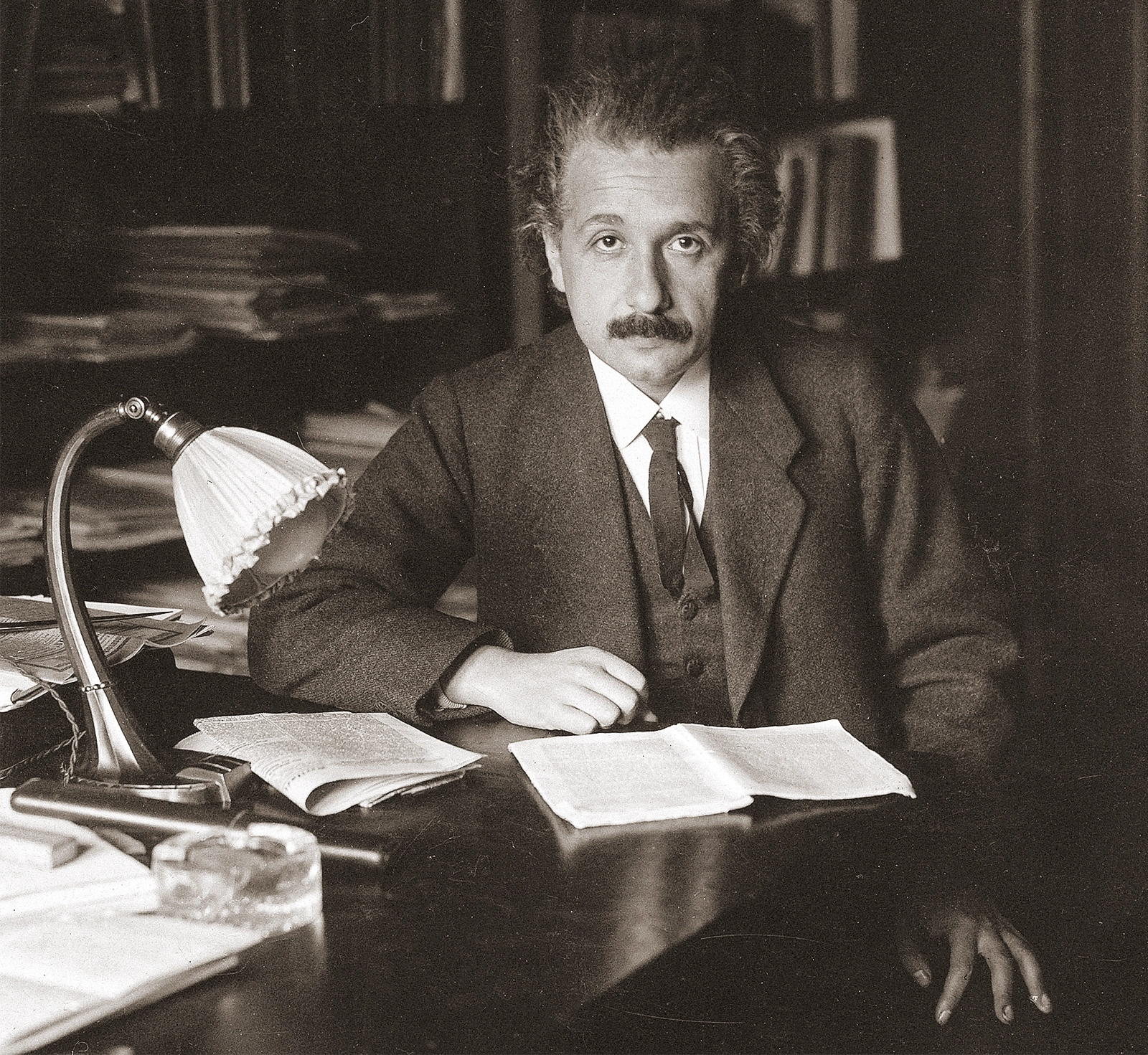
Albert Einstein famously believed in an eternal and unchanging universe.
Linda Hall Library of Science, Engineering and Technology
De Sitter found that an empty universe — one devoid of matter, but which still has a cosmological constant — could take on one of just three shapes, depending on the sign of the cosmological constant: It could be flat, as Einstein predicted, positively curved, or negatively curved.
If the cosmological constant is positive, then space-time is positively curved into what is now called de Sitter space. If the cosmological constant is negative, then space-time is negatively curved into anti-de Sitter space. And if the cosmological constant is zero, then space-time is flat.
You can tell the shape of the universe you’re in by observing how two otherwise stationary objects evolve as time ticks forward. Imagine marking two dots on a balloon; if you blow up the balloon, the two dots will move away from each other as the balloon expands. This is what happens in positively curved space-time. In negatively curved space-time, stationary particles move toward each other, as if the balloon were deflating.
In positively curved de Sitter space, space expands at an exponential rate. If you are an observer living within de Sitter space, this expansion creates a horizon beyond which it’s impossible to communicate. If you try to send a message to someone beyond your horizon, the expanding space will ensure that it never makes it, almost like a current too powerful for a swimmer to overcome. “It’s expanding so fast that there are parts of space-time which, if you wait forever, you will never be able to see,” said Monica Pate, a theoretical physicist at New York University.
Anti-de Sitter space, on the other hand, acts like a box. The edge of this box isn’t something you can touch — only light can reach it — but it bounds an anti-de Sitter universe like a picture frame. Everything is drawn back to the box’s center. If you broadcast a message in anti-de Sitter space, or throw a rock, it will eventually boomerang back to you. “You can think of it as a constant” — not uniform, but persistent — “gravity everywhere,” Pate said.
We don’t live in exactly any of these idealized universes; we live in a universe with an unbalanced amount of both matter and dark energy. However, our universe likely looked a lot like de Sitter space in the far past, during a period of rapid expansion called inflation. After that, it looked flatter for a while, thanks to the presence of matter and light. But as space continues to expand today, and matter becomes sparser, the universe is looking increasingly like de Sitter space again.
“People think eventually we will live in pure de Sitter space, or something like it, for a very long time,” said Daniel Green, a cosmologist from the University of California, San Diego.
Quantum Questions
Unfortunately, de Sitter space causes huge problems for physicists trying to understand the universe at the smallest scales. The issue, as is so often the case, lies with the strange rules of quantum mechanics.
In quantum mechanics, there’s no such thing as certainty. Because of random quantum fluctuations, even simple questions about where a particle is or how many particles there are in a small area don’t have well-defined answers.
And yet, we need to probe those smallest bits of space to make sense of how the quantum world relates to our macroscopic experience. The more precisely you want to probe, the more energy you need to use to overcome a background of quantum fluctuations. Essentially, this is why physicists use miles-long particle colliders that accelerate particles to enormous energies.
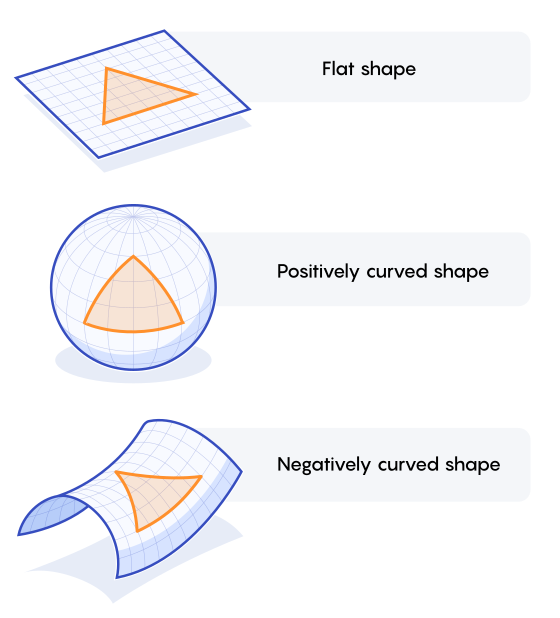
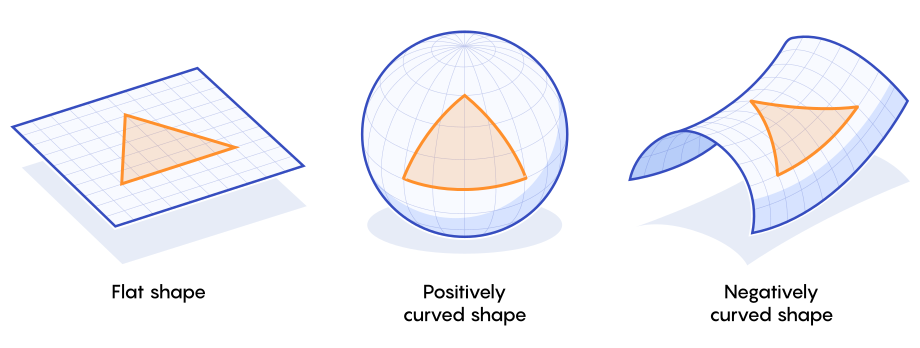
In curved space, parallel paths don’t stay parallel. Willem de Sitter realized that something similar happens in a universe with a cosmological constant: A positive constant would cause objects to drift apart over time, and a negative constant would cause objects to come closer together.
Mark Belan/Quanta Magazine
But there’s a limit to how much energy you can use for a single measurement. Put too much energy in a small space, and you’ll create a black hole. To make precise measurements without hitting this limit, physicists need to find another way to reduce the quantum fluctuations.
In flat space, physicists can do this by taking measurements from (effectively) infinitely far away — far enough away to shield their measuring devices from the fluctuations. In anti-de Sitter space, it’s even easier: Quantum fluctuations go to zero on the boundary of a boxlike universe, so you can make perfect sense of quantum measurements by setting up your experiment on the universe’s edge.
In de Sitter space, there’s a problem. As you go farther away from the particles you’re measuring, quantum fluctuations don’t get any smaller. “Gravity is fluctuating, quantum mechanically, everywhere,” Green said. “And there’s no place to shield yourself from that.” Without an accessible boundary to take a measurement from, it’s as if an experimenter in de Sitter space is always stuck inside their own experiment.
“The whole machinery of quantum mechanics is built on the idea that there’s a quantum system, and then some big, giant experimentalist comes along and measures that system,” Green said. In de Sitter space, where there’s no line between the quantum system and the observer, this machinery falls apart.
Through the Looking Glass
The problems with de Sitter space get worse. Much of physicists’ intuition stops being helpful in an expanding universe. Energy, for instance, is not conserved. “The expansion is literally pumping energy, changing the universe,” said João Penedones of the Swiss Federal Institute of Technology Lausanne.
Even the concept of a particle is different. We typically think of a particle as an object that has some location and moves through space. “In de Sitter, there is no such thing,” said Manuel Loparco, a former graduate student of Penedones who is now at the University of Turin. The constant influx of energy in de Sitter space will eventually cause a particle to spread out or decay.
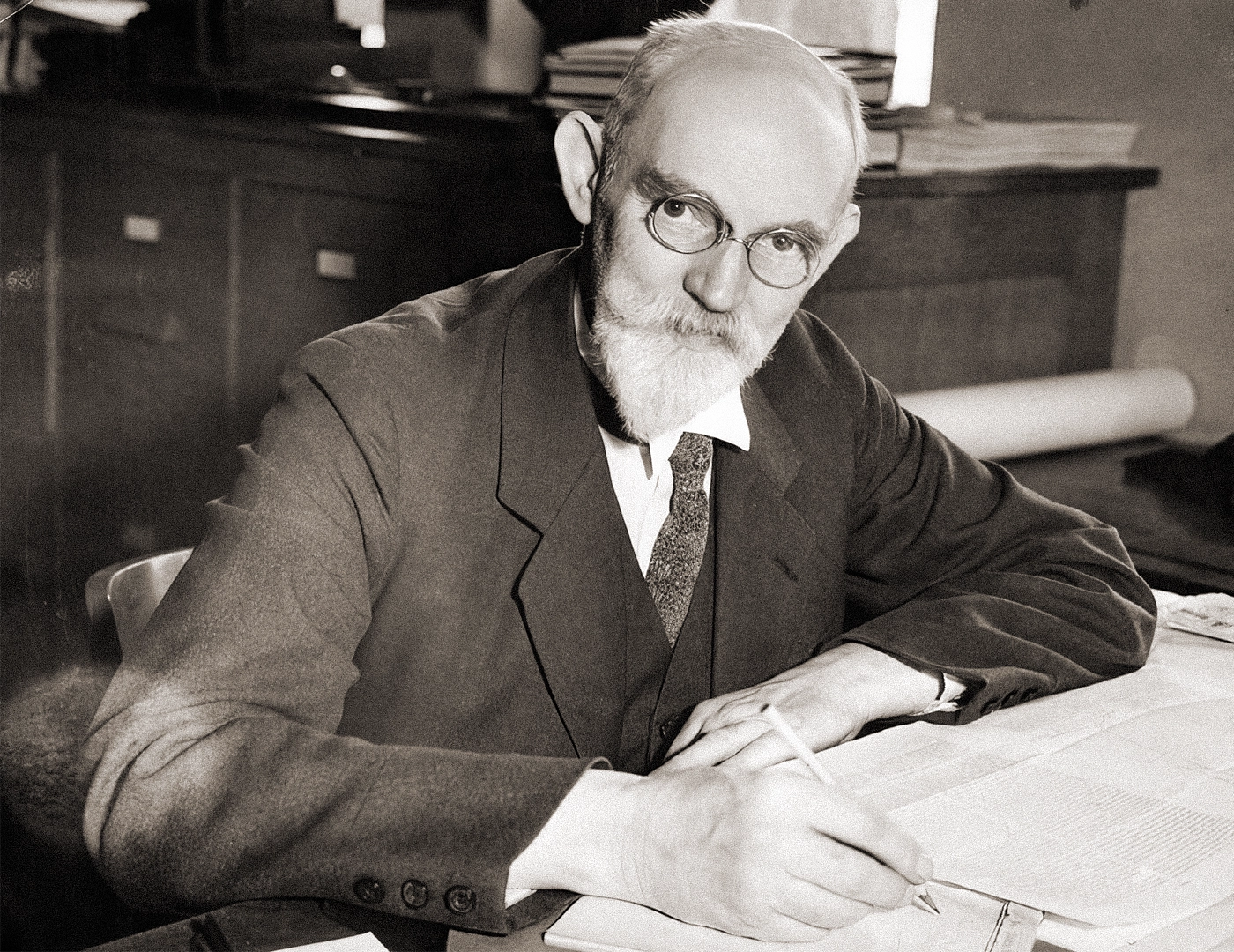
Willem de Sitter realized that it was a natural consequence of Einstein’s theory of relativity for the universe to evolve.
Photographic Archive/University of Chicago/Creative Commons
In a paper first posted to the scientific preprint site arxiv.org in May 2025, Penedones and Loparco tried asking a simple question: What does a photon, or a particle of light, look like in exponentially expanding space? The answer, which arose from careful mathematics, shocked them. Photons, which are massless, could be made out of massive particles in de Sitter space.
The finding has strange implications. For example, if photons don’t have any mass, they should be stable, because particles can only decay into lighter things. But massive photons in de Sitter space could spontaneously decay into matter — which could then decay back into light again. “We’re still trying to understand the physical implications of that,” Penedones said.
These are the types of calculations that physicists are working to make sense of in de Sitter space. Their goal is to sort the hard technical problems from the hard conceptual problems, asking “What can we calculate; what can’t we calculate?” Green said. The hope, he said, is that this work will leave scientists “in a much better position to solve some of these other bigger problems, because we won’t be confusing them with the smaller, more tractable problems.”
Penedones still finds value in the challenge of trying to understand different versions of the universe — de Sitter, anti-de Sitter, flat — if only to better understand quantum theory. “De Sitter tells you that your intuition that you develop in flat space is not true in all spaces,” he said. “That’s why it’s useful to do some things in de Sitter: to lose your prejudice.”
Pushing Boundaries
To try to make sense of the quantum mechanics of de Sitter space, some physicists have turned to black holes. Black holes are ultra-dense objects from which light cannot escape. While you cannot physically probe a black hole, physicists have studied their insides theoretically. And over the last few years, they’ve made a lot of progress.
Advancements in understanding black holes build on holography, the idea that the two-dimensional surface of the black hole somehow captures everything about the three-dimensional space inside it. Physicists treat the volume of the black hole as illusory, like a hologram.
Black holes have been useful settings for studying quantum gravity, since the extreme gravity of a black hole acts strongly even on the quantum scale. But in recent years, physicists have noted that black holes are also surprisingly similar to de Sitter space.
Around a black hole, the region where light can no longer overcome the black hole’s gravitational pull forms what’s called a horizon. In de Sitter space, a kind of horizon forms around an observer because space is expanding too quickly for light to reach them from beyond a certain distance. If our universe continues to expand forever as physicists predict, then it will be as if we are trapped in a black hole; everything beyond our de Sitter horizon will always remain out of reach.
“We think of black hole cosmology as being sort of a warm-up problem for understanding quantum effects and cosmology,” said Tom Hartman, a physicist at Stanford University. “So anytime we make progress on black holes, we go back and ask: Can we apply this to de Sitter?”
So far, when Hartman and others have tried to apply their advancements in understanding black holes to de Sitter space, they can’t seem to make sense of the results. A black hole has a single horizon, whereas de Sitter space has many, centered on different observers. Without a single boundary to anchor physicists’ calculations, a de Sitter universe seems incapable of holding anything quantum at all. “There’s something empty about it,” Hartman said. “Like if you try to formulate a quantum theory of de Sitter space, there’s some sense in which it wants to not have any states in it.”
This is a clear contrast to the world we observe, which is both full of quantum particles and increasingly de Sitter–looking. “The most likely answer is that we’re not interpreting that calculation correctly,” Green said.
Still, physicists are hopeful that holography will one day apply more generally to de Sitter space, and that it will answer some of our biggest questions about quantum gravity. “That’s always been kind of believed, but I think in the last few years, it’s become more convincing,” Hartman said.
What other surprises de Sitter holds are yet to be seen, but the landscape seems to be ripe for insights, Loparco said. “It’s really low-hanging fruit that we’re picking.”