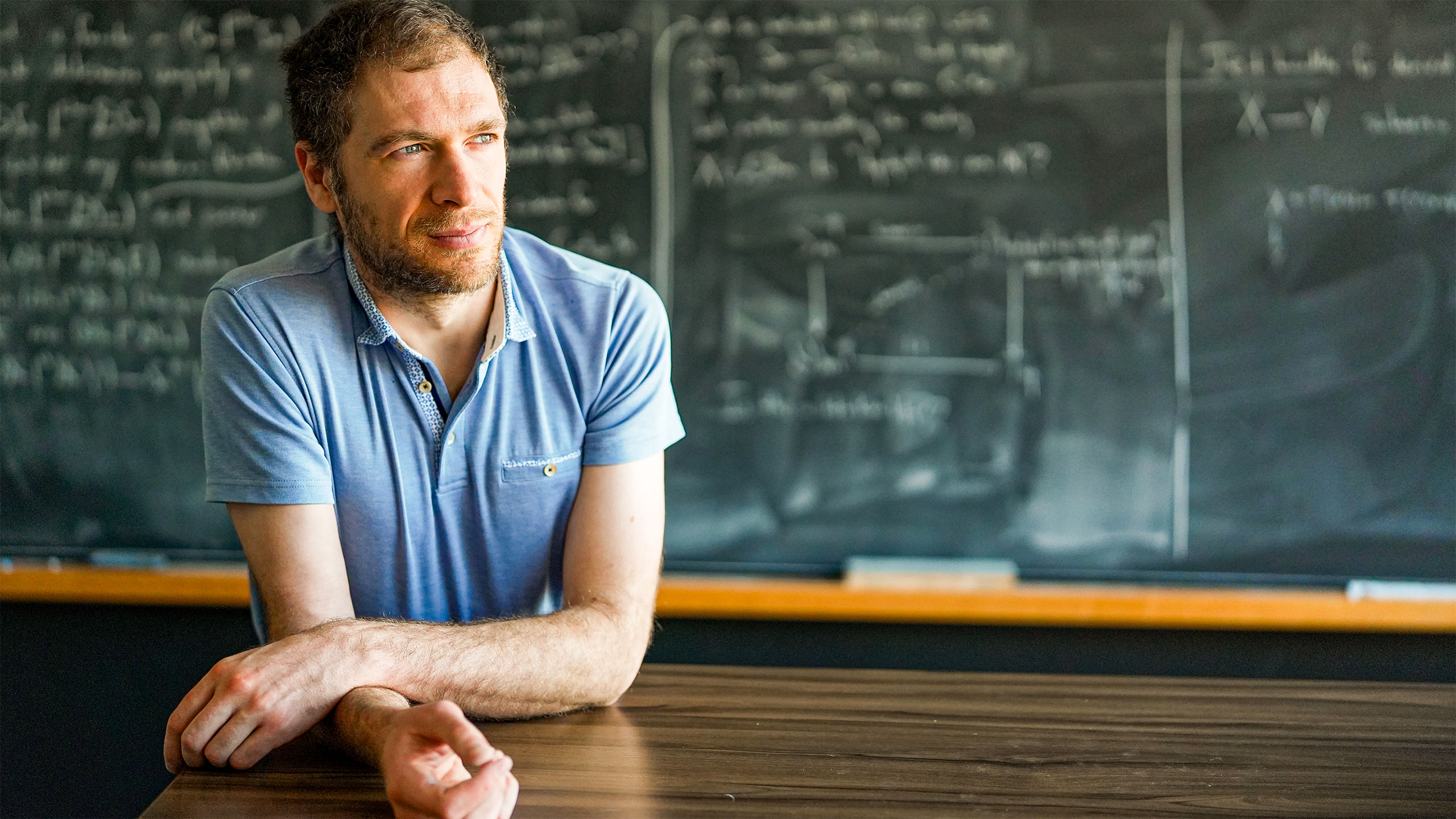
John Pardon is known to his colleagues and students as quiet but insightful. As one formerstudent put it, “You really have to go fishing for his knowledge.”
Phil Yam
Introduction
Several eminent mathematicians tell different versions of the same story about John Pardon.
Fifteen years ago, János Kollár was seated next to Pardon at a Phi Beta Kappa dinner. Kollár held an endowed chair as a full professor at Princeton University, where he’d been teaching for over a decade after stints at the University of Utah and at Harvard University as a member of its Society of Fellows, arguably the country’s most prestigious postdoctoral fellowship. Which is to say, Kollár is not bad at math. Pardon was an undergraduate, a few months into his senior year.
Kollár had gotten stuck on a question in the field of topology. At the dinner, he mentioned it to Pardon in passing. Two weeks later, he got an email from Pardon — with the solution. “And it’s not just that he solved the question I needed, but he did a much more general case in a very nice way,” Kollár recalled. He found working with the 21-year-old a pleasure. It felt, he said, “like working with a postdoc who had very good ideas.”
When Pardon graduated the following May, it was at the top of the Princeton class. In his valedictory address, he asked his fellow graduates, rhetorically, “When is the last time you had a truly original idea?” He proceeded to answer his own question: “The single most basic form of expression that humans draw upon is imitation of others, and so I think having an original idea may qualify you as being partially insane.”
By young Pardon’s definition, present-day Pardon, who turned 37 in June, is more than a little crazy, in that he has had not one but many original ideas. For these, the International Mathematical Union has now awarded him the Fields Medal, the most prestigious prize in math. “He started off solving well-known spectacular problems,” said Tobias Ekholm of Uppsala University. “At a slightly older age, he’s doing this same spectacular work, but he has this ability: He solves a famous problem but does it in a way that creates a framework, a whole new package, that will be useful to other people.”
Pardon, now at Stony Brook University in New York, is not particularly prolific. “His publication list is not very long,” said Kai Cieliebak of the University of Augsburg. “But every paper he wrote is some kind of breakthrough paper. All of them appeared in very top high-level journals.” Furthermore, Cieliebak said, Pardon “has done work in really a whole number of, to my understanding, completely separate areas of math. Probably somewhere in his brain these things might be connected.” As his former student Mohan Swaminathan, now at the Tata Institute of Fundamental Research, put it, “If John has a problem, he goes really deep and learns whatever is necessary for it.”
Pardon is tall and quiet. He has a gentle, unassuming affect and a reputation for kindness. He’s likely to be the best mathematician in any room he walks into, but he wears this lightly. He’s helpful to colleagues, sporadically answering graduate students’ questions on the online bulletin board MathOverflow. He sometimes weighs in on other subjects as well, with an invariable polite decisiveness. When one user, exasperated by their inability to make restaurant-quality pancakes, asked for help, Pardon offered advice: “The difference between ‘fluffy and fall-apart crumbly’ and ‘thinner, chewy, and sort of dense,’” he wrote, “is precisely governed by baking powder/soda. … If you want thin and chewy, omit the baking powder.” Pardon is as likely to ask for help as he is to offer it — airline ticketing, Schengen visas, and Wi-Fi passwords are as frustrating and confusing to him as they are to anybody. He is a father of two sons. He plays the cello well and learned to speak Chinese fluently in college, eventually winning a Chinese-language debate tournament held in Singapore.
Pardon declined to speak on the record for this profile. Many people who know him remark on his reluctance to say just about anything, least of all about himself. “He will only say something when he feels it is definitely correct,” said Shaoyun Bai, a mathematician at the Massachusetts Institute of Technology who got his doctorate under Pardon.
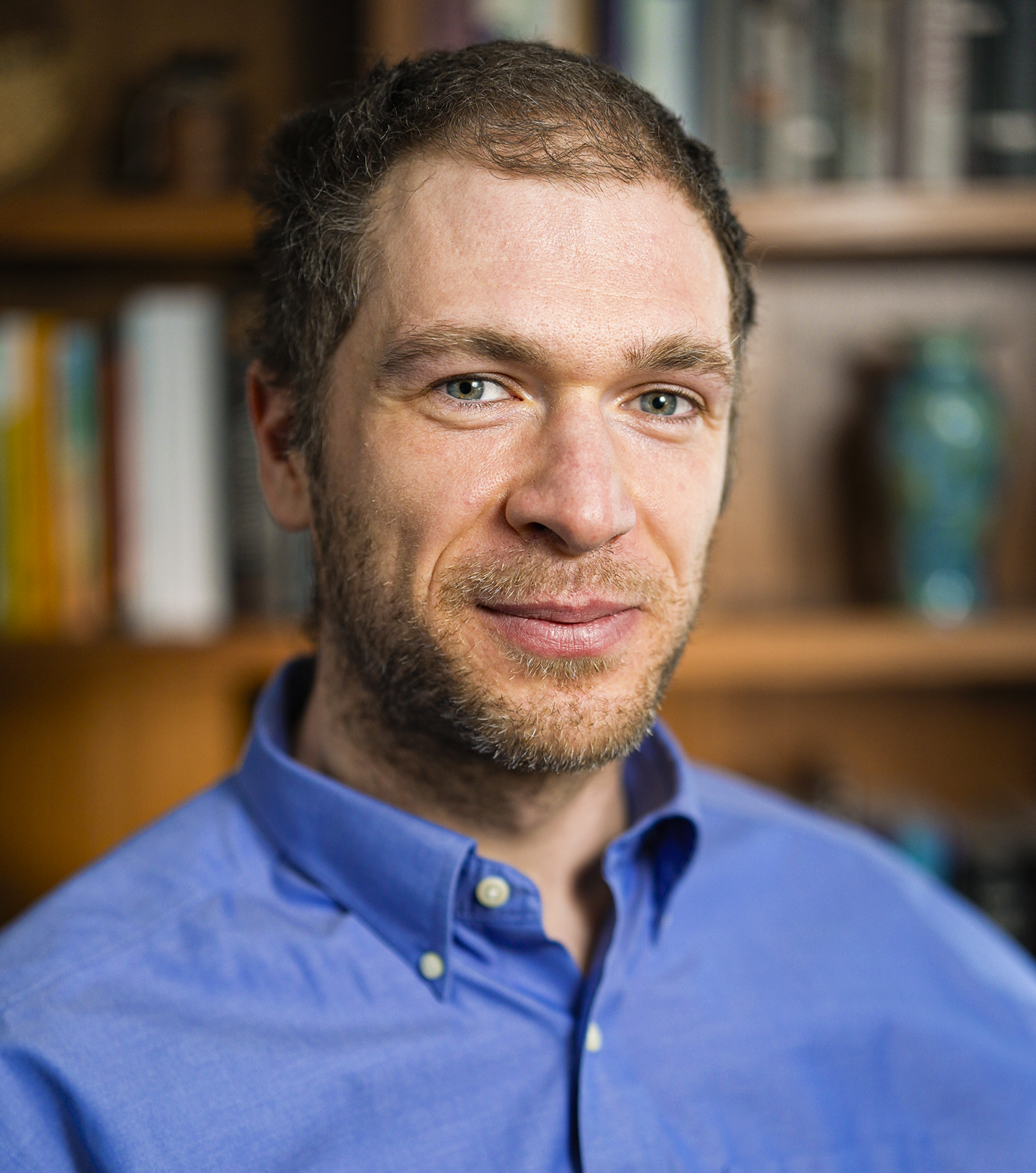
Pardon, though not particularly prolific, has proved major theorems in many different areas of math.
Phil Yam
“He refrains from saying too much,” said Thomas Massoni of Stanford University, another former student. “He knows so much that you really have to go fishing for his knowledge.” Multiple students recounted meetings with him where they had to do almost all the talking — but he was always available, glad to meet with them, and a patient listener. As Barış Kartal, who worked with Pardon while doing a postdoctoral fellowship, said, “He is silent, but he says very useful things.”
“I think John knows who he is and probably doesn’t want to come across as a cartoon of ‘Here’s a boy genius who’s done such-and-such a thing,’” said David Gabai, a former chairman of the Princeton math department. This is a real, reasonable concern. Nonetheless, when mathematicians speak about him, it’s hard to avoid the conclusion that he is a once-in-a-generation mathematical talent.
Like a generational talent in sports — Ohtani, Jordan, Messi — Pardon appears to be playing a different game than his colleagues, all of whom are themselves exceptionally skilled. But his achievements aren’t as easy to appreciate as a star athlete’s. Without years of study, it’s tough to understand just how surprising Pardon’s proof of a conjecture about six-dimensional manifolds really is. An earlier Fields Medal had been awarded in part just for making the conjecture.
So, with every intention of avoiding caricature, here’s a glimpse of Pardon’s work in knot theory, topology, and symplectic geometry.
Knot a Problem
Pardon was already the star of Princeton’s math department when he sat next to Kollár at that dinner during his senior year. He’d grown up in North Carolina, and by the time he was in high school, he was taking math courses at Duke University, where his father was a math professor.
Once in college, he set out to solve an open problem in knot theory that he’d first encountered in high school. As he later told his Stony Brook colleague Simon Donaldson, now at Imperial College London, he had more or less given up on it by the end of his junior year. But a line of attack occurred to him while he was walking in an English park that summer. A few months later, he had his proof.
Knot theory is one of those areas of math that are just what they sound like, but also somehow far deeper and more complicated than they seem. It is the study of knots — literally, given a length of rope, how can you tie it? (Mathematicians often splice the ends of the rope together.) But this question generalizes to higher dimensions and differently structured spaces, and in the end, the structure of knots is a powerful tool for understanding the geometry and topology of the spaces in which they can be embedded.
In 1983, the prominent mathematician Mikhael Gromov made a conjecture about a property of knots called the distortion. Consider two points on a knot. You can measure the distance between them in two different ways. Either you can travel along the rope itself, as though you were a tiny ant, or you can take a straight-line shortcut across space, as a (small) crow flies. It’s easy to intuit that the length you travel along the rope will always be at least as long as the straight-line distance. For any given knot, there will be a pair of points for which the ratio between the distance along the rope and the straight-line distance is the biggest. That ratio is the knot’s distortion.
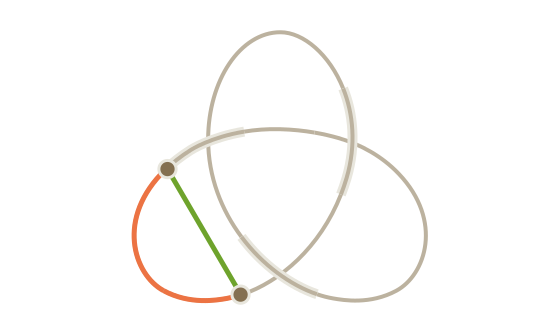
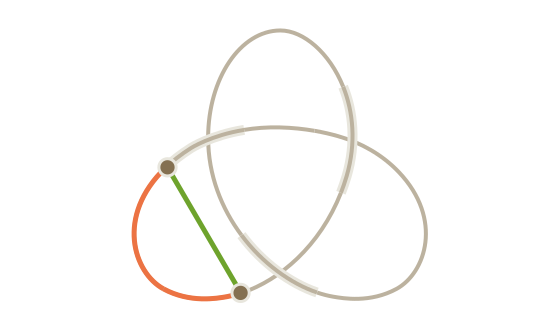
Mark Belan/Quanta Magazine
Knots have the advantage of being flexible: So long as you don’t tear the rope, you can move it around to minimize the distortion. Gromov asked a question about “torus knots,” which can be drawn on the surface of a doughnut without crossing themselves. You can think of the doughnut as a sort of mold that helps make the structure of the knots clear, as seen below:
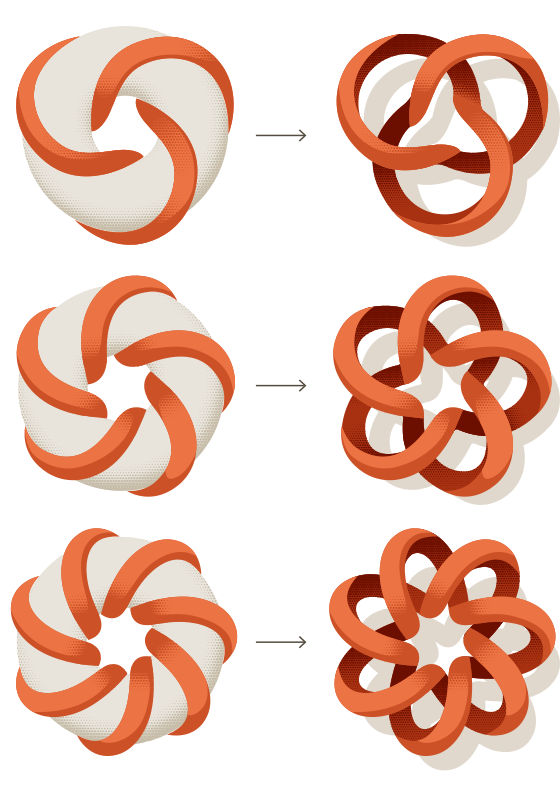
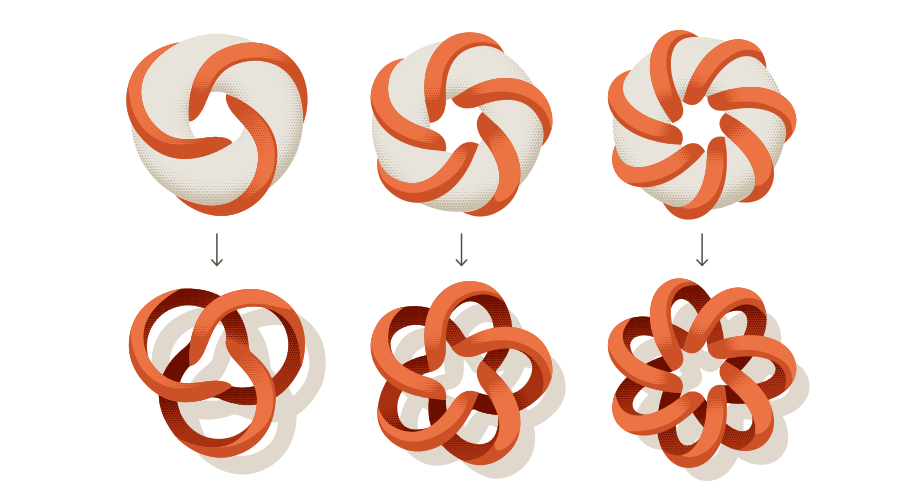
Gromov wanted to know if, as you wrap the rope more and more times around the doughnut to make your knot, there might be an upper bound to the distortion. He asked if any torus knot might be rearranged so as to make the ratio smaller than a fixed upper bound: 100.
One day in 2010, Gabai remembers Pardon — still an undergraduate — walking into his office and saying, “Well, I’ve proven such-and-such a theorem.” He’d shown that the answer to Gromov’s question was no: There are knots that have an arbitrarily large distortion, no matter how cleverly you try to rearrange them.
Since the distortion is one measure of how tangled a knot is, he essentially proved that it’s possible to create knots of this particular type, once thought to be relatively tame, that are arbitrarily tangled. Pardon’s proof was later published in the Annals of Mathematics, the field’s top journal — a rare achievement for an undergraduate.
Cieliebak speaks of the paper in a wistful tone. “It’s a paper you can sit down and read,” he said. “It has this genius touch to it.”
Transverse Days
If the knot distortion paper was the valedictory to Pardon’s collegiate career, he was just getting started. He arrived at Stanford as one of several standouts in a strong class of graduate students, according to Yakov Eliashberg, one of the most prominent geometers of his generation. There, Pardon could often be seen on the steps in front of the math department building, lost in thought. “He’d sit there for the longest time,” said the Stanford mathematician Ralph Cohen. “You’d go by and say hello. Sometimes he’d recognize you and nod hello. Sometimes he’d be deep in thought and wouldn’t know you’re there.”
At first, Pardon worked on some problems in low-dimensional topology. Then, after asking Eliashberg to be his adviser, he began to work in symplectic geometry.
In the web of mathematical disciplines, symplectic geometry sits somewhere between topology and geometry. Historically, it originated in the study of “phase space” — an abstract, high-dimensional space in which each possible state of a physical system (for instance, the positions and momenta of atoms bouncing around in a gas) gets represented as a single point.
Position and momentum are related in a particular mathematical way: If you change one, you change the other. Symplectic geometry begins with this relationship, which has geometric consequences, and abstracts it to other, mathematically similar objects. These objects have more flexibility than traditional geometric objects, such as a rectangle or a sphere, but have more rigidity than topological objects, which can be stretched and compressed at will.
Pardon’s doctoral dissertation on the “virtual cycle problem” made him instantly famous among symplectic geometers, said Leonid Polterovich of Tel Aviv University, who spoke of Pardon with amazement. Many of the top people in the field, he remembers, had been trying to solve the problem for years. “Some young guy comes and just does this,” Polterovich said. “He’s very precise, obviously has a fantastic skill of developing language. It’s really special. It’s not just tricks.”
To understand the virtual cycle problem, it helps to consider a concept called transversality. Two curves intersect in a transverse way if they cross like so:
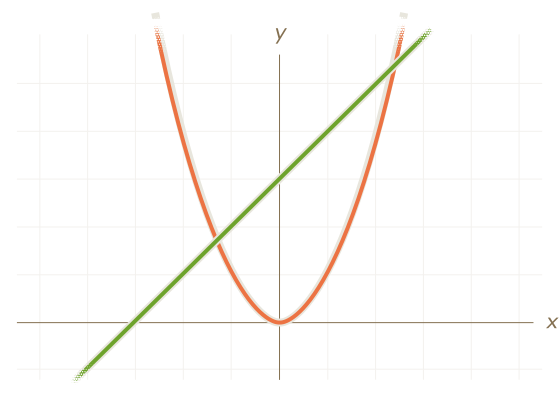
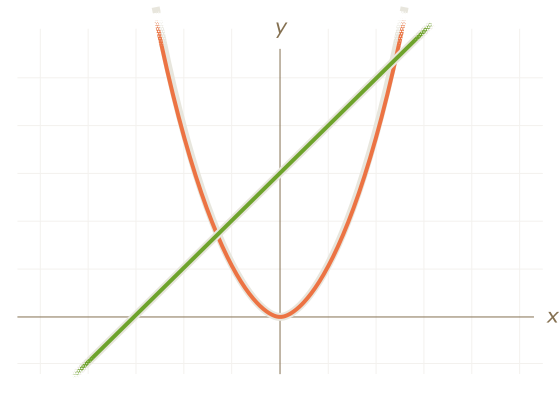
If, on the other hand, they just barely “kiss” each other — intersecting at a tangent — then their intersection is not transverse.
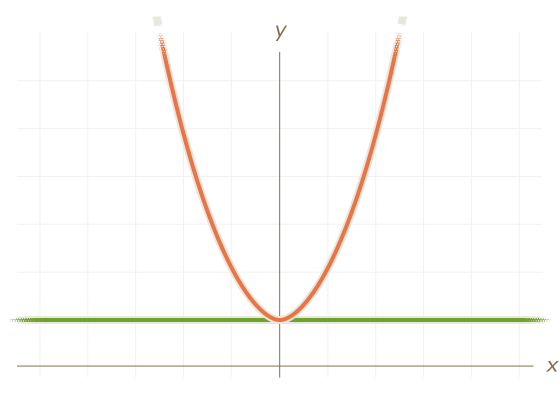
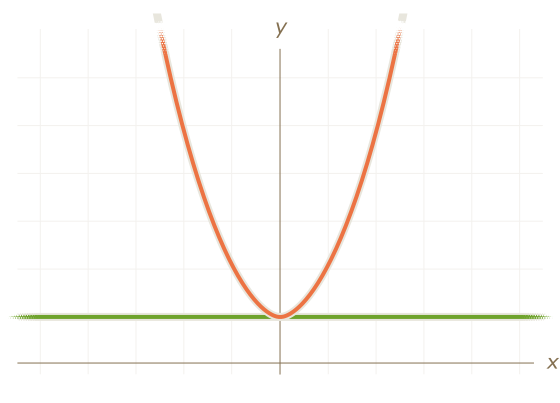
Transverse and non-transverse intersections also arise with surfaces, which are, in the end, higher-dimensional analogues of curves.
In symplectic geometry, the basic object of study is called a symplectic manifold. One central way in which mathematicians in the field try to understand a symplectic manifold is by studying mappings that send points on other, well-studied surfaces to points on that manifold. The mappings that symplectic geometers are interested in have to satisfy certain mathematical conditions that make it possible to count them. “Rather rapidly it was understood that this counting doesn’t work very well,” Polterovich said, because the presence of non-transverse intersections in the relevant calculations can lead to incorrect counts.
In his dissertation, Pardon “succeeded in developing a novel language … which led to the resolution of this problem,” Polterovich said. By coming up with a new way to think about so-called virtual cycles — a technique for circumventing the issues caused by non-transverse intersections — he was able to count rigorously. As Polterovich put it, “It was clean. It was powerful.”
The result came at a time when symplectic geometry was in something of a slow-burn crisis, rife with disputes over whether key results had been established rigorously. “We really didn’t properly prove everything,” Eliashberg said. Pardon’s approach helped get around some of these foundational obstacles. “With some magic things he invented,” Polterovich said, “Pardon succeeded in gluing all this information together.” His wasn’t the first, or only, technique for dealing with transversality, but it was more widely applicable than any of the previous approaches. Now, Eliashberg said, “a kind of foundation for certain parts of symplectic field theory are built on his machinery.”
As Eliashberg’s Stanford colleague Mohammed Abouzaid said, Pardon’s thesis “made it possible for many people to stop worrying about things. … It was immediately impactful.”
As a mark of just how impactful it was, even before Pardon officially received his doctorate, Princeton began recruiting him to return as a full professor — unheard of for someone fresh out of graduate school. It required some explaining to the university’s dean, Kollár remembered.
Shortly after finishing his doctorate, Pardon teamed up with Sheel Ganatra and Vivek Shende to prove a series of other landmark results in symplectic geometry. “Working with John has been one of the great professional highlights of my career,” Ganatra said. “It has been wonderful for me.” He remembers visiting Pardon at Princeton and spending an afternoon eating much of a bag of “what must have been 100 peaches” while working through details of what would become their second paper together. On another occasion, they spent a week in Beijing, eating durian and doing math. “He loves fresh fruit,” Ganatra said. “He really loves fresh fruit.”
“He can be quiet at first, but his mind is always thinking,” Ganatra added. “We’ll have moments when we are talking, and all of the sudden we’re leaping forward.”
Counting Curves
In 2016, Pardon left Stanford for Princeton, where he spent six years as a professor before moving to the Simons Center for Geometry and Physics at Stony Brook University. There, he solved his biggest problem yet, proving a 20-year-old conjecture about counting curves. The unifying thread to Pardon’s work is not a particular mathematical area or theme; he simply solves problems that are, to him, interesting.
As in symplectic geometry, curve counting gives mathematicians deep insight into the spaces where those curves live. On a flat piece of paper, if you choose two points, you can only draw one line (a kind of curve) between them. This seems obvious enough, but it says something fundamental about the structure of 2D space.
Though you can draw infinitely many lines on a 2D plane or in 3D space, there’s a classic result in geometry that a shape called a quintic threefold contains exactly 2,875 lines: The geometry of the shape constrains the number of lines that are possible.
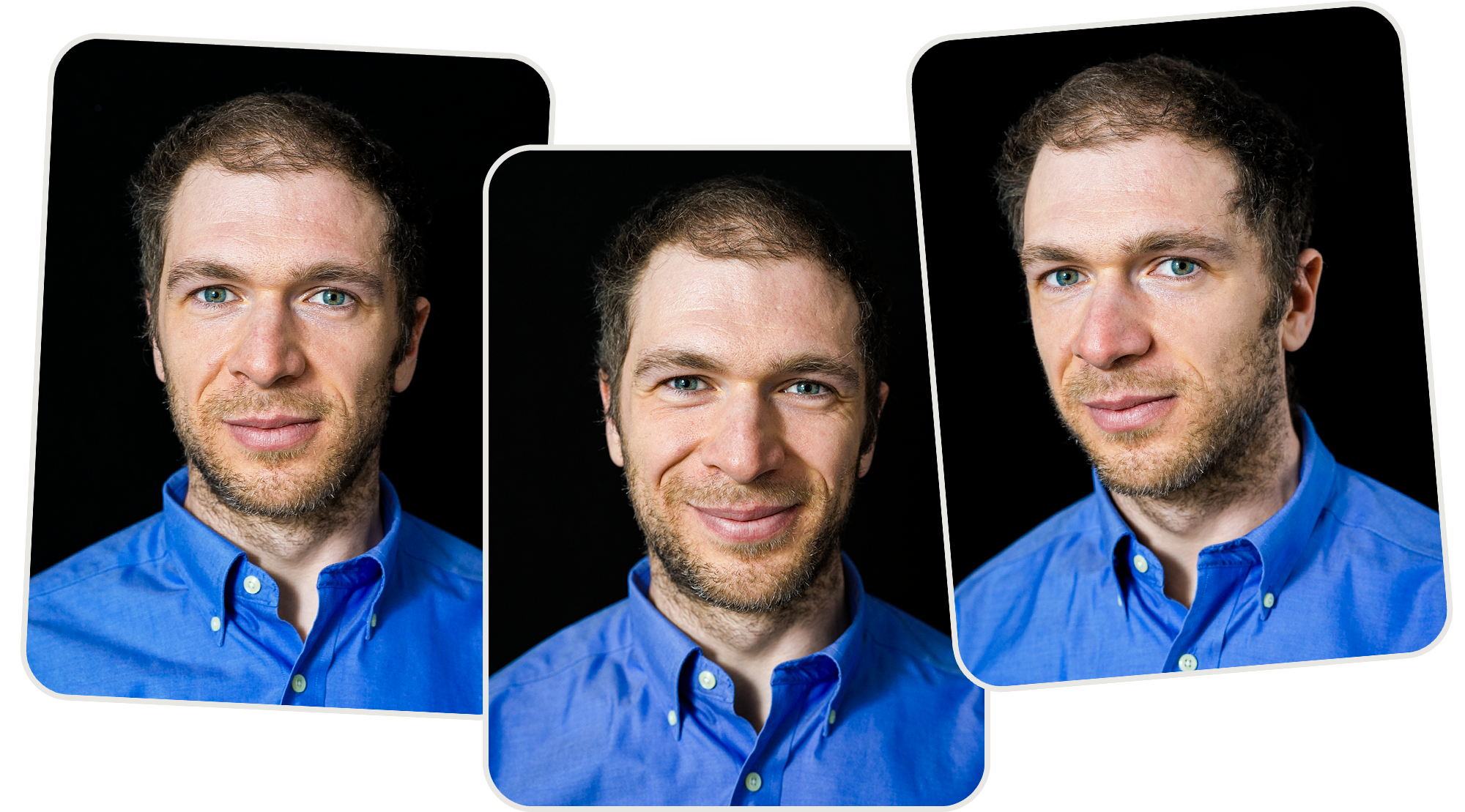
Pardon is drawn to particular problems, rather than broader fields or unifying themes.
Phil Yam
Quintic threefolds are an example of a type of six-dimensional shape called a Calabi-Yau manifold, which is not only mathematically intriguing but also useful in theoretical physics. Geometers are particularly interested in counting curves on these shapes as a way to understand them. Many versions of string theory predict that six extra dimensions are “curled up” into microscopic sizes, in the shape of Calabi-Yau manifolds. If this is true, the shapes form an inextricable, if invisible, part of our world. (In this formulation, gravity-like forces acting in the hidden dimensions are what we see as electricity, magnetism, and the strong and weak nuclear forces.)
Calabi-Yau manifolds are still not fully understood. In 2003, three mathematicians and a physicist formulated the MNOP conjecture, which states that two different ways of counting curves on Calabi-Yau manifolds are equivalent in a deep and unexpected way.
For a given Calabi-Yau manifold, mathematicians are interested in counting not just one type of curve (such as lines) but many of them, all at once. For example, a given curve has a property called a genus, a number that provides information about its structure. You might want to know how many curves you can draw on your Calabi-Yau manifold that are of a particular class and have a genus of zero — and how many curves from that class have genus 1, genus 2, genus 3, and so on.
You usually can’t count the number of curves with each genus directly, for a number of technical reasons. In order to get meaningful counts, mathematicians instead have to deploy an arsenal of tricks — resulting in an infinite sequence of numbers, which mathematicians call the “virtual” number of curves.
“The word ‘virtual’ is doing a lot of work,” notes Jim Bryan, a mathematician at the University of British Columbia who has been studying the MNOP conjecture for the past several decades. “These numbers are far from the literal count.” The numbers, which help count curves of ever-increasing genus, are called Gromov-Witten invariants. (They are named after the same Gromov whose conjecture about knots Pardon disproved, and the physicist Ed Witten.)
These invariants emerged as an object of study in the late 1980s and early 1990s. While working on his dissertation with Simon Donaldson in the late 1990s, Richard Thomas, now of Imperial College London, described another infinite sequence of numbers associated with Calabi-Yau manifolds. These numbers, called Donaldson-Thomas invariants, help count curves organized not by genus but by a different property.
These two ways of counting curves are mathematically very different. “These numbers look like they have nothing to do with each other,” Bryan said. If you take a particular Calabi-Yau manifold and a class of curves you’re interested in, the Gromov-Witten and Donaldson-Thomas invariants will give you two completely different sequences of numbers.
But the MNOP conjecture posits that they both correspond to properties of the same underlying function, called a partition function. “MNOP says these two sequences are the coefficients of the same function expanded in two different ways,” Bryan said. “The conjecture is pretty strange.”
If mathematicians could prove it was true, it would imply that both sets of invariants were indeed counting the same thing, an extremely useful equivalence. Depending on the context, mathematicians might want to use one set of invariants over the other; the MNOP conjecture, if true, would let them move between the two. “That is why people care about MNOP — it effectively doubles the number of tools one has to study the partition function,” Bryan said.
But for two decades, the conjecture remained open, despite many efforts to prove it. Then, in the summer of 2023, Pardon shared a proof online.
“It came out of nowhere,” said Bryan, who has spent a good chunk of the past few years studying the proof. He would have dismissed it entirely if not for Pardon’s reputation. To show that the two different ways of counting were equivalent, Pardon used tools from a completely different area of math and created a whole new mathematical structure, now called a Pardon algebra. “The method of the proof is so different than what we’ve seen before that it really rewires the way I think about the entire subject,” Bryan said. “This is the biggest result in enumerative algebraic geometry for the last 20 years.”
The Big Book
Pardon is now writing a book about the foundations of symplectic geometry. He’s made his work in progress available online, since many have asked him to do so.
The book’s preface captures the gap between how Pardon discusses his own work and how others think of what he does. “The interesting material is spread a bit thin,” Pardon writes. He hopes “to formulate statements and proofs which are as simple and down-to-earth as possible.” He allows that he may have failed in this aim.
The book reworks the foundations of symplectic geometry using ideas from a branch of math called higher category theory. “Many mathematicians view it as a little esoteric,” said Hiro Lee Tanaka, who studies higher category theory at Texas State University. “John’s speaking my language, which is not the language he spoke 10 years ago.”
“John is not afraid of big machinery, of abstract nonsense,” Abouzaid said. “He isn’t afraid of it; he just uses it.” But, Abouzaid added, Pardon’s technical facility is not what’s most impressive. “That’s not the point — the point is that there is geometric insight.” It’s like one musician praising another not only for their impeccable technique but for the feeling it allows them to bring to a performance.
“Most of the real work has been in finding the ‘right’ formalism, after which the proofs fall into place with little resistance,” Pardon continues in the preface. “This work is largely hidden from the view of the consumer, and so the main results may appear deceptively trivial.”
They aren’t.
Editor’s note: The Simons Center for Geometry and Physics at Stony Brook University is funded by the Simons Foundation, which also funds this editorially independent magazine. Simons Foundation funding decisions have no influence on our coverage.