From an early age, Jacob Tsimerman showed great mathematical promise. “My mom told me, ‘You don’t have to be a mathematician just because you’re good at it,’” he said. “I didn’t really take her seriously.”
Caroline Gutman for Quanta Magazine
Jacob Tsimerman knows that many people see mathematics as a search for beauty. Over the course of his career, he has encountered beauty many times. But beauty is not what drives him. What he loves most is to solve hard problems, and to be the first to do so.
“In my experience, and I think many people’s experience, math is very much a goal-oriented endeavor,” he said. “The truth-and-beauty stuff is there when you’re zoomed out, but when you’re zoomed in, you just want to win.”
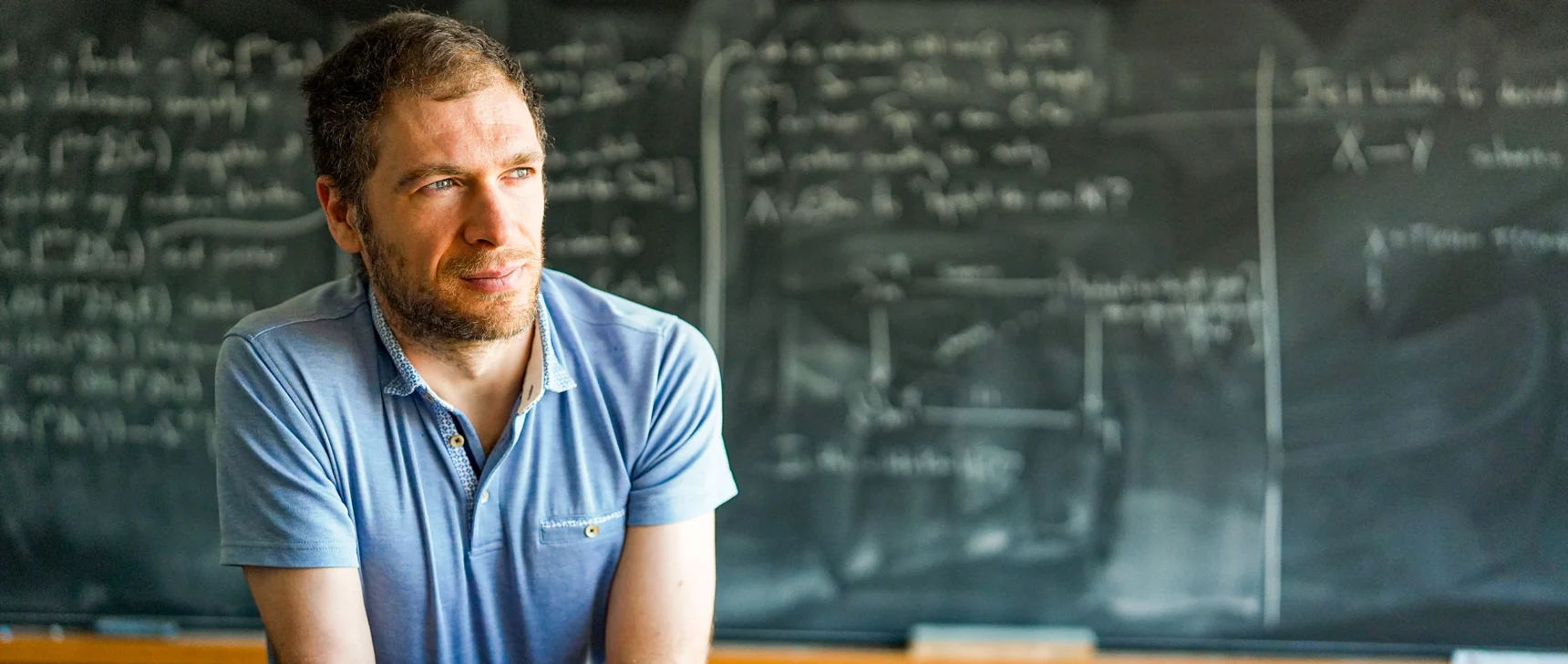
Tsimerman, who has slightly wild brown hair and a beard, talks fast and with visible enthusiasm. He is open and funny, but also precise — quick to pause and clarify a thought.
His fierce drive to win has fueled Tsimerman’s efforts at every stage of his career, resulting in teenage glory at the International Mathematical Olympiad, early matriculation at Princeton University, and proofs that reshaped areas of number theory and algebraic geometry, earning him a collection of top prizes.
It’s an impulse that Tsimerman has also been wary about. He knew it could consume him, especially when it came to the most entrancing honor of all — the Fields Medal, awarded every four years to the most accomplished mathematicians in the world under the age of 40 in the year the prize is given.
“I made it an explicit goal for myself not to focus on winning it,” he said. “I was like, ‘Jacob, you can’t become obsessed with it.’”
The mind trick worked, for a time. For nearly two decades, Tsimerman, 38, kept his drive focused on the math itself and became known as one of the most talented problem solvers of his generation.
But as he approached the last cycle in which he’d be eligible for the Fields Medal, he realized that his successes put him in contention. He relented and dedicated himself to the pursuit.
“Two years ago, I knew I was close, and I did let myself become obsessed,” he said.
The final push has paid off, as Tsimerman has been named one of four winners of the Fields Medal. The honor reflects a career built around borrowing techniques from one area of math and leveraging them in another to reveal surprising underlying structure.
“In my experience, and I think many people’s experience, math is very much a goal-oriented endeavor,” Tsimerman said.
Caroline Gutman for Quanta Magazine
“He’s a brilliant problem solver. He can learn anything,” said Peter Sarnak, a professor at Princeton and the Institute for Advanced Study and Tsimerman’s graduate school adviser.
Following each milestone in his career, Tsimerman has taken stock, asking himself whether math is really how he wants to spend his life, and whether he’s in fact good enough to succeed in it. And at every previous stage the answer has come back yes.
But this time may be different. As Tsimerman contemplates what’s next with a Fields Medal around his neck, he does so as a new form of problem solver rises — one that no human may be able to beat, and which has him questioning his future in math.
Competing To Learn
Tsimerman was born in 1988 in Kazan, in southwest Russia. When he was 3, his family moved to Israel, where his mother took a job as a high school math teacher.
Around that time, his grandfather, a physicist, began giving him little puzzles. There was one about how long it takes to fill a bathtub with two taps running, and another about two speeding trains on a collision course with a junction between them. His mother also began handing him textbooks. Even as she nurtured his mathematical ability, she was careful to let Tsimerman know he didn’t need to go down this path if he didn’t want to.
“My mom told me, ‘You don’t have to be a mathematician just because you’re good at it,’” he said. “I didn’t really take her seriously.”
When Tsimerman was 9, his family moved to Toronto, and he began entering math competitions. His father, a computer scientist, took him to the contests and brought him roast beef sandwiches midway through the long exams.
In seventh grade, he participated in the Canadian Mathematical Olympiad for the first time. There were five problems, and Tsimerman got most of them wrong. Afterward, he went over to the University of Toronto, near his school, and found a blackboard. For hours, the 12-year-old toiled over one of the geometry questions he had failed to solve during the competition. Eventually, he got it.
“I was super happy I’d solved an Olympiad geometry problem,” he said.
Mathematicians debate the utility of competition math as preparation for a research career. Many argue that it encourages the wrong mindset, because competition problems are guaranteed to have answers, while research requires coming to terms with the fact that many problems may not be solvable at all.
Tsimerman doesn’t see it that way. To him, competition math teaches the skill that has mattered most to him: how to stick with a problem.
“Competition math teaches you to sit with one problem for many hours, even though you’re almost certainly stuck,” he said. “If that’s not research math, I don’t know what is.”
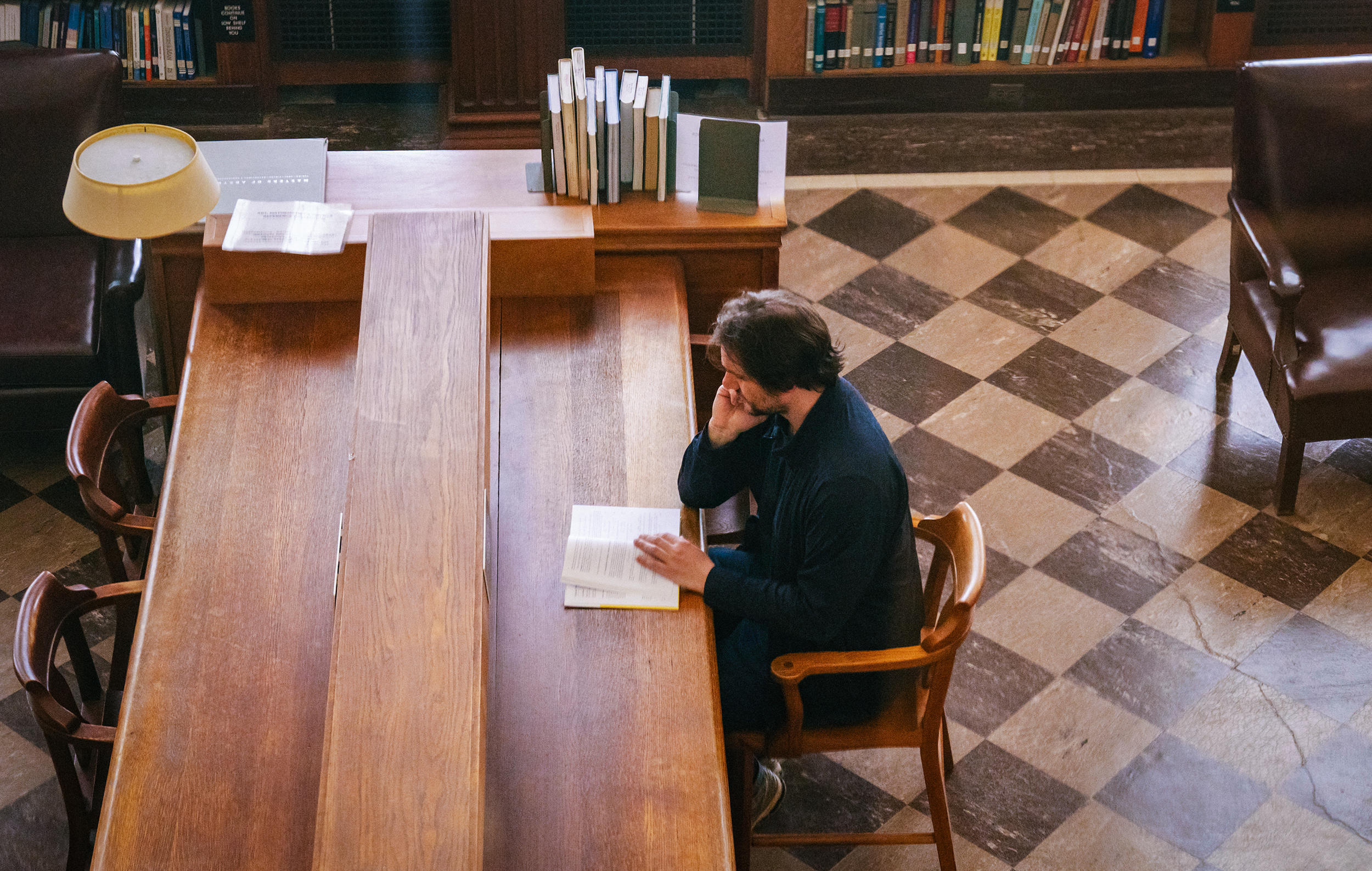
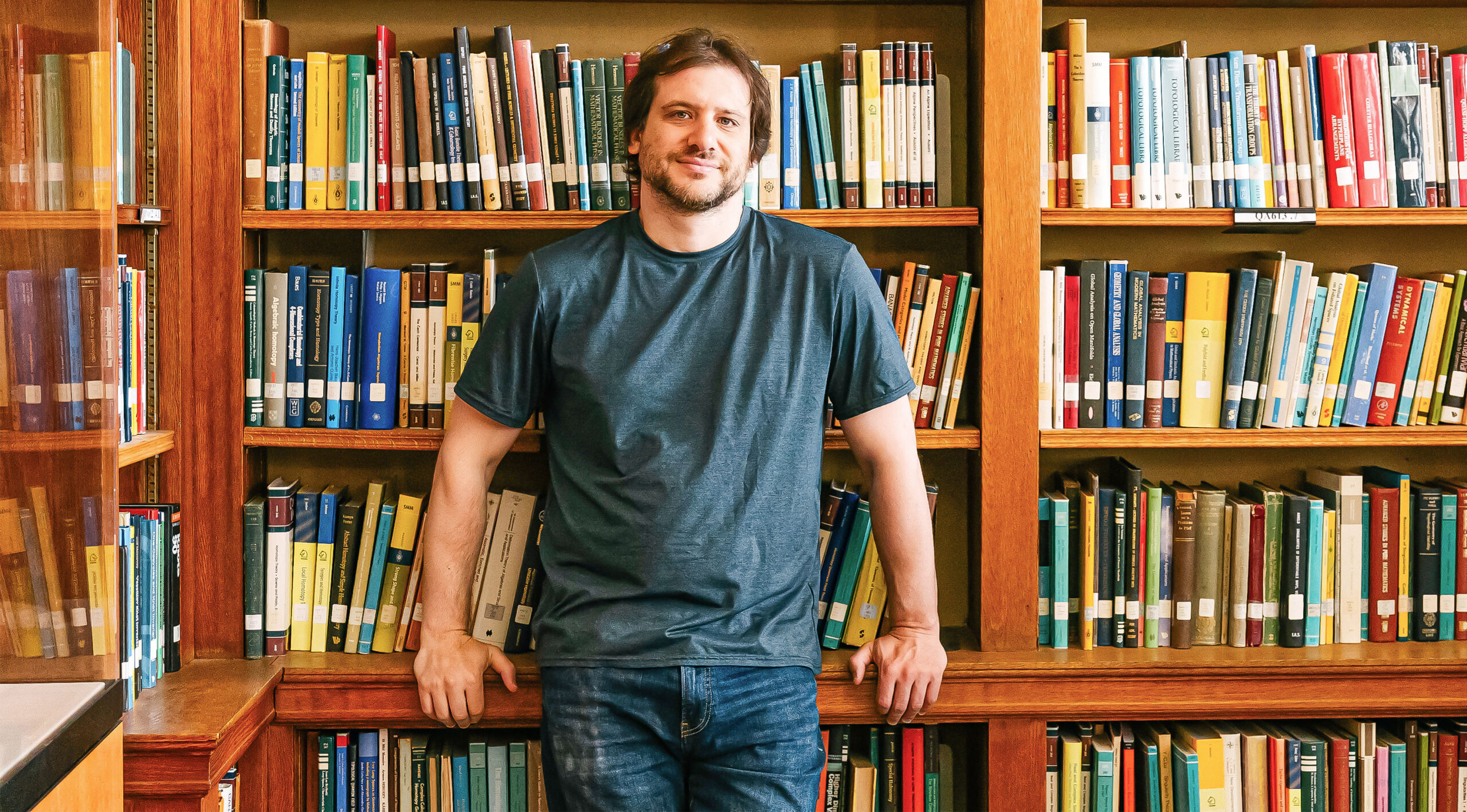
Tsimerman at the Institute for Advanced Study in Princeton, New Jersey, where he spent the last academic year.
Caroline Gutman for Quanta Magazine
After his failed effort at the Olympiad, Tsimerman devoted himself to improving. He spent five hours every day practicing Olympiad problems after school rather than doing his regular homework.
It paid off. In 2003, when he was 15, Tsimerman won a gold medal at the International Mathematical Olympiad in Tokyo, correctly answering four of six problems. The following year, in Athens, he notched a perfect score.
After that, Tsimerman conducted what would be the first of several reassessments at critical points in his math career. He decided to retire from competition math, reasoning that after receiving a perfect score, he could only blemish his record with further participation. At that level at least, he had nothing left to win.
Learning To Fail
Tsimerman quit high school at 16 to enroll at the University of Toronto. Over the next two years, he devoured every available math course and earned an undergraduate degree at 18.
In 2006, he began graduate school at Princeton like other teen phenoms before him, including Terry Tao (Fields medalist in 2006) and Akshay Venkatesh (Fields medalist in 2018). Soon after arriving, he sought out Sarnak, a renowned mathematician with a reputation as a skilled mentor.
“I was told Peter and I would mesh well and that he’s at the center of the universe and would guide me the right way,” Tsimerman said. “It was good advice on both counts.”
Sarnak gave Tsimerman a long list of books and papers to read. Tsimerman spent the first eight months of graduate school working through it.
The more he read, the more overwhelmed he became. As he read page after page of theory, the field seemed to grow vaster, and he felt more anxious about his own place within it. Finally, he went back to Sarnak and pleaded for a concrete task, anything that would allow him to gain a foothold in the field and take stock of his chances of succeeding within it.
“I said, ‘I need a problem. I need a problem to work on because I can’t keep reading theory,’” he said.
Sarnak gave him a problem in an area of math called analytic number theory, which had been Tsimerman’s least favorite topic as an undergraduate. He had come to Princeton hoping to avoid the area completely. But here was Sarnak, offering him the problem he had asked for, and he knew there was no way he could say no.
“It took me three years to call Peter by his first name,” Tsimerman said. “I wasn’t about to say, ‘Give me a different problem.’”
He solved the problem, and he and Sarnak wrote up the proof together as Tsimerman’s first result. It changed his relationship with research. Tsimerman had arrived at Princeton knowing how to solve contest problems. Now, with Sarnak, he had gained confidence that he could succeed as a researcher too.
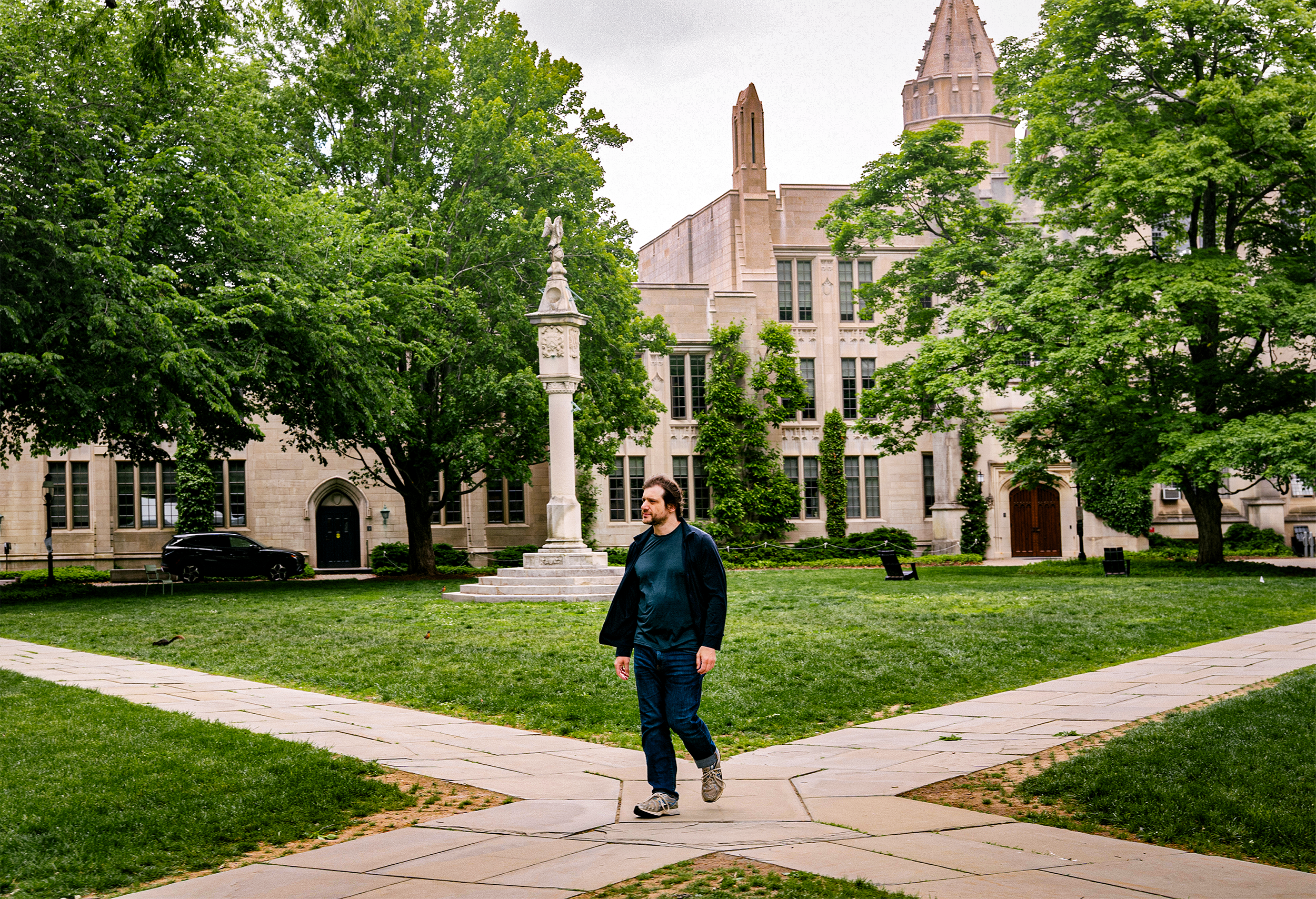
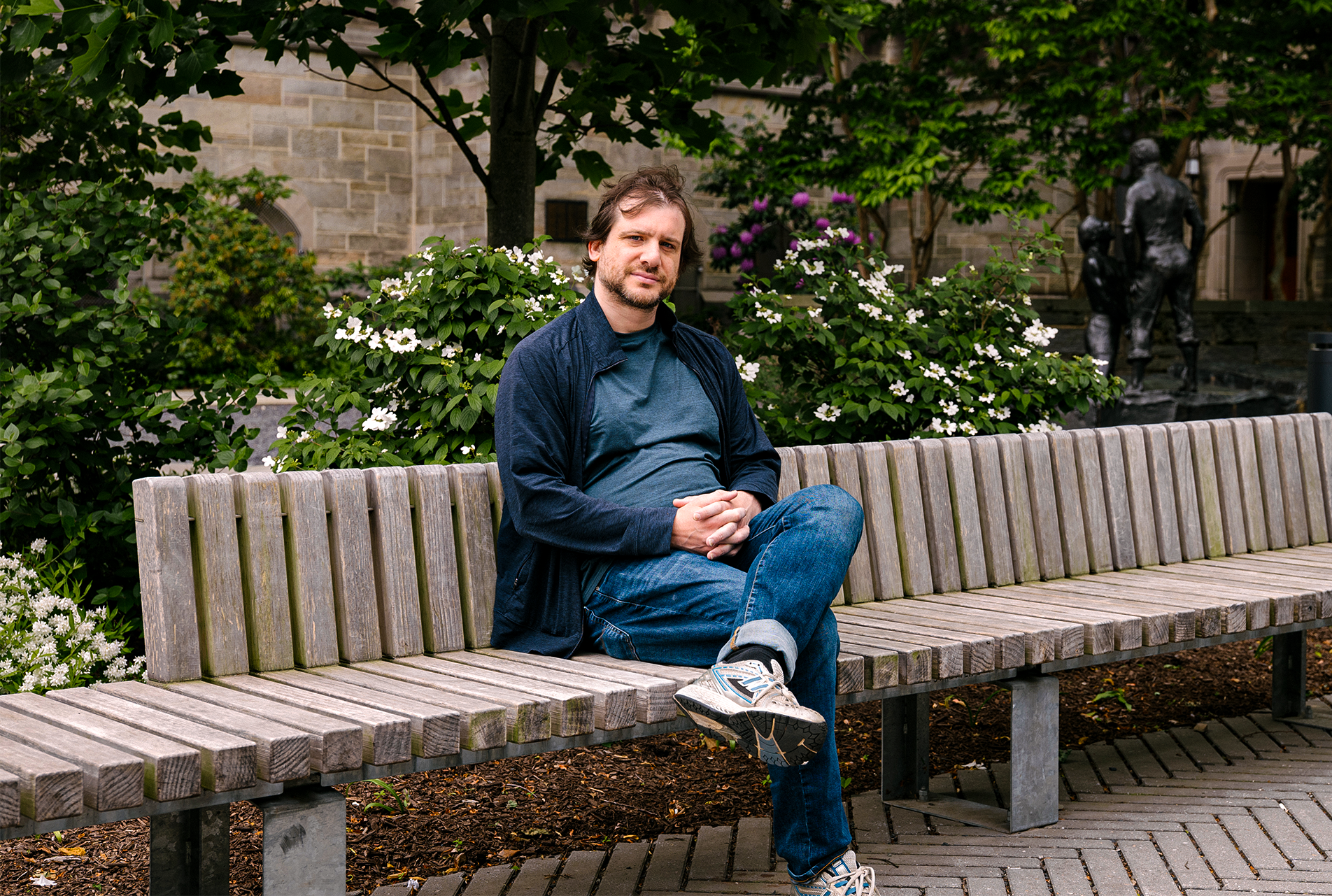
Tsimerman on the Princeton University campus.
Caroline Gutman for Quanta Magazine
“For the first two years I was extremely intimidated and kind of worried,” Tsimerman said. “Your first paper seems impossible to write. It seemed impossible to me until I’d done it, then I was like, ‘OK, I can do this.’”
After that, Sarnak gave Tsimerman a steady diet of hard problems. Tsimerman would go off, think about the problems for a few months, then come back and report that he’d gotten nowhere. Sarnak would say, “Great,” and then hand him another impossible task.
In Sarnak’s mind, the goal was not for Tsimerman to solve the problems. It was for him to understand what exactly makes hard problems hard, the way he might appreciate the specific technical difficulties and treacherous places that make it hard to scale a mountain — a kind of prerequisite knowledge for eventually making it to the top.
“The way you solve a problem is, you have to understand where the difficulties are, and you have to fail and develop an intuition of where the answers are,” Sarnak said. “It can be learned, but it’s much better learned when you try something, fail, form an intuition, and try again.”
Hidden Structure
Fail enough, learn where trouble lies, and maybe eventually you’ll succeed. That was Sarnak’s idea, and it was what eventually happened when Sarnak told Tsimerman to look at another difficult problem called the André-Oort conjecture.
The André-Oort conjecture, posed in limited form by Yves André in 1989 and in more general terms by Frans Oort in 1995, grows from a central idea in modern mathematics — that arithmetic and geometry are deeply connected.
To take a simple example, picture the graph of the solutions to an equation. The graph might pass through a few points whose coordinates are whole numbers. That could happen by accident. But if it passes through many points with whole-number coordinates, mathematicians take this as a sign of hidden structure in the equation that explains why it repeatedly intersects with these special points.
André-Oort is a much more sophisticated version of that idea. Instead of the two-dimensional graph of an equation, it concerns higher-dimensional geometric spaces whose points can represent entire mathematical objects.
Some of those points correspond to arithmetic objects with unusually rich numerical properties. André-Oort makes an assertion about cases when many of these special arithmetic points appear together inside the same geometric region.
“If you have an arithmetic phenomenon that you don’t expect to happen, then there should be a geometric reason for it,” Tsimerman said.
When Sarnak first introduced Tsimerman to André-Oort, the conjecture was far out of reach. But eventually Tsimerman found one hard piece of the problem he could attack.
To prove André-Oort, mathematicians needed a way to show that special points did not appear in isolation. As with ants, where there’s one, there are often many.
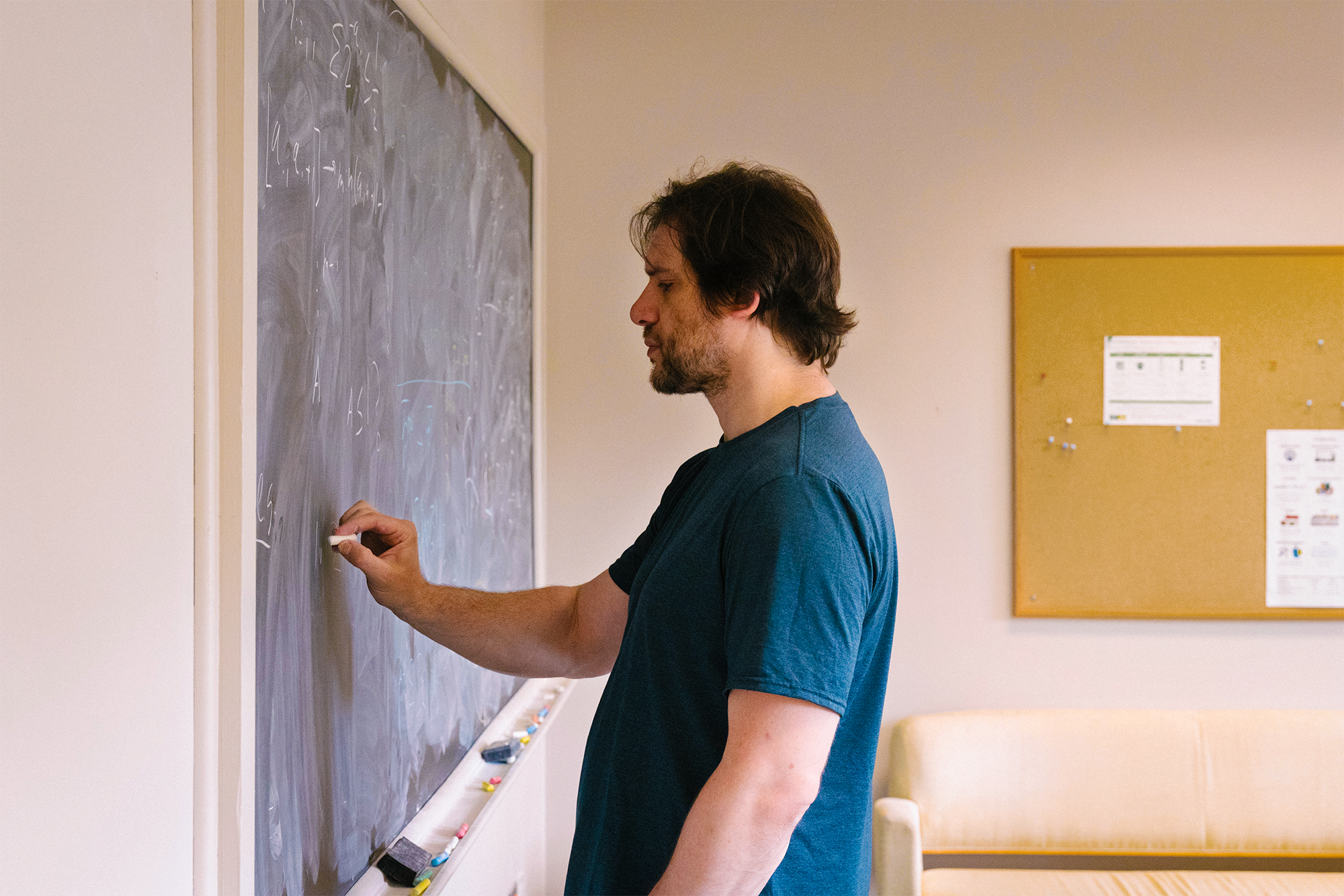
Tsimerman likes to move between various areas of math. “You want to learn expertise in one area and bring it to another area where it’s useful but not yet used,” he said. “That’s the golden goose.”
Caroline Gutman for Quanta Magazine
One way to get from one special point to others is via something called a Galois orbit. That is the complete collection of points produced when you start at one point and apply the symmetries of the number system in which the point is defined. Find a special point and apply the symmetries, and they’ll take you to another special point. Apply the symmetries again, get a third special point, and so on, until you’ve collected every point that can be reached in this way.
For his dissertation, Tsimerman set out to prove that in the setting of André-Oort, those orbits had to contain at least a certain number of points. That would allow mathematicians to begin turning isolated arithmetic coincidences into evidence of a larger geometric pattern.
Proof He Belongs
By 2010, when Tsimerman was approaching the end of his graduate studies, other mathematicians had made partial progress toward solving the conjecture. A group based in France had proved the conjecture if the generalized Riemann hypothesis is true, and that famously remains one of math’s great unsolved problems. Separately, a mathematician at the University of Oxford named Jonathan Pila had found a different strategy. Pila’s approach was powerful enough to prove the simplest case of the conjecture but no more.
“We quickly saw that Pila’s method has a chance to generalize, but there were millions of hurdles along the way,” Sarnak said.
Pila had also been a student of Sarnak’s, and in 2010 Sarnak invited him to Princeton to share his work. During that visit, Sarnak made sure to introduce him to Tsimerman.
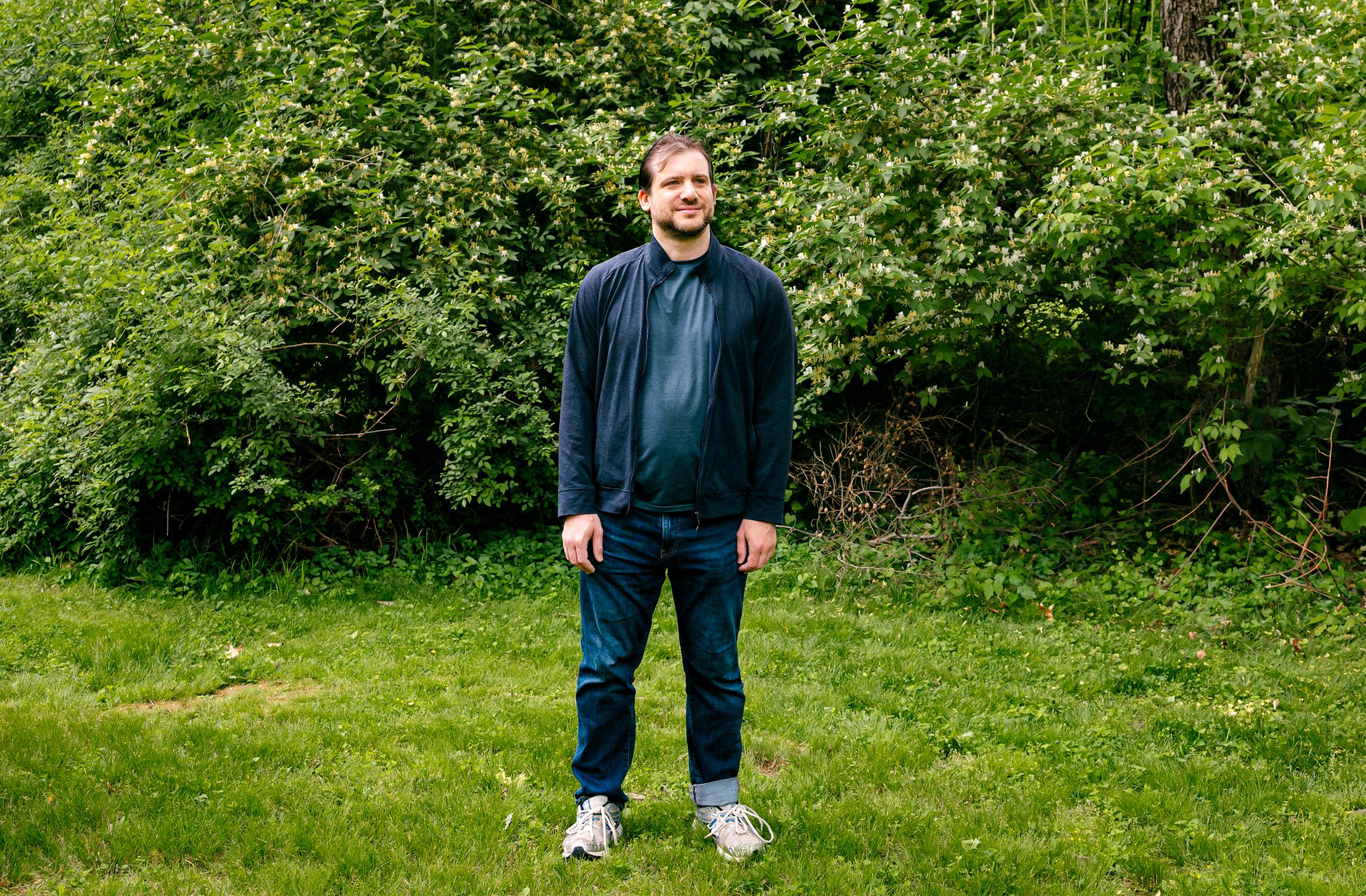
In the last few years, Tsimerman committed himself to projects with the kind of depth and impact he thought would matter most to those judging his work.
Caroline Gutman for Quanta Magazine
“Peter asked me to explain the paper to him and said he has this very good student, would I mind if he sat in? That student was Jacob,” Pila said.
The timing was lucky. Pila’s method needed a way to produce many special points, and Tsimerman’s work on Galois orbits offered exactly that kind of possibility. In his dissertation, Tsimerman combined Pila’s methods with his work on Galois orbits to prove an important and difficult special case of the André-Oort conjecture.
A proof of the full conjecture was still far off — it would take more than a decade, and additional collaborators, to get there — but even the partial result established Tsimerman as a top-flight researcher, not just a competition phenom.
At that point, Tsimerman was confident he could do research and knew he could get a good job. And just as he had when he was younger, when he recorded a perfect score at the Math Olympiad, he checked in with himself, this time to assess whether the career opening up before him was one he really wanted.
“The only doubt I had about becoming a mathematician was at the end of graduate school,” he said. “I asked myself, ‘Do I really want this?’”
A Personal Edge
While in graduate school, Tsimerman did a two-month internship at Jane Street, the elite quantitative trading firm, and worked part time for another investment firm. Quantitative finance had some of the things he liked — it offered hard problems, smart colleagues, and a clear-cut sense of progress, in the form of waxing or waning account balances. But after a few months it was clear to him that he preferred the open-endedness of math research.
“I just like doing longer research projects. They were freer,” he said.
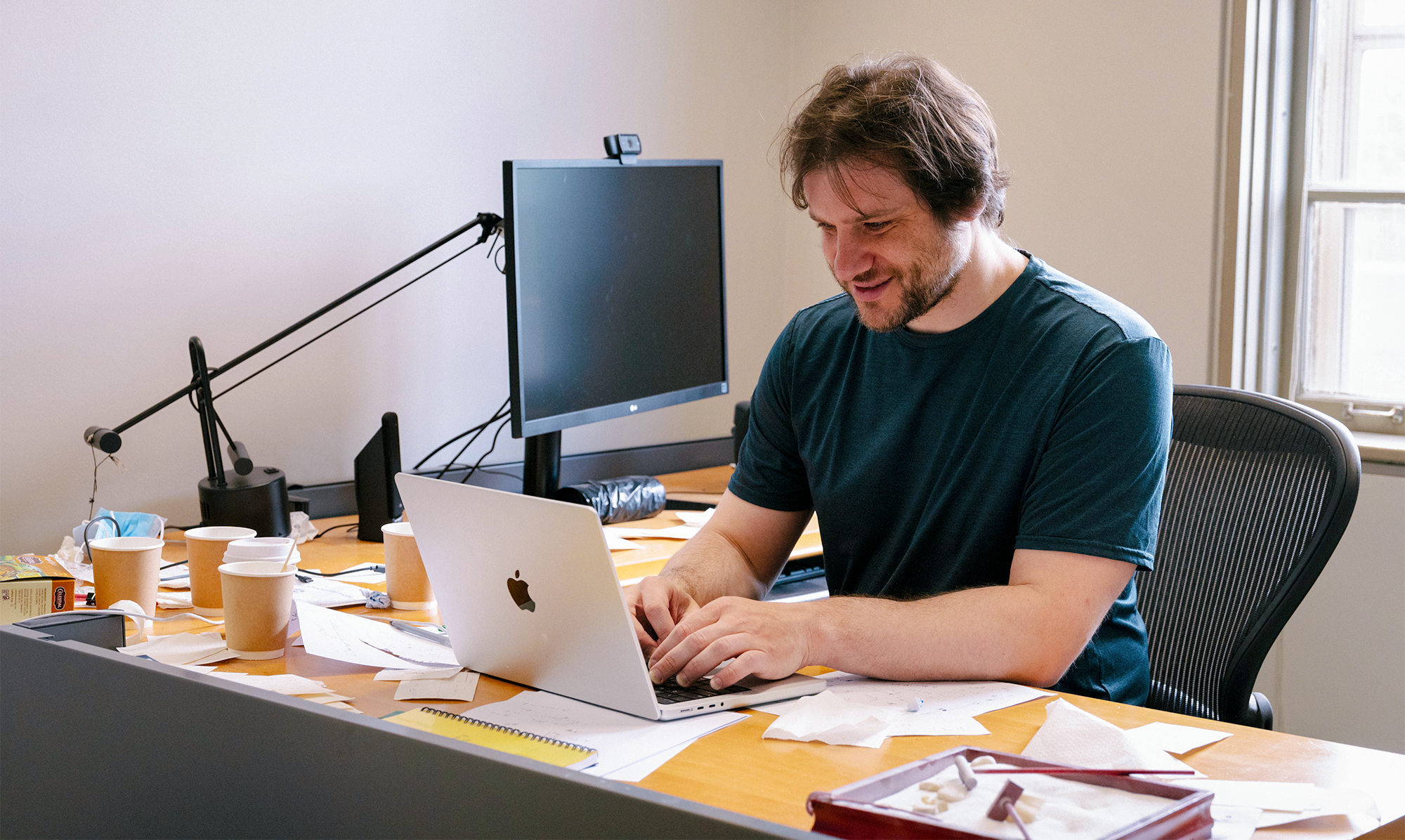
Tsimerman in his office at the IAS.
Caroline Gutman for Quanta Magazine
After Tsimerman’s flirtation with finance, he confronted his lingering doubts about his fitness as a researcher. At Princeton, he had proved he could solve research problems, but many of the problems that had shaped him had come from Sarnak. Tsimerman wanted to prove to himself that he could set his own research agenda.
He began by looking for places where the tools he knew gave him a competitive advantage. Mathematicians often talk about the value of bringing ideas from one area into another. Tsimerman talks that way too, but with a more competitive edge. To him, moving between areas of math is a way of finding problems where he has resources that established researchers in the area might not.
“You want to learn expertise in one area and bring it to another area where it’s useful but not yet used,” he said. “That’s the golden goose.”
One possibility was to focus on Hodge theory, an area of mathematics that studies geometric spaces by translating them into analytic objects — objects built from functions, integrals, and other more flexible tools than polynomial equations.
In the 1970s, a mathematician named Philip Griffiths had predicted that in some situations, even after these objects pass from the rigid geometric world into this more flexible analytic world, some underlying geometric structure should remain.
The problem, known as Griffiths’ conjecture, had the same flavor as André-Oort, where a loose analytic object, when viewed the right way, should turn out to have hidden algebraic structure. The work also brought him closer to Benjamin Bakker, a friend from graduate school.
“In grad school I had the feeling we were on pretty different paths math-wise,” said Bakker, now a professor at the University of Illinois, Chicago. “He was more on the number-theory side, and I was more on the geometry side of things. But of course you can draw a line from any one point in math to any other point, so that’s all an illusion.”
Working with Bakker and Yohan Brunebarbe, Tsimerman brought tools he had learned from André-Oort into Hodge theory. In 2018, they proved Griffiths’ conjecture and developed a framework called o-minimal GAGA, which gave mathematicians a new way to show that some analytic spaces have hidden algebraic structure.
After years of demonstrating his ability as a problem solver, Tsimerman had now shown that he could build new mathematical machinery as well.
“We like in math to say people are problem solvers and theory builders,” Sarnak said. “Jacob is a problem solver and a theory builder; I say that in a very strong way.”
The Final Push
By the early 2020s, Tsimerman had established himself as one of the best mathematicians in the world. The doubts that had followed him to Princeton and for years after had fallen away, and he began racking up results at a rapid clip.
In 2021, Tsimerman, Pila, and Ananth Shankar posted a proof of the full André-Oort conjecture, completing the long process that had begun when Tsimerman first took up the problem as a graduate student. By then he had also delved deeper into Hodge theory, where the machinery he’d helped develop kept producing new results. In 2024, Tsimerman, Bakker, and two collaborators proved a major new theorem about certain spaces arising in Hodge theory.
The results brought prizes. Tsimerman won the 2022 New Horizons in Mathematics award and the 2023 Ostrowski Prize. By the time he entered his mid-30s and last cycle of eligibility for the Fields Medal, winning it no longer seemed a remote possibility. Realizing that, he abandoned his vow not to become obsessed with the honor and made it his explicit goal.
“I worked hard and sacrificed enjoyment to try and win it,” he said.
The sacrifice was less about working longer hours and more about changing what he chose to work on.
Until then, Tsimerman had preferred to work on fun projects that caught his interest — what he describes as “cool little things here and there.” But in the last few years, he decided to commit himself to projects with the kind of depth and impact he thought would matter most to mathematicians judging his body of work, including the committee that chooses the Fields medalists.
“I stopped doing fun side projects and buckled down on projects that were high-return,” he said.
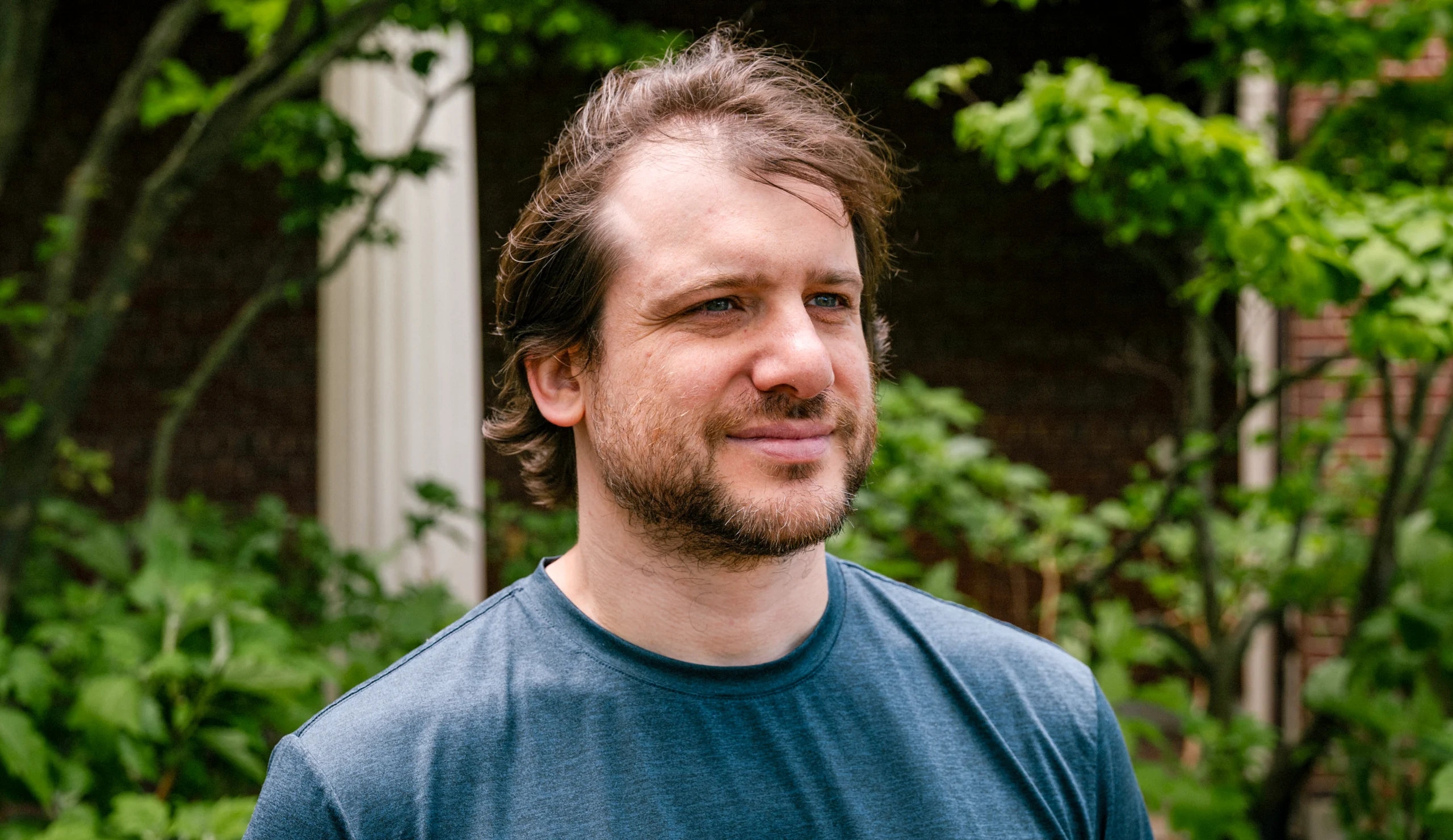
Tsimerman has stopped taking students because of the uncertainty surrounding AI’s effects on math.
Caroline Gutman for Quanta Magazine
One of those projects was a paper with Arul Shankar, a mathematician at Toronto, on “secondary main terms for quartics.” Tsimerman had wanted to finish it for a long time; however, the project required working through some dense technical details that he’d been avoiding. But with the Fields Medal in view, he and Shankar spent several months pushing through the calculations, posting the result in August 2025.
From 2024 to 2025, Tsimerman posted 11 papers to the preprint site arxiv.org across a range of fields. Then, late one Friday in January 2026, he received an email from Hiraku Nakajima, the president of the International Mathematical Union, asking to schedule a time to speak with him.
Tsimerman woke his wife to tell her that he thought he had won the Fields Medal, then spent the weekend waiting nervously to find out. When the call finally came through the following Monday, Tsimerman, who was at the Institute for Advanced Study (IAS) in Princeton for the year, went outside to absorb the good news.
“I walked in the IAS woods for a while to work off some residual nervous energy and take it in,” he said. “It was nice.”
An AI Crossroads
As before, success finds Tsimerman at another crossroads. He has received the Fields Medal at a moment when the future of mathematics feels more uncertain than ever.
As recently as 2025, artificial intelligence was still struggling to solve high-school-level competition problems. But early in 2026, AI systems began proving increasingly sophisticated results. The advance has culminated, for now, in OpenAI’s disproof in May 2026 of the unit distance conjecture, a result widely viewed as good enough to be published in the top journals in mathematics.
The rapid improvement in AI math capabilities has occurred so suddenly that mathematicians do not know what to make of it. Some remain skeptical that AI is actually useful for serious research. Others, including Terry Tao, have begun to imagine it as a powerful assistant, able to extend what human mathematicians can do.
Tsimerman has become one of the highest-profile voices for a third, more disruptive take. As he looks at the high-slope trajectory AI is on, he thinks the future of the field is in jeopardy.
“I think AI will be better than mathematicians at doing math within two years,” he said.
That belief has already changed how he spends his time. Tsimerman has stopped taking graduate students, because he worries that starting a conventional research project now could leave a student preparing for a mathematical career that may not exist.
“I don’t know what to do with a grad student in math who’s not very AI motivated,” he said.
Tsimerman now spends less time on classical math research. Rather than organize math conferences, he is coordinating events that he hopes will prepare mathematicians for the changes ahead. He has also shifted his research focus toward AI safety. Tsimerman thinks mathematicians have a role to play in understanding how systems of AI agents behave, and in deriving proofs that ensure that these complex systems won’t act in unintended ways.
“The risks are super high, the stakes are super high, so we need a very high level of assurance,” he said.
Societal impacts aside, AI’s march also has very personal implications for Tsimerman. He has always loved mathematics as a problem-solving activity, where the point is to reach the answer first. If machines become better problem solvers than any human, he is not sure the work will hold enough meaning to keep him or other mathematicians engaged. In early May 2026, making his debut on the social media platform X, he made this point bluntly.
“There are many people whose primary enjoyment of math comes through problem solving in one of its incarnations,” he wrote. “If that disappears, that is not a trivial issue and many of them might not want to do it anymore.”
Correction: July 23, 2026
The original version of this article stated that Arul Shankar was a co-author on both the André-Oort and secondary terms for quartics papers. In fact, Tsimerman’s collaborator on the on the André-Oort paper was Ananth Shankar.