

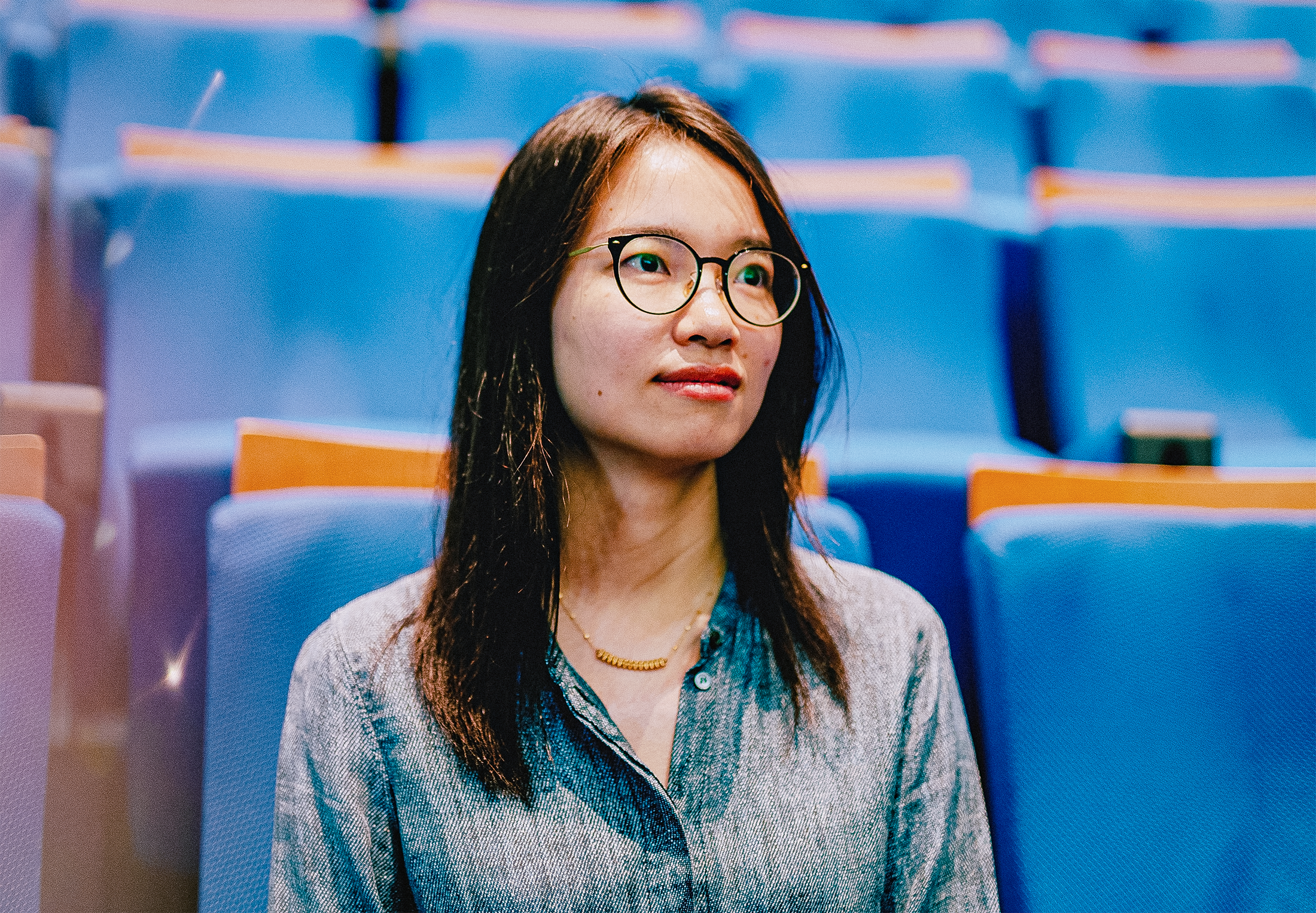
Hong Wang, pictured here working on a new article at the Institute for Advanced Scientific Studies (IHES) in France, is just the third woman to receive a Fields Medal in the award’s 90-year history.
Julien Pebrel/M.Y.O.P.
Introduction
One might imagine that, for a mathematician, proving a monumental theorem is a blissful experience. It wasn’t so for Hong Wang. In February 2025, Wang and her collaborator Joshua Zahl presented a 127-page proof of a long-standing conjecture at the intersection of multiple branches of math. The duo had been checking their work for months and had sent it to select colleagues for review before finally mustering the courage to post it publicly. Wang worried less that the arguments were flawed than that they might be imperfectly expressed and therefore unclear.
No error was found, the proof’s logic was digested and streamlined, and everyone became convinced of its soundness. Wang and Zahl had proved the three-dimensional Kakeya conjecture.
The proof triggered a succession of prizes for Wang, who comes from Guilin, China: the Salem Prize, the Ostrowski Prize, and the International Congress of Chinese Mathematicians’ Gold Medal of Mathematics in 2025; the Antonio Ambrosetti Medal, Sadosky Prize, Clay Research Award, and New Horizons in Mathematics Prize in the first half of 2026; and finally a 2026 Fields Medal, widely regarded as math’s highest honor, given to exceptionally accomplished mathematicians under 40. Wang, 35, a professor of mathematics at New York University and the Institute for Advanced Scientific Studies (IHES) in France, is just the third female winner in the Fields’ 90-year history.
The attention has meant more speaking invitations and travel and interview requests that she struggles to refuse, which impinge on the time she can spend trying to understand how long, thin tubes pointing in different directions can overlap.

Early morning walks help Wang handle the stress and self-doubt that come with her mathematical research.
Julien Pebrel/M.Y.O.P.
This is the issue at the heart of the “Kakeya-type problems” that are Wang’s specialty, a family of mathematical questions and conjectures that lies at the center of the Venn diagram of harmonic analysis (the study of how signals break up into constituent frequencies), geometric measure theory (pertaining to the shapes and sizes of non-smooth things), and partial differential equations (which describe systems that change in multiple ways simultaneously), with further connections to number theory, combinatorics, and beyond. “All of these connections are why this area is considered so central and why Hong is celebrated so much,” said Pablo Shmerkin, a mathematician at the University of British Columbia.
When she isn’t traveling, Wang works with the devotion and discipline of a cloistered nun or elite athlete. “She’s crazy into math,” said Shukun Wu of Indiana University, a collaborator. “She’s definitely one of the most dedicated people I’ve seen.” She denies herself time-consuming indulgences like reading books or having a dog, though she does make time for friends, yoga, and early-morning walks to see the dogs at Washington Square Park, which all help relieve the stress and feelings of self-doubt that, for her, can accompany mathematical research.
The desire to feel confident in her knowledge and ability seems to have shaped Wang’s life. It is, for example, what draws her to mathematics: to her, the least doubtful thing. Even though she never took the time to celebrate her landmark proof — nor felt any consequent ego boost — at least Wang can now say with utter certainty that tubes pointing in every direction in 3D space can’t overlap very much.
Many Wonderful Things
Reserved at first but easily loosened up, Wang wears tortoiseshell panto glasses and rings on both index fingers, which would occasionally dart into the frame of video calls — silver on the left and gold on the right. From the West Coast, where she was spending a few months visiting collaborators and friends, she explained that her life started out a lot more carefree.
In Guilin in the 1990s, she would come home from school and read (Greek myths, Harry Potter, The Lord of the Rings), or watch television, or play table tennis or badminton. Her parents didn’t pressure her academically, despite both being schoolteachers. The three of them enjoyed evening walks around Guilin, often called China’s most beautiful city, situated amid steep emerald hills with a river running through it.
During Wang’s childhood in Guilin, China, math was just one pastime among many, but she clearly showed an early aptitude for it.
Julien Pebrel/M.Y.O.P.
Math began as one hobby among all the others. Whenever she got a new textbook, she’d complete all the exercises before the semester started. She’d get more math books from the bookstore and solve all their problems as well.
She remembers one brainteaser at the end of a chapter that asked: How should you plant seven trees to get the greatest number of rows of three trees? Like the Kakeya-type problems she would study later, the puzzle is about “incidence geometry,” or how objects overlap — in this case, lines (rows of trees) and points (trees). Wang quickly figured out that you should plant the trees in the shape of an equilateral triangle, with a tree at each corner, a tree at the midpoint of each side, and the seventh tree in the center. This forms six rows of trees: three along the sides and three through the middle. She got the answer faster than her father, a math teacher. She was 6.
Wang came to appreciate math for its permanence. History is forever being revised; learning English was frustrating because it seemed to have as many exceptions as rules. Only theorems seemed reliable. “No one can come and say, ‘Oh, actually, this is not true,’” she said.
Both parents wanted her to live as normal a life as possible, Wang recalled. She just wanted to learn as much as possible, so she skipped a couple of grades.
Toward the end of middle school, her grades started to matter for getting into a good high school in Guilin. Wang set her sights on studying math at Peking University in Beijing, one of the most prestigious universities in China. According to her, Peking reserved a single spot in its math program for a student from her province in 2007, with admission based on a standardized test. She did not receive the highest score.
But she did well enough to attend the university as an earth sciences major and hoped to transfer to math once there. Her geophysics professor encouraged her, affirming the importance of math to science, for instance in the way seismic waves are used to map Earth’s interior (math that, in fact, relates to the Kakeya problem, though she didn’t know it at the time). She worked hard and was eventually allowed to switch majors. She recalled an offhand remark by her father that analysis, the type of math concerned with evolving quantities, limits, measures, and approximations, is much easier than algebra, with its symbolic equations and exact solutions. Wang rebelled by focusing on algebra.

A detour into architecture while studying in France was short-lived. The tangible goals of math drew Wang back to analysis.
Julien Pebrel/M.Y.O.P.
She didn’t have top grades and doubted she would get into graduate school. Then representatives from the École Polytechnique near Paris, one of France’s prestigious, highly selective grandes écoles, held exams in Beijing for its postbaccalaureate program. In 2011 she moved to France.
All her courses were taught in French, which she didn’t speak. Fortunately, she already knew much of the math in her first-semester classes. She shared meals with her French-speaking classmates, quietly listening, politely asking for clarification, gradually understanding more. She took classes in analysis and found that it came more naturally to her than algebra.
She was faring well in her classes, but she didn’t think she was good enough to do mathematical research. For a semester, she switched to architecture and interned at a Paris firm. “I didn’t have much stress,” she said. “But I didn’t know the goal.” So she recommitted to math. “I decided not to worry about whether I would be good or not and just work on understanding better,” she said.
Strange Sets
In 2013, during a research internship at the Massachusetts Institute of Technology, Wang attended a seminar by an analyst named Larry Guth. Guth discussed his recent proof, with the mathematician Nets Katz of Rice University, of the Erdős distinct distances problem, which asks: For any finite set of points on a plane, how many distances are there between pairs of points? Guth explained the problem and his solution so clearly that Wang felt she could grasp part of the proof well, and this motivated her. She learned that it was closely related to many other problems of a similar character, all with incidence geometry at their heart. She was admitted to the doctoral program at MIT the next year and chose Guth as her adviser.

The “Kakeya-type problems” Wang focuses on are connected to harmonic analysis, geometric measure theory, and partial differential equations, as well as number theory, combinatorics, and more.
Julien Pebrel/M.Y.O.P.
Later her specialty would be the Kakeya-type problems. The most famous problem in this family and the one most of the others depend on is the Kakeya set conjecture. It’s the modern version of a question asked in 1917 by the Tohoku University mathematician Sōichi Kakeya, who wondered about the smallest area you can sweep out with a needle as you rotate it in every direction on a plane. Simply turning the needle around its midpoint sweeps out a disk. Kakeya realized that by shifting the needle as you turn it, as if making a three-point turn in a car, you can keep it within half the disk’s area, sweeping out a shape called a deltoid.
A couple of years later, the Russian and later Cambridge-based mathematician Abram Besicovitch showed that you can do dramatically better. You can point the needle in all directions while covering no area at all — at least with an abstracted version of the problem. In this case there’s no sweeping needle, but an infinite set of line segments that point in all directions on the plane — one for each possible way the needle could be pointing — called a Kakeya set. Without changing the direction of any line segment, you can move them around to pack them into a smaller and smaller area. Besicovitch found that these line segments can, in fact, be packed into zero area. How? An equilateral triangle is another shape, like a deltoid but with a larger area, that can contain a Kakeya set. Imagine cutting that triangle straight down the middle and shifting (without rotating) one of the halves so that it lies on top of the other as much as possible.
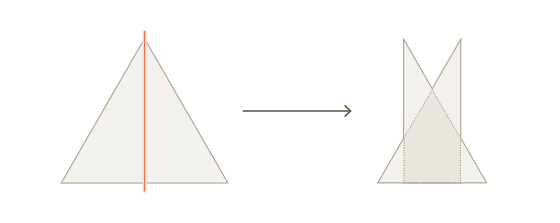
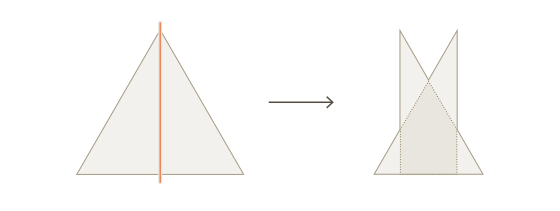
Now cut each half of the original triangle in half and shift the halves again to maximize the overlap. You’ve again squeezed the line segments into a smaller area.
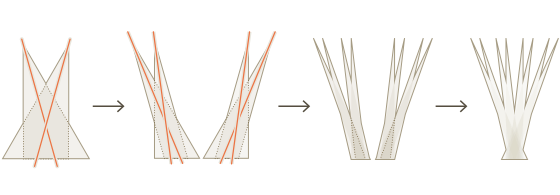
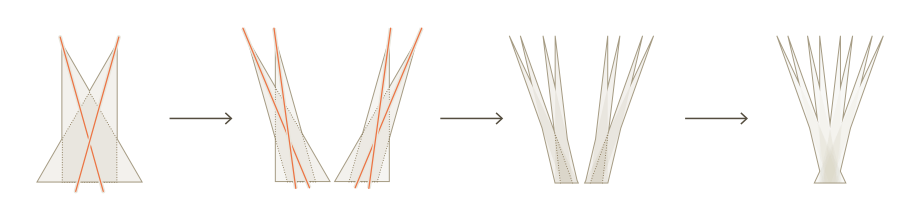
Repeat this procedure ad infinitum, sliding the line segments back and forth using a geometric procedure called a Pál joint, and then rotate the triangle so you can repeat the procedure from each corner. Put the results together and you will have accounted for line segments pointing in every direction, squeezed into zero area.
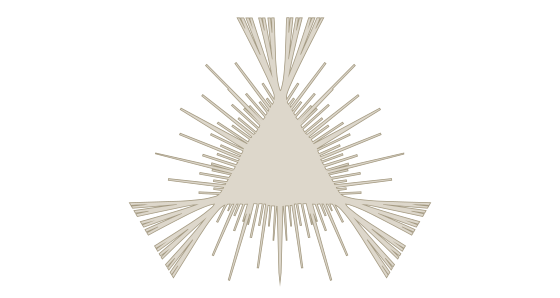
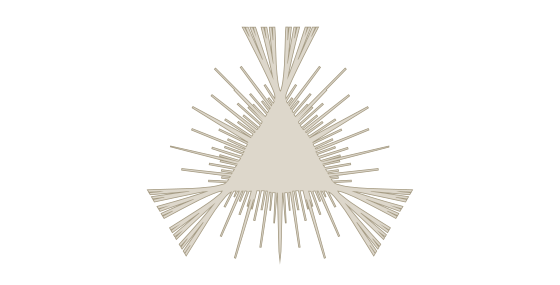
Besicovitch showed that this works in higher dimensions too. Kakeya sets consisting of line segments pointing in all directions in 3D space can have zero volume.
But despite lacking area or volume, these strange, spiky sets still occupy space. The line segments in the Kakeya set were not somehow squeezed together into a single, one-dimensional line; they still point in all directions. The question is: How much space does a Kakeya set occupy? Another way to put that question, mathematically, is: How many dimensions does it exist in?
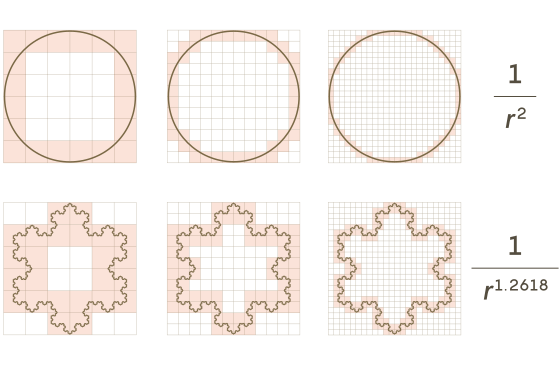
An operational way to determine an object’s dimensionality is to imagine covering it with tiny boxes of uniform size and counting how many boxes it takes. The number depends on how small the boxes are, but an object’s dimensionality relates to how that number changes as the size of the box changes. If you want to cover a 1D object such as a line segment, the number of boxes you’ll need is proportional to 1/r, where r is the width of the box. If you want to cover a 2D object, the number you’ll need is proportional to 1/r2. For a 3D object, it’s 1/r3, and so on. That exponent is the object’s dimension.
However, that exponent is not always equivalent to the apparent number of dimensions of the space the object exists in. Take the case of fractals, or objects that have ever more detailed structure as you zoom in, such as the Koch curve or Koch snowflake. In these cases, the smaller the boxes are, the more structure there is for them to line up along, so they scale differently. The exponent of r in the scaling law is a fraction, which indicates how much new structure is revealed as you zoom in. Fractals such as the Koch curve or snowflake, with its infinitely detailed edge, are somewhere in between integer dimensions.
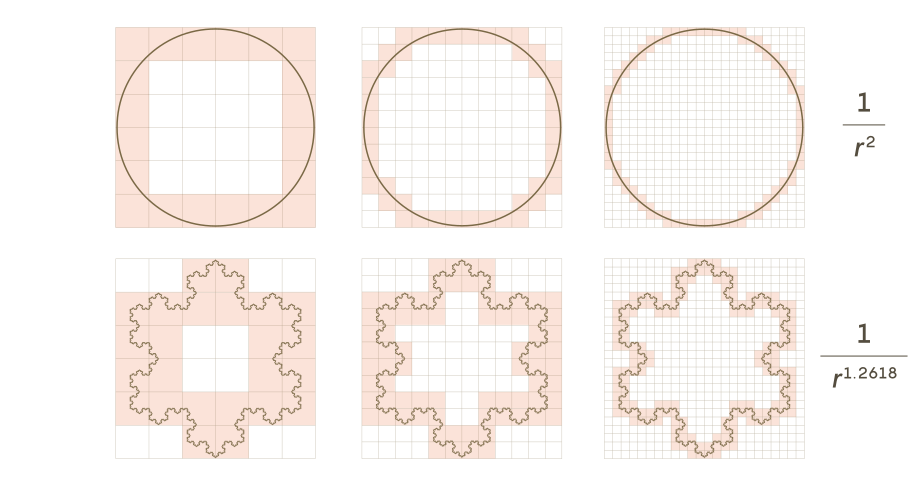
The crux of the Kakeya set conjecture is whether these sets occupy all dimensions of the space they point in every direction of: that is, whether a Kakeya set of line segments pointing in every direction on a plane is itself 2D, whether a Kakeya set pointing in every direction in a volume of space is itself 3D, and so on. The sets behave, in this specific way, like solid objects, even though, as Besicovitch showed, they can have no area or volume. It’s not clear who first posed this conjecture or when, but it existed in 1971, when the British mathematician Roy Davies proved that it is true in the 2D case. That it holds in three dimensions became known as the 3D Kakeya set conjecture. If it were to be disproved, this would mean the line segments of a Kakeya set, despite pointing in all directions, can be so cleverly bundled that they behave more like fractals than solid objects — that they have lower dimension than the 3D space they point in.
Because the Kakeya set is made up of line segments, mathematicians have reimagined the boxes used to measure dimensionality as being fused together into long, thin tubes. The question is how the number of tubes you need to cover the set scales with the thickness of the tubes. The Kakeya set conjecture says the scaling is like that of any other 3D object. If instead Kakeya sets can occupy a fraction of the full dimensionality of the space, then more detail — more line segments clustered in spaces inside — would reveal itself at smaller scales.

Wang speaks with mathematician Frank Merle over tea. Prior to the proof of the 3D Kakeya set conjecture, her reputation had been growing through a series of collaborations with blockbuster results.
Julien Pebrel/M.Y.O.P.
Interest in the 3D Kakeya conjecture rose in the 1970s when the Princeton mathematician Charles Fefferman established that it has a close connection to a powerful phenomenon called Fourier transformation, where any signal or function can be decomposed into sine waves of different frequencies and directions. A major open question in Fourier analysis (also called harmonic analysis) is what happens when the waves all have the same wavelength but are oriented in different directions. What happens to the combined signal where they interact? The Fourier restriction conjecture says that in such cases, the combined signal must be very spatially spread out and diffuse. Because the component frequencies are all traveling in slightly different directions, they can’t overlap and constructively interfere enough to form a highly concentrated wave or signal, a consideration relevant to signal processing and imaging.
“You can imagine that each wave lives on one of the long thin tubes,” Wang said. Will they overlap a lot, concentrating a signal, or not?
A Sticky Situation
A couple of years after arriving at MIT, Wang was chipping away at relatives of the Kakeya problem alongside Guth and others. Within a year, they’d solved a special case of the Falconer distance problem, a harder variant of the problem Guth solved with Katz. Wang also made progress on the Fourier restriction problem by framing it in terms of incidence geometry patterns. “It’s pretty rare that anyone could say anything new about this problem because it’s so difficult, so it was surprising for a Ph.D. student [to do so],” said Jonathan Hickman, a mathematician at the University of Edinburgh. “I sent her an email and said, ‘Wow.’”

“I decided not to worry about whether I would be good or not and just work on understanding better,” Wang said.
Julien Pebrel/M.Y.O.P.
Shmerkin, from the University of British Columbia, who had also worked on the Falconer distance problem, noticed Wang’s talent while visiting Guth at MIT. She struck him as creative, and as a sponge for new techniques. She seemed to understand incidence geometry deeply even though she had only recently started working on it.
The research area was already replete with new tools, and Wang soon imported more tools from geometric measure theory that she had learned during a collaboration with Shmerkin on the Falconer distance set problem. She was greatly inspired by Shmerkin’s “multiscale analysis” approach, a way of comparing what happens at different scales in order to arrive at contradictions. “She is always very kind and acknowledges that some of the ideas came from my work, but she was able to apply them in these fantastic ways that I couldn’t have envisioned,” Shmerkin said.
Wang’s reputation grew in 2019 when she, Guth, and Ruixiang Zhang of the University of California, Berkeley proved the 2D case of the local smoothing conjecture, one of the holy grails of harmonic analysis, which says that the solution to the wave equation can’t concentrate energy in a small region for an extended period. The same year, her doctorate complete, she moved to Princeton, New Jersey, for a postdoc at the Institute for Advanced Study. She worried that she couldn’t succeed without Guth, but gradually she began new collaborations and made headway on more Kakeya-type problems. Hiring committees took notice; she got a faculty job at the University of California, Los Angeles in 2021, and in 2023 she became an associate professor at NYU. A month after getting there, she produced another blockbuster result: Along with Kevin Ren, she proved the 2D Furstenberg set conjecture, which estimates the dimensionality of a set of points on the plane that contains a subset of lines pointing in every direction.
Despite these successes, Wang still felt like an underdog. “Each time it just felt lucky,” she said of her various proofs.
It was at the Institute for Advanced Study during the pandemic that Wang had decided to turn her attention to the 3D Kakeya set conjecture. The problem had resisted many challengers over the decades; proofs had even been announced and then shown to be wrong. “I never figured out the Kakeya conjecture, but there have been four or five times I thought I might have,” Guth said. Each time, he spotted his error before going public.
Wang read a 2014 blog post by the UCLA mathematician Terence Tao laying out a proof strategy that Tao and Katz had developed but never pursued. The approach seemed promising, so she contacted Joshua Zahl, then at the University of British Columbia, another mathematician who had studied aspects of the Kakeya problem in his thesis. They decided to investigate what Tao and Katz had described.
The strategy, which wound up requiring an enormous arsenal of techniques, was to show that any hypothetical counterexample to the conjecture — a potential way of squeezing line segments pointing in every direction in 3D space into fewer than three dimensions — must have such a rigid and efficient structure that it would contradict theorems governing the interplay between addition and multiplication. This general approach of positing a counterexample that disproves some conjecture, then twisting it into such knots that you conclude it can’t exist after all (leaving the conjecture as the only option), is a common proof strategy.

The renowned proof of the 3D Kakeya set conjecture, with Joshua Zahl, ran to 127 pages and required a range of cleverly applied mathematical tools. “You have doubt,” Wang said. “But also the argument feels natural.”
Julien Pebrel/M.Y.O.P.
In this case, Wang and Zahl focused on what are called “sticky” Kakeya sets, because line segments in these sets with similar orientations tend to stick together in space. These line segments bundle closely enough that thicker tubes could efficiently hold them, so the set as a whole could potentially exhibit fractal scaling, rather than behaving like a 3D object. They first proved that sticky sets aren’t counterexamples; they are 3D after all.
But there was more to do. “It wasn’t clear to people whether the sticky case truly was the main enemy,” said Zahl, who has the clean-cut look and comportment of a fighter pilot. So next they assumed a more general counterexample: a Kakeya set with some dimensionality less than three (say, 3 − x). By analyzing how many tubes intersect some midsize spherical region in the set, they could show that it must be either sticky (proved to be 3D) or not sticky, which, they could show, meant it must be higher-dimensional than had been assumed. “Then we win either way,” Wang said. They could repeat this argument for smaller and smaller values of x, until ultimately they could conclude that every Kakeya set must be 3D.
In early 2024, four years after they began their attempt, the proof’s complicated inductive logic seemed to be working out, though neither Wang nor Zahl let themselves draw that conclusion. “This is a difficult problem, and who am I to solve it?” Wang said. “You have doubt. But also the argument feels natural.” She could visualize the logic in her mind’s eye: tubes at one scale turning into planks on larger scales, then expanding into slabs that fill the entire volume. The way the shapes evolved into each other showed her that Kakeya sets are inevitably 3D. But it would take another year for Wang and Zahl to publicly announce the proof.
Finding Balance
As the proof was examined, studied, and confirmed, it shifted the landscape in Wang’s corner of math. “It’s a bit strange in the community because the holy grail has been achieved in some sense,” Shmerkin said. The Kakeya problem “is not solved in every dimension, but a big part of the holy grail has been achieved. So we are all asking ourselves, what do we do next? And of course, all of these techniques have opened the way to do many nice things.”

Even prior to her Fields Medal win, Wang was recognized on the street in China. The award means her profile — and the travel and distractions that come with it — will grow.
Julien Pebrel/M.Y.O.P.
The 3D versions of other, even harder problems remain open, such as the 3D restriction and local smoothing conjectures. Another obvious target for Wang and her community is the 4D Kakeya conjecture, if not a general proof in all dimensions, though no one knows what that would look like yet.
Wang said that at the moment she doesn’t want to get too invested in solving any particular problem. Her star has risen in China to the extent that she now gets recognized in public. The Fields Medal will make her a person of distinction there, and in the worldwide math community. She worries about falling behind, and still believes that she must put in more hours than her colleagues to be as good as they are. When challenged on this — everyone considers her extremely talented — she seemed genuinely surprised and pleased.
With more Kakeya-type problems in view, Wang is excited for what is to come. Another hard problem, reserved for the future, is how to feel confident as a mathematician while holding space that doesn’t center around math. Wang is encouraged that Guth, her adviser, finds time to read for pleasure. “I always wish that I could come back to that time when I just feel like I had infinite time to read,” she said. “I think that time was really nice.”