Quanta Magazine | Science and Math News

Robert Neubecker for Quanta Magazine
Latest Articles
After 80 Years, Mathematicians Give Famed ‘Erdős Method’ an Upgrade
Decades ago, Paul Erdős used randomness to illuminate the vast and weird world of networks. Now mathematicians are making his technique even more powerful.
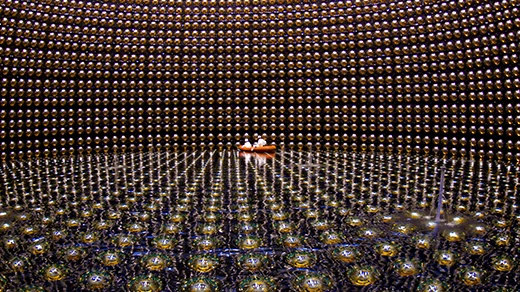
How Physicists Track and Trap the Elusive Neutrino
The hunt for these ghostly particles has required some of the most audacious experimental setups ever built.

A Dark Dimension Could Link Two of the Universe’s Great Unknowns
Recent observations suggest that dark energy is changing over time. Theorists wonder if dark matter is, too.

Why the Human Genome’s Tangled Physicality May Confound AI
Our genetic heritage is not a blueprint or an algorithm, as many biologists have imagined, but something else entirely.

Seven Perfect Shuffles Randomize a Deck of Cards. But How Many Sloppy Ones?
A decades-old proof showed that seven shuffles are enough to mix up a deck of cards. But it requires you to cut the deck with the precision of a professional magician. A new proof gets around that obstacle.

Where Did Earth Get Its Oceans? Maybe It Made Them Itself.
At first, scientists thought Earth’s water came from comets. Then, asteroids. Now, they wonder if Earth’s water is homegrown.
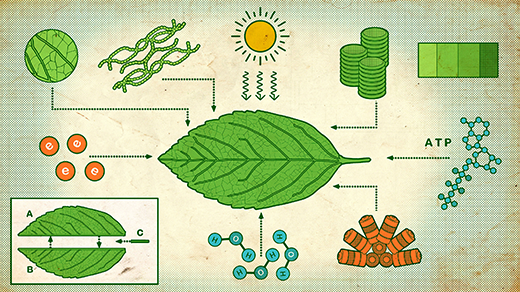
An Early Step on the Long, Strange Road to Photosynthesis
An ancient lineage of cyanobacteria is helping biologists uncover an early evolutionary stage of the mind-boggling process that turns light into life.

How Terry Tao Became an Evangelist for AI in Math
With automated proof-checkers, a problem can be broken up into small chunks, solved bit-by-bit, then reassembled with confidence that every piece is correct. For some, this heralds a new area in mathematical research.
Featured Videos
See all videos
The 4-Page Paper That Broke Mathematics
Emily Buder/Quanta Magazine




Special Features
Quanta Podcast
How Many Elementary Particles Are There, Really?
Plausible answers range from 17 to — in all seriousness — 995.5.
Recommended Features

Multimedia

How Can Infinity Come in Many Sizes?
Intuition breaks down once we’re dealing with the endless. To begin with: Some infinities are bigger than others.
About Quanta Magazine
Illuminating basic science and math research through public service journalism.
More about usQuanta Magazine is committed to in-depth, accurate journalism that serves the public interest. Each article braids the complexities of science with the malleable art of storytelling and is meticulously reported, edited and fact-checked. Launched and funded by the Simons Foundation, Quanta is editorially independent — our articles do not reflect or represent the views of the foundation.