You are looking for
Advanced search

Physicists Rewrite a Quantum Rule That Clashes With Our Universe
...experiment where unitarity looks creaky involves black holes, intense concentrations of matter that warp space-time into a dead end. Stephen Hawking calculated in 1974 that black holes evaporate over time,...
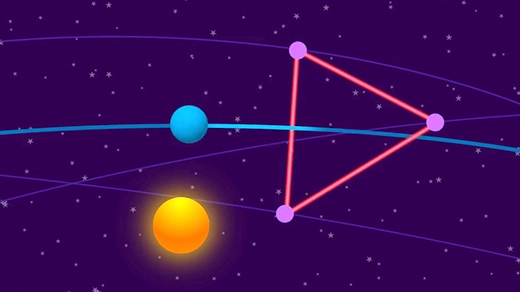
Hopes of Big Bang Discoveries Ride on a Future Spacecraft
...a few billion. This will let LISA listen in on astrophysical events that ground-based observatories can’t “hear,” such as the mergers of supermassive black holes (as opposed to star-sized black...

The Physicist Who’s Challenging the Quantum Orthodoxy
...the black hole’s event horizon. But if the black hole evaporation process is indeterministic then there’s no paradox. We never learn what was thrown into the black hole because predictability...
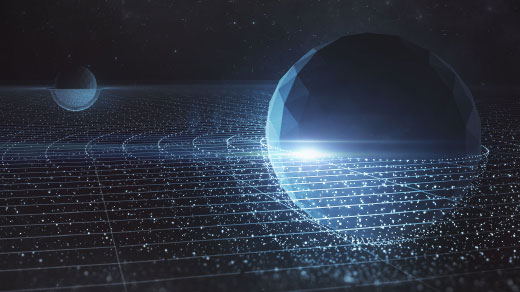
Physicists Find a Way to See the ‘Grin’ of Quantum Gravity
...nature of gravity and space-time must be revealed — always hide behind the horizons of black holes. “Even a few years ago it was a generic consensus that, most likely,...

The Year in Physics
...April — a dark void, encircled by a luminous ring, humanity’s first-ever look at a black hole. The existence of black holes had not been in doubt, of course: Astronomers...

The Year in Physics
...unique. It singlehandedly upends notions about the young universe. Black holes were thought to have come along only after the formation of galaxies, once stars gravitationally collapsed into black holes...
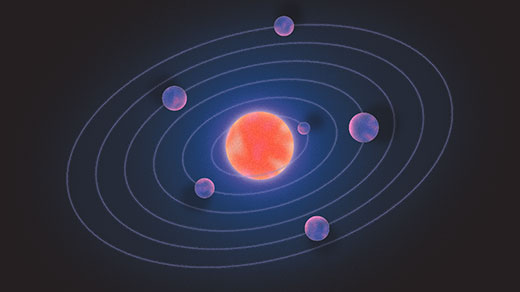
A Deepening Crisis Forces Physicists to Rethink Structure of Nature’s Laws
...of colliding black holes is resolved by a “hidden” symmetry that links low- and high-frequency deformations of the shape of the black holes. Like other researchers, Dubovsky doesn’t seem to...
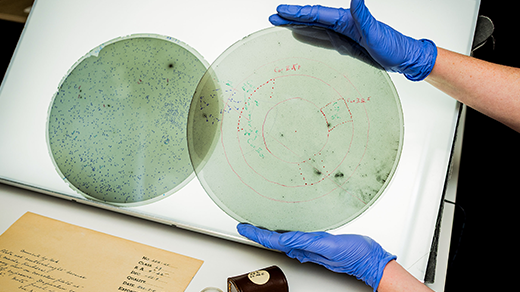
How Modern and Antique Technologies Reveal a Dynamic Cosmos
...region that features a binary system of mammoth yet compact objects. There, two supermassive black holes and their surrounding accretion disks are locked in a dance that will eventually merge...

A Cosmic-Ray Hunter Takes to the Sky
...that the bigger the better, so the supermassive black holes are usually a little bit ahead. It could be somewhere in the middle: intermediate-mass black holes. Or ultrahigh-energy cosmic rays...