String Theory Inspires a Brilliant, Baffling New Math Proof
Kristina Armitage/Quanta Magazine
Introduction
In August, a team of mathematicians posted a paper claiming to solve a major problem in algebraic geometry — using entirely alien techniques. It instantly captivated the field, stoking excitement in some mathematicians and skepticism in others.
The result deals with polynomial equations, which combine variables raised to powers (like y = x or x2 − 3xy = z2). These equations are some of the simplest and most ubiquitous in mathematics, and today, they’re fundamental to lots of different areas of study. As a result, mathematicians want to study their solutions, which can be represented as geometric shapes like curves, surfaces and higher-dimensional objects called manifolds.
There are infinitely many types of polynomial equations that mathematicians want to tame. But they all fall into one of two basic categories — equations whose solutions can be computed by following a simple recipe, and equations whose solutions have a richer, more complicated structure. The second category is where the mathematical juice is: It’s where mathematicians want to focus their attention to make major advances.
But after sorting just a few types of polynomials into the “easy” and “hard” piles, mathematicians got stuck. For the past half-century, even relatively simple-looking polynomials have resisted classification.
Then this summer, the new proof appeared. It claimed to end the stalemate, offering up a tantalizing vision for how to classify lots of other types of polynomials that have until now seemed completely out of reach.
The problem is that no one in the world of algebraic geometry understands it. At least, not yet. The proof relies on ideas imported from the world of string theory. Its techniques are wholly unfamiliar to the mathematicians who have dedicated their careers to classifying polynomials.
Some researchers trust the reputation of one of the paper’s authors, a Fields medalist named Maxim Kontsevich. But Kontsevich also has a penchant for making audacious claims, giving others pause. Reading groups have sprung up in math departments across the world to decipher the groundbreaking result and relieve the tension.
This review may take years. But it’s also revived hope for an area of study that had stalled. And it marks an early victory for a broader mathematical program that Kontsevich has championed for decades — one that he hopes will build bridges between algebra, geometry and physics.
“The general perception,” said Paolo Stellari, a mathematician at the University of Milan who was not involved in the work, “is that we might be looking at a piece of the mathematics of the future.”
The Rational Approach
The effort to classify all polynomials deals with the oldest kind of math: solving equations. To solve the simple polynomial y = 2x, for instance, you just need to find values of x and y that satisfy the equation. There are infinitely many solutions to this equation, such as x = 1, y = 2. When you graph all the solutions in the coordinate plane, you get a line.
Other polynomials are harder to solve directly, and their solutions cut out more complicated, higher-dimensional shapes in space.
But for some of these equations, it turns out, there’s a really simple way to find every possible solution. Instead of separately plugging different numbers into each variable, you can get all the solutions at once by rewriting the variables in terms of a new variable, t.
Consider the polynomial x2 + y2 = 1, which defines a circle. Now set x equal to 2t/(1 + t2), and y equal to (1 − t2)/(1 + t2). When you plug these new formulas back into your original equation, you get 1 = 1, a statement that’s always true, no matter what t is. This means that by choosing any real-number value for t, you’ll instantly get a solution to the original polynomial. For instance, when you set t equal to 1, you get x = 2(1)/(1 + (1)2) = 1, and y = 0. And indeed, x = 1, y = 0 is a solution to the original equation: (1)2 + (0)2 = 1.
This straightforward way of framing all your solutions is called a rational parameterization. It’s equivalent to mapping every point on the graph of your original polynomial — in this case, a circle — to a unique point on a straight line.
Any degree-1 polynomial equation — that is, any polynomial whose terms are raised to a power of at most 1 — can be parameterized like this. It doesn’t matter how many variables the equation has: It might have two variables, or 200. Once you go beyond two variables, the solutions to your polynomial equation will form complicated higher-dimensional shapes. But because the polynomial can still be parameterized, there’s a way to map every point in your high-dimensional shape to points on a particularly simple space in the same number of dimensions (like the line). This, in turn, gives you a straightforward way to compute all the polynomial’s solutions.
Similarly, any degree-2 polynomial (whose terms are raised to a power of at most 2) has a rational parameterization.
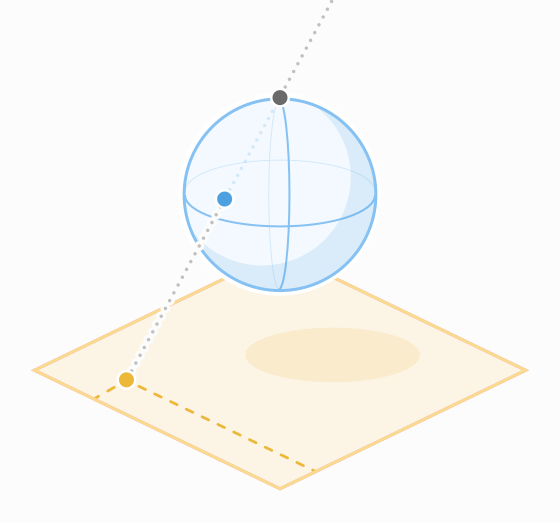
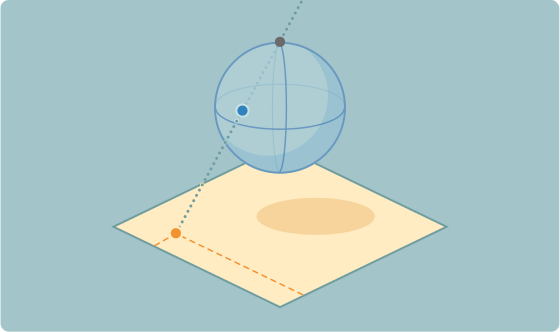
But if an equation’s degree is 3 or more, it can’t always be parameterized. It depends on how many variables the equation has.
Take a typical kind of degree-3 polynomial: elliptic curves, like y2 = x3 + 1, which have only two variables. “Elliptic curves are glorious, they’re wonderful, but you can’t possibly parameterize them,” said Brendan Hassett of Brown University. There’s no simple formula for x and y that gives you all of an elliptic curve’s solutions, so there’s no way to map the curve to a straight line. “If you could, they would not be so much fun,” Hassett said.
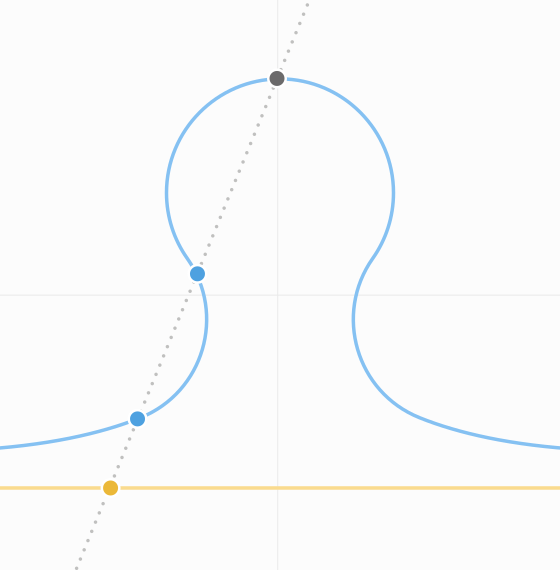
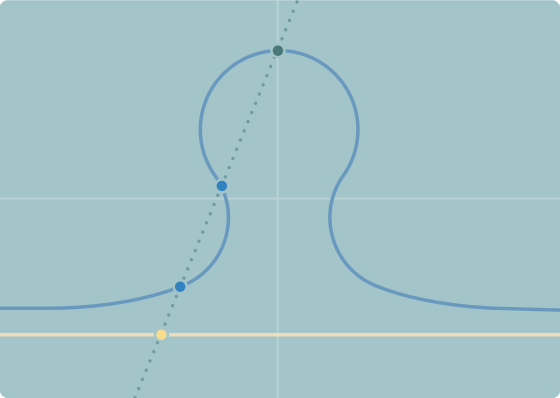
Unlike in the previous examples, your dashed line sometimes maps two different points on the elliptic curve (blue) to the same point on the yellow line below. You can’t find a map that avoids this, meaning that the elliptic curve has a more complicated set of solutions than the circle or sphere.
Instead, the solutions to an elliptic curve have a far richer structure — one that’s played a vital role in number theory for centuries, and that cryptographers have taken advantage of to encode secret messages.
What about degree-3 equations with more variables, then? Are they parameterizable, or is the structure of their solutions more fun, the way it is for elliptic curves?
In 1866, the German mathematician Alfred Clebsch showed that degree-3 equations with three variables — whose solutions form two-dimensional surfaces — are usually parameterizable. More than a century later, Herbert Clemens and Phillip Griffiths published a monumental proof in which they showed that the opposite is true for most degree-3 equations with four variables. These equations, which form three-dimensional manifolds called three-folds, are not parameterizable: Their solutions can’t be mapped to a simple 3D space.
Many mathematicians suspected that the next polynomial to be classified — degree-3 equations with five variables (forming four-dimensional manifolds known as four-folds) — wouldn’t usually be parameterizable either. In fact, they figured that polynomials should never be parameterizable past a certain point. But Clemens and Griffiths’ techniques didn’t work for four-folds.
And so for decades, the classification effort lay dormant.
Converting a Prophet
Mathematicians were surprised when, at a conference in Moscow in the summer of 2019, Maxim Kontsevich got up to speak about classifying four-folds.
For one thing, Kontsevich is known for taking a high-level approach to mathematics, preferring to pose ambitious conjectures and sketch out broad programs, often leaving the subtler details and formal proof-writing to others. He described his role on a recent project as something between a prophet and a daydreamer.

Maxim Kontsevich often prefers thinking about broad mathematical visions rather than individual problems.
©IHES/Flann Mérer
For the past three decades, he’s been focused on developing a program called homological mirror symmetry, which has its roots in string theory. In the 1980s, string theorists wanted to count the number of curves on high-dimensional manifolds to answer questions about how the building blocks of the universe might behave. To count the curves on a given manifold, they considered its “mirror image” — another manifold that, though very different from the original, had related properties. In particular, they found that an algebraic object associated to the mirror image, called a Hodge structure, could reveal the number of curves on the original manifold. The reverse was also true: If you count the curves on the mirror image, you’ll get information about the original manifold’s Hodge structure.
In 1994, Kontsevich sketched out a program to explain the underlying reason for this correspondence. His program also predicted that the correspondence extended to all kinds of manifolds beyond those relevant to string theory.
For now, no one knows how to prove Kontsevich’s mirror symmetry program. “It will be next-century mathematics,” he said. But over the years, he’s made partial progress toward a proof — while also exploring the program’s potential consequences.
In 2002, one of Kontsevich’s friends, Ludmil Katzarkov of the University of Miami, hypothesized one such consequence: that the program might be relevant to the classification of polynomial equations.
Katzarkov was familiar with Clemens and Griffiths’ 1972 proof that three-folds aren’t parameterizable. In that work, the pair looked at a given three-fold’s Hodge structure directly. They then used it to show that the three-fold couldn’t be mapped to a simple 3D space. But the Hodge structures associated with four-folds were too complicated to analyze using the same tools.
Katzarkov’s idea was to access the four-fold’s Hodge structure indirectly — by counting how many curves of a particular type lived on its mirror image. Typically, mathematicians studying the Hodge structures of four-folds don’t think about curve counts like these: They only come up in seemingly unrelated areas of math, like string theory. But if the mirror symmetry program is true, then the number of curves on the mirror image should illuminate features of the original four-fold’s Hodge structure.

Ludmil Katzarkov has argued for decades that mirror symmetry, an ambitious mathematical program inspired by physics, holds the key to solving a major open problem in algebraic geometry.
Natalia Leal
In particular, Katzarkov wanted to break the mirror image’s curve count into pieces, then use the mirror symmetry program to show that there was a corresponding way to break up the four-fold’s Hodge structure. He could then work with these pieces of the Hodge structure, rather than the whole thing, to show that four-folds can’t be parameterized. If any one of the pieces couldn’t be mapped to a simple 4D space, he’d have his proof.
But this line of reasoning depended on the assumption that Kontsevich’s mirror symmetry program was true for four-folds. “It was clear that it should be true, but I didn’t have the technical ability to see how to do it,” Katzarkov said.
He knew someone who did have that ability, though: Kontsevich himself.
But his friend wasn’t interested.
Digging In
For years, Katzarkov tried to convince Kontsevich to apply his research on mirror symmetry to the classification of polynomials — to no avail. Kontsevich wanted to focus on the whole program, not this particular problem. Then in 2018, the pair, along with Tony Pantev of the University of Pennsylvania, worked on another problem that involved breaking Hodge structures and curve counts into pieces. It convinced Kontsevich to hear Katzarkov out.
Katzarkov walked him through his idea again. Immediately, Kontsevich discovered an alternative path that Katzarkov had long sought but never found: a way to draw inspiration from mirror symmetry without actually relying on it. “After you’ve spent years thinking about this, you see it happening in seconds,” Katzarkov said. “That’s a spectacular moment.”
Kontsevich argued that it should be possible to use the four-fold’s own curve counts — rather than those of its mirror image — to break up the Hodge structure. They just had to figure out how to relate the two in a way that gave them the pieces they needed. Then they’d be able to focus on each piece (or “atom,” as they called it) of the Hodge structure separately.
This was the plan Kontsevich laid out for his audience at the 2019 conference in Moscow. To some mathematicians, it sounded as though a rigorous proof was just around the corner. Mathematicians are a conservative bunch and often wait for absolute certainty to present new ideas. But Kontsevich has always been a little bolder. “He’s very open with his ideas, and very forward-thinking,” said Daniel Pomerleano, a mathematician at the University of Massachusetts, Boston, who studies mirror symmetry.
There was a major ingredient they still had no idea how to address, Kontsevich warned: a formula for how each atom would change as mathematicians tried to map the four-fold to new spaces. Only with such a formula in hand could they prove that some atom would never reach a state corresponding to a properly “simplified” four-fold. This would imply that four-folds weren’t parameterizable, and that their solutions were rich and complicated. “But people somehow got the impression that he said it was done,” Pomerleano said, and they expected a proof soon.
When that didn’t come to pass, some mathematicians began to doubt that he had a real solution. In the meantime, Tony Yue Yu, then at the French National Center for Scientific Research, joined the team. Yu’s fresh insights and meticulous style of proof, Kontsevich said, turned out to be crucial to the project.
When lockdowns began during the Covid pandemic, Yu visited Kontsevich at France’s nearby Institute for Advanced Scientific Studies (IHES). They relished the quiet of the deserted institute, spending hours in lecture halls where there were more blackboards, Yu recalled.
Meeting regularly with Pantev and Katzarkov over Zoom, they quickly completed the first part of their proof, figuring out precisely how to use the number of curves on a given four-fold to break its Hodge structure into atoms. But they struggled to find a formula to describe how the atoms could then be transformed.
What they didn’t know was that a mathematician who had attended Kontsevich’s lecture in Moscow — Hiroshi Iritani of Kyoto University — had also started pursuing such a formula. “He was enchanted by my conjecture,” Kontsevich said. “I didn’t know, but he started to work on it.”
In July 2023, Iritani proved a formula for how the atoms would change as four-folds were mapped to new spaces. It didn’t give quite as much information as Kontsevich and his colleagues needed, but over the next two years, they figured out how to hone it. They then used their new formula to show that four-folds would always have at least one atom that couldn’t be transformed to match simple 4D space. Four-folds weren’t parameterizable.
Still Processing
When the team posted their proof in August, many mathematicians were excited. It was the biggest advance in the classification project in decades, and hinted at a new way to tackle the classification of polynomial equations well beyond four-folds.
But other mathematicians weren’t so sure. Six years had passed since the lecture in Moscow. Had Kontsevich finally made good on his promise, or were there still details to fill in?
And how could they assuage their doubts, when the proof’s techniques were so completely foreign — the stuff of string theory, not polynomial classification? “They say, ‘This is black magic, what is this machinery?’” Kontsevich said.
“Suddenly they come with this completely new approach, using tools that were previously widely believed to have nothing to do with this subject,” said Shaoyun Bai of the Massachusetts Institute of Technology. “The people who know the problem don’t understand the tools.”
Bai is one of several mathematicians now trying to bridge this gap in understanding. Over the past few months, he has co-organized a “reading seminar” made up of graduate students, postdoctoral researchers and professors who hope to make sense of the new paper. Each week, a different mathematician digs into some aspect of the proof and presents it to the rest of the group.
But even now, after 11 of these 90-minute sessions, the participants still feel lost when it comes to major details of the proof. “The paper contains brilliant original ideas,” Bai said, which “require substantial time to absorb.”
Similar reading groups have been congregating in Paris, Beijing, South Korea and elsewhere. “People all over the globe are working on the same paper right now,” Stellari said. “That’s a special thing.”
Hassett likens it to Grigori Perelman’s 2003 proof of the Poincaré conjecture, which also used entirely new techniques to solve a famous problem. It was only after other mathematicians reproduced Perelman’s proof using more traditional tools that the community truly accepted it.
“There will be resistance,” Katzarkov said, “but we did the work, and I’m sure it’s correct.” He and Kontsevich also see it as a major win for the mirror symmetry program: While they’re not closer to proving it, the result provides further evidence that it’s true.
“I’m very old, and very tired,” Katzarkov said. “But I’m willing to develop this theory as long as I’m alive.”
Clarification: December 15, 2025
This article has been updated to provide context for a description of Kontsevich as something between a prophet and a daydreamer.