What's up in
Genome
Latest Articles
How Virus-like ‘Jumping Genes’ Became Our Partners in Evolution
Half of our genome is made of transposons — snips of DNA that can move and copy themselves. But they’re more than parasites or genetic junk.
Why the Human Genome’s Tangled Physicality May Confound AI
Our genetic heritage is not a blueprint or an algorithm, as many biologists have imagined, but something else entirely.
What’s the Future of Gene Editing?
In the first episode of the new season of ‘The Joy of Why,’ Nobel Laureate Jennifer Doudna discusses how she discovered CRISPR’s genome-editing power, the breakthroughs and hurdles during its explosive growth, and what lies ahead for this groundbreaking technology.
How Ecotypes Harbor the Genetic Memory of a Species’ Past
Evolutionary biologists are uncovering genomic mechanisms that allow populations to adapt quickly to different, hyperlocal habitats without splitting into new species.
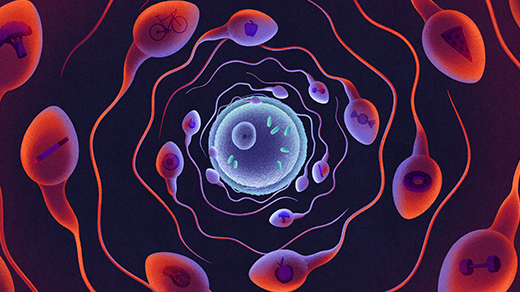
How Dad’s Fitness May Be Packaged and Passed Down in Sperm RNA
Research into how a father’s choices — such as diet, exercise, stress, nicotine use — may transfer traits to his children has become impossible to ignore.
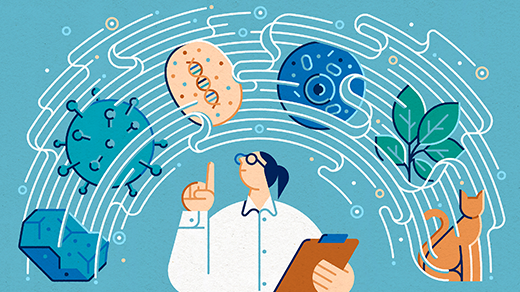
A Cell So Minimal That It Challenges Definitions of Life
The newly described microbe represents a world of parasitic, intercellular biodiversity only beginning to be revealed by genome sequencing.

The Poetry Fan Who Taught an LLM to Read and Write DNA
By treating DNA as a language, Brian Hie’s “ChatGPT for genomes” could pick up patterns that humans can’t see, accelerating biological design.
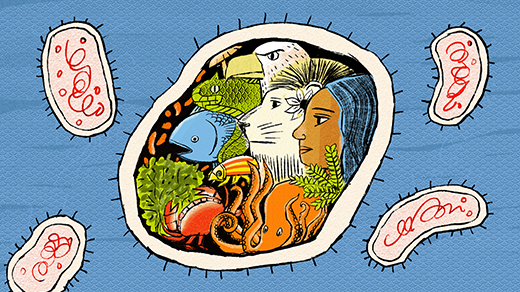
All Life on Earth Today Descended From a Single Cell. Meet LUCA.
The clearest picture yet of our “last universal common ancestor” suggests it was a relatively complex organism living 4.2 billion years ago, a time long considered too harsh for life to flourish.

He’s Gleaning the Design Rules of Life to Re-Create It
Yizhi “Patrick” Cai is coordinating a global effort to write a complete synthetic yeast genome. If he succeeds, the resulting cell will be the artificial life most closely related to humans to date.