What's up in
Mathematical physics
Latest Articles
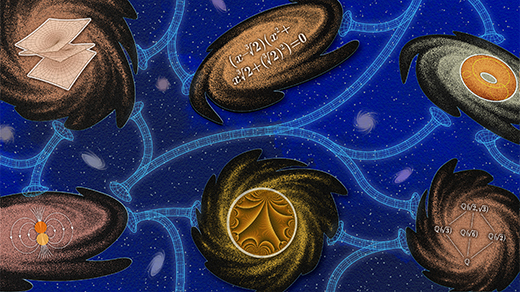
What Is Math’s Mysterious Langlands Program Really About?
Hidden correspondences hint at a deeper structure to the mathematical universe. Our columnist unpacks one of those connections and asks mathematicians what they might mean.

AI Has Solved One of Math’s $1 Million Millennium Prize Problems
Mathematicians at OpenAI showed that the Navier-Stokes equations, which describe how fluids flow, can sometimes “blow up.” But the massive result is not without controversy.

Theory of Fluids Enters the 21st Century
From the 1800s to the early 2000s, physicists used the same theory to understand the behavior of fluids. Now, using a modern insight, they have redefined fluids from the bottom up.

What Is the Positive Grassmannian and Why Does It Show Up Everywhere?
Lauren Williams tells 'The Joy of Why' how studying a fundamental object in algebraic combinatorics led to a career full of surprises.

Are Strings Still Our Best Hope for a Theory of Everything?
Columnist Natalie Wolchover examines the latest developments in the “forever war” over whether string theory can describe the world.

Using AI, Mathematicians Find Hidden Glitches in Fluid Equations
A $1 million prize awaits anyone who can show where the math of fluid flow breaks down. With specially trained AI systems, researchers have found a slew of new candidates in simpler versions of the problem.
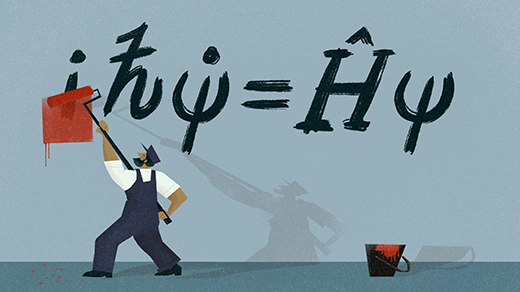
Physicists Take the Imaginary Numbers Out of Quantum Mechanics
Quantum mechanics has at last been formulated exclusively with real numbers, bringing a mathematical puzzle at the heart of the theory into a new era of inquiry.
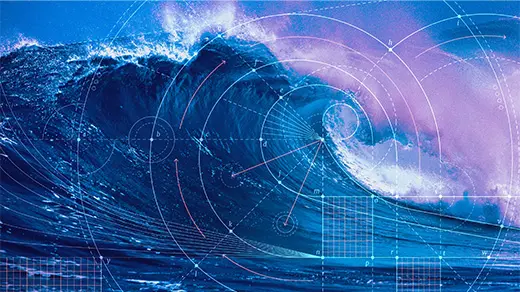
The Hidden Math of Ocean Waves Crashes Into View
The math of even the simplest ocean waves is notoriously uncooperative. A team of Italian mathematicians has made major advances toward understanding it.
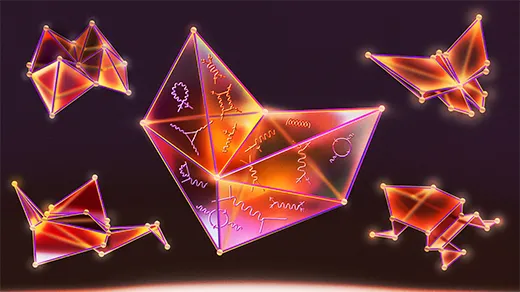
Origami Patterns Solve a Major Physics Riddle
The amplituhedron, a shape at the heart of particle physics, appears to be deeply connected to the mathematics of paper folding.