The Man Who Stole Infinity
When Demian Goos followed Karin Richter into her office on March 12 of last year, the first thing he noticed was the bust. It sat atop a tall pedestal in the corner of the room, depicting a bald, elderly gentleman with a stoic countenance. Goos saw no trace of the anxious, lonely man who had obsessed him for over a year.
Instead, this was Georg Cantor as history saw him. An intellectual giant: steadfast, strong-willed, determined to bring about a mathematical revolution over the clamorous objections of his peers.
It was here, at the University of Halle in Germany, that Cantor launched his revolution 150 years ago. Here, in 1874, he published one of the most important papers in math’s 4,000-year history. That paper crystallized a concept that had long been viewed as a mathematical malignancy to be shunned at all costs: infinity. It forced mathematicians to question some of their longest-held assumptions, rocking mathematics to its very foundations. And it gave rise to a new field of study that would eventually bring about a rewriting of the entire subject.
Now Goos, a 35-year-old mathematician and journalist, had come to Halle — a five-hour train ride from his home in Mainz — to look at some letters from Cantor’s estate. He’d seen a scan of one and was pretty sure he knew what the others would say. But he wanted to see them in person.
Richter — who, like Cantor, had spent her entire career here, first as a research mathematician and then, after retiring, as a lecturer on the history of mathematics — gestured for Goos to sit. She lifted a thin blue binder from the scattered piles of books and papers on her desk. Inside were dozens of plastic sheet protectors, each one containing an old, handwritten letter.
Goos began flipping through, contemplating the letters with the relish of an archaeologist entering a long-lost tomb. Then he reached a particular page and froze. He struggled to catch his breath.
It wasn’t the handwriting. At this point in his research on Cantor, he’d become accustomed to the strange, nearly indecipherable Gothic script known as kurrentschrift, which Germans used until around 1900.
It wasn’t the signature. He knew that the German mathematician Richard Dedekind had been a key player in Cantor’s quest to understand infinity and solidify math’s foundations, and that the two had exchanged many letters.
It was the date: November 30, 1873.
He’d never seen this letter before. No one had. It was believed to be lost, destroyed in the tumult of World War II or perhaps by Cantor himself.
This was the letter that had the power to rewrite Cantor’s legacy. The letter that proved once and for all that Cantor’s famous 1874 paper, the one that would go on to reshape all of mathematics, had been an act of plagiarism.
A Meeting of Minds
Cantor was born in St. Petersburg, Russia, in 1845. When he was 11 years old, his father got sick, and the family moved to Germany to escape the dangerous Russian winters. Cantor would live there his entire life and eventually lose any trace of an accent. But he never felt totally comfortable in his adoptive home.
As Cantor’s father continued to decline, he placed all his hopes on the eldest of his six children. For Cantor’s confirmation, his father wrote the 15-year-old boy a letter, warning him that many promising talents are defeated by those who resist their ideas — that only an unshakable religious conviction would prevent him from becoming another “so-called ruined genius.” In order to meet his potential as a “shining star on the horizon of science,” he would have to persevere in the face of his detractors.
Cantor carried his father’s letter with him for the rest of his life. He internalized its heroic view of intellectual defiance, and he soon found a place to direct his own talent: mathematics. As he put it, math was the field “toward which an unknown, secret voice calls him.” At 18, when his father died, he used his inheritance to enroll in the University of Berlin, one of the great capitals of mathematics.
There, a conflict was beginning to simmer.
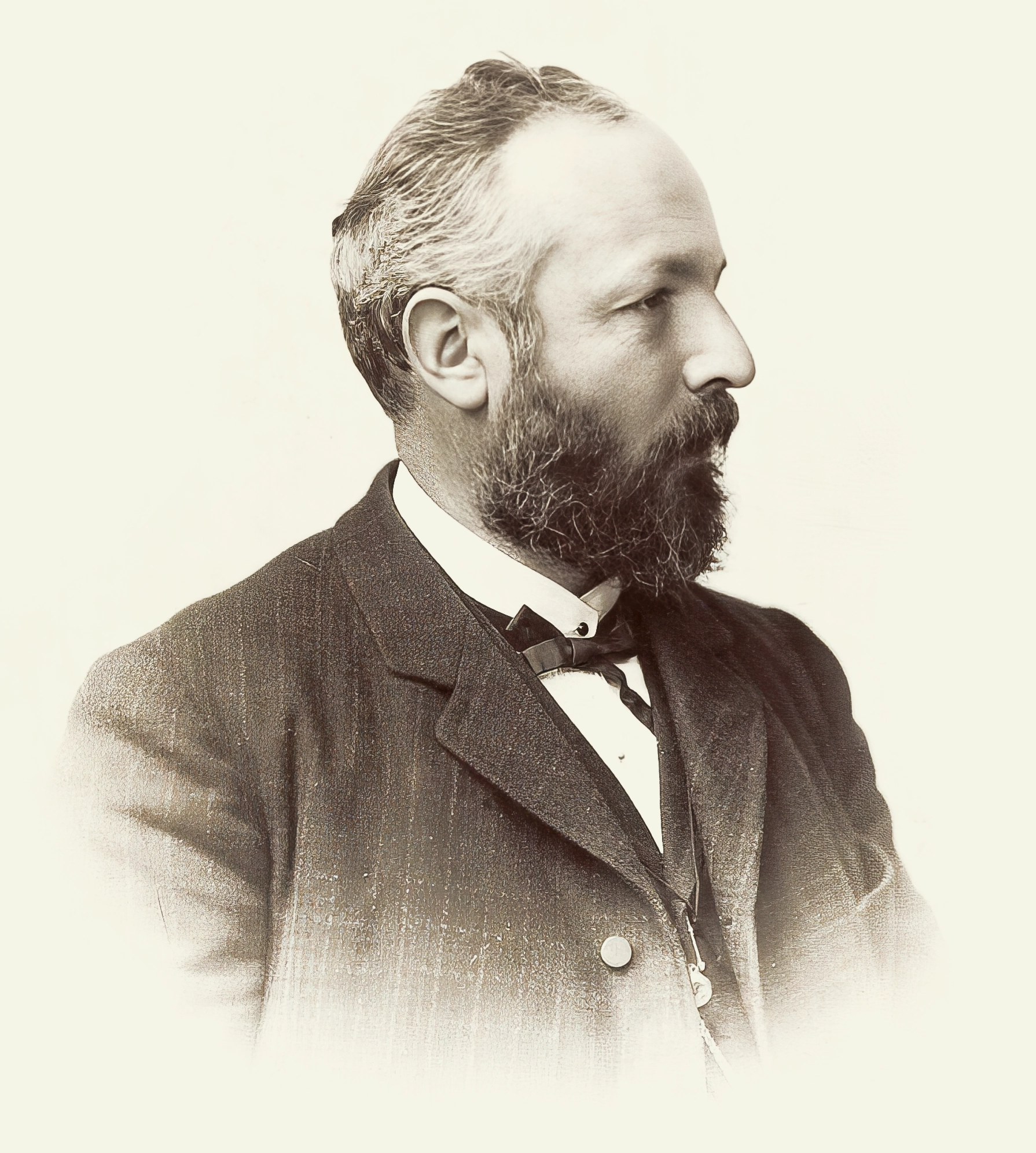
Georg Cantor constantly sought to make his mark in mathematics. But by the 1890s, his ambition had led him into a state of major depression.
The issue was infinity. Mathematicians had invented the abstraction millennia ago to deal with the problem that, for any number you name, you can always name a bigger one. But infinity came with its own problems. The ancient Greek philosopher Zeno used it to concoct all sorts of paradoxes. When infinity entered the picture, straightforward concepts like size and addition seemed to break down.
Infinity also presented a religious challenge. Christian theology decreed that God must be greater than any of his creations — the only true infinity, bigger than any number. If everyday mathematicians could control this unquantifiable quantity, it would be an affront to God, and thus the authority of the Church.
For thousands of years, mathematicians evaded these hazards by agreeing that infinity is just a useful trick, not a valid mathematical entity. As the great mathematician Carl Friedrich Gauss put it in a letter from 1831, infinity was nothing more than a “façon de parler” — a figure of speech.
But within a few decades, infinity became harder to ignore.
Mathematicians were starting to revisit their most fundamental concepts, hoping to make them more precise. Even their understanding of what numbers were, they began to realize, lay on shaky foundations.
Until then, they had only thought about numbers as the answers they got when they solved equations in algebra: whole numbers, fractions, square roots. Now some of them wanted to explore how these different species all related to one another, and whether there were other species out there to discover.
Among these explorers was a quiet German mathematician named Richard Dedekind. In 1858, he found a way to rigorously define the real numbers — any number that appears on the number line. But he didn’t share his finding. A slow and methodical thinker, he preferred to discuss his results with others until he was sure he was right.
In 1870, meanwhile, Cantor, unaware of Dedekind’s work, had finished his graduate studies and was starting to examine practical questions about how certain equations behave. He wasn’t yet interested in philosophical questions about the nature of numbers, but his work led him to come up with his own definition of the real numbers.
In early 1872, Dedekind and Cantor independently published their results.
They had both done something radical: They’d redefined the number line.
Before their papers, mathematicians had assumed that even though the number line might look like a continuous object, if you zoomed in far enough, you’d eventually find gaps.
Take the stretch of the number line between zero and 1. It contains infinitely many fractions: For any two fractions, you can always zoom in to find another one between them. But no matter how much you zoom in, there are certain numbers, like $latex \sqrt{2}$, that you’ll never reach. There are gaps — the infinity is broken.
In their 1872 papers, though, Cantor and Dedekind had found a way to construct a number line that was complete. No matter how much you zoomed in on any given stretch of it, it remained an unbroken expanse of infinitely many real numbers, continuously linked.
Suddenly, the monstrosity of infinity, long feared by mathematicians, could no longer be relegated to some unreachable part of the number line. It hid within its every crevice.
That summer, both Cantor and Dedekind spent their holiday in the scenic lakefront village of Gersau, Switzerland, where they crossed paths for the first time and took a long walk together to discuss their ideas.

A print from the 1890s of the Swiss village of Gersau, where Cantor and Dedekind met by chance and quickly became friends.
Photochrom Print Collection
To any spectator, the two men strolling along the lakeshore would have seemed an odd match. At 27, Cantor was tall, broad-shouldered, and boisterous. He reveled in attention from his peers, but beneath it all, he was deeply anxious about how they perceived him. It made him work fast, trying to publish quickly and often. Dedekind, on the other hand, was 13 years older than Cantor but much shorter and more reserved. And he shared none of Cantor’s urgency to publish. In fact, over the course of his life, he would publish relatively little.
But they hit it off at once. In letters they wrote later, both reminisced again and again about that beautiful day spent discussing math by the lake. They’d found in each other a partner, a friend.
It wouldn’t last.
In Pursuit of a Story
Ever since he can remember, Demian Goos has deeply cared about the rules. In 2008, when he was 17 years old, he and his family moved from Germany, where he’d grown up, to Argentina, where his mother was from. There, Goos decided to take up refereeing. “I enjoyed playing soccer with friends,” he said — but even more than he enjoyed playing, “I always felt annoyed by injustice in sports. When I was watching a match and they got a call wrong, I wanted to contribute to getting it right.”
It gave him the chance to turn his convictions into action. For the next 15 years — during his time as an undergraduate, graduate student, and postdoctoral researcher and lecturer in mathematics at the National University of Rosario — he refereed professional games for a major regional soccer tournament. One time, he recalled, a fan in the crowd flashed a machete at him, an oblique threat. But when the fan’s team committed a foul on the following play, Goos didn’t flinch. He simply took a deep breath and pulled out his red card.
“Refereeing was a really formative experience,” he said. “I don’t back down when people try to intimidate me.”

Demian Goos, a German Argentinian mathematician and journalist, has always felt most at home in Argentina. Here, he drinks maté, a traditional herbal tea from South America.
Zack Savitsky for Quanta Magazine
Though he enjoyed mathematics research, Goos was most drawn to the stories behind the theorems. He spent his free time reading about the history of mathematical ideas and dramatically recounting the stories he’d learned for his peers at the university café, which they took to calling his “office.” As a postdoc, he sometimes took his students outside to illustrate math concepts, like optimization algorithms or chaotic systems, through interpretive dance. Many students enjoyed it, he said, but some professors warned him against using such unorthodox methods. “They probably thought they could scare me,” Goos said. “They hadn’t heard the machete story.”
In 2020, while still a postdoc, he became ill and had to travel back to Germany frequently for treatment. A couple years later, he moved back full time. Once he finished his postdoc and was in better health, he decided it was time to leave academia and pursue his love for storytelling. And so, in early 2023, he started a science journalism fellowship at the Free University of Berlin, where he focused on developing a podcast. He wanted to tell the most gripping stories in the history of mathematics.
And he had an idea of where to start.
“Since I’m the emotional guy I am, I focused on the most emotional story ever,” he said — the story of how infinity became real and led to the birth of set theory, which offered a new foundation for all of modern math. “It pushes our understanding of mathematics to its limit,” Goos said. “You have to say goodbye to mathematical intuition and just be open and receptive to all the shenanigans that you will encounter there.”

Goos produces a podcast about the history of math and science. It was his work on this podcast that led him to uncover new evidence in the story of what really happened between Cantor and Dedekind.
Zack Savitsky for Quanta Magazine
He had learned in school that Cantor was the sole founder of set theory — and that it all started with a proof he published in 1874. In that proof, Cantor showed that there are different sizes of infinity, putting to bed the notion that infinity was merely a piece of mathematical trickery.
Goos began research for a podcast about Cantor’s discovery. But he soon found that the true story was more complicated than he’d been told.
“My approach originally was to tell the story everybody tells. It’s a beautiful story,” he said. “But it’s a wrong story. It’s not really what happened.”
The Trojan Horse
The true story was that Cantor wasn’t a lone genius. He had a partner — at least for a time.
Whenever Cantor met like-minded mathematicians, he was known to court them eagerly. He would show up at a collaborator’s residence at daybreak, excited to discuss some new idea he’d had, sometimes waiting for hours until they woke up. So it was with Dedekind. After their 1872 encounter in Gersau, Cantor took every opportunity to ask the older mathematician for advice.
In November 1873, Cantor began an exchange that would forever alter the course of human knowledge. “Allow me to put a question to you,” he wrote to Dedekind in a hastily penned letter. “It has a certain theoretical interest for me, but I cannot answer it myself; perhaps you can.”
Cantor had found an outlet for the zealous drive his father had instilled: the infinite nature of the number line. “He had a very strong sense of mission,” said José Ferreirós, a historian and philosopher of mathematics at the University of Seville in Spain. “He was convinced that the introduction of actual infinity was going to change not only mathematics, but science in general.” To Cantor, this kind of infinity didn’t contradict God’s supremacy. It just meant that rather than being remote and unknowable, God was everywhere, residing between all things.
He began studying the real numbers as a single, infinite package, asking questions no one had thought to ask before. Was there a difference between the infinity signaled by the three dots in 1, 2, 3, … , and the one built into the mysterious continuum of the number line? In other words, were there more real numbers than whole numbers?
On its face, the question seemed nonsensical. What would it even mean for these infinite sets to be different sizes?
Cantor wanted to find out.
He asked Dedekind whether the two sets of numbers could be put in “one-to-one correspondence” — a pairing of every real number with its own distinct whole number. He’d managed to do this, he wrote, for a different set: He’d proved that the rational numbers (numbers that can be written as a fraction) could each be assigned a unique whole number, without leaving any numbers left over. That is, even though there appeared to be far more rational numbers than whole numbers, the two sets were actually the same size. Both were therefore what mathematicians would later call “countable.”
But Cantor couldn’t figure out how to compare the whole numbers to the real numbers in the same way. Dedekind quickly replied that neither could he — but that he’d worked out a proof that the algebraic numbers (the numbers you get as solutions to algebra problems) could be counted. “I would not have written all this,” Dedekind wrote to Cantor in closing, “if I did not consider it possible that one or the other remark might be useful to you.”
From there, the mathematical volley continued. Energized by Dedekind’s progress, Cantor spent the following days plugging away at the remaining question — the real numbers. Could he finally show that, unlike the algebraic numbers, they were a bigger infinity than the whole numbers?
On December 7, 1873, he wrote to Dedekind that he thought he’d finally succeeded: “But if I should be deceiving myself, I should certainly find no more indulgent judge than you.” He laid out his proof. But it was unwieldy, convoluted. Dedekind replied with a way to simplify Cantor’s proof, building a clearer argument without losing any rigor or accuracy. Meanwhile Cantor, before he’d received Dedekind’s letter, sent him a similar idea for how to streamline the proof, though he hadn’t worked out the details the way Dedekind had.
Cantor considered what he had in hand: two sets, both infinite, but one somehow larger than the other. The implications were revolutionary. He began to dream of not one infinity, but an entire hierarchy of them. And if infinities could be so concretely compared, then they had to be real, not just figures of speech.
His proof, he realized, had the potential to shake the math world to its core. But not without angering some of its most prominent figures.
One of those figures was Leopold Kronecker, a mathematical ideologue who detested infinity. He didn’t believe in the number line’s packed nooks and crannies. According to the mathematician Ferdinand von Lindemann, who proved that π isn’t algebraic — you can never pose an ordinary algebra problem where π is the answer — Kronecker once told him his work was worthless, since such “transcendental” numbers didn’t exist.
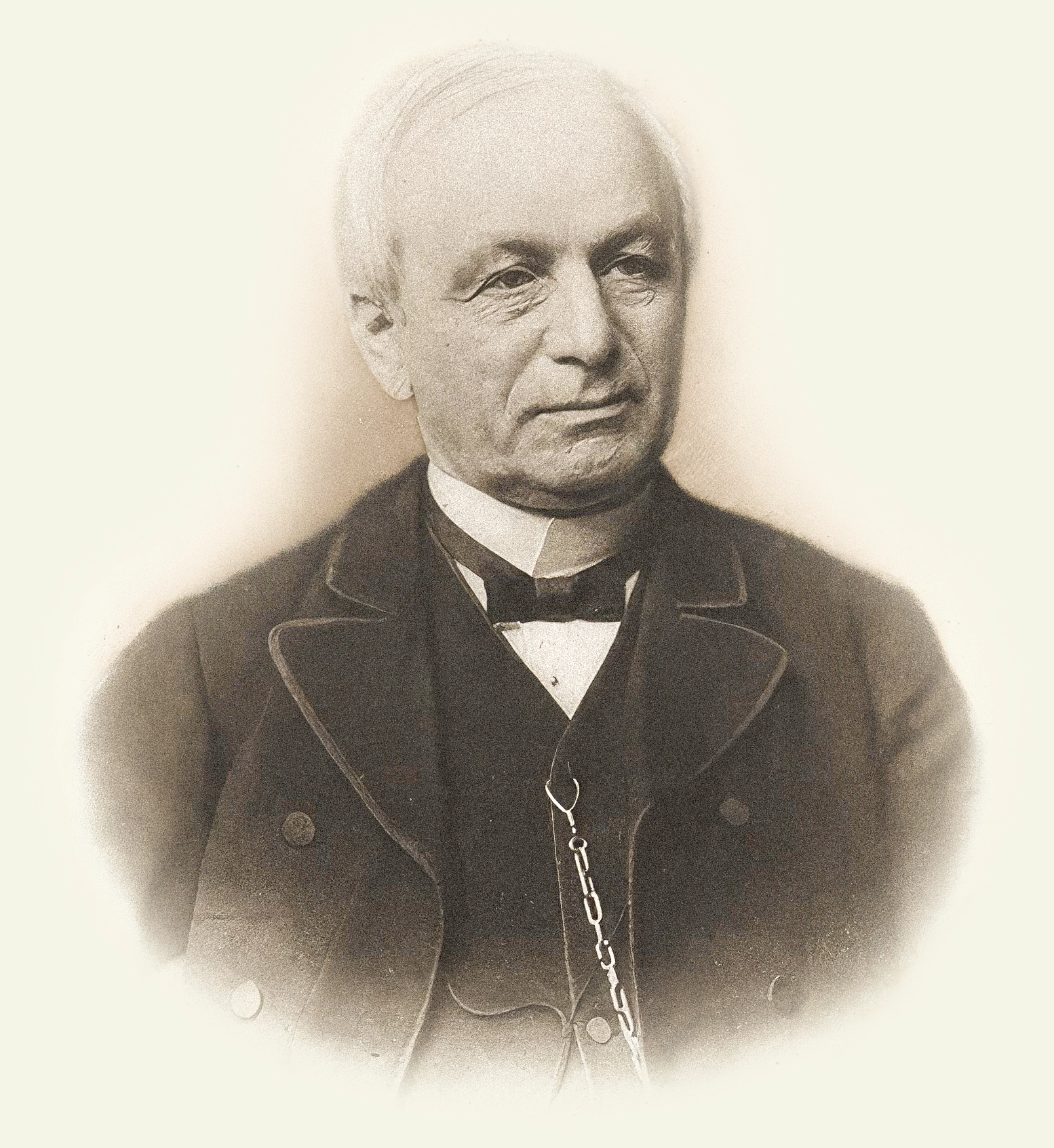
To Leopold Kronecker, infinity had no place in mathematics. When Cantor challenged this belief, Kronecker set out to destroy his reputation and stop him from publishing.
Public Domain
Kronecker was also a major gatekeeper in the world of math. He was on the editorial board of Crelle’s Journal, one of the world’s preeminent math publications. And he never hesitated to use his enormous influence to push his reactionary agenda. Often, he would decide which results would reach other mathematicians quickly — or at all.
Cantor, after discussing his work with his mentor Karl Weierstrass, wanted to publish the findings in Crelle. There, he figured, he’d be able to bring infinity into the mainstream. To reveal the mind of God to the entire world. To become a shining star on math’s horizon.
Cantor’s sense of mission, that “secret voice” within him, began to swell.
Cantor had a good relationship with Kronecker. But several years before, Dedekind had beaten Kronecker to a major result, and Kronecker’s dislike for him was well known. If Cantor submitted a paper co-authored with Kronecker’s nemesis — a paper that openly declared that multiple sizes of infinity exist — it might never get published.
So he made two decisions.
The first was to build a mathematical Trojan horse.
Weierstrass had been most excited about the proof that algebraic numbers are countable. (He would later use that result to prove a theorem of his own.) So Cantor chose a misleading title that only mentioned algebraic numbers.
But he saw that proof — Dedekind’s proof — as a decoy, a wedge he could use to pry open the forbidden gates of infinity. Writing his paper, Cantor put the proof about algebraic numbers first. Below it, he added his own proof that the real numbers cannot be counted — Dedekind’s simplified version of it, that is. Cantor downplayed this second section’s true import. “He deliberately chose a wording that would not sound suspicious to Kronecker and all those who hated infinity,” Goos said.
Cantor’s second decision was to claim full authorship for himself. He carefully erased every trace of his collaborator’s contribution, including stray uses of terms that anyone in the know would recognize as Dedekind’s.
In classic Cantor fashion, he slapped the paper together within a day and submitted it to Crelle. The following morning, Christmas Day 1873, he posted a letter to Dedekind, letting him know that Weierstrass had convinced him to publish. “As you will see,” he wrote, “your remarks, which I value highly, and your manner of putting some of the points were of great assistance to me.”
Writing the Story
The first evidence of Cantor’s deception was uncovered in the early 20th century by another great German mathematician. Emmy Noether was a Dedekind acolyte. She would often wax poetic about his mathematical prescience. As she liked to tell her students, “Everything is already in Dedekind.” In 1930, she was collecting all of his mathematical work into a four-volume publication when she happened on some of the letters he’d kept from his correspondence with Cantor. She partnered with the French philosopher Jean Cavaillès to gather and publish them as well.
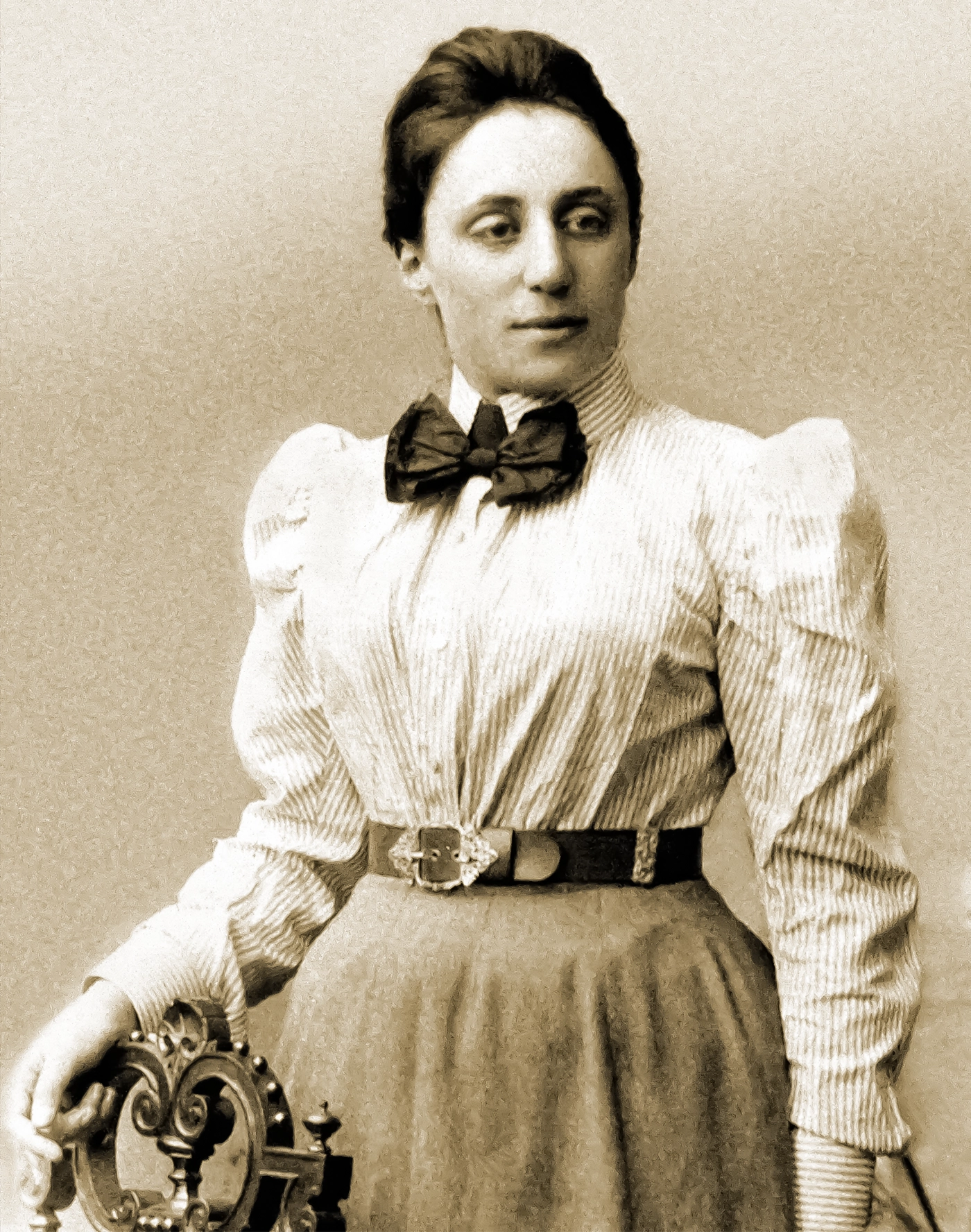
The renowned mathematician Emmy Noether helped collect the first evidence of Cantor’s wrongdoing.
Ian Dagnall Computing/Alamy
It had been over a decade since Dedekind and Cantor had died. Noether and Cavaillès spent the next few years tracking down letters from Dedekind’s estate. In 1933, after Adolf Hitler’s rise to power, Noether, who was Jewish, fled from Germany to the U.S., where she died two years later from cancer. But Cavaillès completed their project in 1937.
The correspondence as it was presented in the book was strange. It began with a flurry of letters starting shortly after Cantor and Dedekind met in 1872. The letters, from Dedekind’s estate, included only those that he’d received, not ones he’d sent to Cantor. Then the correspondence suddenly ended in January 1874, and several years of silence followed. When the exchange resumed in 1877, Dedekind’s own letters to Cantor now appeared as well. Dedekind had apparently decided to keep a copy of everything he was sending to his fellow mathematician.
There was also a note Dedekind seemed to have written to himself after he saw Cantor’s 1874 publication in Crelle. In it, he recounted how he’d sent Cantor the first proof in the paper and the revised version of the second — only to see them both appear “almost word for word” in print just a few months later under Cantor’s name alone.
Dedekind never went public with this claim, and Noether and Cavaillès didn’t comment on it. “I think for them it was a very conscious decision not to say anything and just to let the letters speak for themselves,” said Ferreirós, the historian in Seville. “That was the honor code of the time.”
No one else called attention to it either — at least not in print. The earliest biographies of Cantor, written by his mathematical disciples, simply lauded his genius.
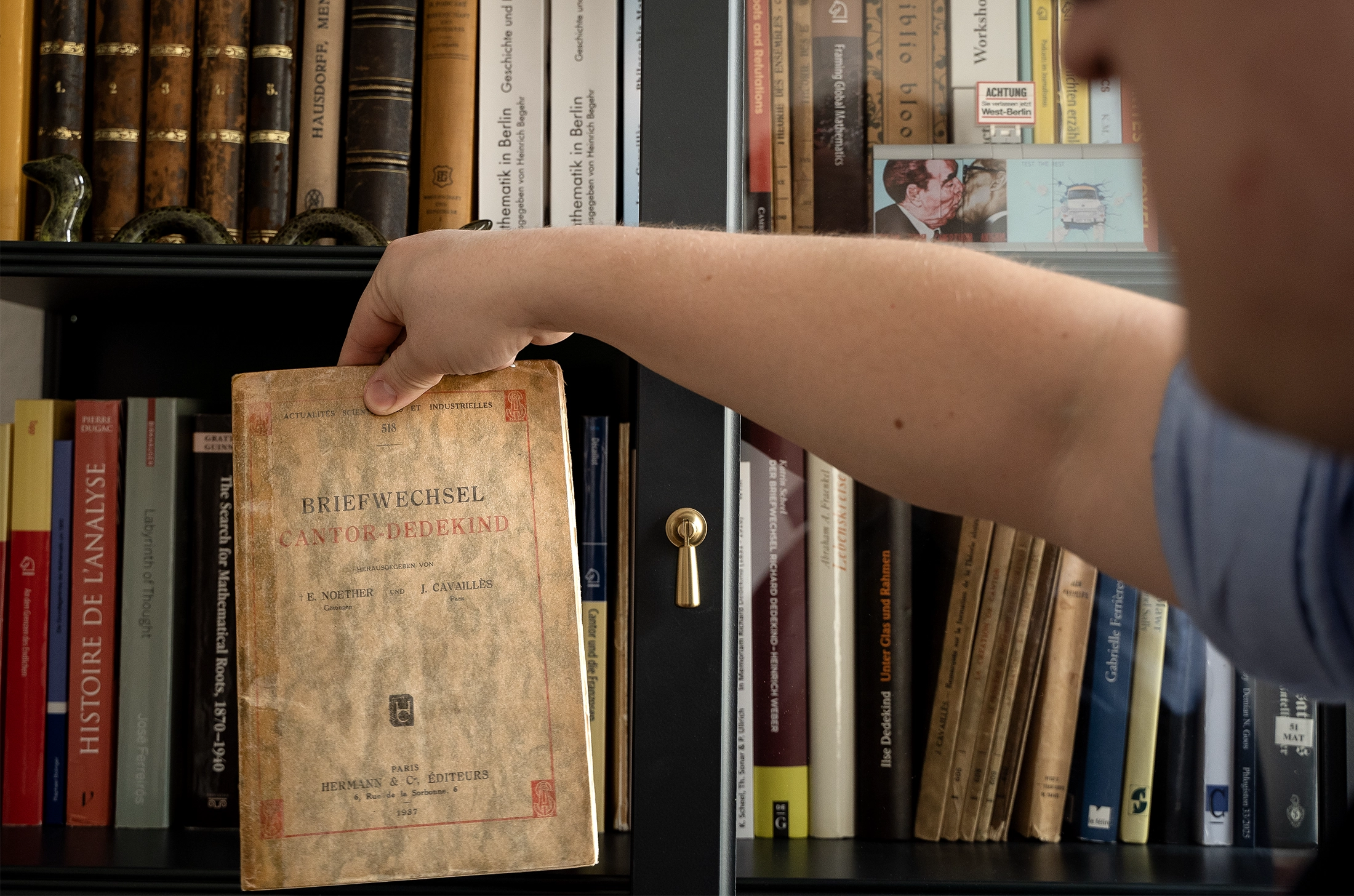
Goos holding the first published record of Cantor and Dedekind’s exchanges.
Zack Savitsky for Quanta Magazine
Decades later, historians such as Ivor Grattan-Guinness revisited the Cantor-Dedekind exchange. Grattan-Guinness tried desperately to track down the letters Dedekind had sent to Cantor in 1873 — the ones that might prove Cantor’s wrongdoing. They had supposedly been left in Cantor’s office at the University of Halle after his death, but now they were nowhere to be found. Most likely, Grattan-Guinness concluded, they’d been lost during World War II, or in the destruction that followed once American and Soviet forces occupied Halle in 1945.
Without the letters, Grattan-Guinness and his contemporaries decided not to accuse Cantor of ethical misconduct. Some decided that he’d acted with Dedekind’s permission; others excused his choice, since he’d begun the exchange and come up with the first version of the more significant second proof.
But when Goos learned of this history while working on his podcast in 2024, he was outraged. He could only find one piece of writing that explicitly discussed Cantor’s wrongdoing. In a 1993 paper, Ferreirós accused Cantor of stealing and publishing Dedekind’s work without credit. But other Cantor biographers immediately pushed back on Ferreirós’ narrative, arguing that it was too extreme an interpretation of what had happened. Besides, without Dedekind’s missing letter, there was no real proof of the supposed crime — only Dedekind’s note, written afterward. How could anyone be so sure its claims were true?

José Ferreirós, a historian and philosopher of mathematics at the University of Seville, was the first person to accuse Cantor of plagiarism in print.
Universidad de Sevilla
It remained an obscure debate among historians of mathematics, and Cantor’s lone-genius mystique endured.
Goos wanted to tell the real story on his podcast — and to back it up. He saw one way to do that. But it was a long shot.
“They were always saying the letters were lost after the war,” he said. That bothered him. “There is a lot that was lost without any doubt, but it doesn’t mean that nothing else survived.”
Many great historians had searched for the letters and come up short. Goos had just started his research. But could all the experts have missed something?
A Lonely Existence
Cantor’s paper in Crelle didn’t make a huge splash, as mathematicians largely missed what he’d hidden between the lines. But he’d landed his first blow in what would become a lifelong assault on the mathematical status quo. He’d published a proof, in math’s foremost journal, that infinity came in different sizes. It would eventually force mathematicians to rethink the foundations of the field — to decide on its most fundamental rules and their consequences.
Meanwhile, Dedekind stopped replying to Cantor. For nearly three years, they didn’t correspond at all. Then, for reasons that aren’t entirely clear, Dedekind cautiously reengaged. But this time, he kept a draft of every letter he sent: a record for safekeeping.
The two began discussing infinity again. Cantor was planning to follow up on his work on infinity’s many sizes, and he wanted advice. His letters were now more supplicating, Dedekind’s warier. But the correspondence was productive, and Cantor soon submitted a new, more daring paper to Crelle — this time, without a disguise.
Kronecker revolted. He used all his influence in the Berlin circle to delay the review process as much as possible. But after several months, Weierstrass and others interceded on Cantor’s behalf, and the paper eventually appeared in the journal.
Once again, ideas from Dedekind’s letters to Cantor appeared in the paper without credit. Once again, Dedekind cut off their correspondence.
Cantor would perhaps come to regret this break with one of his only intellectual allies. He’d been struggling to turn the mathematical backwater of Halle into an epicenter of the field that was growing out of his work: set theory. His best bet for achieving this was to hire Dedekind. In 1882, he tried to recruit him, as if nothing had happened. Dedekind politely declined.
As Cantor continued to publish results on infinity, Kronecker worked to turn the mathematical community against him. He called Cantor a “corruptor of the youth” and a “renegade.” When Cantor, trying to leave Halle, applied for a position at the more prestigious University of Berlin in 1883, Kronecker — a professor there — blocked his appointment. Other mathematicians, including some of Cantor’s friends, began to discourage him from publishing, too.
Cantor took all of this resistance personally. “He has this longing for approval,” Goos said. “But it’s the very nature of doing things differently from everybody else that they won’t like it.” In 1884, Cantor was hospitalized due to a major depressive episode. Over time, he grew more and more isolated. “There was a pattern,” Ferreirós said. “Many of his relationships with colleagues ended on bad terms.”
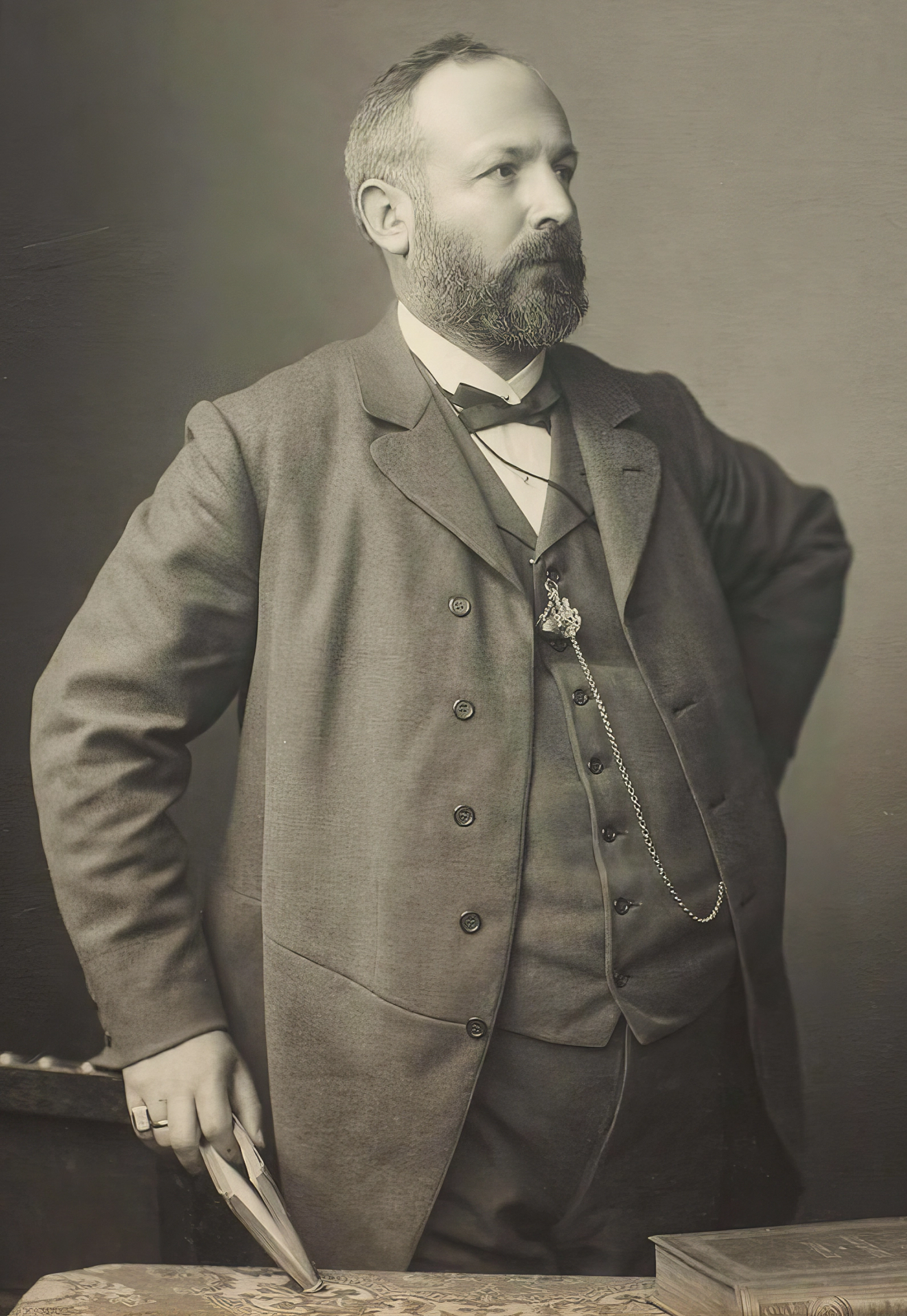
Cantor often appears self-assured and powerful in his later photos. But beneath his confident exterior, he was lonely and anxious.
UAHW, Rep. 40/VI, Nr. 1, Bild 75
Eventually, Cantor fell victim to the opposition his father had warned him about. When he was repeatedly denied the academic posts and honors he felt he deserved, his sense of mission gave way to resentment. His depression returned, and he was hospitalized several times over the next two decades. In 1917, he was finally committed to a sanatorium, where he wrote his wife regularly, begging her to let him come home. He died the following year.
Cantor had been forced to the margins. But gradually his ideas began to gain traction among a new generation of mathematicians. They saw in Cantor’s work the potential to rewrite all of mathematics from the ground up.
A Lucky Find
Goos, too, was looking to do some rewriting. In his 2024 podcast, he covered the conflict between Cantor and Dedekind. But having failed to unearth any new evidence, he found it difficult to shift the debate. He turned to other projects.
Still, he couldn’t let the story go.
He continued to dig for clues about the lost letters in his free time. “I don’t really think there is one book left that I don’t have,” he said. He tracked down original sources and scoured university archives whenever he could. “I’m talking really about primary sources that are mentioned once in a single line in a single article,” he said.
That’s how, in the summer of 2024, he stumbled on a partial scan of what looked like a letter from Dedekind to Cantor. It was on a webpage titled “Georg-Cantor-Vereinigung” — the Georg Cantor Association. “It’s a group of people who try to keep Cantor’s memory alive,” Goos said. The letter was from 1877, long after the conflict, so Dedekind’s draft of it was already in the historical record. But there had never been any record of the copy he’d sent to Cantor. Goos tried contacting various members of the organization but got no reply.
Months later, he returned to the webpage. But this time, he noticed that below the scan, the site mentioned a 2009 donation of letters from an heir. He tracked down who that heir could possibly be, and after poring over many family trees and other documents, he finally came across a Dr. Angelika Vahlen — Cantor’s great-granddaughter, who appeared to be living in Halle.
When he called her, she told him that she knew nothing about mathematics (she was an archaeologist, in fact), but that she’d wanted to make whatever letters she possessed available to historians for study. She had given them to the University of Halle (today formally known as Martin Luther University Halle-Wittenberg), and they’d ended up with the president of the Cantor Association, a math professor named Karin Richter.
Goos tracked Richter down. Arrived at her office in March 2025. Opened the thin blue binder she handed him.
He’d been expecting to see the later letter from Dedekind that was posted on the Cantor Association’s website. It would be like his other pursuits of original sources — a good way to verify what was already known and perhaps glean some new insights.
But here before him was the letter he’d been hoping to find for over a year. He was sure of it. Although Dedekind’s meticulous, ornate handwriting was somehow even more indecipherable than Cantor’s uneven scrawl, Goos could see that the pages were peppered with the phrase algebraischen Zahlen: “algebraic numbers.” And at the bottom, unmistakable, was the sign-off: “With warmest regards, your most devoted R. Dedekind — Braunschweig, 30 November, 1873.”
Did Richter even know what she had? He asked for scans. Richter said she’d think about it.
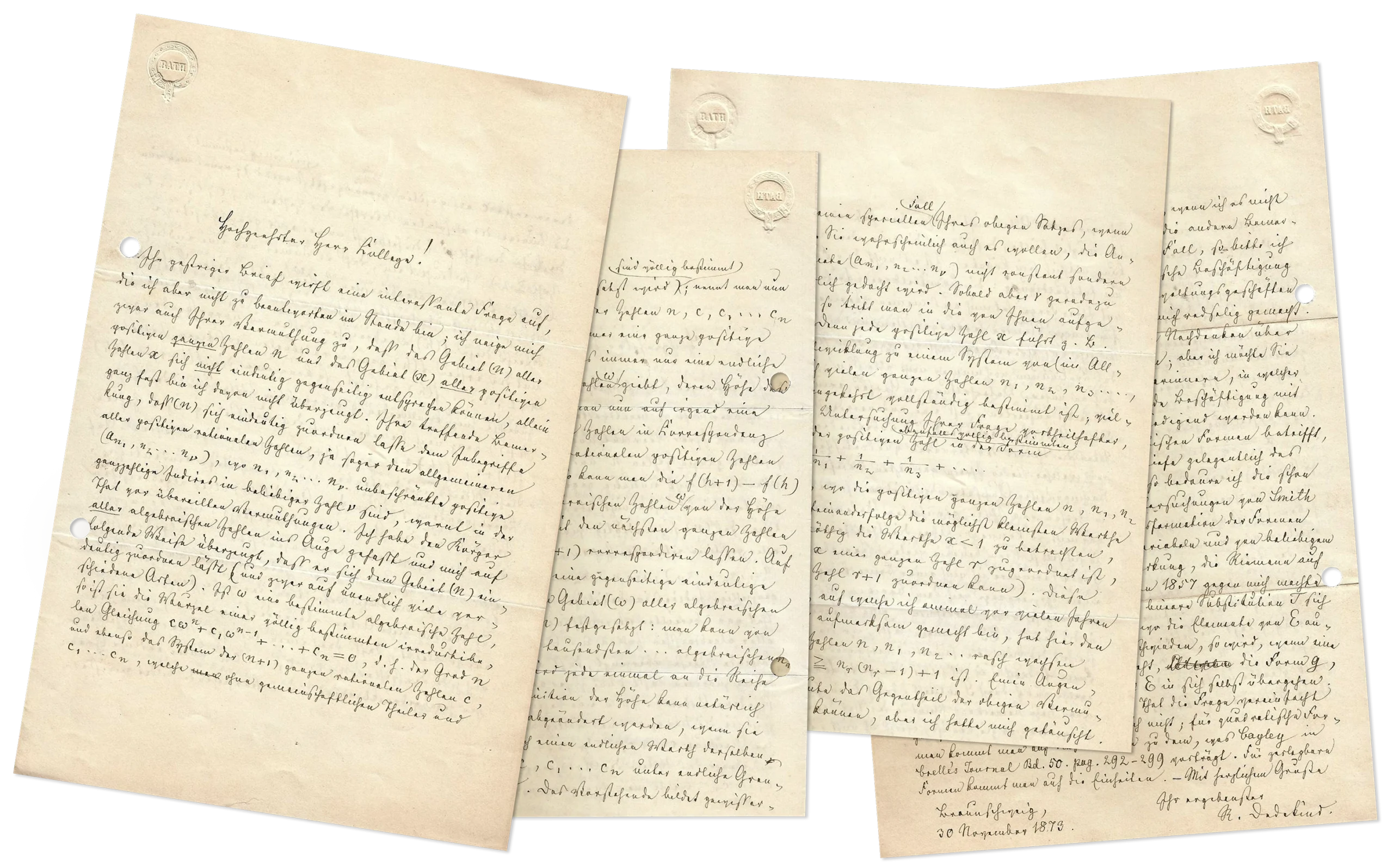
The letter from Dedekind to Cantor, dated November 30, 1873, that went missing for more than a century. In it, Dedekind provides a proof that the set of algebraic numbers is the same size as the set of whole numbers — a result that Cantor later plagiarized.
Braunschweig University Archive (G98 No. 4)
On the train ride back home — his second five-hour trip of the day — Goos contemplated the discovery he was sitting on. He knew the situation was delicate. He’d experienced German mathematicians’ dismissiveness when he brought up Cantor’s betrayal of Dedekind. “Pride is something that Germans don’t often feel comfortable with,” Goos said. “But we are proud of Cantor.” It would be hard to find a bigger Cantor fan than Richter, and she hadn’t seemed eager to share the scans.
When he called Richter’s phone number two days later, his hopes sank. It was no longer in service. “How do you tell somebody this? You know, I talked to this lady, she didn’t seem really happy to share these letters, so I called her, and her phone doesn’t exist anymore,” he said. “Come on, Demian, come on!” He berated himself for being too polite to pull out his phone in Richter’s office and start taking photos.
He spent the next month contacting everyone he knew in Halle, begging them to find a way to get to Richter. “I’m starting to think I’m going crazy,” he said. “Does she even exist?” Finally, one of Richter’s colleagues told him when and where she’d be giving her next lecture. He made the 10-hour round trip again in April, and Richter explained that she’d changed phone providers. She handed him a single scan and transcription. It was just one letter, but it was the one that mattered.
Another month later, another trek, and Richter handed over another Dedekind letter, this one from the summer of 1873. Goos didn’t know if he could afford any more of these trips: “I’m not rich,” he said. It was time, he decided, to let the world know what he’d found.
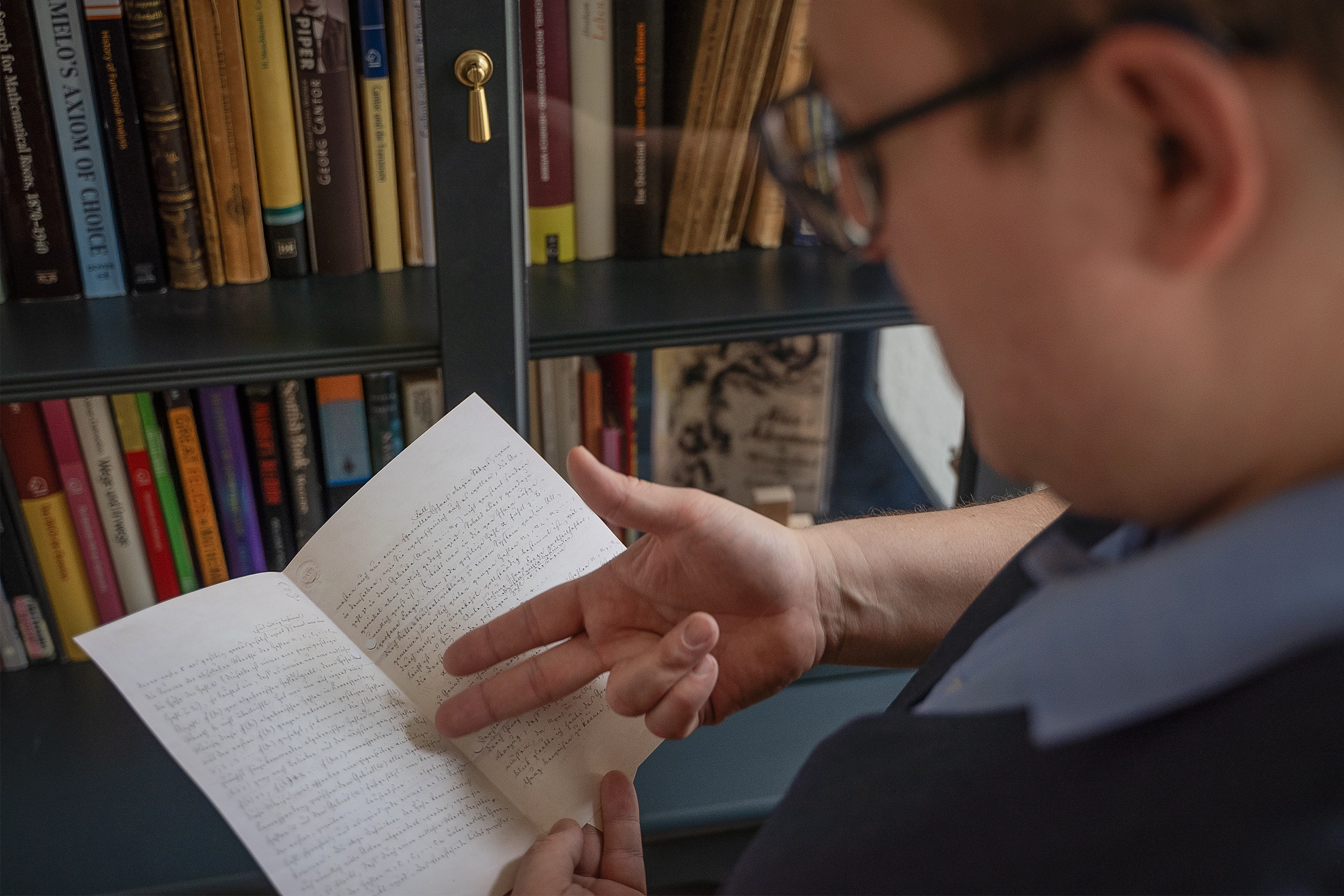
Goos reading the scan of the missing letter.
Zack Savitsky for Quanta Magazine
A Truer Legacy
Today, Cantor’s renown far exceeds Dedekind’s.
Both made major contributions to the foundations of mathematics. But Cantor is often credited with wrangling infinity and inventing set theory, the language that all of modern math is now written in. His reputation as one of history’s greatest mathematicians has been bolstered by biographies and popular books, and he’s one of the few mathematicians known to people outside the world of math.
There are no English-language biographies of Dedekind. His Wikipedia page is a quarter the length of his erstwhile friend’s. Among mathematicians — largely thanks to Noether’s efforts — he retains a reputation as a lesser-known visionary. “The more I learn about Dedekind, the more impressed I am,” said Joel David Hamkins, a set theorist and philosopher at the University of Notre Dame. “Cantor proved all these great theorems, but Dedekind was probably the greater mathematician.”
The real story behind Cantor’s 1874 paper has been sitting in the open for 90 years. But it isn’t the kind of story people like to tell. “Every branch of science needs a hero,” Ferreirós said. “Chemistry has Lavoisier, mechanics has Newton, relativity has Einstein. There’s always this one, only one. But that’s always a lie.”
Since challenging the lie, Goos has met resistance. When he’s shared his discovery of the lost letter, mathematicians have questioned its importance — especially in Germany. He’s had trouble getting people to see why it matters. Their reaction echoes historians’ response to Ferreirós’ paper 30 years ago.
But it does matter. Math is often viewed as the science that lives at the safest distance from the real world and its imperfections. Its truths are absolute. It values beauty and elegance above all other things. What matters is the work, the world being explored. Everything else, including authorship and credit, is secondary.
But this masks the reality of how the pursuit of scientific truth works. “Math is a collective enterprise,” Ferreirós said. “Even in the case of set theory, you don’t have this wonderful example of a single guy inventing the whole thing.”
It also masks the fact that math is done by people. It’s impossible to divorce egos and opinions and personal flaws from the work itself. “Wonderful,” Goos likes to reply to those mathematicians who dismiss Cantor’s misconduct. “The next paper you write, make it anonymous. Then we’ll see if it’s about the science.” When it comes to their own work, mathematicians are very concerned with credit. Many of them have a near-encyclopedic knowledge of who came up with which theorem, and who won which awards.
The revelation about Cantor’s result doesn’t undermine his legacy. He was still the first person to prove that there are more real numbers than whole ones, which is what ultimately opened up infinity to study. “It’s really the second theorem that’s important, in my view,” Hamkins said. And the original proof of that theorem wasn’t Dedekind’s.
But it’s still important to recognize Dedekind’s role in one of math’s greatest discoveries, and Cantor’s decision not to credit him. Ultimately, Cantor’s choices only reduce him from hero to human — a more honest picture. “Cantor was a man who did not easily connect to other people,” Richter said. “It was very, very hard for Cantor.”
“He was very young, very passionate and enthusiastic,” Ferreirós said. “And he made a big mistake.”
This, in the end, is the better story — because it’s true.