Transformation
A weekly dispatch exploring the latest news in math and AI

Konstantin Kakaes
Latest Articles
Software developer finds first 3D “einstein” tile
More than any other area of modern math, the study of tiling has been hospitable to amateurs. Now a Greek software developer has written the latest chapter in that story, by using AI to find a simple solution to a long-standing three-dimensional mystery.
In tiling, mathematicians are interested in figuring out what patterns are created when shapes fill space. Why is it that triangles and squares can tile an infinite plane — meaning they cover all of it without gaps or overlaps — but regular pentagons cannot? Are there shapes that can tile a plane but only in a way that never repeats?
In the 1960s, a set of thousands of tiles was discovered that did so; in the 1970s this was whittled down to a set of two tiles. But for decades nobody could find a single tile. Eventually, in 2009, an amateur mathematician in Tasmania named Joan Taylor found such a shape (what mathematicians sometimes playfully call an “einstein,” a pun on the German words for “one piece”). But Taylor’s tile had a bunch of disconnected parts. Then in 2022, David Smith, a retired print technician in northern England, found a simple, connected, hat-like shape that can only tile the plane aperiodically. This settled the question in two dimensions. But what about three?
On September 16, Ioannis Tsiokos, a software developer in Athens, shared a paper claiming to have successfully prompted GPT-6 Astra into coming up with a three-dimensional aperiodic monotile, which he has dubbed Chair44. “The 3D Einstein was found by Astra, not me,” Tsiokos wrote in an email, adding, “I have only understood the intuitive geometric argument of the proof, not the mathematics of it.”
Chair44 is a cube with a chunk taken out of it, together with some simple rules about how copies of itself can fit together. These rules can be conceptualized as arrows that must match, or they can be hard-coded as bumps and dimples in the cube.
As Chaim Goodman-Strauss, one of Smith’s co-authors on the 2D monotile result, explained in a paper about the 3D shape, the chair tiles can only fit together in a way that creates a larger “supertile” that has the same shape. And those supertiles in turn can only fit together to form 2nd-level supertiles, which in turn form 3rd-level supertiles and so forth. This phenomenon can be used to show that the tiles can fill 3D space — but only aperiodically.
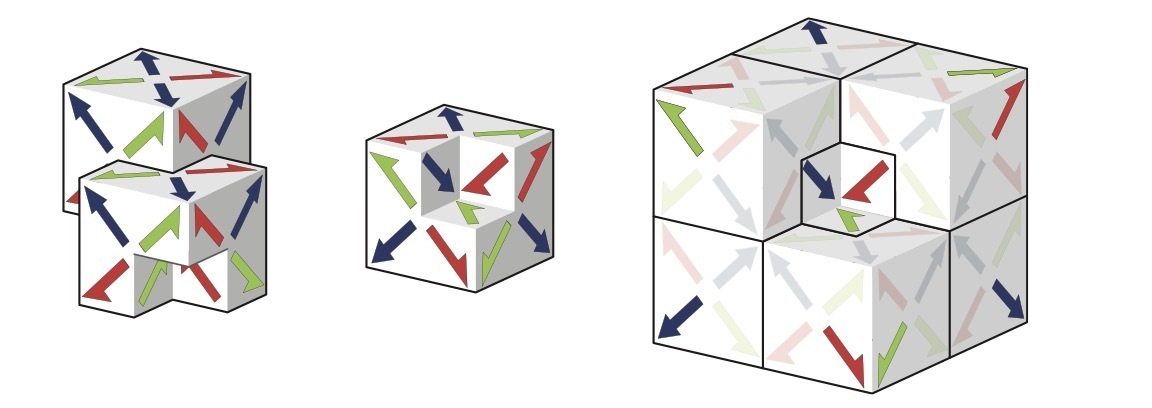
The arrow diagram above comes from Goodman-Strauss’s paper, which he posted online on September 21. He’d seen Tsiokos’s original 61-page AI-written article, then spent the time and effort it took to express the mathematical core of the argument in a tight eight pages. (Felix Flicker of Bristol University has written another succinct analysis.)
“Hats off to Tsiokos for this discovery,” Goodman-Strauss wrote, before continuing:
However, the paper itself and the formalization that it claims for support are not in a form that is readily usable to anyone who wants to understand or check it.… We must, absolutely, insist on a higher standard for scientific discourse. The aim must be to communicate, clearly, with people in the community — certainly this is an historical requirement for publication.
Tiling has deep connections with mathematical logic, which has inspired other mathematicians in more recent work. As Craig Kaplan, another co-author of the 2D monotile paper, wrote in an email:
In an age of AI-generated proofs, we lose some of that vigorous intellectual process. We receive the final outcome of our question, but in a way that produces no direct understanding, and that fails to spin off useful new ideas, objects, and methods. Some of that will surely come after the fact, but I think it’s not too precious to claim that in the before times, there was value in the fact that human minds had to wrestle mightily with these problems in order to solve them. The path they took was often more important than the final answer.
In other news:
OpenAI announced an independent advisory board made up of eminent mathematicians and the physicist Edward Witten.
In one of the many guest essays Terence Tao has been hosting on his blog over the past week, Grant Sanderson of the YouTube channel 3Blue1Brown called for a Hilbert-style list of open, important problems in mathematical exposition. Count us in.
Additional reporting by Natalie Wolchover.
Fields medalists denounce AI companies
A year ago this week, an unusual collection of mathematicians, philosophers, historians, and social scientists gathered in Leiden, home to the oldest university in the Netherlands, to ponder how artificial intelligence was changing math.
A document written by a group of people who attended the gathering, called the Leiden Declaration, was released on June 2. It sought to mitigate the potential risks that widespread AI use would pose to research mathematics. But it was measured, and written with an eye towards consensus.
Over the course of the summer, the tenor has shifted. Artificial intelligence has gone from success to success in math, but in a way that has turned the potential concerns of the Leiden Declaration into actual ones. On September 8, OpenAI announced that their model had solved one of math’s most famous problems, spawning a dispute over authorship, publishing norms, and other concerns. On September 11, a group of 25 Fields medalists published a polemic that does not mince words:
The push by AI companies to solve mathematical problems as a benchmark is detrimental to the science of mathematics, and to the mathematical community. The goals of the AI companies and the goals of the mathematical community are severely misaligned.
In just a few days, over 7,400 researchers endorsed the new declaration, more than had signed the Leiden Declaration in over three months.
Terence Tao of the University of California, Los Angeles, in many ways embodies the rapid evolution of the mathematical community as a whole. He has worked in the past with Google DeepMind and organized an OpenAI-funded workshop on “Accelerating Math and Theoretical Physics with AI.” Now he has signed both declarations. “I do not regret my past efforts to raise awareness of the potential of AI in mathematics, to engage with industry, and to promote a vision of sustainable incorporation of these tools,” he recently wrote.
But in the last few months, he noted, “the situation has deteriorated markedly.”
I spoke to dozens of mathematicians last winter and spring while reporting a feature about how AI is changing math. I was struck by how guarded they were. More than one mathematician spoke to me on-the-record about the benefits of AI, only to ask not to be quoted when speaking about its drawbacks.
In a sense, the ground was softened for the Fields medalists by a procession of younger, less established mathematicians. Kirwin Hampshire, a graduate student at the University of Victoria, was arguably the first, describing the Leiden Declaration in a late July essay as a “well-muffled scream.” A few days later, another graduate student, Caltech’s Tasmin Chu, called for a boycott of the use of AI to prove new theorems. A few days after that, Max Weinreich, an assistant professor at CUNY Baruch College, went further, arguing for “total opposition to the use of artificial intelligence in mathematics.” In mid-August, Iris Shi, who recently completed her Ph.D. at the University of Florida, published a lament critiquing how AI had changed how math research is done: “Easy incremental progress gets spit out by the LLM while I occupy myself with washing its Godawful prose out of a report in the foreground.”
A few days prior, a group of five young mathematicians had launched a publication, Proofs and Prompts, devoted to hosting a discussion by and for mathematicians about what AI means for math. On August 30, they published a critique of AI by Hugo Duminil-Copin, a Fields medalist and one of the authors of the more recent declaration.
Even as no-holds-barred criticisms of AI have become more acceptable, many, if not most, mathematicians are coming to rely on frontier AI models as a research tool. A total boycott seems unlikely. Nevertheless, after a tumultuous summer, the mathematical community is reasserting itself.
In other news:
University of Toronto mathematician Daniel Litt published an essay laying out “a positive vision of the future of mathematics, and the human practice of mathematics.”
EpochAI announced a benchmark of 68 Lean-formalized Erdős problems, curated by Thomas Bloom of the University of Manchester, the creator of Erdosproblems.com.
The Navier-Stokes proof has blown up the math world
Earlier this week, mathematicians at OpenAI announced that 10,000 autonomous AI agents under their direction had found a “singularity” in the Navier-Stokes equations — resolving one of the six remaining Millennium Prize problems. It potentially marks a major shift in what mathematics research will look like going forward. But it didn’t come without controversy. We wrote about the details of the result, the long research program that made it possible, and who deserves the credit. Read that story here.
Elusive complex structure found for S6, the six-dimensional sphere
A large language model has found an object that has eluded mathematicians since 1947, despite intense efforts to find it or prove it doesn’t exist.
In the mid-20th century, mathematicians sought to learn more about the nature of high-dimensional spheres by asking if it’s possible to create a “complex structure” on them. The idea is to divide a sphere into smaller pieces, and see if each piece can be mapped to a list of complex numbers (numbers of the form a + bi where i is the square root of –1) in a way that allows for consistent, well-behaved transitions between each piece.
Mathematicians have known since the 1850s that every point on the ordinary two-dimensional sphere can be identified with a single complex number. But can each point on the surface of a four-dimensional sphere be identified with a pair of complex numbers? Can each point on a six-dimensional sphere be identified with a triplet? And so on. (Since complex numbers each consist of two real numbers, it only makes sense to ask the question for even dimensions.)
When the German mathematician Heniz Hopf first posed these questions in 1947, he showed that four- and eight-dimensional spheres don’t have a complex structure. By 1951, researchers had shown the same for ten-dimensional spheres and above. But the six-dimensional sphere, S6, remained enigmatic. Was this phenomenon particular to two dimensions? If not, it might suggest something deeper about the relationship between geometry and complex variables. “In some sense, the six-sphere is the simplest manifold for which we did not know the answer,” said Mohammed Abouzaid, a geometer and topologist at Stanford University.
As numerous mathematicians have tried and failed to settle the question one way or the other, the stakes of the problem have grown.
On August 23, Levent Alpöge, a researcher at Anthropic, announced in a tweet that S6 has a complex structure. (A few days earlier, together with Tristan Buckmaster of New York University, he had found a proof of a singularity in the 3D Euler equations, which they announced earlier this week.) The tweet was accompanied by a nearly 100-page paper written using Claude, Anthropic’s AI model, which Abouzaid describes as “so poorly written that it will take a while to check.” (Alpöge agrees with the criticism, writing in a later tweet, “Yea clearly my bad for fucking up the writeup.”) He said he was too excited to take the time to explain the result clearly.
I spoke with several experts in the field who say that although it will take some time for a consensus to solidify about the correctness of Alpöge’s proof, early signs point to it being true. As Philip Engel of the University of Illinois in Chicago, who has written an expository note streamlining and clarifying the arguments Alpöge first publicized, told me, “For myself, I did all the computations necessary to convince myself that it’s true.”
A version of the statement has also been formally proved by Boris Alexeev at OpenAI, but Abouzaid cautions that although the formalization “is making the community confident that the statement is correct, the effort to digest Alpöge’s proof, and its connection to the formalized proof, have just begun.”
Arguably one reason mathematicians struggled to find the object is that an influential 1996 paper asserted that it couldn’t possibly exist. (In the aftermath of the new proof, that paper is now thought to be wrong.) Engel expects the new construction will have some interesting implications, leading to a “little bit of a zoo” as mathematicians generalize it. “Maybe we all would have died not knowing the answer if the AI hadn’t discovered it,” he said.
Announcing “Transformation,” a dispatch about math and AI
“Exponential” is a widely misused term. It shows up as a synonym for “rapid,” but its precise meaning is far more remarkable. As many readers of Quanta will already know, it means to double and double and double again, the pace of change accelerating faster and faster. It’s hard to develop intuition for just how rapid this kind of growth is, not least because it rarely lasts: Changes begin to come so quickly that they run out of steam.
Computing power is an exception that has held for the better part of a century. Built atop that exponential growth, frontier artificial-intelligence models have likewise grown exponentially for the last decade and a half.
In the autumn of 2025, I began reporting a feature for Quanta about the impact artificial-intelligence algorithms were having on math research. In all candor, I expected that impact to be limited. I knew that AI had a tendency to hallucinate, and in my limited firsthand use of large language models, I’d found them unreliable. I’d been a journalist for two and a half decades, so tech industry hype was not new to me. I knew that some serious people were using AI on real problems — I expected to find that, like any other tool, it would have certain interesting niche uses. The possibility that it might transform the discipline seemed remote.
As I reported the story over the course of the last months of 2025 and the first of 2026, I was surprised by what I found. Fundamental change had not yet arrived, but it was impossible to avoid the conclusion that it was coming. My intuition for what exponential growth can do was — predictably — off.
Over this past summer, the scale of the change AI is bringing to math has become clearer. As Akshay Venkatesh of the Institute for Advanced Study wrote in a prescient essay: “Mechanical reasoning will change not only how we do mathematics, but what it is; this must be renegotiated amongst its practitioners and with society.”
These updates are intended to be a chronicle of that renegotiation, which is now underway at a rapid, sometimes frenetic, pace.
Our goals here are twofold.
First, as new results are established with the aid of artificial-intelligence algorithms, we will explain them in a timely fashion. We will put new results in mathematical context: How important do mathematicians think the latest counterexample is? How novel is a connection that AI discovered between different branches of math? What are the potential consequences of a new method of proof? Did AI reveal that a problem previously thought to be hard was simpler than it seemed, or did it solve a hard problem?
Second, we will cover the ways in which mathematicians are wrestling with the changes AI is bringing to their discipline. That response is, like the mathematical community itself, varied. Some welcomed these changes; others now call for resistance to AI or even “total opposition to the use of artificial intelligence in mathematics.” How effective is formalization as a tool for combating AI slop? Can an AI model be a co-author on a paper, or even its sole author? How do peer review and mathematical journals change when AI is used to do math?
It is my expectation that some aspects of what it is to be a mathematician will abide through the transformations brought by AI. Others will, in all likelihood, be wholly changed.
These are just some of the topics we will tackle. If you have an idea for something you think we should cover, we’d like to hear from you. Please write us at [email protected].
These are, of course, big questions. We will continue to cover them both here and in the rest of Quanta’s digital pages.
Welcome to Transformation.