What Do Gödel’s Incompleteness Theorems Truly Mean?
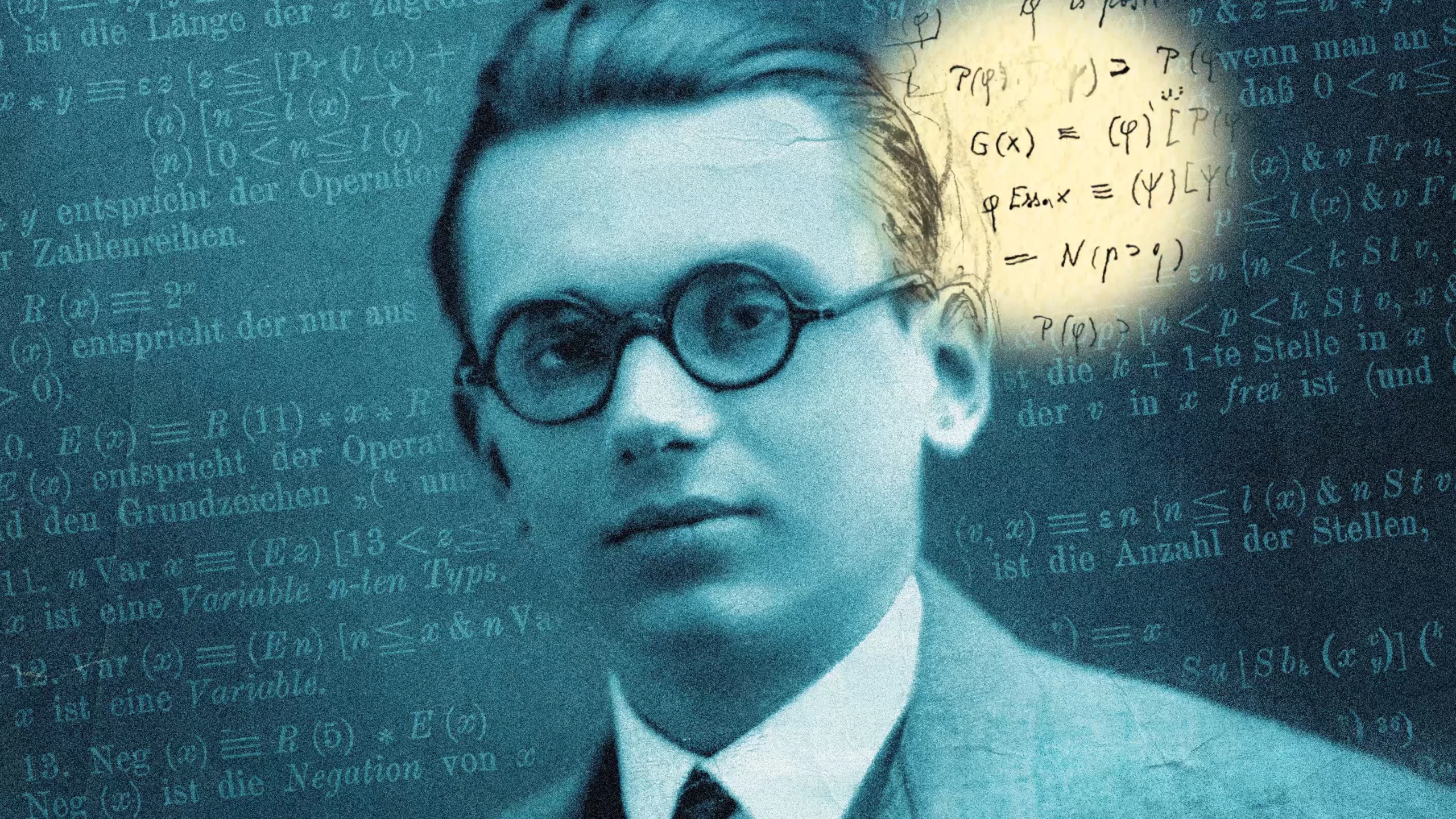

In 1931, by turning logic on itself, Kurt Gödel proved a pair of theorems that transformed the landscape of knowledge and truth. These “incompleteness theorems” established that no formal system of mathematics — no finite set of rules, or axioms, from which everything is supposed to follow — can ever be complete. There will always be true mathematical statements that don’t logically follow from those axioms.
I spent the early weeks of the Covid pandemic learning how the 25-year-old Austrian logician and mathematician did such a thing, and then writing a rundown of his proof in fewer than 2,000 words. (My wife, when I reminded her of this period: “Oh yeah, that time you almost went crazy?” A slight exaggeration.)
But even after grasping the steps of Gödel’s proof, I was unsure what to make of his theorems, which are commonly understood as ruling out the possibility of a mathematical “theory of everything.” It’s not just me. In Gödel’s Proof (a classic 1958 book that I heavily relied upon for my account), philosopher Ernest Nagel and mathematician James R. Newman wrote that the meaning of Gödel’s theorems “has not been fully fathomed.”
Maybe not, but six decades have passed since then. Where are we with these ideas today? Recently, I asked logicians, mathematicians, philosophers, and one physicist to discuss the meaning of incompleteness. They had plenty to say about the implications of Gödel’s strange intellectual achievement and how it changed the course of humanity’s unending search for truth.

PANU RAATIKAINEN, philosopher at Tampere University and author of the Stanford Encyclopedia of Philosophy entry on Gödel’s incompleteness theorems
Ever since the ancient Greeks, the axiomatic method has been widely taken as the ideal way of organizing scientific knowledge. The aim is to have a small number of “self-evident” basic propositions — axioms, principles, or laws — such that all truths of the field in question can be logically derived from them.
Gödel’s incompleteness theorems show with mathematical precision that this ideal necessarily fails for large parts of mathematics. The whole of mathematical truth concerning even just positive integers (1, 2, 3 …) is so perplexingly complex that it does not follow from any finite set of axioms.
This means that some mathematical problems are not even in principle solvable by our current mathematical methods. Progress may require creative conceptual innovation. As a result, mathematical truths do not make up a unified whole of equally indubitable truths; instead, their status as knowledge varies gradually from doubtless facts to increasingly uncertain hypotheses.
Raatikainen makes a good point that Gödel’s theorems muddy the waters between where objective truth ends and invented math begins. One historical way people have tried to overcome the limitations of Gödel’s theorems has been to propose additional axioms beyond the commonly accepted ones. Say you want to prove a statement with the traditional axioms, but you find that you can’t — that it is undecidable. If you add a new axiom to your starting set, you may then be able to prove the statement true. Adding a different axiom, however, and you may be able to prove it false. So whether it’s true or false depends on the choice you’ve made. Suddenly, “truth” is more contingent on one’s preferences or assumptions.
REBECCA GOLDSTEIN, philosopher and author of Incompleteness: The Proof and Paradox of Kurt Gödel
Intuitions have always played an important role in mathematics. After all, we can’t prove everything; we need to accept some truths (i.e., the axioms) without proof in order to get our proofs off the ground. But we’ve learned over the centuries that sometimes intuitions prove unreliable — so unreliable as to generate actual paradoxes — meaning we’re driven to assert out-and-out contradictions.
In the early 20th century, Bertrand Russell and Alfred North Whitehead were working on The Principles of Mathematics, which attempted to reduce arithmetic to logic. [The view that math is nothing but logic is known as “logicism.”] The work led Russell to the discovery of what came to be called Russell’s Paradox. It concerns the set of all sets that aren’t members of themselves. The paradox reveals itself when you ask: Is this set a member of itself? The contradiction: If it is, then it isn’t. And if it isn’t, then it is. (Georg Cantor, considered the founder of set theory, had already realized the contradiction back in the 1890s.)
The response of mathematicians — most forcefully David Hilbert, the leading mathematician of that time — was to rid mathematics of iffy intuitions by way of formally axiomatizing mathematics into a consistent and complete set of algorithmic, recursive rules, essentially reducing math to a mechanical game of symbol manipulation. This goal of formalization was christened the Hilbert Program.
What Gödel proved was that the Hilbert Program was unrealizable. His first incompleteness theorem states that in every formal system of mathematics that is rich enough to express arithmetic, there will be propositions that are both true and unprovable. So, although formal systems comprised of mechanical rules of symbol manipulation successfully eliminate all intuitions, they also fail to capture all that we know to be mathematically true — a knowledge enriched by intuitions concerning the infinite structures that we call numbers.
It’s fascinating that our intuitions about numbers might go beyond what we can prove.
Personally, my intuition is silent on the mathematical statement that, in the years after Gödel’s proof, made incompleteness real. It is called the continuum hypothesis, and it asserts that the set of all real numbers (the continuum) is the second-smallest infinite set after the set of natural numbers (1, 2, 3 …). It was found to be undecidable using the standard axioms of mathematics. Extra axioms can be engineered to establish it as true or false, but logicians are divided on which way to go.
A physicist I spoke with warns that the undecidability of the continuum hypothesis has implications for his field: that physicists might need to avoid the continuum altogether.
CLAUS KIEFER, physicist at the University of Cologne, author of a 2024 paper on the relevance of Gödelian incompleteness for fundamental physics
Kurt Gödel’s proof has far-reaching and unexpected consequences for mathematics. Given that physical laws are formulated in mathematical language, is it relevant for physics, too? I think yes.
Among the most important undecidable statements is the continuum hypothesis (CH), proved to be undecidable in the Gödelian sense by Paul Cohen in 1963. The name “continuum” comes from the postulate to identify the points on a line with the real numbers. But how many real numbers are there? There is an uncountable infinity of them, but can this uncountability be specified? The CH states that the real numbers form the next-smallest infinite set after the infinite set of the natural numbers, which are countable.
Now consider that the known fundamental interactions in physics are defined on a space-time continuum. The uncountable number of points associated with this continuum is responsible for various problems in physics. In Einstein’s theory of general relativity, for instance, our modern theory of gravity, it leads to singularities that prohibit the mathematical description of the universe’s origin and the interior of black holes. In the Standard Model of particle physics, described by a quantum field theory, direct calculations yield infinite results for energies and other physical quantities, which must be eliminated by a sophisticated and nonintuitive mathematical procedure.
The situation becomes more severe in the push for a final unified theory of all interactions. A unified theory should be characterized by a consistent and complete mathematical language. But if a unified theory were to describe space-time as a continuum, the CH may render the theory incomplete. Physicists have already shown that the CH leads to undecidable questions in quantum field theory, such as whether certain atomic systems have an “energy gap,” enabling them to settle into stable ground states. This undecidability stems from the fact that the calculation assumes the atoms inhabit a space-time continuum. One may argue that a more fundamental theory (with more complete axioms) could decide the question, but the final theory should not have undecidable statements. So it should not involve a continuum.
In my opinion, this situation of undecidability can only be avoided if the structure of space and time is discrete — that is, characterized by a countable infinity of points only. There are hints for a discreteness in some approaches to quantum gravity, for example string theory or loop quantum gravity, but the situation is far from clear.
It’s worth noting that on top of these troubles with the continuum hypothesis, high-energy physicists have many other reasons to think a continuous space-time is not fundamental to reality, but rather only a long-distance illusion that emerges from other parts.
JOUKO VÄÄNÄNEN, mathematician and logician at the universities of Helsinki and Amsterdam
Incompleteness is an unwelcome but unavoidable fact of life in mathematics, like irrational and transcendental numbers in number theory, or Heisenberg’s uncertainty principle in physics.
There is a kind of “Gödel barrier” that formal language cannot circumvent: The stronger the expressive power of a logic (meaning the more things you can say in the logic), the weaker is its effectiveness (meaning our ability to prove statements true or false in the logic), and the stronger the effectiveness, the weaker is the expressive power.
For example, one of the simplest logical systems is propositional logic, which lets you combine statements with operations such as “and,” “or,” and “not.” It is very effective, but its expressive power is weak. On the other end of the spectrum, there’s second-order logic, which lets you make statements about objects, properties, sets, and relationships. It has tremendous expressive power and very weak effectiveness. It is as if the “product” of effectiveness and expressive power were constant, just as in Heisenberg’s uncertainty principle, which says that there is a limit to the precision with which certain “complementary” pairs of physical properties, such as position and momentum, can be simultaneously known; in other words, the more accurately one property is measured, the less accurately the other property can be known. In logic, in a remarkable analogy, effectiveness and expressiveness are such “complementary” properties. This is the real content of Gödel’s incompleteness theorems.
We stumble forward in mathematics without any certainty of consistency or completeness. This is just how things are.
It is shocking that mathematics, which is the basis of exact sciences, lacks a foundation that can be proved to be consistent and complete. Hilbert can be forgiven for thinking that this cannot be the case. However, it is the case, as certainly as the square root of two is irrational. Mathematics has a puzzling lump of incompleteness which can be pushed from place to place but it will never disappear.
Surprisingly, Gödel himself was a little more optimistic. Here, Rachael Alvir explains that Gödel maintained the dream of a formal logical system that could settle the continuum hypothesis and all other questions about sets, the building blocks of modern mathematics. His incompleteness theorems tell us that any such system, so long as it consists of a finite list of axioms, will give rise to new statements that are undecidable within that system. But he wondered about the possibility of an infinite succession of ever-larger axiomatic systems that could settle every question.
RACHAEL ALVIR, logician and lecturer at the University of Waterloo
We have all been exposed to the general idea that Gödel killed Hilbert’s Program for thorough formalization of math. This is a common interpretation, so I was shocked when I first read Gödel’s original works. In his 1931 paper, in which the incompleteness theorems are first proven, Gödel explicitly states the opposite: “It must be expressly noted that Proposition XI (and the corresponding results for M and A) represent no contradiction of the formalistic standpoint of Hilbert.” In a footnote, he reiterates that the undecidable theorems of the 1931 paper are only undecidable relative to one system. The undecidable statements of any given logical framework can be mathematically proven to be true or false in a larger logical framework.
Gödel had no qualm with the claim that mathematics could prove or disprove every well-posed statement. Rather, Gödel took issue with Hilbert’s restrictive methods. Why should we believe there is a single, finite set of axioms, from which every truth will follow in a finite number of logical steps? Gödel believed that it was possible to redefine what we mean by a formal mathematical framework, or allow for alternative frameworks. He often discussed an infinite sequence of acceptable logical systems, each more powerful than the last. Every well-formulated mathematical question might be answerable within one of them.
Often people will speak as if the CH is the smoking gun that shows sometimes mathematical questions have no answer. But in my opinion, this situation provides very little evidence that there are “absolutely undecidable” mathematical problems, relative to any given permissible framework. It is simply one example of a statement which has not currently been decided, and on its own provides no reason to suspect it could not be decided in the future using new techniques. There are extensive, ongoing debates about this deep in the trenches of mathematics and philosophy.
The strongest point I wish to make is that the mathematical results, on their own, cannot settle the question. It is far from obvious that there are mathematical questions with no solution. For me, Gödel’s theorems do not show that mathematics is limited, but rather that mathematics is much wider and more powerful than Hilbert’s finitistic view.
Alvir further clarified that there are different ways the old dream of mathematical truth might be realized. One approach could be to tack on to the commonly accepted axioms a new one that settles the CH and doesn’t otherwise lead to any contradictions. Another approach is to discover a scheme for an infinitude of axioms that settles the CH and other questions. Or we could switch to a different logical system than the standard one, and in that alt-logic, settle the CH. (“My personal favorite [logical system] is called L-omega-1-omega,” Alvir told me, for anyone who wants to explore that further.) Or maybe the answer is “something totally new,” she said — “a truly novel stroke of creative genius. … We come up with radically new mathematical techniques to solve problems all the time. Why expect we won’t do the same for the CH?”
Of course, proving the CH true or false wouldn’t vanquish all undecidability.
I’m going to let Väänänen’s colleague (and wife) have the last word.
JULIETTE KENNEDY, philosopher of mathematics and mathematical logician at the University of Helsinki, editor of Interpreting Gödel: Critical Essays
It is easy to lose one’s sense of wonder at the fact that such a blindingly obvious set of axioms — the Peano axioms for arithmetic (the set of rules about the natural numbers 0, 1, 2, 3 … closely related to the system that Gödel used in his proof, such as the rule, “Every number has a successor”) — is essentially incomplete and undecidable, meaning that all axiomatizable consistent extensions are incomplete and undecidable. Hold on to that wonder! The incompleteness theorems teach us that when it comes to our attempt to master the conceptual order, whether it be in mathematics or, for that matter, in any other domain, we will always fail — and indeed, in this case more than any other, we should be glad to have failed, for failure was clearly the more interesting, the more profound, outcome.