An Early Step on the Long, Strange Road to Photosynthesis
Son of Alan for Quanta Magazine
Introduction
Every second, trillions of watts of solar energy — more than 10,000 times the energy used by modern humans — blast the Earth’s surface. Around 2.4 billion years ago, life took an evolutionary leap when bacteria learned to harness these photons to break apart water molecules and stitch carbon atoms into sugars. Along the way, they flooded Earth’s atmosphere with oxygen and rewrote the rules of life.
“The oxygen-evolving capability was a big innovation. I sometimes call that a singular event,” said Robert Blankenship, a retired biochemist from Washington University in St. Louis. “By all accounts, it only happened once during the process of evolution, and that really set up the world for becoming oxygenated and the wholly aerobic world that we live in now.”
However, the set of chemical reactions we call photosynthesis has bewitched and befuddled scientists for generations. It requires the coordination of dozens of proteins and hundreds of pigments that harvest photons, all embedded in a cellular structure less than one-thousandth the width of a human hair. Electrons pinball across membranes and between compounds to drive molecular turbines that rebuild air and water into sugars to provide the energy and raw materials that cells need to grow.
We now know this process in fundamental detail; advances in microscopy and cell biology mean that researchers can essentially track a single electron through photosynthetic proteins to illuminate the full molecular mechanism. This level of detail dims, however, as scientists attempt to travel back in time to understand how photosynthesis could possibly have first evolved in single-celled organisms called cyanobacteria over 2 billion years ago.
“It’s now pretty clear that all the photosynthetic [protein] complexes descend from a single common origin,” said Blankenship, who spent his career studying the molecular mechanisms of photosynthesis. “But the nature of that very first organism is not very well understood.”
To solve such riddles, biologists often turn to organisms that share many, but not all, of the traits they want to understand. But for years, they believed that nearly all modern cyanobacteria evolved in a single, closely related cluster, offering little variation that might reveal mechanisms of early photosynthesis. The discovery of Gloeobacteria, a group of photosynthetic bacteria that branched off from other cyanobacteria over 2 billion years ago, changed this. Although Gloeobacteria haven’t remained at an evolutionary standstill — no organism has — they seem to have changed little over billions of years, making them a sort of genetic time capsule.
“[Gloeobacteria] tell us a little bit about what the earliest cyanobacteria might have looked like,” said Christen Grettenberger, a geochemist and microbiologist at the University of California, Davis. “It’s not some weird one-off species. It has a real pattern of retaining these tools.”
The most recently identified Gloeobacteria species, Anthocerotibacter panamensis, harvests light using a different set of proteins than modern cyanobacteria — but converts sunlight into chemical energy within protein complexes that vary only slightly from those in other Gloeobacteria. These traits add new color to the long, strange evolutionary story of photosynthesis.
A Photon Capture Machine
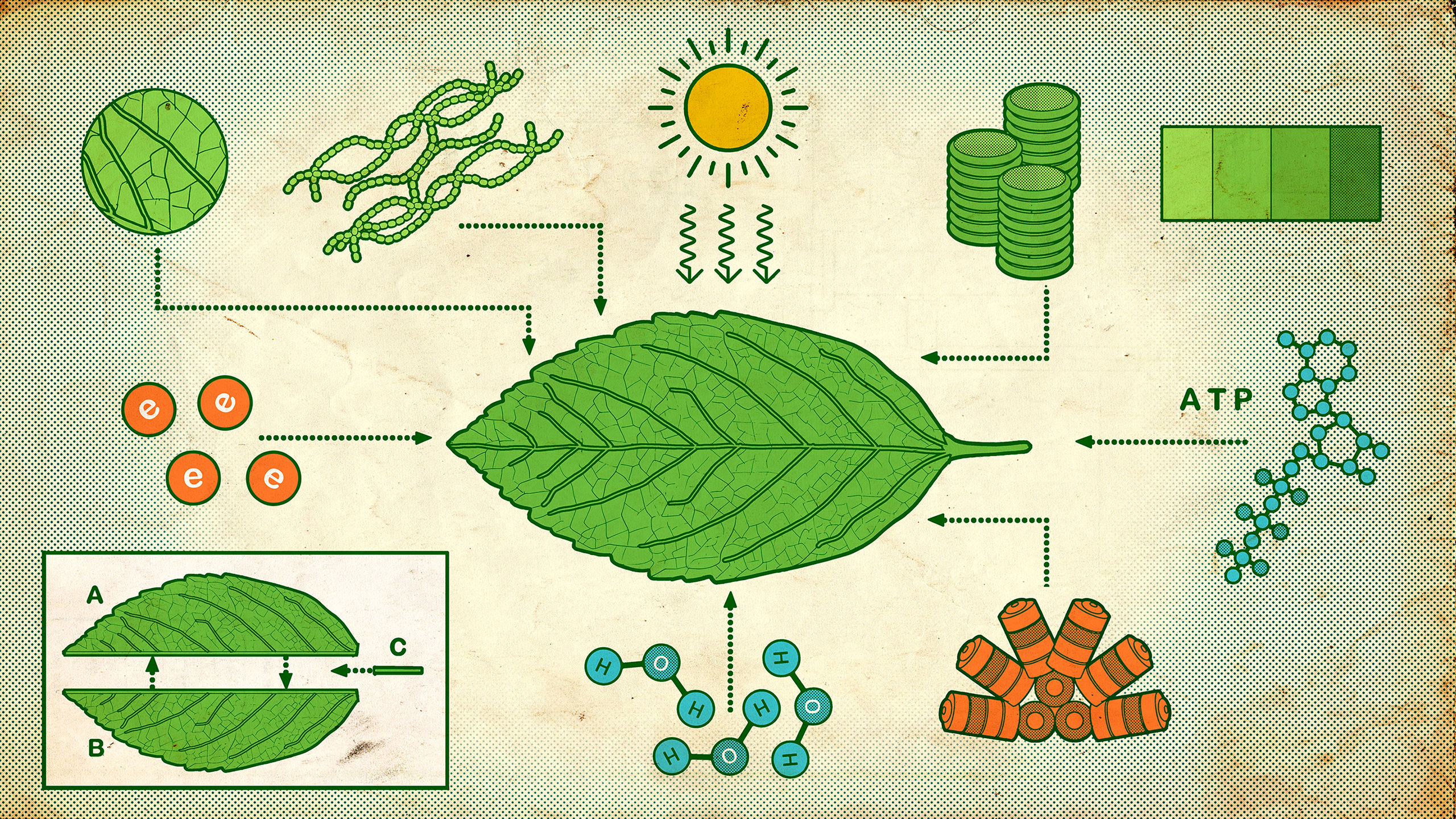
Before striking a plant leaf, a solar photon travels 93 million miles through empty space. The most dynamic part of this journey happens in the last few billionths of a meter, as a Rube Goldberg machine of proteins and pigments converts the photon’s light energy into chemical energy.
Mark Belan/Quanta Magazine
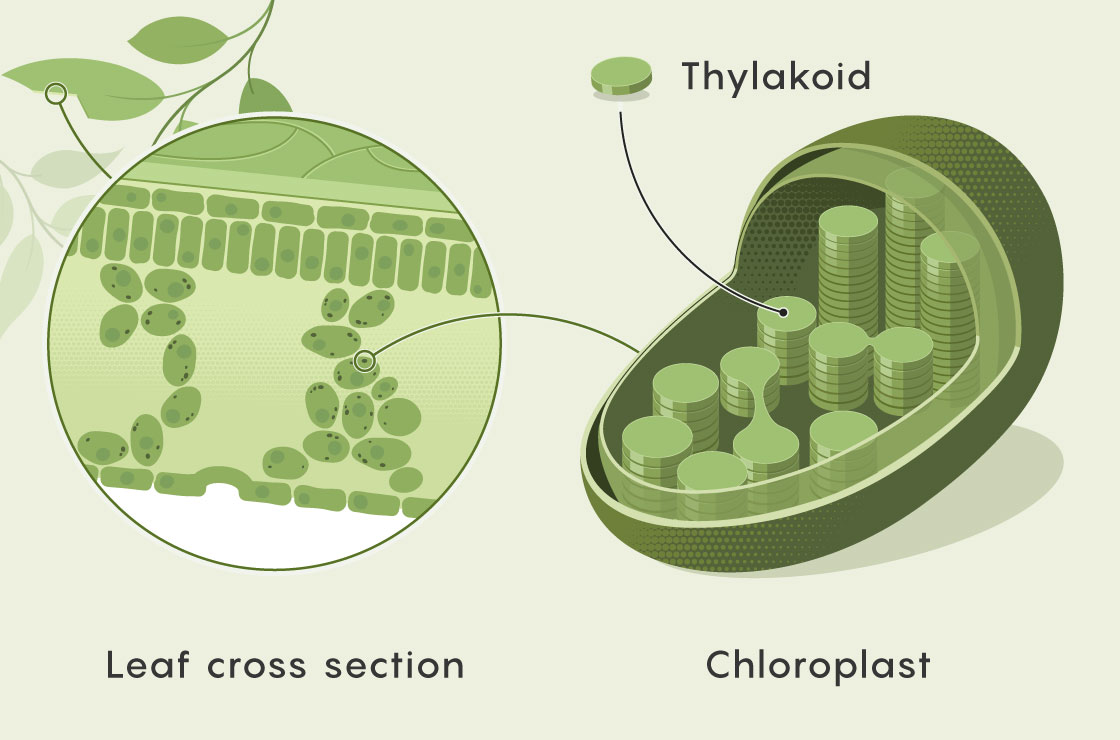
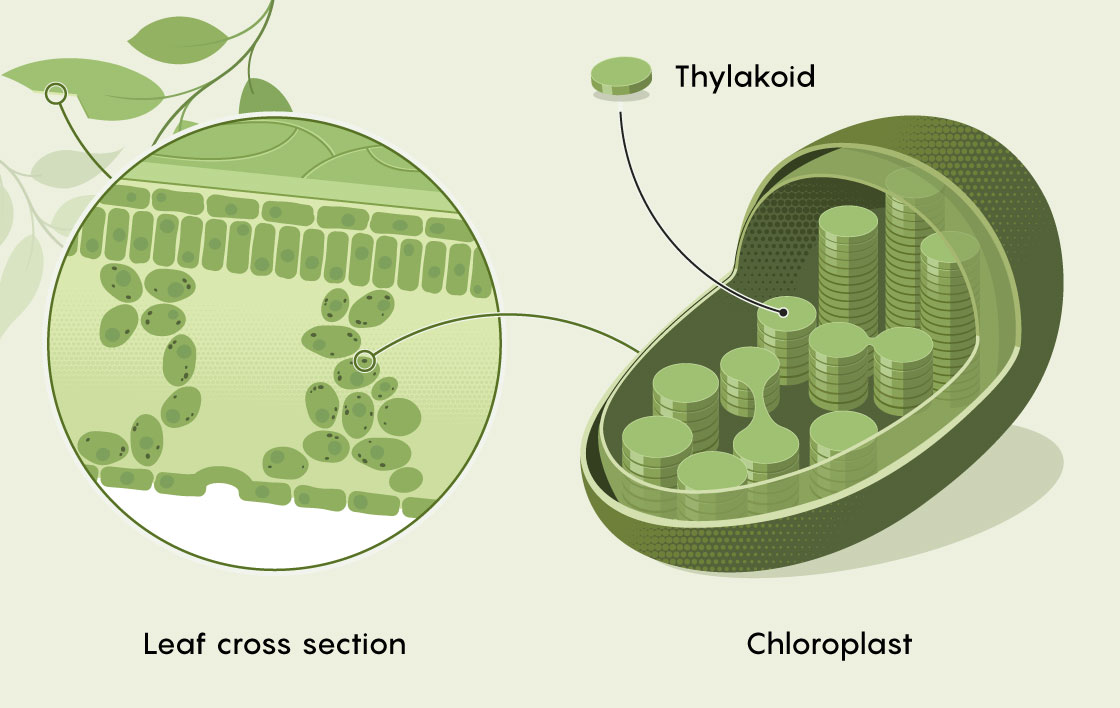
The leaves of modern land plants are packed with chloroplasts, oblong organelles that are themselves stuffed with stacks of coin-shaped compartments known as thylakoids. Thousands of proteins and pigments stud the thylakoid membrane, creating a sprawling biochemical circuit with a single purpose. A large protein complex there, named photosystem II, hosts light-harvesting “antenna” complexes on its outer ring that maximize the number of photons the plant can snag. Chlorophyll and other pigments embedded within the antennae absorb the energy from captured photons. Then, as in a game of hot potato, chlorophyll and other pigment molecules funnel this excess energy to the reaction center of the photosystem.
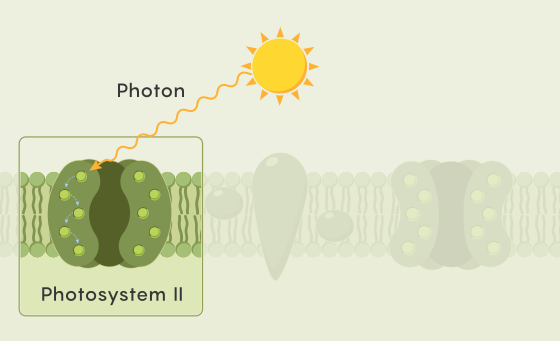
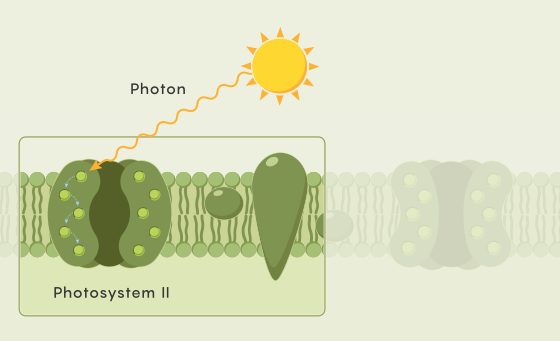
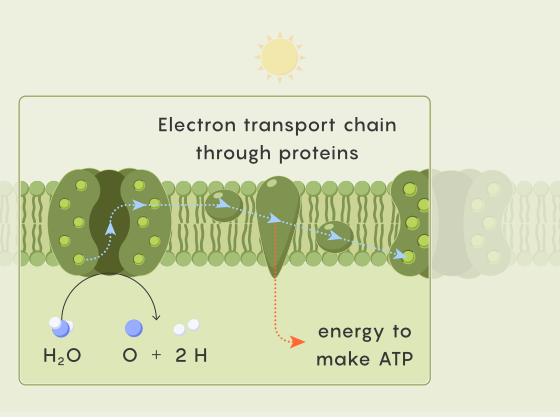
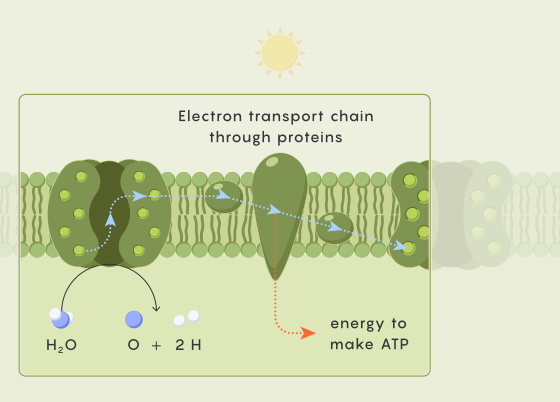
Energy is lost every time the photon hops between pigments, but it retains enough to jolt electrons loose from nearby water molecules, releasing oxygen as waste. These liberated electrons then flow through a series of membrane-bound proteins, known as an electron transport chain, where their energy pumps protons and spins molecular turbines. This molecular assembly line generates life’s energy currency, a molecule known as adenosine triphosphate (ATP).
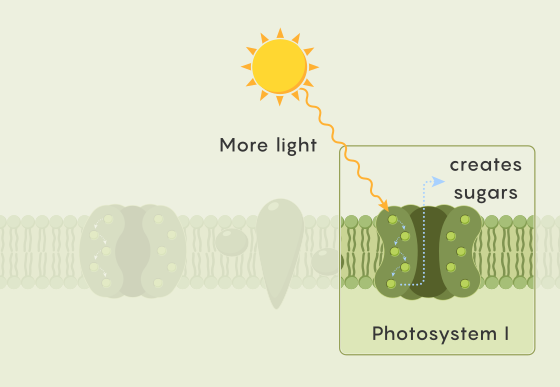
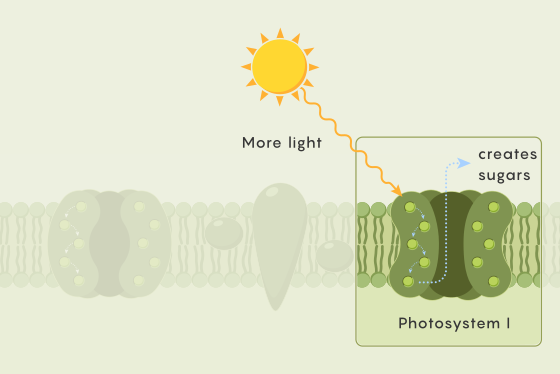
But photosynthesis isn’t complete at that stage. Mostly depleted, the electrons then reach photosystem I, where another burst of sunshine kicks the flow back into high gear. Supercharged again, the electrons drive a separate set of reactions that build sugars from carbon dioxide. These sugars are themselves a form of energy, as the plant (as well as other organisms) can break them down to make more ATP.
Over billions of years, the reaction centers of the two photosystems have remained remarkably unchanged. Evolutionary innovation has occurred, however, in the astonishing array of antenna complexes and accessory pigments seen across photosynthetic life. This juxtaposition of severe conservation with extreme diversity creates a challenge for scientists trying to understand how photosynthesis first evolved.
Even the earliest photosynthetic system must have already been a tiny solar-powered electrical circuit, capturing light and channeling electrons into metabolism, said Christopher Gisriel, a biochemist at the University of Wisconsin, Madison. “At a minimum, we know that it would have all the features that we see in the diversity of reaction centers or photosystems today,” he said. “It would have had the ability to somehow collect that light and perform charge separation and then move those electrons into metabolism.”
There is some photosynthetic diversity in living organisms that can provide insight into how this complex process could have evolved. For example, some bacteria use only photosystem I and avoid oxygen altogether in a form of anoxygenic photosynthesis. Many researchers therefore hypothesize that anoxygenic photosynthesis and its photosystem evolved first. Then, at some point in the distant past, the system’s genes were duplicated. Over evolutionary time, this theory goes, one of those copies mutated and evolved to give rise to a second photosystem that uses oxygen to harvest energy more efficiently.
Not all evolutionary biologists agree that photosystem I came first, but if it did, then how and when did it evolve? Even a primitive, stripped-down version would be an evolutionary marvel. The protein megacomplex boasts multiple subunits in a precise structure, where antenna proteins are decorated with chlorophylls and other pigments and surround a core reaction center where electrons twirl in an elaborate pas de deux.
This is why researchers are flocking to an ancient lineage of single-celled cyanobacteria that could hold a more primal version of this process.
A Strange Antenna
The cells arrived as microscopic stowaways. They traveled on the leaf of a hornwort from Panama to the lab of the plant biologist Fay-Wei Li in Ithaca, New York. There, Li’s laboratory technician Duncan Hauser stripped microbial detritus from the hornwort’s leaves. He thought he had done a thorough job, but a chance glimpse of a small green speck under the microscope revealed he had missed something.
That Hauser had discovered a new species of bacterium wasn’t especially exciting; most microbial species have yet to be identified and described. But as Hauser, Li, and then-postdoc Nasim Rahmatpour peered more intently at the interloper, they realized that its color and shape didn’t resemble those of most other cyanobacteria. An analysis of its DNA revealed their contaminant to be a type of Gloeobacterium, a lineage of photosynthetic microbes that branched off from cyanobacteria over 2 billion years ago. They named it Anthocerotibacter panamensis in honor of its Central American birthplace and published their results in July 2021.
Even among the little-known Gloeobacteria, A. panamensis was unusual: It branched off from the rest of the group 1.4 billion years ago. “This is an entirely different organism from the ones that we know of,” said Li, who is based at the plant-focused Boyce Thompson Institute. “We know very little about them, and they’re completely different from other cyanobacteria.”
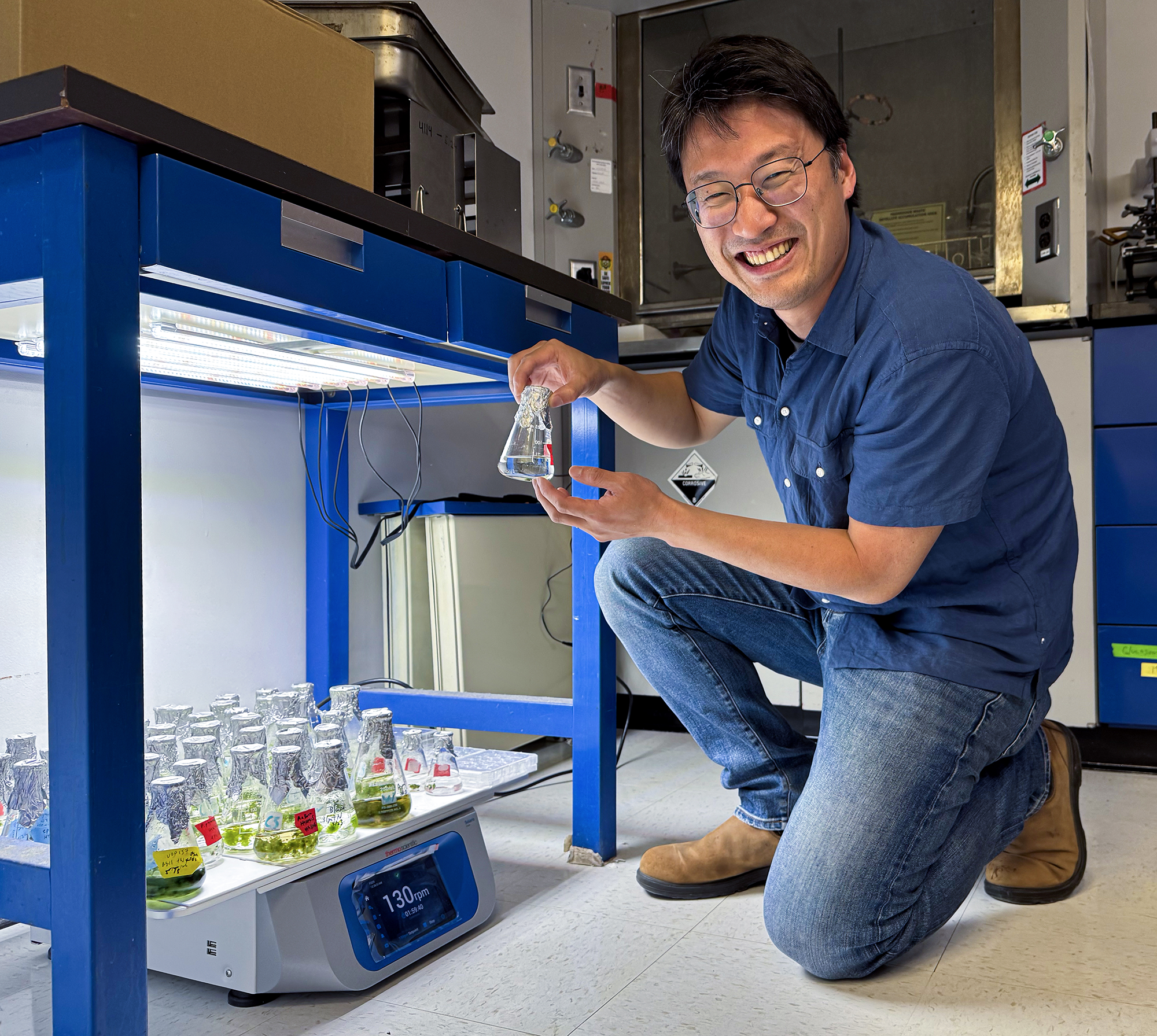
Fay-Wei Li and his team characterized a new type of Gloeobacteria, a lineage that split from modern cyanobacteria more than 2 billion years ago, and cultured it in the lab.
Courtesy of Fay-Wei Li
Li’s team used cryo-electron microscopy to examine the bacterium’s subcellular structures and capture detailed images of its inner workings. A. panamensis had both photosystems — but no thylakoids. A sister species, Gloeobacter violaceus, discovered in 1974, also lacked thylakoids, indicating that the now-familiar structures found throughout modern cyanobacteria likely hadn’t yet evolved when Gloeobacteria split from the group. Instead, its photosystems stud the cell’s external plasma membrane rather than the thylakoid membrane found in plants and modern cyanobacteria.
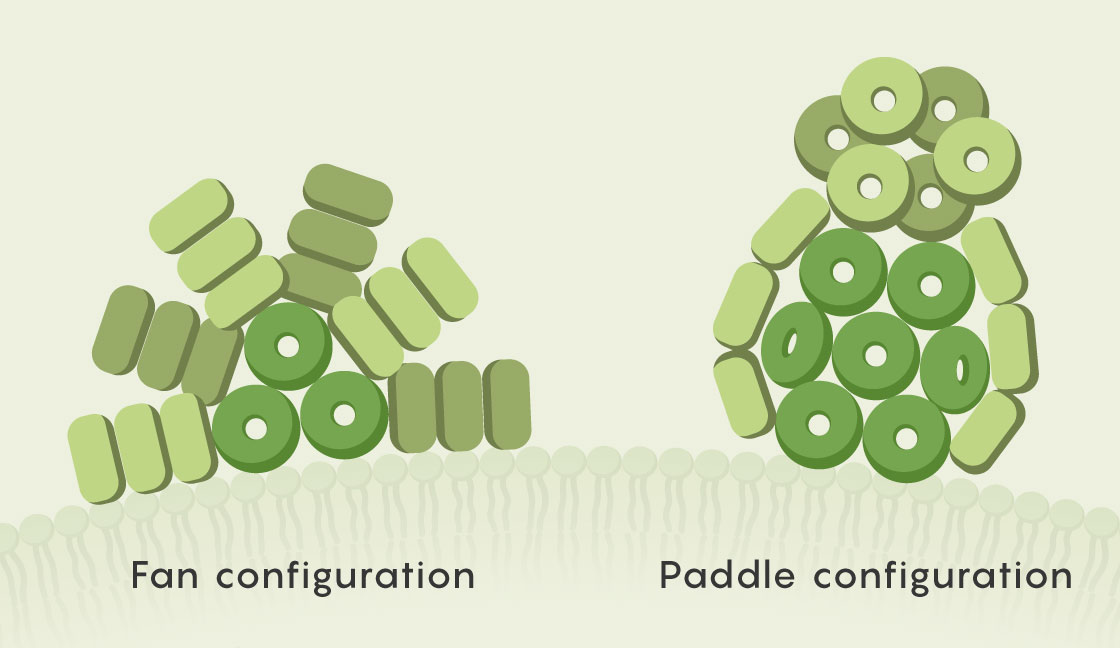
Among the most conspicuous anomalies were the structures A. panamensis used to harvest light. Most modern cyanobacteria have large antenna complexes (or phycobilisomes), built from proteins infused with light-absorbing pigments, that fan out from the thylakoid membrane in a large semicircle. The antenna complex in A. panamensis, however, looked nothing like a fan: It better resembled a canoe paddle. In 2023, experiments showed that this paddle-shaped antenna strongly reduced the rate at which A. panamensis could photosynthesize. Li suspects that the paddle shape doesn’t collect as many photons as a fan shape.
But what about its core photosynthetic machinery? A different team of scientists, including Gisriel, conducted a deep dive into photosystem I of A. panamensis to look for clues to how oxygen-producing photosynthesis might have evolved. The reaction center at the heart of the photosystem, where chlorophyll pigments absorb photons and produce sugar from carbon dioxide, showed only a few small changes when compared to the photosystems of other Gloeobacteria. However, there was far more evolutionary change on the photosystem’s light-harvesting proteins that bind the pigments, such as the ones that make up the paddle-shaped antenna complex.
These results, published in May 2025 in the Proceedings of the National Academy of Sciences, suggest that the forces of natural selection have made limited changes to the photosystem’s core, but that other aspects of the photosynthetic machinery have proved more malleable.
“The photosynthetic system complexes are incredibly similar. There’s not that much variation, even where there’s relatively significant changes [in other places],” said the chemist Gary Brudvig of Yale University, a co-author on the paper. “Once nature came on with the solution, it didn’t change very much. It kept the basic framework.”
The new findings in A. panamensis suggest that Gloeobacteria may indeed reflect a more ancient, basal form of photosynthesis. Over the past few billion years, most cyanobacteria and plants have evolved new features — more complex photosynthetic proteins as well as entirely new structures, such as thylakoids, to make the process more efficient. However, the photosystem I architecture of the Gloeobacteria has changed little over all that time. Now researchers can inspect the core of the photosynthesis reaction center to understand how this ancient molecular machine might have evolved.
“In my opinion, this makes it all that much more unlikely that oxygenic photosynthesis was at the root of the bacterial tree,” said Charles Delwiche at the University of Maryland, who studies the evolution of photosynthesis and was not involved in the study.
That is assuming, however, that structures in Gloeobacteria are nearly identical to what they were billions of years ago. “[It] is not a snapshot in time. It’s not a fossil from 2.5 billion years ago,” said Patrick Shih, a plant synthetic biologist at the University of California, Berkeley who was not involved in the study. “It’s undergone 2.5 billion years of evolution since that most recent common ancestor.” That’s why discovering more sister species to A. panamensis remains important, he said: More examples are needed to make a fully convincing case.
Evolutionary Oddity
The evolutionary discoveries surrounding A. panamensis — its lack of thylakoids, unique antenna, and stable photosystem — have encouraged Grettenberger and Li to embark on a global quest for more Gloeobacteria. Grettenberger wants not only more DNA evidence of this important group, but also species that, like A. panamensis, can grow in the lab.
“It would be really, really nice if we could get even earlier branching [species], so that we could see a stepwise evolution,” she said. Only by enlarging the comparison group will biologists be able to determine whether some of the traits seen in A. panamensis are evolutionary oddities or more broadly representative of early life, she added.
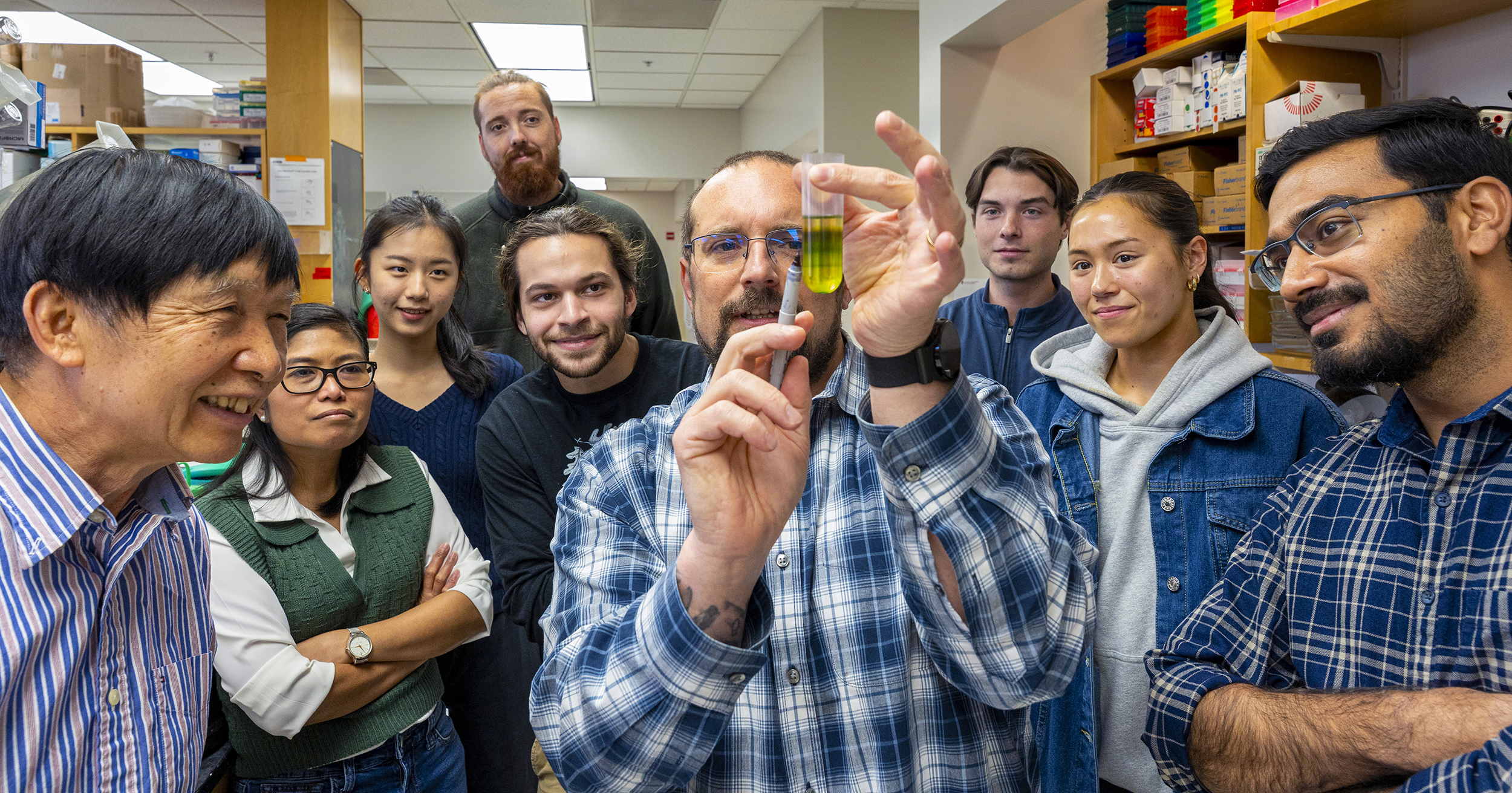
The biochemist Christopher Gisriel (center) and his team found that the core photosynthetic machinery of A. panamensis remained remarkably similar to that of other Gloeobacteria despite 1.4 billion years of evolutionary distance between them.
Paul Escalante
More examples could also help address the mystery of which photosystem evolved first. While the hypothesis that the very first photosynthetic organisms were anoxygenic would be the most logical explanation, in several papers published in 2019 and 2021, the evolutionary biologist Tanai Cardona at Queen Mary University of London argued that oxygenic photosynthesis may well have evolved first. Scientists have so long assumed that anoxygenic photosynthesis — and photosystem I — came first that any new data is immediately interpreted through that lens, he said, even though the data remains incomplete.
Both photosystems “go back to a single ancestor,” said Cardona, who co-authored the 2025 paper on A. panamensis. “But at this stage, we have no sequence evidence to suggest that one gave rise to the other.” The gene duplication event that doubled the photosystems, allowing one copy to evolve a novel process, happened so long ago that any evidence of that first photosystem has been buried by extinction and billions of years of change. Still, clues are likely out there.
For Shih, the implications of this work go far beyond basic science. The reality is that the chemical reactions that comprise photosynthesis and sugar production — the foundation of life’s diet, and thus humanity’s — are highly inefficient. Shih and other scientists are working to engineer improvements in photosynthesis to boost crop production. Before scientists start experimenting, they need to know how the parts of the photosynthetic system fit together.
That system, as we have it today, started some 2 billion years ago, when the emergence of oxygenic photosynthesis left an indelible green stain across Earth’s surface. That was when microbes wrested energy from light and, in the process, breathed new life into the world.