Key Chemistry Question Answered, No Quantum Computer Required
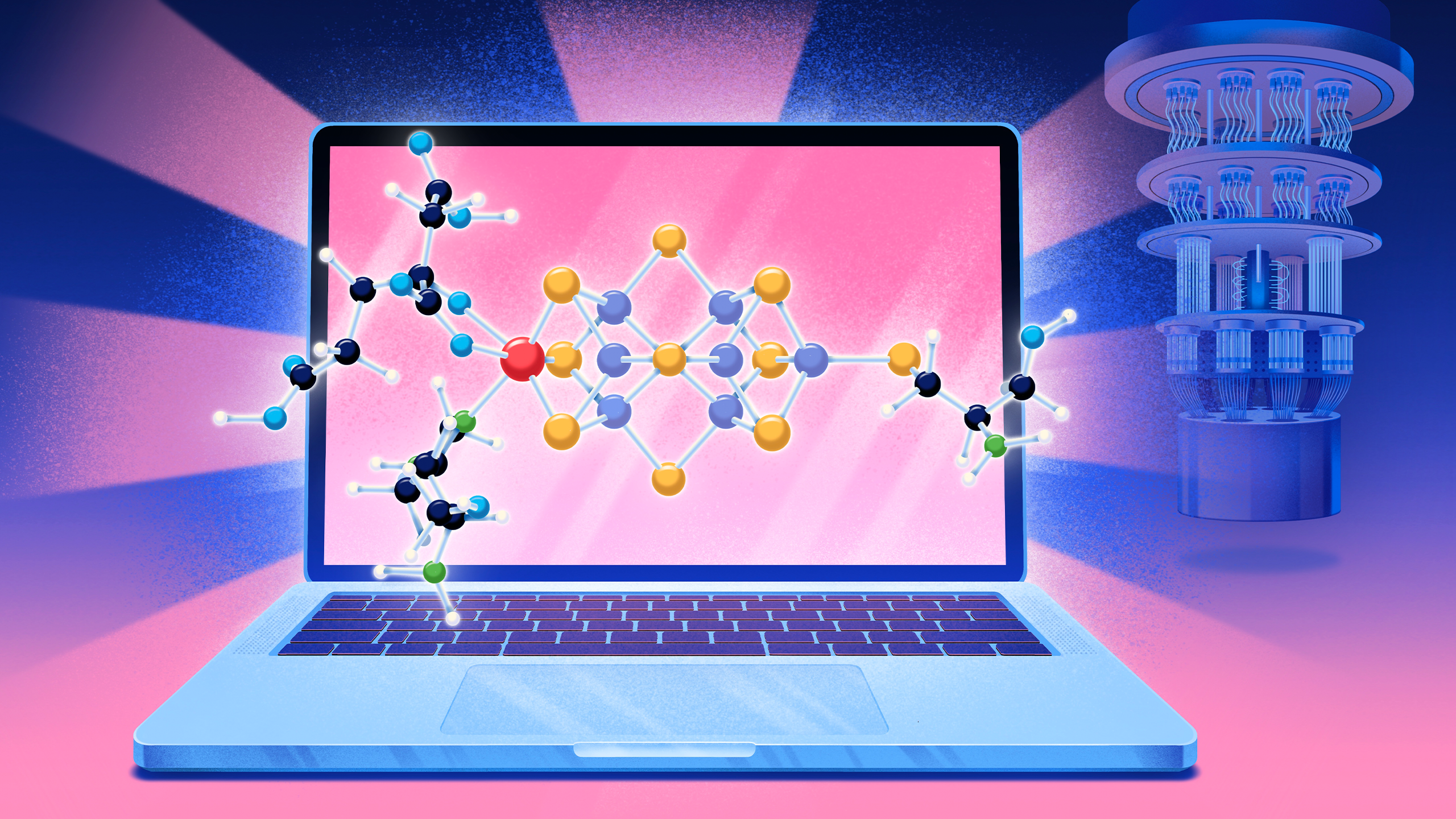
Nash Weerasekera for Quanta Magazine
Introduction
What Garnet Chan cares most about is basic science. He entered chemistry decades ago to understand some of the most consequential biochemical processes on Earth.
But since then, he’s become a central figure in a different arena: the debate over whether quantum computers will have a decisive advantage over ordinary “classical” ones. Over the past decade, many quantum computing researchers have identified the very reactions Chan studies as an area in which quantum computers should excel. Chan, however, has long doubted that powerful quantum computers — which are still years away — will be necessary.
“My main interest is in solving chemical problems. If classical computers are the right tool to do it, we should,” he said. While he believes quantum computers will eventually play an important role in the field, “I don’t see why we should wait for a fault-tolerant quantum computer to be built.”
Now he has a result that strengthens his case.
In early January, Chan and five other quantum chemists based out of the California Institute of Technology reached a key milestone in understanding the enzyme nitrogenase, which converts atmospheric nitrogen into ammonia and makes life on our planet possible. It was a major triumph for theoretical chemists, the outcome of decades of effort.
But for years, nitrogenase had also served as a proof-of-concept target in the realm of quantum computing. To understand the enzyme, researchers must follow the behavior of many electrons that are all linked together via quantum entanglement. The number of possible configurations grows explosively large. Researchers hypothesized that they would likely only be able to decipher the system via a machine that could manipulate quantum states.
But Chan and his colleagues used purely classical methods. That makes their result a pivotal statement not only about the chemistry that supports life, but also about whether quantum computers are needed to understand it.
“I think it’s important to clarify that this is not an impossible task where you have to first build a quantum computer to say anything about the problem,” Chan said.

While Garnet Chan is excited for the day when quantum computers will help solve important problems in chemistry, he sees no need to wait: Contrary to popular belief, he argues, quantum computers aren’t needed to answer some of the field’s biggest questions.
Jerry Camarillo Photography
Not everyone agrees. Some researchers cite the many years it took to obtain the result classically. Even if one chemistry problem has ultimately proved tractable with classical methods, they say, quantum computers are still needed to make these kinds of discoveries at scale.
“If we pick any optimization problem and you put 20 years into it, you can figure out that one system,” said James Whitfield, a quantum computing theorist at Dartmouth College. “But whether that solution is transferable? Questions like that won’t be answered by solving one instance of one molecular system.”
Solving this particular problem about nitrogenase may not settle the debate over quantum computers just yet, but each step toward understanding the enzyme’s full chemistry makes the debate less hypothetical.
Nature’s Ammonia Factory
Alongside photosynthesis, nitrogen fixation is one of the most essential chemical processes for life on Earth. Nitrogenase is what makes it possible.
Before nitrogenase evolved, living things were limited by the amount of nitrogen available to be incorporated into organic matter. It was an ironic obstacle, given that the planet was in fact suffused with nitrogen: The element accounts for about 80% of the atmosphere. But atmospheric nitrogen exists as the diatomic molecule N2, which is inert and therefore unusable in biological processes. Only rare high-energy events could break the molecule into nitrates that life could use.
“Organisms were literally waiting for lightning to strike. That’s how you’d get nitrogen to be available for biomass,” said Daniel Suess, a chemist at the Massachusetts Institute of Technology who studies nitrogenase.
But 3 billion years ago, the nitrogen floodgates opened when nitrogenase evolved in early prokaryotes. The enzyme accomplished what no other biological process could do: It broke the triple bond holding N2 together and converted the inert gas into biologically useful ammonia.
The enzyme was effective but extraordinarily complicated. That was beside the point to the early microbes that benefited from it, but it would come to matter enormously to the humans who, billions of years later, wanted to replicate its trick in order to make fertilizer.
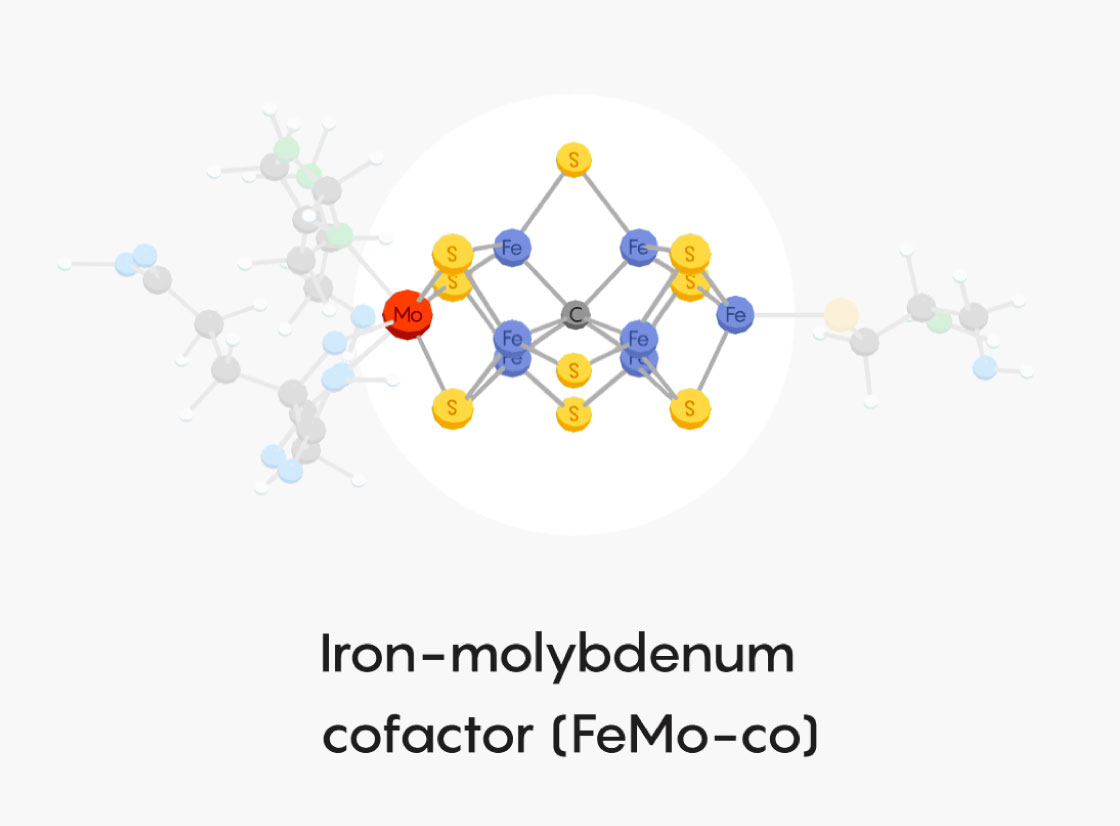
Part of what makes nitrogenase so chemically difficult is its “active site” — a cluster of iron and molybdenum atoms called FeMo-co. Each iron atom carries four or five unpaired electrons whose behavior depends on that of the others. In fact, FeMo-co is one of the most correlated systems in all of biology, and a prime example of what’s known as the electron correlation problem: Because its electrons can’t be treated independently, it’s extremely hard to determine properties of the overall system, such as its true electronic structure and energy.
For most of human history, the pressing question wasn’t how nitrogenase worked — it was how to get enough of what it produced. As late as the 19th century, the most reliable source of usable nitrogen was guano harvested from islands off the coast of Peru, a resource so valuable and rare that nations went to war over it. Then the German chemists Fritz Haber and Carl Bosch cracked industrial nitrogen fixation in 1909, and the practical significance of the problem receded.
The scientific one — understanding how nitrogenase, tucked inside an ordinary soil bacterium, accomplishes what the Haber-Bosch process requires an industrial furnace to do — remained open.
It was an important question in its own right — and one that would achieve new prominence as people debated the best way to solve it.
An Unlikely Test
A classical computer processes information as bits, which take one of two values: either 0 or 1. A quantum computer instead uses qubits, which can exist in a superposition of 0 and 1 simultaneously and can become entangled with one another in ways that have no classical analogue. That means that when (or if) a large-scale quantum computer exists, it will be able to explore many possible solutions to a problem at once, rather than grinding through them in sequence.
For certain kinds of problems with the right mathematical structure, this promises an exponential speedup over anything a classical machine could achieve. The question, ever since quantum computing took off as a subject of theoretical study in the 1990s, has been which problems qualify. One of the most promising domains seems to be simulating chemical interactions: The electron interactions that govern how molecules behave are quantum mechanical at their core, which suggests that a quantum computer might be uniquely suited to modeling them.
The status of nitrogenase as an informal quantum computing benchmark traces back to a 2011 meeting Microsoft organized to explore applications for its nascent quantum computing group. Chan, who’d already been studying nitrogenase for more than a decade at the time, gave a talk on the enzyme.
He doesn’t know to what extent that talk influenced later events, but in 2017, Microsoft researchers published a paper in the Proceedings of the National Academy of Sciences arguing that the entangled complexity of nitrogenase made it a compelling test for quantum computers.
In Chan’s view, it was a strange fit from the start. He disputed the claim, continuing to believe that it was possible to model nitrogenase using classical methods like the ones he’d spent his career developing.
Over the next decade, he would get to work proving it.
Ground-State Debates
Chan and other researchers didn’t set out to explain how nitrogenase works end to end. Rather, they turned to a widely used computational model of FeMo-co and asked a more preliminary question: What is its ground-state energy?
The ground state — FeMo-co’s lowest-energy electronic configuration — is the starting point for the whole reaction. But FeMo-co contains a cluster of seven iron atoms, each with four or five unpaired electrons whose quantum “spins” can point up or down, whose orbitals can shift, and whose behavior depends on what the electrons around them are doing.
This makes measuring FeMo-co’s ground-state energy extraordinarily complex. There are more than 78,000 plausible configurations the electrons might be in; the ground state is a superposition, or a sort of weighted combination, of all these configurations. In principle, the Schrödinger equation tells you how all these different configurations contribute to the ground state and what its overall energy should be. But in practice, solving that equation directly and exactly for a system with as many interacting electrons as FeMo-co has is often impossible.
This is true for both quantum and classical computers. In both cases, you have to start with a simpler approximation of the ground state’s basic structure — an educated guess, often reached only after years of research, about which configurations are contributing the most to the ground state.
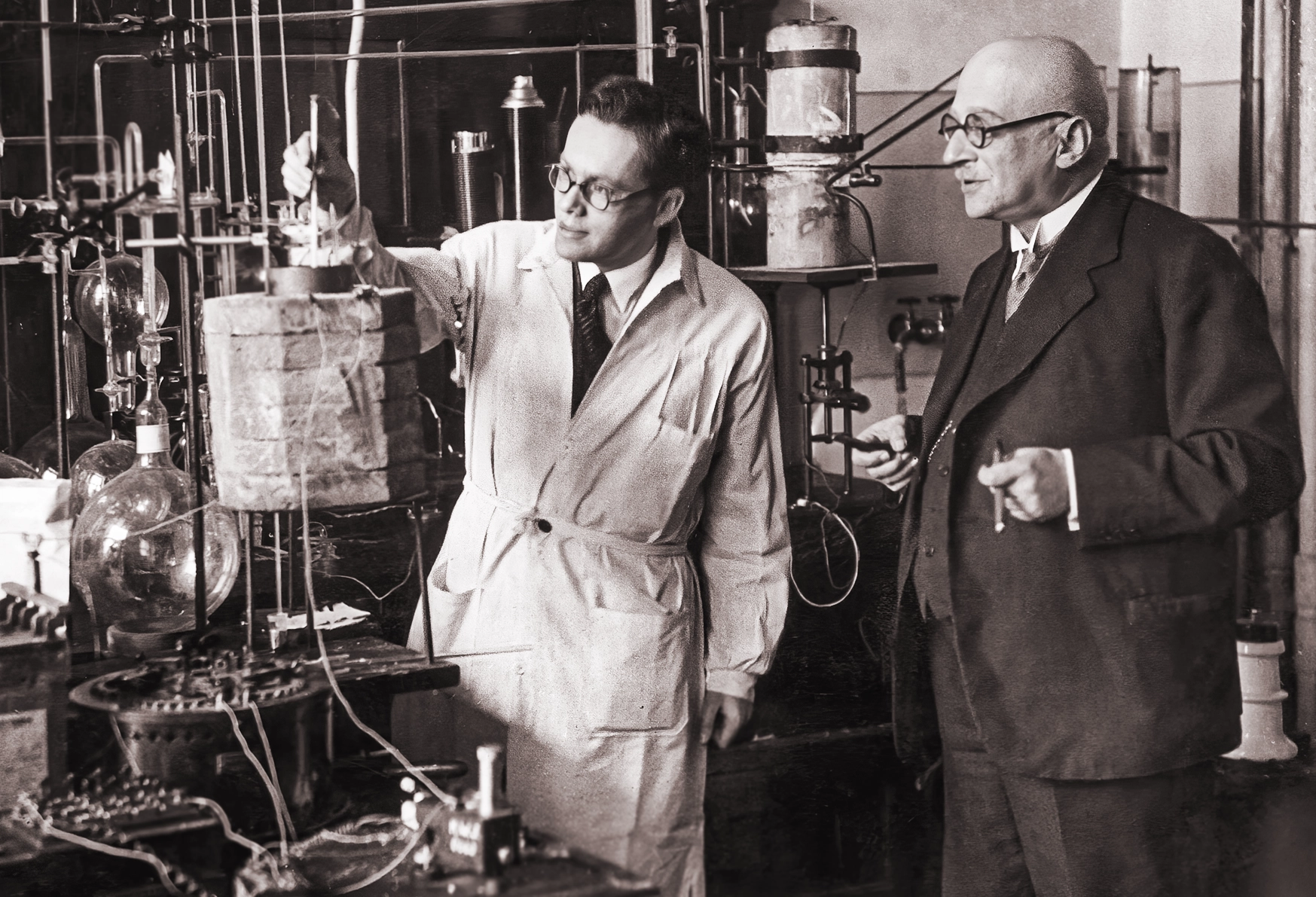
Fritz Haber (right) in his laboratory at the Kaiser Wilhelm Institute for Physical Chemistry in Berlin, alongside the chemical engineer Ladislaus Farkas. Haber developed industrial processes for mass-producing both ammonia fertilizer and chemical weapons.
Sueddeutsche Zeitung Photo/Alamy
Then, if you’re using a classical computer, you can try to progressively account for other configurations and show that you can safely ignore the huge number of remaining configurations because they don’t add much to the ground-state energy.
On the other hand, in theory, a quantum computer won’t require you to leave configurations out of your final estimate. Instead, the computer can represent your initial guess directly as a quantum state, and then evolve that state forward in time until it naturally reaches the right ground-state structure — allowing you to calculate the energy precisely.
Many researchers think quantum computers are at an advantage here, because the process of classically ruling out insignificant configurations can get prohibitively difficult. Chan and others, however, disagree. For one thing, they argue, quantum computers still encounter the same bottleneck of needing that reasonable initial guess, and there’s no obvious reason why quantum methods should have any advantage at clearing that bottleneck. Moreover, classical techniques have been rapidly maturing.
But for Chan, asserting that quantum computers might not be needed after all was “like trying to resist the ocean tide,” he said.
Sifting Out the Solution
Since receiving his doctorate from the University of Cambridge in 2000, Chan had been developing and refining ways to compress complicated quantum states by focusing only on their most important configurations. He and his team now hoped to apply these approaches to FeMo-co.
They used two different techniques to winnow down the configurations they needed to look at. Using one method, they started with their guess and incrementally adjusted the behavior of small numbers of electrons. They then showed that adjusting larger numbers of electrons didn’t lead to significant energy changes, giving them a clear recipe for which configurations they could ignore and which they couldn’t.
Their second method was the one that Chan had spent his career working on. It involved breaking their initial state into pieces and allowing only a limited amount of information to flow between those pieces. They then showed that they only needed to consider changes in that information flow up to a particular limit. “Realizing that the description could be achieved by ‘simpler’ methods and pushing these methods extremely hard (as the problem is still computationally challenging) was the key,” Chan wrote in an email.
Both methods produced the same energy estimate for FeMo-co’s ground state (and matched what scientists had observed experimentally), giving the researchers confidence that they had found the true ground state.
The Debate Shifts
Chan hopes that the technical breakthroughs his team made can now be extended to model the full nitrogenase enzyme and its reaction. “My hope is that all these people advocating ‘We need to build a quantum computer to solve the nitrogenase problem’ will join this mission now that we have a route to doing it,” he said.
But getting from the ground state to a full mathematical description of the reaction will be far more difficult, involving calculating energies for a whole sequence of intermediate chemical states. “We’re not even close to achieving the holy grail of this,” Suess said. “We’ve still just described the resting state. But the method is promising in that it suggests we can proceed with some confidence.”
It’s also unclear what the result might mean for researchers’ hopes for quantum computing. Whitfield argues that calculating a single ground-state energy value was never where quantum computers were expected to best their classical counterparts. Their likely advantage, he said, instead lies in that next question on the table: modeling how the system evolves over time. That’s likely to showcase how inefficient classical methods can get — and how much more powerful quantum computers can be.
After years of friendly sparring with the quantum computing community, Chan does not expect the new result to change many minds. After all, he said, quantum chemistry simulation via quantum computers still holds great promise: If a quantum computer were to become available tomorrow, he would gladly use it. But he hopes his team’s new result will help correct the misconception that the hardest chemical problems are simply out of reach until quantum hardware arrives.
“Science is self-correcting,” he wrote in an email, “but quite often, the corrections do not receive the same attention as the initial claim, because the field has moved on to other claims.”