What's up in
Birds
Latest Articles
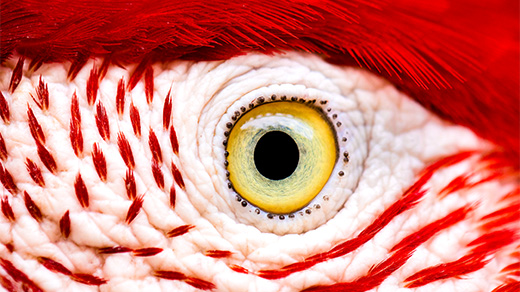
How the Bird Eye Was Pushed to an Evolutionary Extreme
The bird retina is one of the most energetically expensive tissues in the animal kingdom, yet it doesn’t use the energy advantage of oxygen. New research finally explains how this is possible.
Do Beautiful Birds Have an Evolutionary Advantage?
Richard Prum explains why he thinks feathers and vibrant traits in birds evolved not solely for survival, but also through aesthetic choice.
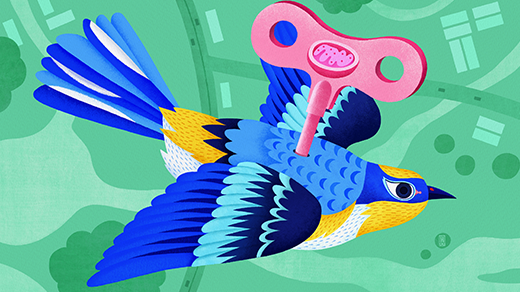
‘Turbocharged’ Mitochondria Power Birds’ Epic Migratory Journeys
Slight changes in the number, shape, efficiency and interconnectedness of organelles in the cells of flight muscles provide extra energy for birds’ continent-spanning feats.
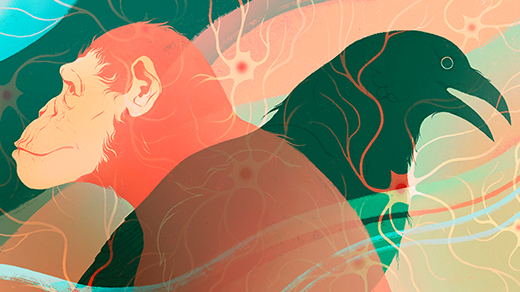
Intelligence Evolved at Least Twice in Vertebrate Animals
Complex neural pathways likely arose independently in birds and mammals, suggesting that vertebrates evolved intelligence multiple times.
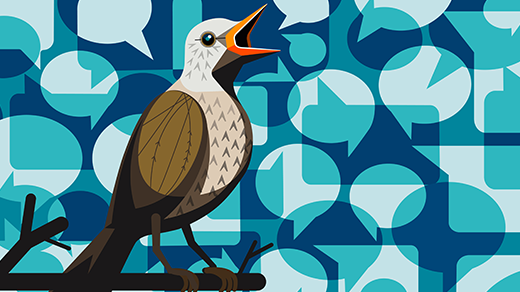
What Can Birdsong Teach Us About Human Language?
We often consider spoken language to be a feature that distinguishes humans from other forms of animal life. Brain research, however, suggests that other creatures — including certain birds — share some of our neural circuitry related to language. In this episode, co-host Janna Levin explores the origins and underlying mechanisms of human speech and birdsong with neurobiologist and geneticist Erich Jarvis.
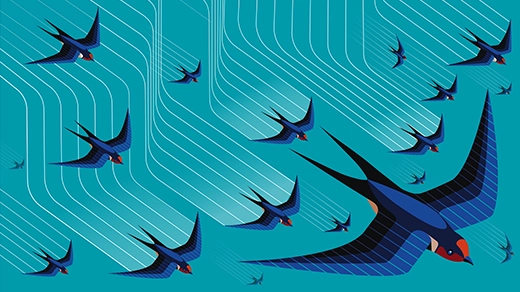
How Is Flocking Like Computing?
Birds flock. Locusts swarm. Fish school. From chaotic assemblies of life, order somehow emerges. In this episode, co-host Steven Strogatz interviews the evolutionary ecologist Iain Couzin about how and why collective behaviors arise.
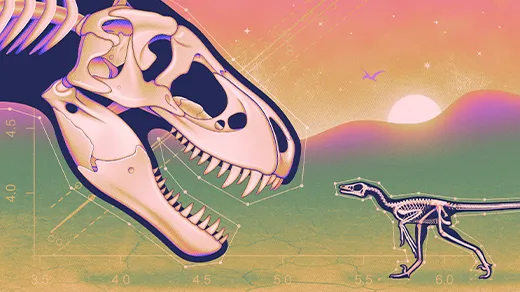
Dinosaur Bone Study Reveals That Not All Giants Grew Alike
A survey of prehistoric bones reveals that T. rex and some of its cousins had more than one way to reach enormous sizes. Evolution may have preserved that variation in modern animals too.
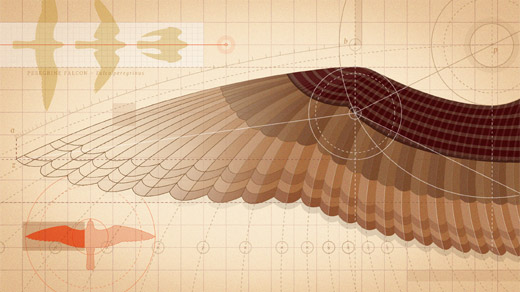
Geometric Analysis Reveals How Birds Mastered Flight
Partnerships between engineers and biologists have begun to reveal how birds evolved their superb maneuverability.
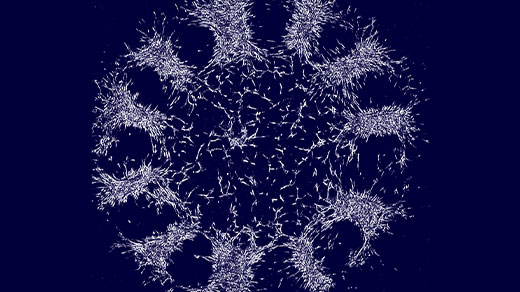
Embryo Cells Set Patterns for Growth by Pushing and Pulling
Patterns that guide the development of feathers and other features can be set by mechanical forces in the embryo, not just by gradients of chemicals.