Two Researchers Are Rebuilding Mathematics From the Ground Up
Kristina Armitage/Quanta Magazine
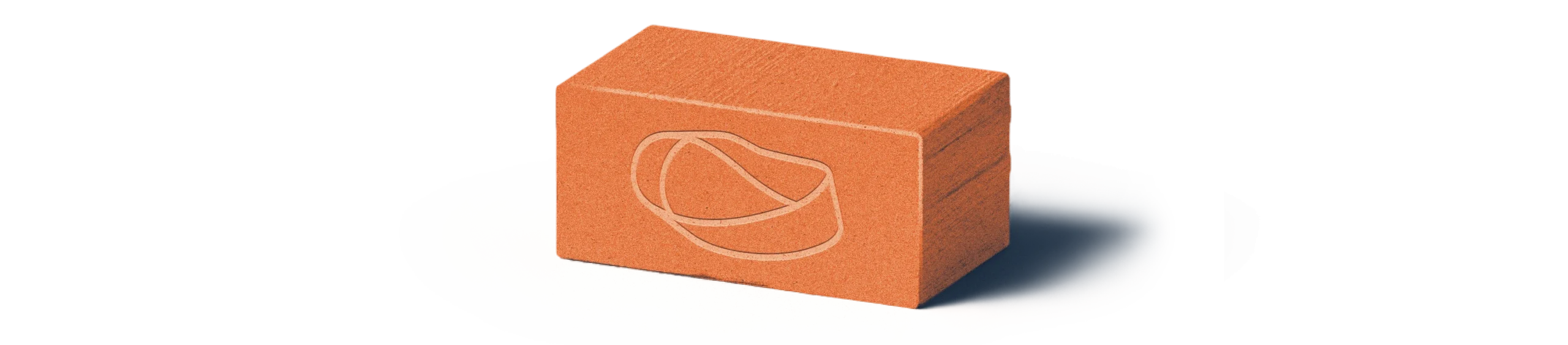
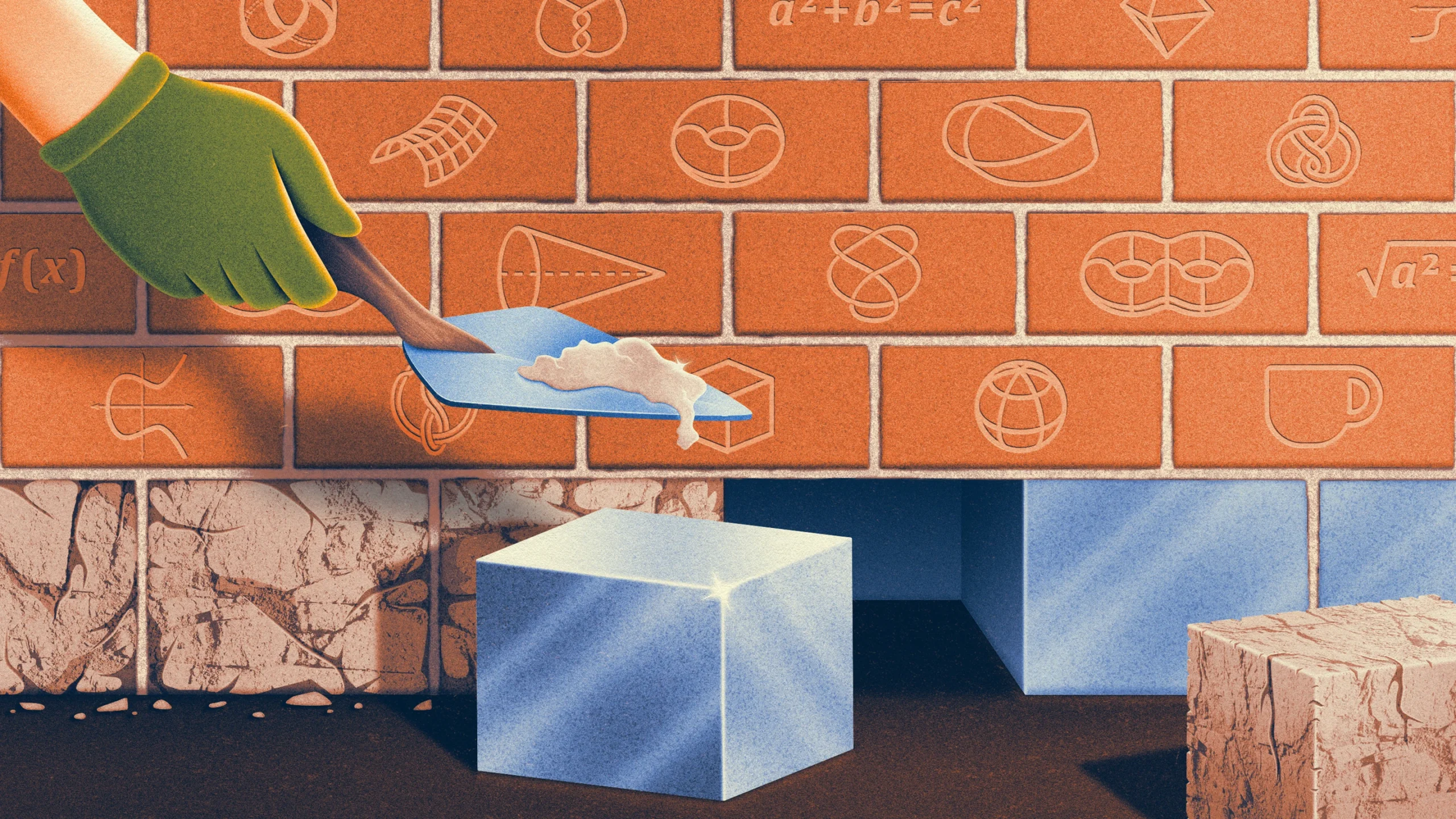
Let’s start with what’s probably the most tired, overused joke in math: A topologist is someone who can’t tell a coffee cup from a doughnut. Both, you see, have a hole in them.
Topology is usually described as a sort of “rubber sheet” geometry in which two shapes are considered the same if one can be stretched or compressed into the other without tearing it. But this summary leaves out something essential: How do topologists, and the many other mathematicians who rely on their methods, rigorously account for all this stretching? They don’t look at a doughnut and a coffee cup, squint, and say to themselves, “Sure, I can intuitively see how to squeeze one into the other, so they must be the same.” Rather, they describe a shape in a way that can “forget” about distance while respecting the underlying structure in a flexible way, allowing it to bend and stretch.
When these “topological spaces” were developed over 100 years ago, they played a major part in the revolutions in logic and set theory that marked the boundary between 19th-century and modern mathematics. Their birth was a crucial waypoint on math’s inexorable march from the numbers and shapes that people encounter in everyday life into ever more abstract caverns of thought. Topological spaces have since become the foundation for huge chunks of mathematics. If you think of math as a skyscraper, topological spaces are concrete pilings, driven deep into the bedrock of common sense that all of math ultimately rests on.
But disconcertingly, topological spaces turn out to be extremely poorly suited for a big chunk of modern math: They are an awkward setting in which to do algebra, which is something mathematicians quite like doing.
For years, mathematicians figured they just had to live with the limitations of topological spaces. If you’re working on the 87th story of a skyscraper, fixing the foundations in the subbasement is a scary proposition.
But over the past decade, Peter Scholze of the Max Planck Institute for Mathematics in Bonn and Dustin Clausen of the Institute of Advanced Scientific Studies in France have sought to replace topological spaces. They have defined a new category of mathematical objects called condensed sets, which resemble a sort of infinitely fine dust and retain all the nicest properties of topological spaces without the drawbacks. Dust, it turns out, is a better foundational material than the pebbly, well-understood soil of topological spaces.
“They are solving a problem we didn’t know we had,” said Ravi Vakil, a mathematician at Stanford University and president of the American Mathematical Society, “because we already had what we thought were reasonable solutions.” As a result, “a whole slate of mathematics has become much simpler.”
It’s an ambitious project. The new definitions and concepts that Scholze and Clausen have introduced are powerful but also complicated and hard to learn. Scholze, for his part, is not sure how widely used they will become. On the other hand, he sees them as just the first step in a far bigger program to understand why numbers behave the way they do.
Doing math can be a little like rock climbing: Just as the route you take up a sheer face can incorporate creativity and even elegance in the way it sequences technical maneuvers, so too can a proof. Both traverse existing terrain. Most research — even some of the best research — takes the form of finding new routes to known peaks. But in mathematics, there is a weird relationship between the equipment and the landscape, as though developing a new type of ice axe causes hitherto unknown mountain ranges to emerge. As those new ranges appear on the horizon, older mountains that had seemed forbiddingly steep begin to resemble gentle hills.

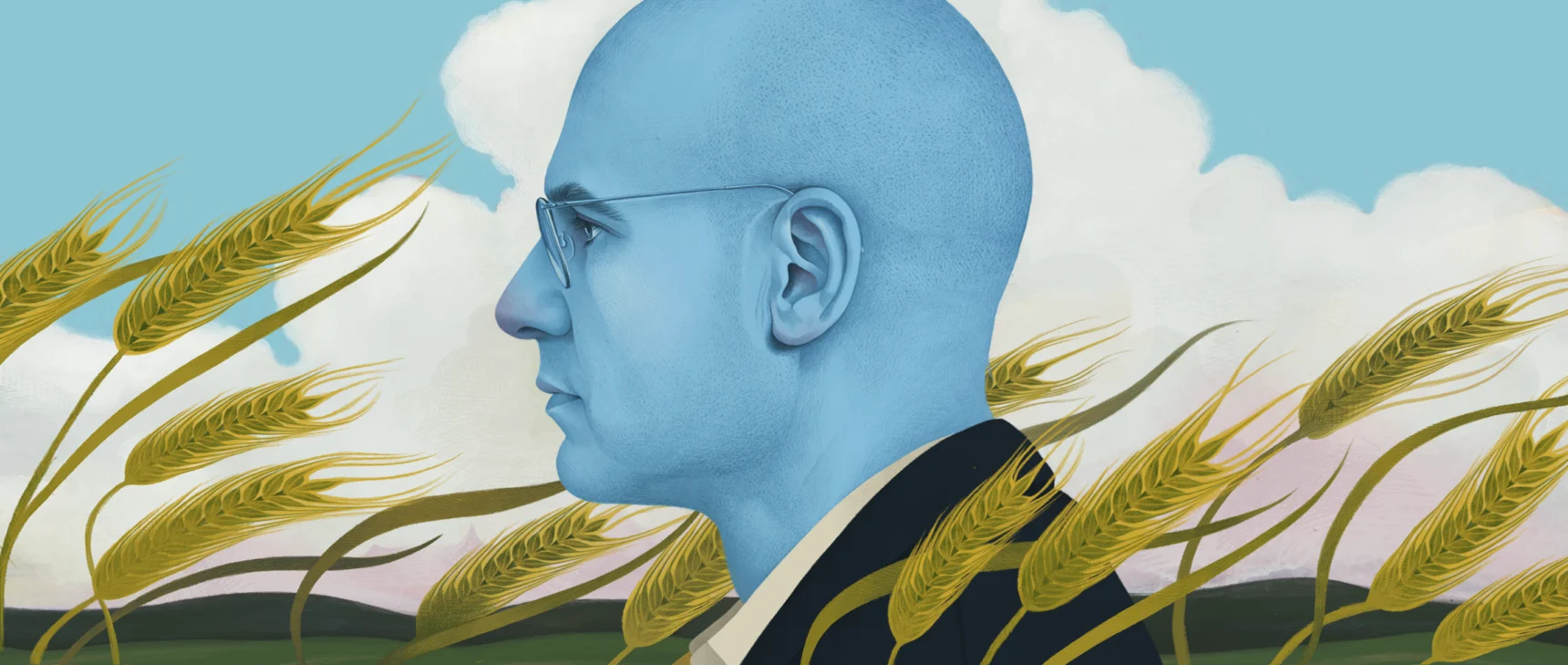
Dustin Clausen, along with Scholze, has spent the past decade developing a new mathematical framework. Their “condensed mathematics” is already helping to connect topology, category theory, algebra, and other areas.
Christophe Peus/IHES
Developing these new tools takes a certain revolutionary confidence — especially when it requires setting aside implements that have been used in the community for so long that they seem to be part of the mountains themselves.
Point of Know Return
It’s possible to discover powerful mathematical truths without having a good language to work in.
Which is to say that topology predates topological spaces. As far back as 1735, Leonhard Euler proved that it was impossible to traverse the city of Königsberg by crossing each of its seven bridges only once. This is a recognizably topological result — the size of each of the city’s landmasses doesn’t matter, nor does the length of the bridges between them. Only the pattern of how they connect to each other does.
For nearly 200 years, research in topology proceeded in fits and starts. In the mid-19th century, August Ferdinand Möbius analyzed the strip that bears his name: a ribbon twisted on itself one time before its ends are joined. It is arguably the strangest topological object to have practical utility in the real world — for instance, in one-sided conveyor belts that wear evenly as they drive machines. Around the same time, Möbius began introducing some of the field’s key ideas, such as how to classify shapes with varying numbers of holes by looking at how loops can be drawn on them.
Shortly afterward, Bernhard Riemann, Henri Poincaré, and others made further advances. But they struggled for lack of the right language. As the Australian mathematician John Stillwell wrote in 2009 of Poincaré’s groundbreaking work in topology: “Along with great breakthroughs, there is also confusion.” Poincaré had ideas that he lacked the vocabulary to properly express.
To an outsider, it seems as if the branch of math closest to topology ought to be geometry. It seems as if topology is geometry, just with flexible objects instead of rigid ones. But the resolution to Poincaré’s confusion would come not from geometry, but from a nascent branch of logic called set theory.
At the turn of the 20th century, researchers were trying to wrestle mathematics onto firmer footing. They had only recently realized that their everyday intuition about numbers was completely wrong; now they were fervently debating which axioms, or obvious truths, they should build their theories on. Seemingly small differences in how they stated their most straightforward assumptions had major consequences for what would be possible or impossible to prove.
They used set theory to hash out these debates about the foundations of mathematics. In 1912, Felix Hausdorff, who had recently started teaching at the University of Bonn — where Scholze would end up generations later — set out to write the first comprehensive treatment of set theory. At the time, Hausdorff, then in his mid-40s, was already an accomplished writer: Under the pseudonym Paul Mongré, he had published a collection of poetry, two books of philosophy that tried to reconcile Nietzsche and Kant, and a play that was produced in 40 cities. As a mathematician, he was successful but not yet a superstar.
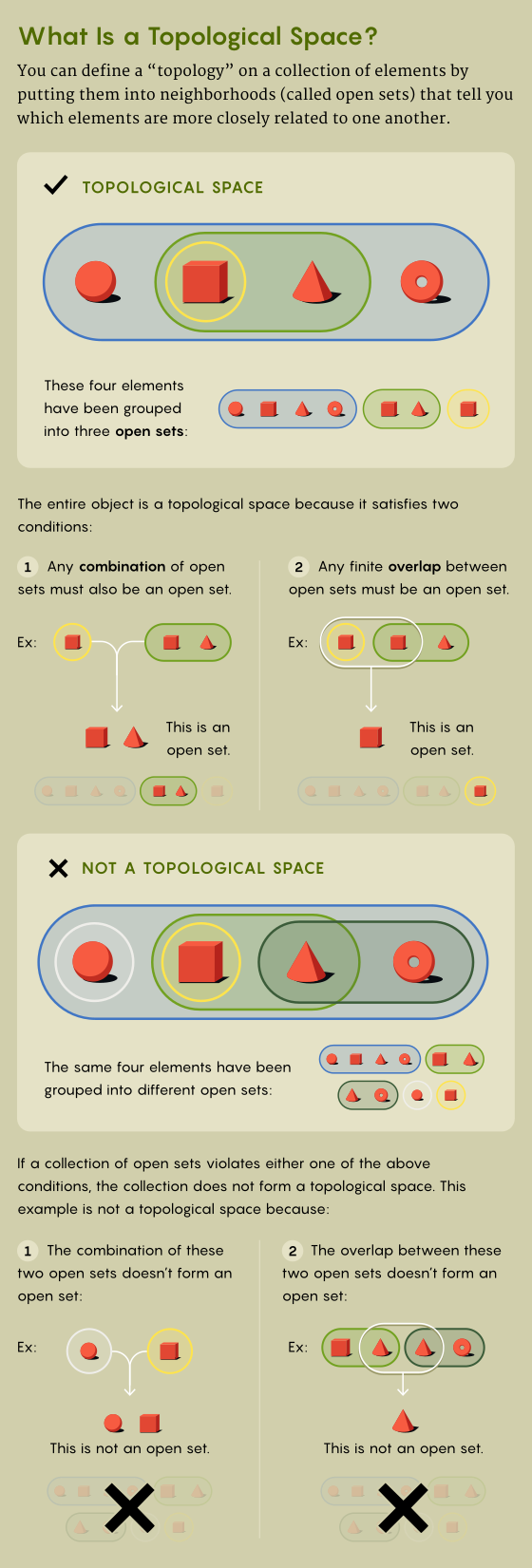
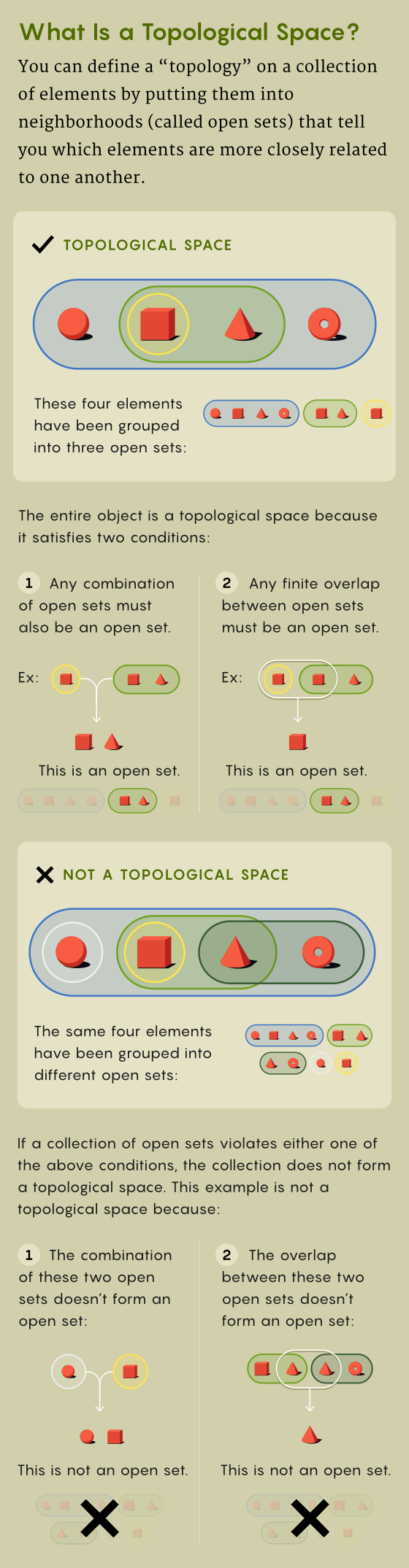
That changed after the 1914 publication of his book Fundamentals of Set Theory. In it, he gave the first description of topological spaces. A topological space is simply a collection of items that are grouped together into what Hausdorff called neighborhoods — today known as open sets. The open sets give structure to the space.
Open sets must satisfy just two conditions. First, any combination of open sets must also be an open set. (If Brooklyn forms a neighborhood and Queens forms a neighborhood, Brooklyn and Queens together must count as a single, bigger neighborhood.) And second, any finite overlap between open sets must also be an open set.
Mark Belan/Quanta Magazine
Topological spaces can be finite or infinite. They can encode intricate structure, or no structure at all. As Scholze put it, topological spaces are “just everywhere. If you have this intuitive idea of points being close to each other, you have topology.”
Consider a more familiar object: the number line. When we think about the way numbers relate to one another, we’re thinking about just one topological space: the so-called standard topology, in which every possible interval (not including its end points) forms a neighborhood, or open set. All these intervals are open sets:
This topology gives the real numbers the structure we’re used to.
But you can instead take the numbers you are used to dealing with, forget all the everyday intuition you’ve built up about them, and define entirely different topological spaces on them. If you think of each number as a book in a library, this would be like taking all the books off their usual shelves and organizing them in a completely different way.
For instance, you might crumple the number line into a ball and squeeze that ball down to a point, making every number arbitrarily close to every other number, like so:
This is akin to throwing all your books into a disorderly heap. The relationships between the books — historical fiction all being on the same shelf, and so on — are lost, because all the books are now neighbors. This is called the indiscrete topology, and we create it by declaring that there are only two open sets: the empty set and the entire number line.
At the other extreme is the “discrete” topology, in which every point forms its own neighborhood:
In this topology, instead of every point being in contact with every other point, no point touches any other one. It’s like putting every book in your library on its own private island. The relationships are again lost, because each book is isolated.
In a way, the old joke about the doughnut and coffee cup misunderstands the power of topological thinking. It’s not so much that it is possible to change distances by stretching or compressing things. It’s that it’s possible to meaningfully think about structure in spaces where distance simply does not exist.
In this way, topological spaces made it possible to explore novel parts of the mathematical landscape. For instance, they provided a new, distance-free way of understanding concepts like continuity and connectedness, which is a profoundly powerful and counterintuitive capability to have. This has allowed mathematicians to generalize those ideas to a much broader range of settings — and to prove important statements in a wide variety of fields. For example, results like the fundamental theorem of algebra, whose proof tripped up even mathematical giants like Carl Friedrich Gauss, end up with very simple proofs once topological arguments come into play.
The introduction of topological spaces also led mathematicians to ask new questions they might not otherwise have thought to ask. As is true of any good mathematical definition, topological spaces both opened new vistas and made it much easier to traverse known ones.
Hausdorff’s book was arguably the beginning of modern topology. As the mathematical collective known as Bourbaki would later write, his well-chosen definitions imbued “his theory with both the full precision and full generality desired. The chapter in which he develops the consequences of these axioms remains a model of axiomatic theory — abstract, yet anticipatory.”
Just a Drop of Water in an Endless Sea
There are many subdisciplines within modern mathematics. Each has its own vocabulary, grammar, and intellectual flavor. But they are never wholly separate — they interact in strange ways. In part, this is because many mathematical objects, like the real numbers, exist as objects of study in multiple disciplines: They have an algebraic structure, an analytic structure, a combinatorial structure, and a topological structure (among others!). Often, areas of overlap end up becoming distinct areas of study.
In 1945, two American mathematicians, Samuel Eilenberg and Saunders MacLane, published an audacious paper that created an entirely new discipline, now known as category theory. In one fell swoop, category theory created a set of expressways between other, existing areas of math.
Eilenberg and MacLane defined “categories” as collections of objects and the relationships (called morphisms) between them. For instance, a category might consist of sets and functions that relate these sets to each other, or of vector spaces and the linear maps that transform one vector space into another.
But the real power of the pair’s theory rested on the next level of abstraction they introduced: What if, they asked, you mapped one whole category onto another, with something they called a functor? A functor takes objects to objects and morphisms to morphisms, in an orderly way. In other words, it doesn’t just give you a way to translate from one group of objects to another; it also preserves the relationships between them — allowing you to connect different areas of math to each other.
Among other aims, Eilenberg and MacLane wanted to connect topology with the rest of math. Topology was already known not to gel particularly well with one of math’s most important areas: algebra. Although “topology has been this enormous gift to algebra,” said Clark Barwick of the University of Edinburgh, it has also “obstructed progress because topology and algebra don’t play all that nicely with each other, because of the particular way topology was built up.”
Category theory quickly goes from stating things that sound obvious to drawing powerful mathematical conclusions on the basis of what its practitioners typically call, with affection, “abstract nonsense.” Some categories have particular properties that make them more useful to mathematicians than others. In those categories, abstract nonsense becomes powerful — in other categories, it ends up just being nonsense.
In topology, you can define a category consisting of topological spaces and the continuous maps between them. In algebra, meanwhile, an important category is that of abelian groups — groups that have useful symmetries. If you want to produce a grand synthesis of the ways in which algebraic things behave topologically, or, conversely, how algebraic considerations govern topological constructions, the natural thing to do is to form a category out of objects that have both topological and algebraic structure, called topological abelian groups.
But topological abelian groups lack the particular properties that category theorists desire. If category theory unveiled a hitherto hidden network of highways between different mountain ranges of math, topologists who wanted to travel on that highway were stuck driving a janky car that kept breaking down and needing repairs.
That’s the problem that Scholze and Clausen wound up trying to solve. As Scholze told me, “I think topologists don’t actually like topological spaces, because it’s not a convenient category.” What if they could define new objects to replace topological spaces — ones that would retain their power, but also create a better kind of category that would finally allow mathematicians to connect topology to algebra and other fields?
The Nicest Revolutionaries
Sometimes new ideas seem ready to burst into the world.
In 2013, Scholze was 25 years old and already making waves as a deep mathematical thinker, hailed as the youngest full professor in Germany.
He and Bhargav Bhatt, then a researcher at the Institute for Advanced Study in Princeton, New Jersey, coauthored a paper in which they came up with a new definition for a particular type of category. In passing, the pair defined a somewhat abstruse mathematical set, a “sheaf on the pro-étale site of a point.” Scholze didn’t think much of it at the time. Those sets, which they didn’t name, “felt like a weird aspect of the story that I didn’t fully comprehend,” Scholze told me.
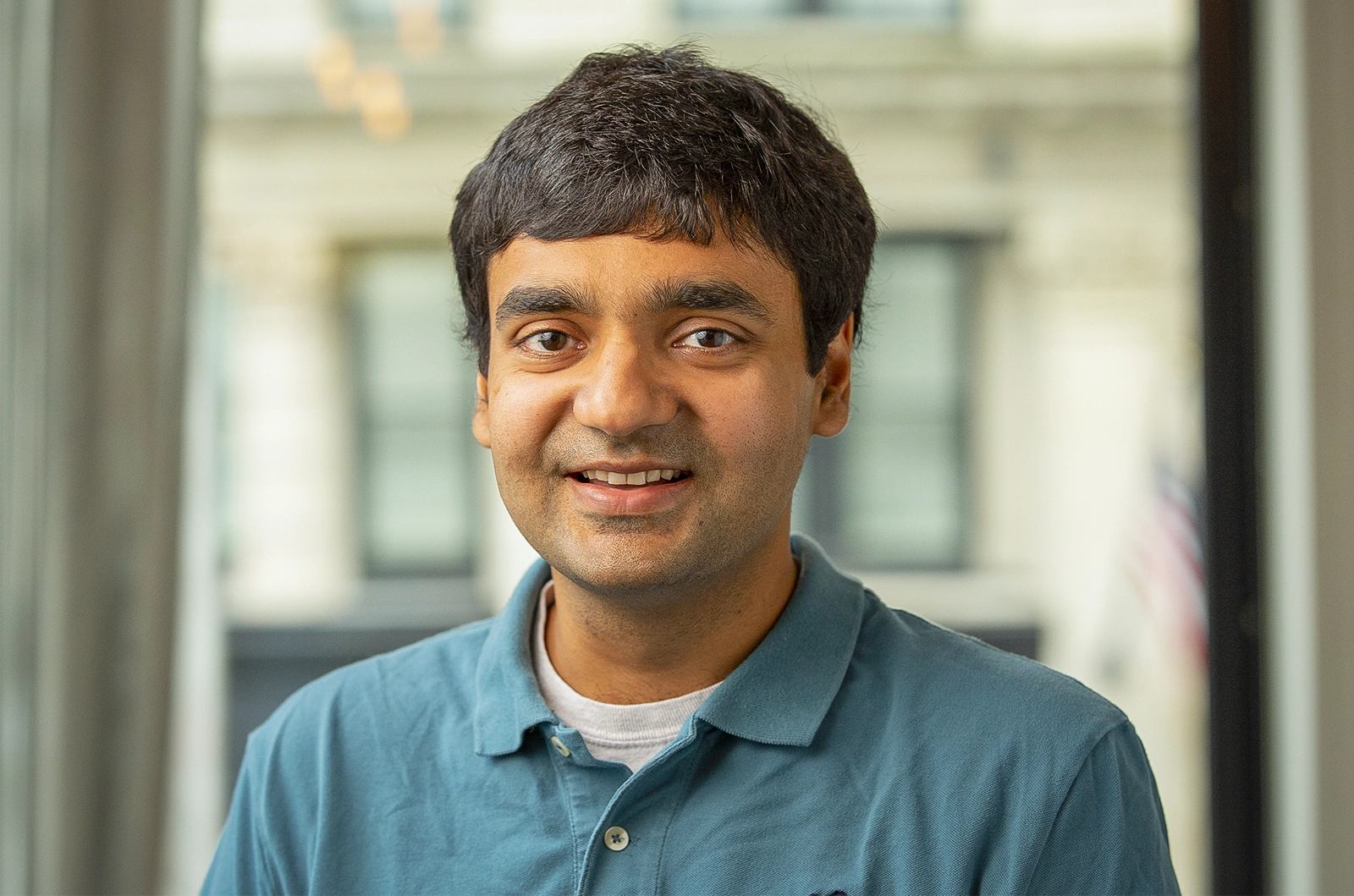
Bhargav Bhatt, along with Scholze, defined the objects that would later become known as condensed sets years before anyone realized their enormous theoretical significance.
Simons Foundation
At the time, Clausen was completing his doctorate at the Massachusetts Institute of Technology. After spending five years as a postdoctoral fellow at the University of Copenhagen, he moved to Bonn in 2018 to work with Scholze, who had just been awarded a Fields Medal, math’s highest honor. Clausen had independently come up with the same kind of set for different reasons, and he persuaded Scholze that they should study it more closely. By this time, Scholze recalled, Clausen had glimpsed a potential opportunity to replace topological sets.
Around the same time, Barwick and his then-student, Peter Haine, independently came up with a slightly different definition in order to answer a particular question in category theory that interested them. “We wanted to solve one problem,” Haine said. “We kind of understood that this theory should be useful for quite a lot of stuff, but there is one thing we really wanted to do: prove this kind of specific result which generalized what we had previously done.”
On the other hand, he said of Clausen and Scholze, “I think they had a lot more that they wanted to do.”
Indeed they did. They gave their sets a name — “condensed sets” — and got to work. They didn’t publish their incremental progress. Instead, in April 2019, Scholze began giving lectures on “condensed mathematics” at the University of Bonn; in May, he posted a 77-page set of notes that culminated in a new, elegant proof of an important theorem called coherent duality. As Johan Commelin, who would go on to collaborate with Scholze, remembers, “coherent duality had an extremely roundabout and technical proof before.” Scholze and Clausen’s proof was clean and elegant.
That, Commelin said, “gave people the motivation to say, ‘Let’s organize reading groups and study seminars all over the world to go through these lecture notes and find out what’s happening.’” Commelin organized one such group at the University of Freiburg, but it was challenging. “I don’t think anybody in our group understood all the details,” he said.
Although condensed sets had started as a tool for proving useful results, Scholze recalled, they quickly became something more. “For me personally, condensed sets changed something very basic about how I think about mathematics,” he said.
“Replacing the topological perspective by the condensed one,” he added, “creeps into everything I’m doing.”
Jeffrey Bergfalk, a set theorist at the University of Barcelona, remembers first meeting Scholze and Clausen in 2019 after he and his fellow set theorist Chris Lambie-Hanson of the Czech Academy of Sciences posted a technical paper online. Set theorists form a particularly small and tight-knit community, somewhat removed from the mathematical mainstream. “We were only expecting to hear from people that we knew,” Bergfalk said. But they got an email from Clausen, who had noticed the paper. He and Scholze, the email said, were thinking about similar things in the context of condensed mathematics — a nascent subject that neither Bergfalk nor Lambie-Hanson had heard of.
It took a moment for Bergfalk to realize the scale of Scholze and Clausen’s ambitions for condensed math. “Dustin and Peter were just wonderfully responsive, really cool and communicative,” he said. “They don’t have to be as nice as they are.” And even though Scholze and Clausen were working well outside their areas of expertise, Bergfalk noted, they asked about the sorts of things you wouldn’t expect anybody but a set theorist to care about. “They were asking us to think in the direction we would want to think anyway,” he said. “Which meant we had to learn condensed math.”
For two people who are reinventing a big chunk of 20th-century mathematics, Clausen and Scholze are unassuming. “To a large extent, what I am doing is rephrasing what others have done in my own words,” Scholze told the mathematician Maria Yakerson in a 2021 interview. “I’m not that much interested in theorems or proofs.” What he wanted to do, he said, was to come up with new definitions: “They must make it easy to state interesting theorems, and they must make it easy to prove them.” Scholze doesn’t see himself as creative. He is, he said, just “trying to give names to what is there.”
Clausen, for his part — as he told Yakerson in a separate interview around the same time — avoids publishing papers, because he believes that the scientific publishing industry is fundamentally flawed. He also largely avoids even informally writing up results, leaving that to collaborators. He just wants to focus on the math; like Scholze, he’s constantly looking for the right names, the right language. (At one point, in fact, he considered pursuing a career in literary translation.)
“I was never completely convinced by topological spaces,” Clausen said. They couldn’t give him an understanding of “this world that’s there, this rich world that we’re trying to get at but we don’t have the proper language to talk about.”
But that only motivated him further. “I’m extremely happy not understanding,” he said, “because I’m even happier when I finally do understand.”
Building on a Foundation of Dust
That’s where condensed sets come in. Condensed sets can be seen as a sort of recipe for building continuous objects, such as the real numbers, out of “totally disconnected” spaces — like making a cake out of disparate grains of flour and sugar, in Scholze’s telling.
Take the so-called Cantor set. Start with the line segment containing all the real numbers between 0 and 1, and remove the middle third. Then remove the middle third from the remaining line segments. Repeat this process infinitely many times, and you’ll end up with a “dust” of points. No point is right next to any other. The space of points is totally disconnected.
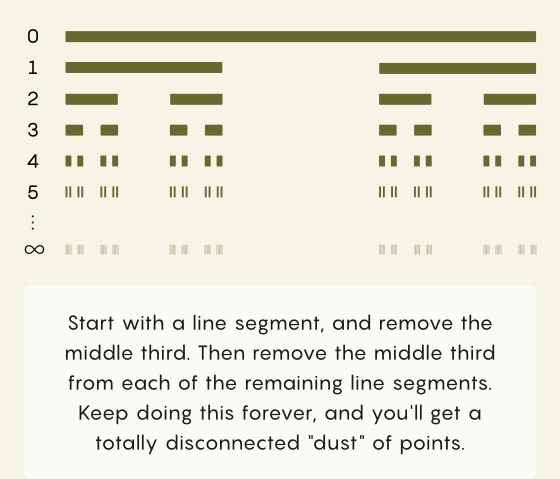
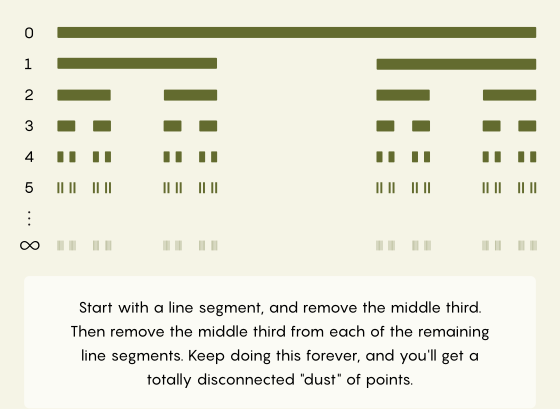
The Cantor set is the simplest kind of condensed set, as well as a building block for making other condensed sets. You can make more complicated condensed sets, Scholze said, by smashing together clouds of points like the Cantor set in a weird way.
Such dust might seem foreign, but Scholze points out that we use it all the time. When you represent numbers as decimal expansions, for instance, you’re essentially thinking of the numbers as a similar kind of dust. It’s like taking each number in the expansion and cutting out its section of the number line, like so:
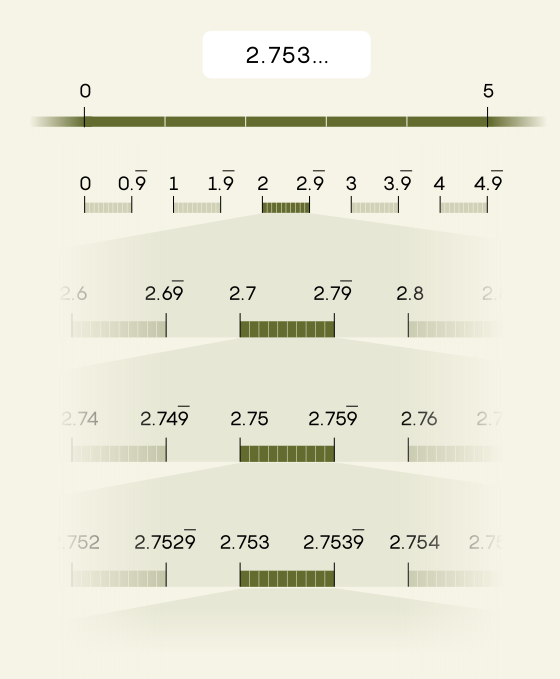
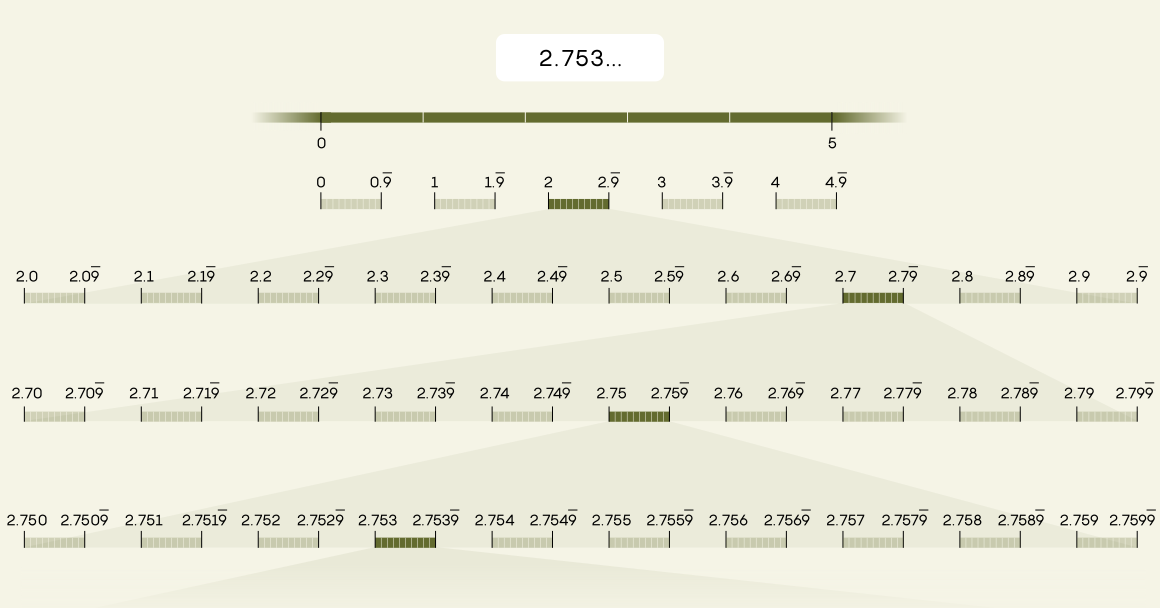
In this way, producing a given number actually involves infinitely “dissecting” the number line. As Scholze put it, the “decimal expansion describes a totally disconnected space because with every new digit, you are chopping up your line more and more.” Every number is totally disconnected from every other one.
How, then, can you use such a disconnected set to get a continuous object like the real number line we’re so used to? You have to glue all the disconnected segments back together by equating, say, 0.49999999999999999… with 0.5 (and 0.50999999999999999… with 0.51, and so on).
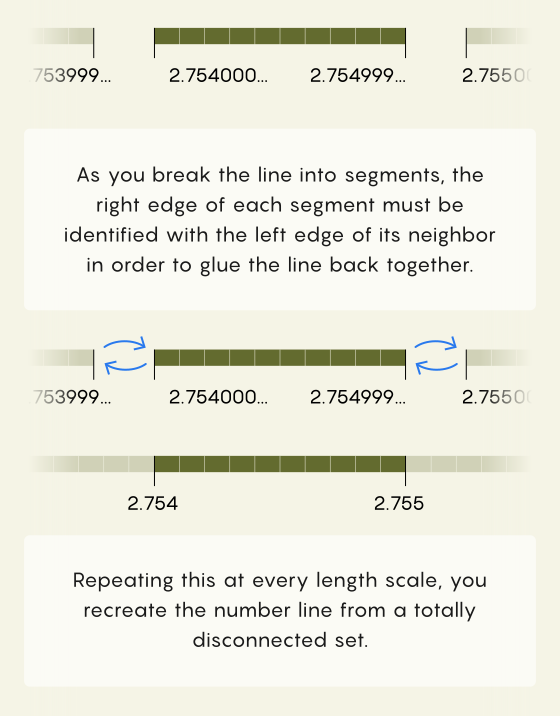
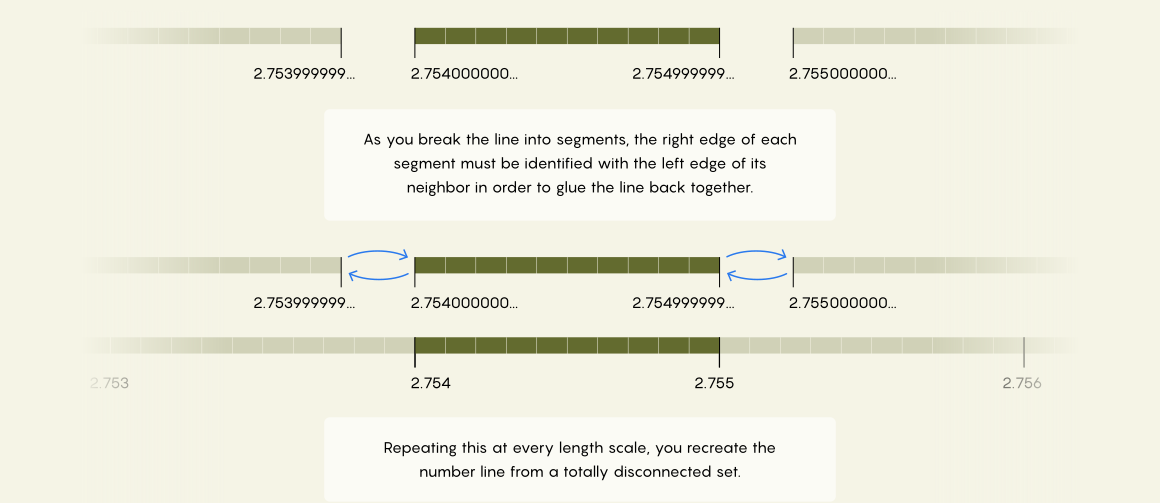
Scholze and Clausen’s condensed sets work similarly: They’re disconnected, but they can be used to build and study continuous objects, like those you want to understand in topology. And if you start with them instead of topological spaces, you get an additional benefit: It turns out, Scholze explained, that “these totally disconnected pieces are extremely simple to describe algebraically.”
Condensed sets form a special type of category that, according to Juan Esteban Rodríguez Camargo, a collaborator of Scholze’s at the Max Plank Institute for Mathematics, finally makes it possible to mix topology, algebra, and other fields “in a very practical and precise way.”
Scholze and Clausen started by using their condensed sets to re-prove old results that previously relied on topological spaces — like the fundamental theorem of algebra. These new proofs have given mathematicians a novel understanding “suitably oiled and greased up and made supple,” Vakil said. “The more you can fit into your intuition, the better you understand.”
Then the pair decided to push even further.
A Condensed History
Since 2019, Scholze and Clausen have kept building new types of structures out of their condensed sets — and sharing new sets of lecture notes. “The ideas were evolving in Bonn way faster than the rest of the world could consume them,” Commelin said. There were “light” condensed sets, and also solid, then liquid, then gaseous spaces — an entire condensed mathematics.
Neither Clausen nor Scholze thinks of himself as a topologist. If the two were less friendly, or their ideas less effective, there might be some resentment over their attempt to rebuild the foundations of a field they don’t tend to work in. “I wouldn’t want to impose anything,” Scholze said when asked what he thinks the impact of condensed math will be. He and Clausen sound as though they are having fun, trying to come up with ideas that they themselves find useful.
But some mathematicians are likening their work to a similar mathematical revolution that took place in the 1950s and ’60s — when Alexander Grothendieck reimagined the field of algebraic geometry in accordance with category theory, vastly extending its reach and power. Grothendieck’s impact on modern mathematics was profound. And now, according to Dagur Asgeirsson, a postdoctoral researcher at the University of Alberta and Clausen’s former graduate student, “I think it’s fair to compare Peter to Grothendieck in this sense. He is reinventing everything somehow.”
“The real excitement about condensed stuff for me is the possibility of defining new objects of study,” Barwick said. It’s “showing you there is this natural class of objects that you just never looked at before, like an unclimbed mountain. We are just chewing at the corners of this vast territory.”
In one set of lecture notes, Clausen and Scholze quoted a well-known saying by the prominent mathematician David Mumford. Mumford’s field of algebraic geometry, he said, “seems to have acquired the reputation of being esoteric, exclusive, and very abstract, with adherents who are secretly plotting to take over all the rest of mathematics.” Clausen and Scholze went on to note that their plan was to use condensed math — also esoteric, exclusive, and abstract — to continue where this effort had left off. They were not entirely joking.
Regardless, their not-so-secret “takeover of mathematics” is continuing. In the last few years, Clausen and Scholze have defined other novel mathematical objects, such as “analytic stacks” and “gestalten.” Some mathematicians consider these to be even more significant than condensed sets.
Scholze suspects that condensed mathematics might prove useful even in areas distant from his and Clausen’s core interest in number theory. Quantum field theory — a central aspect of modern physics, which has long struggled with its foundations — makes use of very sophisticated algebra and category theory, Scholze noted. “At the same time,” he added, “quantum field theories are by their nature very analytic and topological. Mixing these two worlds is a nontrivial matter, but condensed mathematics gives a possible framework to do so.”
Scholze and Clausen’s body of work shows just how much choosing the right language matters — how reframing concepts makes it possible to traverse known terrain more easily and to explore new mathematical vistas. “Trying to get to the bottom of these phenomena is trying to find a language in which to express them,” Scholze said.
In a memoir Grothendieck published late in life, he described mathematicians as builders, even though he argued that they are most certainly not inventing anything, only finding structures that are already there, waiting to be discovered. He wrote: “The most beautiful house, that in which the love of the builder is most evident, is not that which is larger or higher than the others. Rather, a house is beautiful if it faithfully reflects the structure and beauty hidden in things.”
Correction: May 20, 2026
Peter Scholze is now at the Max Planck Institute for Mathematics in Bonn, not the University of Bonn.
Correction: May 26, 2026
The story has been updated to remove a parenthetical that incorrectly stated that Leonhard Euler lived in Königsberg.