How Alexander Grothendieck Revolutionized 20th-Century Mathematics
Mercedes deBellard for Quanta Magazine
Introduction
What Albert Einstein was to 20th-century physics, Alexander Grothendieck was to 20th-century mathematics. He is much less well known because math gets technical even more quickly than physics does. But as with Einstein, Grothendieck’s impact came not just from his own results, revolutionary though they were. His work also reoriented his entire discipline in radical new directions.
Grothendieck was intense and ascetic from his early days. Starting in the early 1950s, when he was in his 20s, he produced thousands of pages of formal and informal notes that changed the course of mathematics. Then in 1970, he quit. He left his post at a prestigious research institute just outside of Paris to teach at the provincial university in Montpellier where he studied as an undergraduate. He mostly stopped talking to other mathematicians. In the early 1990s, he moved to a small village in the Pyrenees, where he lived as a hermit.
Mathematicians are still grappling with the innovations he made half a century ago. His work pushed mathematics to a new level of abstraction by focusing on the relationships between objects rather than the objects themselves. “If there is one thing in mathematics which fascinates me more than any other (and undoubtedly always has), it is neither ‘number’ nor ‘size,’ but invariably shape,” he wrote in his memoirs. “And among the thousand and one faces under which shape chooses to reveal itself to us, that which has fascinated me more than any other and continues to do so is the structure hidden in mathematical things.”
His revolutionary mathematics centered around that search for hidden structure.
Revealing Shapes
Grothendieck is most famous for his work in algebraic geometry. The field first developed as the study of shapes defined by polynomial equations — equations that add together variables raised to fixed powers. These can be as simple as a line (x – y = 0) or a circle (x2 + y2 – 1 = 0). But as you consider more and more variables raised to higher powers and also look for solutions that satisfy sets of many equations instead of just one, things quickly get more complicated — and more abstract.
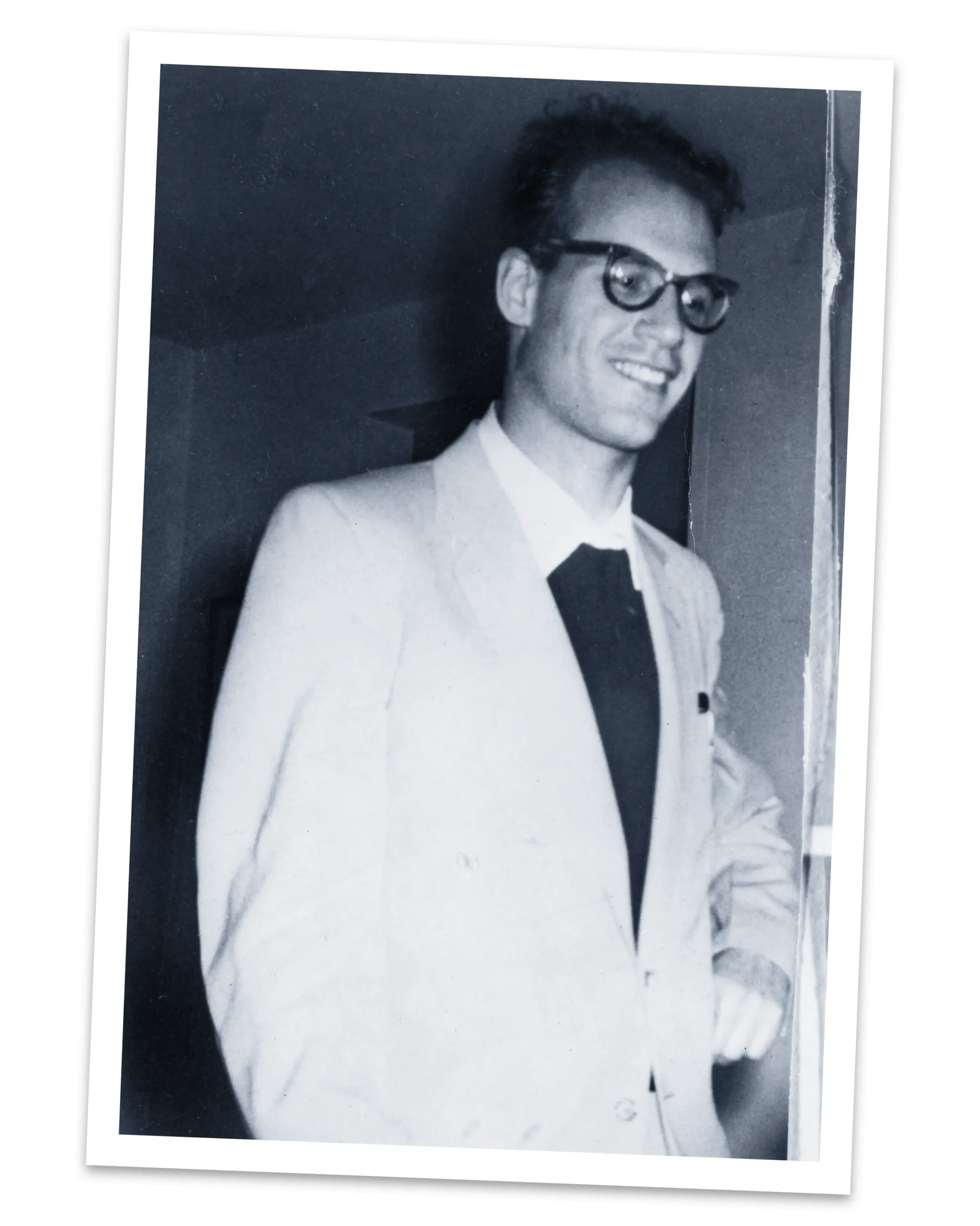
Grothendieck, seen here in 1954, was fascinated by hidden geometric structure. “If there is one thing in mathematics which fascinates me more than any other (and undoubtedly always has), it is neither ‘number’ nor ‘size,’ but invariably shape,” he wrote.
Paul R. Halmos photograph collection, e_ph_08592_pub, The Dolph Briscoe Center for American History, The University of Texas at Austin
The discipline took flight in the late 19th century, when mathematicians started asking questions about what happens if instead of plugging ordinary numbers into your equations, you plug in numbers from other, more abstract sets.
Before Grothendieck, algebraic geometry was an interesting and vibrant subdiscipline within mathematics. But it was also somewhat in crisis, as the mathematician David Mumford later wrote. “Every researcher used his own definitions and terminology, in which the ‘foundations’ of the subject had been described in at least half a dozen different mathematical ‘languages.’”
Then “Grothendieck came along and turned a confused world of researchers upside down, overwhelming them with [a] new terminology … as well as with a huge production of new and very exciting results.”
Grothendieck is most famous for introducing mathematical constructions that helped him and others prove longstanding conjectures, and that eventually became central objects of study in their own right.
His work also put algebraic geometry in the center of a web of many other areas of math — among them topology, number theory, representation theory, and logic. “Grothendieck never worked directly in number theory,” said Brian Conrad of Stanford University, “but the ideas he introduced into algebraic geometry totally transformed how number theory is done.”
His first major result in algebraic geometry was his 1957 generalization of the Riemann-Roch theorem, a proof from a century earlier that dictates how the shape of a surface limits which functions can be defined on it. As Leila Schneps of the French National Center for Scientific Research wrote, Grothendieck’s proof “propelled him to instant stardom in the world of mathematics.”
Thanks to his techniques, “a whole new wealth of operations becomes available,” Conrad said. “It opens up a whole new way to think about why the theorem is true.”
Then, just as quickly, Grothendieck moved on to the next thing. At the 1958 International Congress of Mathematicians, he announced his intention to remake all of algebraic geometry. He was going to do it with something called a scheme.
A New Scheme of Mathematics
A decade earlier, the mathematician André Weil had conjectured a link between solutions to polynomial equations defined in two very different mathematical settings. The first was finite fields, number systems that operate according to a cyclical form of arithmetic. The second was complex numbers, which take our familiar, everyday numbers and add the square root of -1, called i.
Weil made four conjectures that related polynomials from one setting to those from the other. These conjectures, Conrad said, “sound like communication between parallel universes.”
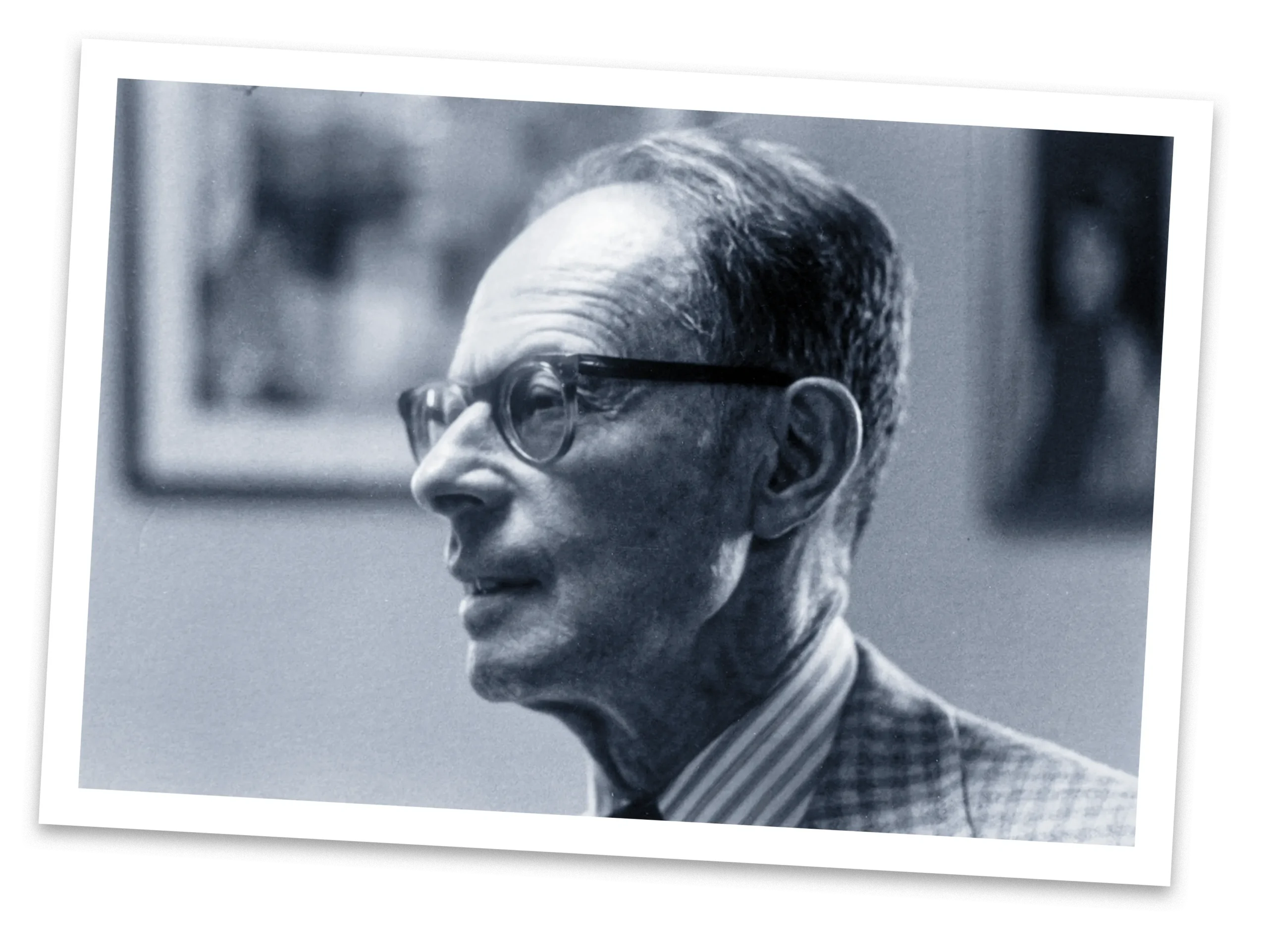
André Weil posed four conjectures that not only became foundational pillars of algebraic geometry, but also linked the field to other major areas of study, including number theory.
Courtesy of Sylvie Weil
As part of the effort to prove these conjectures, Grothendieck proposed his notion of a scheme. The attempted proofs were “a primary motivation for the theory of schemes,” said Daniel Litt of the University of Toronto, but “what it really bought you was a whole lot more.”
Before Weil, mathematicians only really talked about equations like x2 + y2 – 1 = 0 by specifying the particular number system they wanted to work in. The solutions to such equations would look quite different if x and y could only be integers, for example, versus if they could be any real number, or any complex number.
After Grothendieck came up with an explanation for why Weil’s conjectures are true, mathematicians came to believe that equations had meaningful structure independent of whether x and y were complex numbers, or elements of a finite field, or bananas. At first, this belief seems to make as little sense as saying that a sentence has meaning regardless of which language you choose its words from. But Grothendieck defined mathematical structures that made it possible to make such statements rigorous and even intuitive to those who mastered his new language.
As Conrad explained, “Grothendieck found the right way to define abstract notions of space, new ways of thinking about spaces.” He recognized that “the way you probe the geometry of a space is not by looking at the points, but by studying other things.”
That’s where Grothendieck’s schemes came into play. It takes some effort to construct even a simple scheme. But if you read on, it’s possible to understand what schemes are and develop an intuition for why they’re useful.
Schemes are geometric spaces that are built out of abstract algebraic ingredients.
Start with an abstract generalization of the integers called a ring. A ring is a set of elements that can be added, subtracted, and multiplied together, but that can’t always be divided. (In the ring of integers, for instance, you can’t divide 2 by 3, because 2/3 isn’t an integer.)
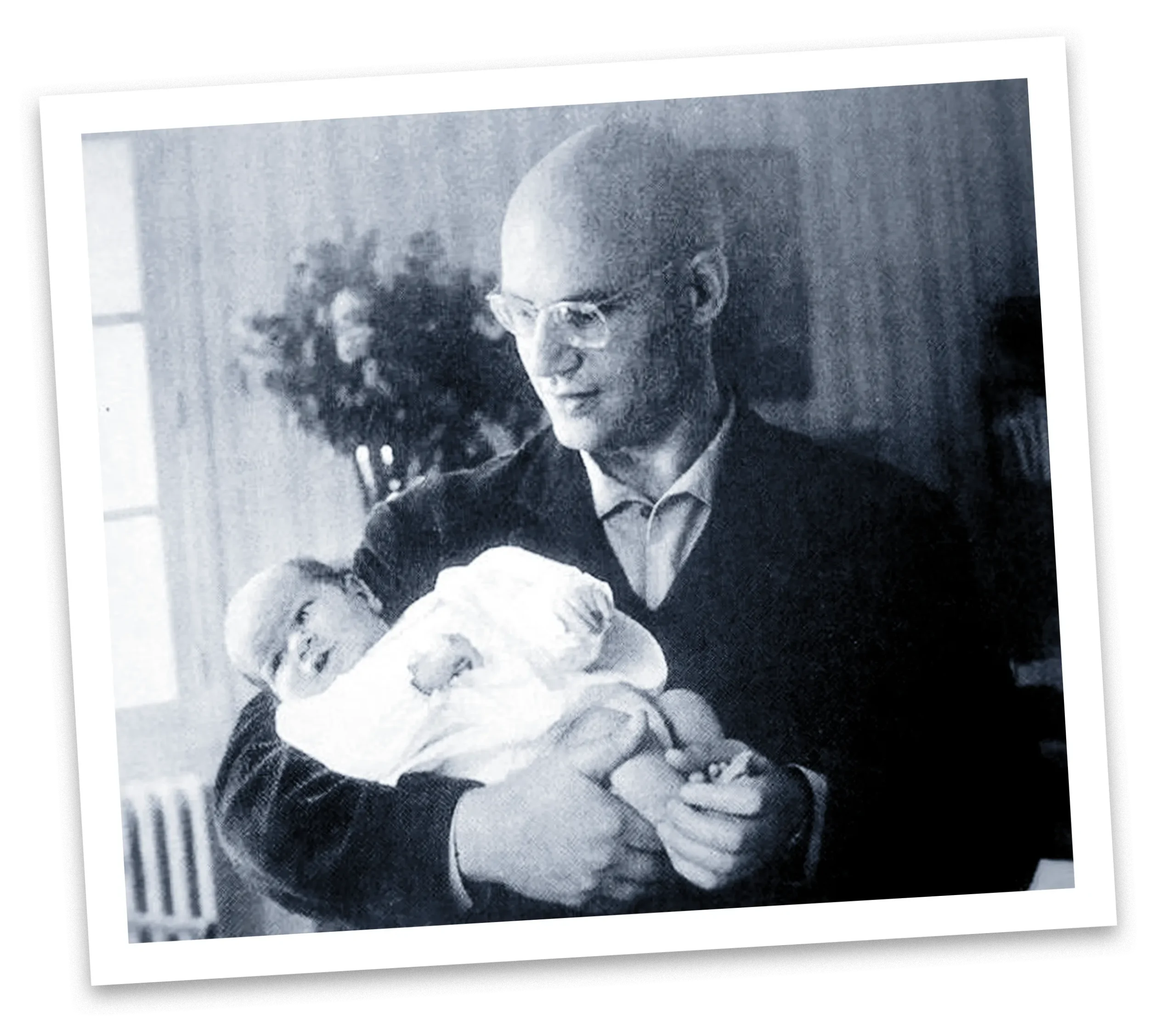
Grothendieck fathered five children. Here he holds his fourth, Mathieu, who was born in 1965.
Shutterstock
Now look at a subset of your ring that is “closed,” meaning that if you add or subtract two elements of the subset, the result is also in the subset. For example, take all multiples of 5. This subset is not only closed, it has another property: You can multiply any number in the ring by an element in the subset, and the result is inevitably also in the subset. That makes the subset what mathematicians call an ideal.
Moreover, if you multiply any two numbers from the ring and end up in this subset (3 × 5 = 15), then one of the numbers you multiplied (5) must have been in this subset, too, even though the other number (3) isn’t.
This second property makes the subset a prime ideal. (To see why, look at the multiples of 6. These form an ideal, but not a prime ideal, because 2 × 3 is in the ideal, but neither 2 nor 3 is.)
In the case of the integers, the prime ideals are sets of multiples corresponding to each of the prime numbers, along with zero. It’s possible to study the set of all the prime ideals of a ring as a single geometric space. First, represent each prime ideal as a point. Then define a “topology” on those points that puts them into neighborhoods, depending on their shared elements. (Strangely, the zero ideal ends up being “close” to every single prime, illustrating a previously unknown structure hidden behind the integers.)
Grothendieck’s innovation was to add a layer on top of this space — a recently discovered mathematical superstructure called a sheaf, which carries additional algebraic information.
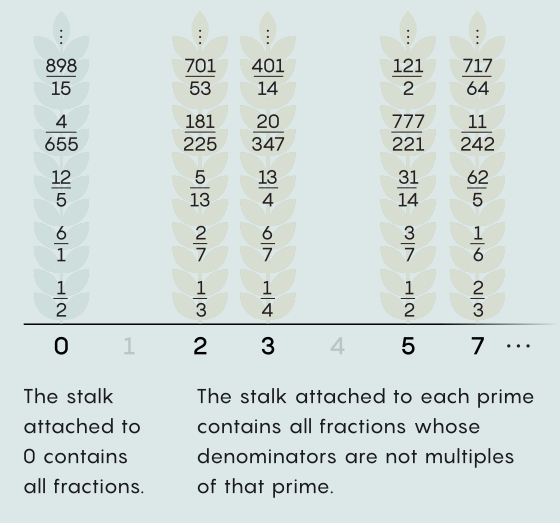
At each point in your space, for instance, this sheaf attaches another set, called a stalk. Let’s return to one of the prime ideals of the integers: the point in our space representing the subset of all multiples of 5. The stalk attached to this point would contain all the fractions whose denominators are not divisible by 5. (The stalk attached to 0 contains all possible fractions.) In this simple example, it’s hard to see what the stalks accomplish, but in more elaborate schemes, computing the contents of stalks and the ways they interact with each other turned out to be a mathematically powerful machine.
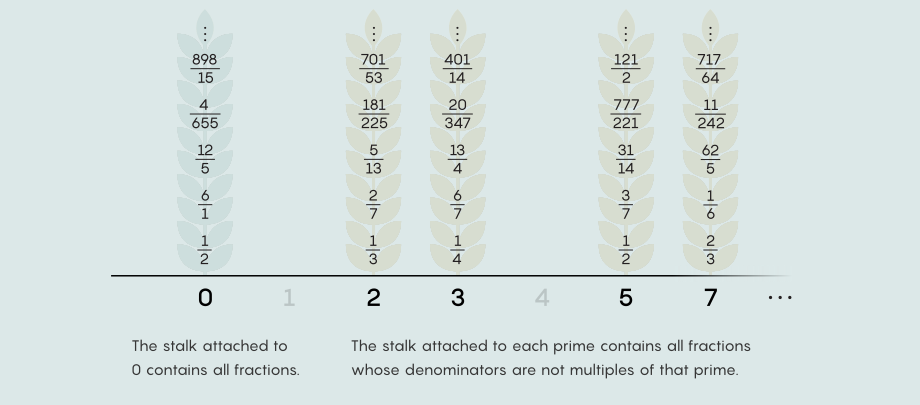
Mark Belan/Quanta Magazine
This entire object — the space of prime ideals, with the sheaf (and all its stalks) built on top of it — is called an affine scheme. In general, schemes are constructed by gluing affine schemes together in a precise mathematical way.
So what does all that have to do with an equation like x2 + y2 – 1 = 0? Well, instead of starting with the ring of integers, you can study a particular ring associated with that polynomial. You can then build the scheme for that ring.
But crucially, the variables x and y can be whatever you want them to be: integers, real numbers, complex numbers, elements of a finite field. By studying the scheme’s properties, you can gain insight about the structure of the equation, independent of any particular number system. It is, impossible though it may sound, a way to study the sentence apart from the language its words are written in.
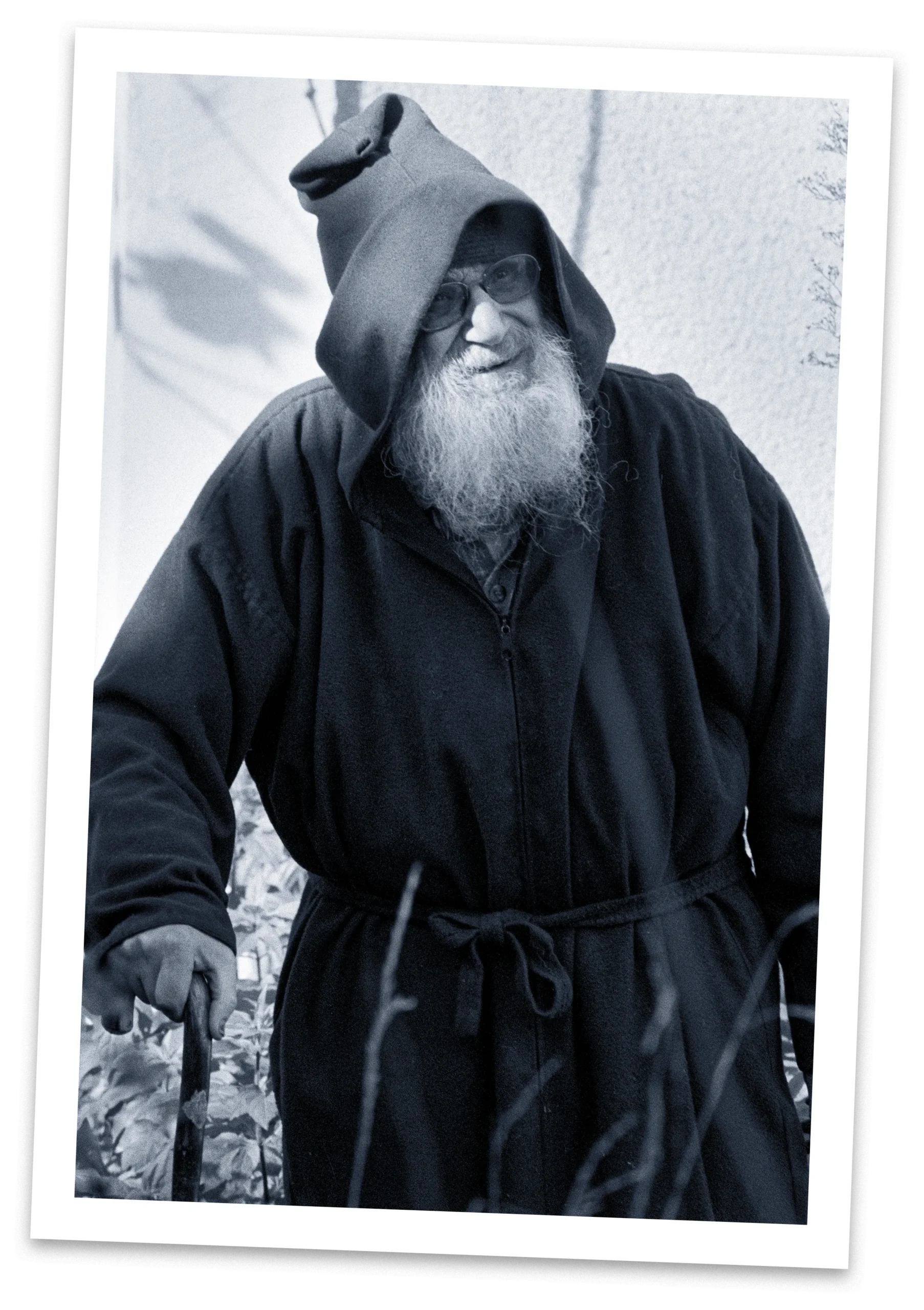
Grothendieck lived the final decades of his life as a recluse in the French countryside. This 2013 photo was taken a year before his death.
Peter Badge
Broadly speaking, this is why Grothendieck and others could use schemes — and a series of ideas building on them — to re-prove one of the four Weil conjectures and prove two more. (Grothendieck’s student Pierre Deligne would later use other structures that Grothendieck developed to prove the fourth, which is a version of the famous Riemann hypothesis in the setting of finite fields.) Grothendieck continued to come up with even more abstract and powerful concepts, including topoi, stacks, motives, and étale cohomology. All play a major role in algebraic geometry and other areas of math today.
Schemes gave mathematicians a novel, systematic way to study the relationships between objects in algebraic geometry. And because schemes allow you to study rings, which appear all over math, as geometric spaces, they can be used to import geometric techniques into algebra, number theory, and beyond.
Grothendieck died in 2014 after years of solitude, estranged from the mathematical community he had helped create. Nonetheless, mathematicians remember him with reverent affection. As the Harvard mathematician Barry Mazur wrote, “During the early ’60s, his conversations had a secure calmness. He would offer mathematical ideas with a smile that always had an expanse of generosity in it … a sense that ‘nothing could be easier in the world’ than to view things as he did.”
His ideas were complicated, but “most of the arguments are very straightforward once you set things up,” Litt said. “You just keep going and going and going. He found us the highway.”